
Organisms and Populations: Class 12 PYQs 2016–2026 with solutions
All 29 CBSE board questions asked from Organisms and Populations in 16 board papers, with the year, set and marks of each. 16 are solved free below. The Class 12 Biology PYQ Book: Solved Board Papers 2016-2026 (CBSE) has every solution, all chapters and 19 full board papers.
Subject experts: Divya Harwani (B.Sc. Biotechnology, M.Sc. Biotechnology) and Jayant Sharma (B.Sc., B.Ed.)



Free: NCERT solutions for Class 12 Biology →
Organisms and Populations: board weightage
Board weightage 2016–2026
| Year | 2016 | 2017 | 2018 | 2019 | 2020 | 2022 | 2023 | 2024 | 2025 | 2026 |
|---|---|---|---|---|---|---|---|---|---|---|
| Questions | 2 | 1 | – | 4 | 4 | 4 | 5 | 2 | 4 | 3 |
| Marks | 8 | 5 | – | 8 | 12 | 8 | 7 | 6 | 14 | 7 |
Most asked topics
29 questions from 16 papers. Repeated questions are shown once with every year they were asked.
Jump to: 1 mark2 marks3 marks4 marks5 marks
1 mark: MCQ and Assertion–Reason
What could be the reason of extinction of Abingdon Tortoise from Galapagos Islands ?
Solution
Answer: (D) Interspecific Competition
Goats introduced on the island ate the same plants much more efficiently. Within a decade the tortoise became extinct.
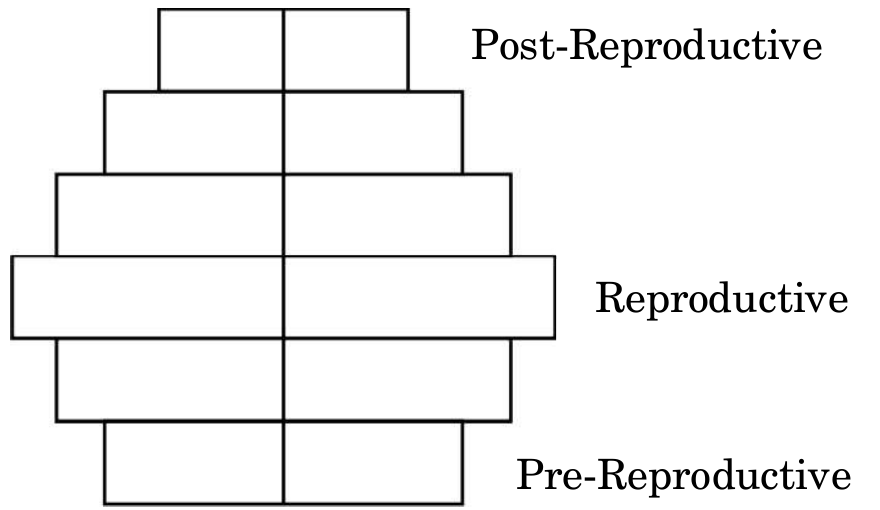
The status of the human population reflected in the human age pyramid given below is :
Solution
Answer: (a) Declining population
The pre-reproductive base is narrower than the reproductive group (urn shape), so fewer young individuals will replace the adults.
Assertion (A) : A cattle egret and grazing cattle in close association is a classic example of commensalism.
Reason (R) : As grazing cattle move through the field, they stir up and flush out insects from the vegetation that otherwise might be difficult for egrets to find and catch.
Solution
Answer: (a) Both A and R are true and R is the correct explanation of A.
The egret benefits by catching the flushed-out insects, and the cattle are neither harmed nor benefited.
Identify the option that does not exhibit a parasitic relationship.
Assertion (A) : The Mediterranean orchid Ophrys uses sexual deceit to get pollinated by a species of bee.
Reason (R) : The female bee changes its colour depending on the temperature of the area.
Give two reasons as to why a weed such a Calotropis flourishes in abandoned fields.
2 marks: very short answer
In some cases, measuring population density by counting individuals may not be feasible. Mention two other parameters that can be used and justify their use with suitable examples.
Solution
Any two:
• Percent cover or biomass: one huge banyan tree with a large canopy matters more than 200 Parthenium plants in the same area, so counting numbers would underestimate the banyan.
• Relative density: for example, the number of fish caught per trap, or bacteria in a Petri dish, when absolute numbers are not needed.
• Indirect estimates: a tiger census in national parks uses pug marks and faecal pellets, without counting or seeing the animals.
Explain how the interaction between sea anemone and clownfish is one of the best examples of commensalism in nature.
Solution
In commensalism one species benefits and the other is neither harmed nor benefited.
The clownfish lives among the stinging tentacles of the sea anemone and is protected from predators, so it benefits. The sea anemone gets no apparent benefit and is not harmed by the clownfish. So the relationship is (+, 0), a commensalism.
Explain how the interaction between a fig tree and its tight one-to-one relationship with the pollinator species of wasp is one of the best examples of mutualism.
Solution
In mutualism both species benefit.
• Each fig species can be pollinated only by its "partner" wasp species and no other.
• The female wasp uses the fig fruit as an egg-laying site, and the developing seeds inside the fruit nourish its larvae.
• While searching for a suitable egg-laying site, the wasp pollinates the fig inflorescence.
So the fig gets pollination and the wasp gets a breeding site and food.
(i) When prickly pear cactus was introduced into Australia in early 1920s, it caused havoc and ecosystem instability by achieving very high population densities. Explain the reason for its rapid spread into millions of hectares of rangeland.
(ii) State the importance of 'Prey-predator' relationship in a habitat.
Solution
(i) In its new habitat, the cactus had no natural predators (herbivores) to keep it in check, so it spread rapidly. It was finally controlled only when a cactus-feeding predator (a moth) was brought from its natural habitat.
(ii) Any two: predators act as conduits for energy transfer across trophic levels; they keep prey populations under control; they help maintain species diversity by reducing competition among prey species. Predators are also "prudent", since over-exploiting the prey would make both prey and predator extinct.
The figures given below show the results of a lab experiment in which two microbial species A and B belonging to same genus were grown in three petri dishes having same culture medium. In Petri dish-I, Species-A was grown alone for 8 weeks. In Petri dish-II, Species-B was grown alone for 8 weeks. In Petri dish-III, both the species were grown together with the same number as Petri dish-I and Petri dish-II for 8 weeks.
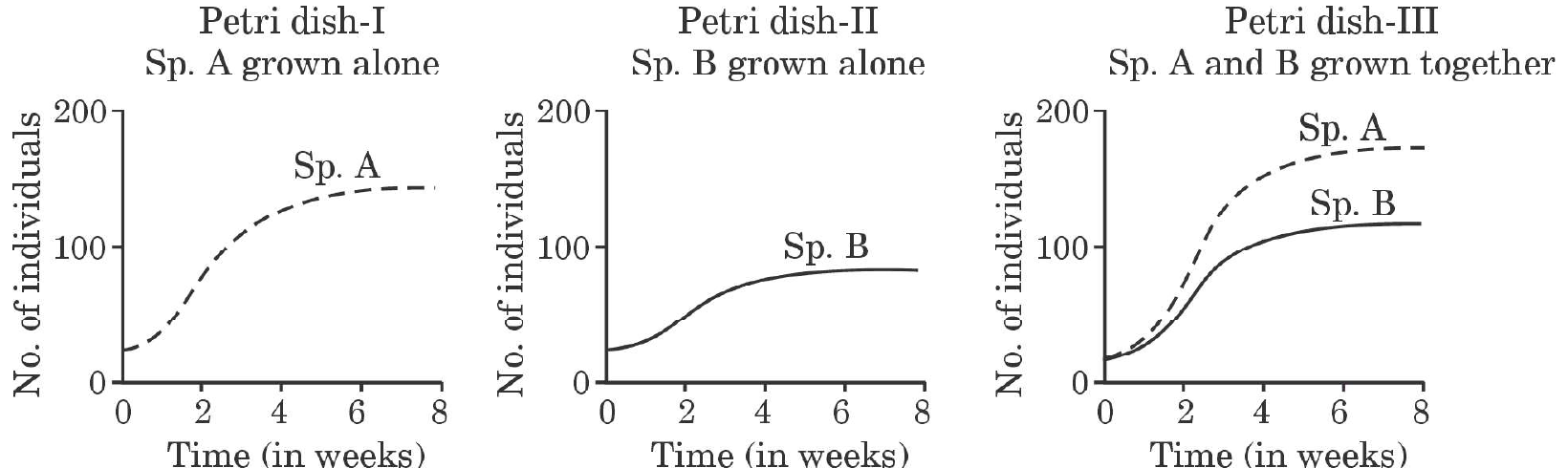
What conclusion will you draw from the graphs in terms of impact of interaction on growth ? Explain, giving reason.
Solution
Both species grow better together than alone: species A rises from about 140 to about 170, and species B from about 80 to about 120. Both benefit from the interaction, so it is mutualism (+, +).
The graphs given below, A and B, represent population of elephants in two different National Parks (a hypothetical situation) at different times.
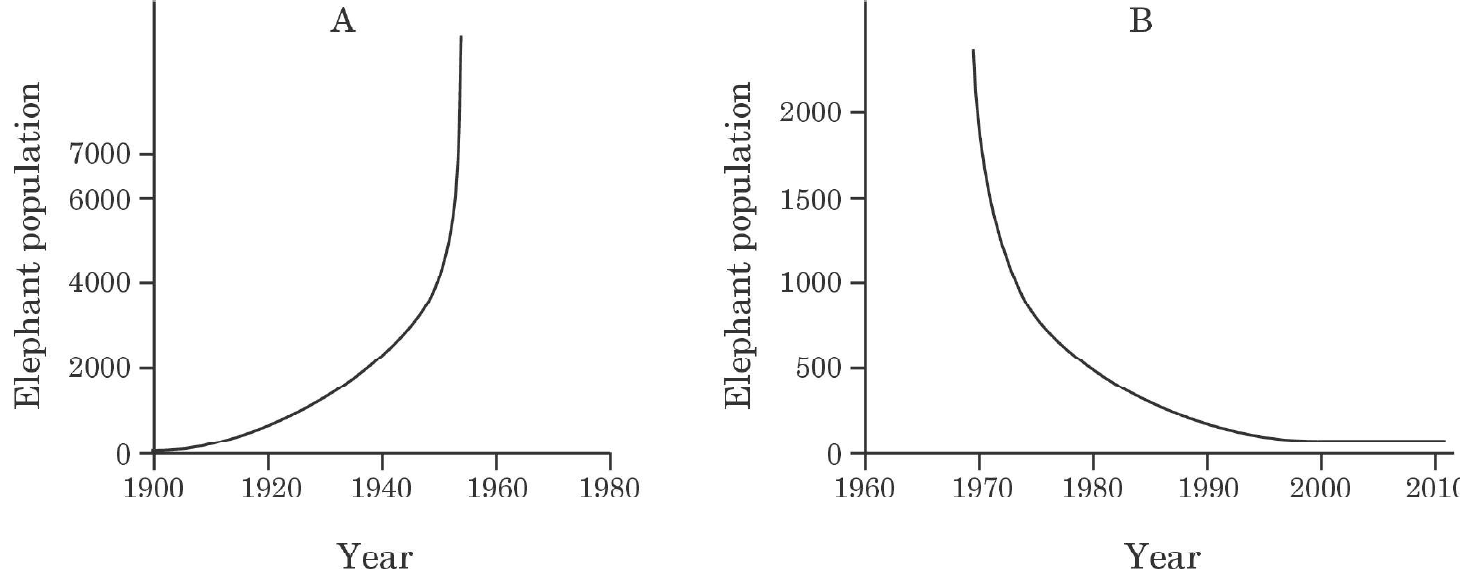
Study the graphs and comment upon the pattern of growth observed. Mention the possible reason for such patterns seen in nature.
As per a recent newspaper report, a particular country showed declining population growth rate. According to you, what could be the two most possible reasons for this decline and why ?
If in a population of size 'N' the birth rate is represented as 'b' and the death rate as 'd', the increase or decrease in 'N' during a unit time period 't' will be : . The equation given above can also be represented as : where r = (b — d). What does 'r' represent ? Write any one significance of calculating 'r' for any population.
What is 'carrying capacity' of a species in a habitat ? Why is logistic growth model considered more realistic ?
3 marks: short answer
(a) Explain how it is ensured that the orchid Ophrys is pollinated by a specific species of bee.
(b) Describe co-evolution with the help of this example.
Solution
(a) The Mediterranean orchid Ophrys uses sexual deceit.
• One petal of its flower bears an uncanny resemblance to the female of the bee species in size, colour and markings.
• The male bee is attracted to what it thinks is a female and "pseudocopulates" with the flower. During this it is dusted with pollen.
• When the same bee pseudocopulates with another flower, it transfers the pollen to it and pollinates it.
(b) The plant and its pollinator evolve together. If the female bee's colour pattern changes even slightly during evolution, pollination success will fall unless the orchid flower co-evolves to keep resembling the female bee.
Predation is referred to as a detrimental interaction. Explain any three positive roles, supported by an example each, that a predator plays in an ecosystem.
Solution
1. Conduits for energy transfer: predators pass on the energy fixed by plants to higher trophic levels. Example: grass → goat → lion (or tiger eating deer).
2. Keep prey populations under control: without predators, prey can reach very high densities and destabilise the ecosystem. Example: the prickly pear cactus, introduced into Australia, spread rapidly until a cactus-feeding predator (a moth) from its native habitat was introduced.
3. Maintain species diversity: predators reduce the intensity of competition among competing prey species. Example: when the predatory starfish Pisaster was removed from a rocky intertidal community in America, more than 10 species of invertebrates became extinct within a year because of interspecific competition.
(Also: biological control of agricultural pests uses this ability of predators.)
Explain the following population interactions with the help of one example each : (a) Brood Parasitism (b) Co-evolution of mutualists
Solution
(a) Brood parasitism: the parasitic bird lays its eggs in the nest of its host and lets the host incubate them. Example: the cuckoo (koel) lays eggs in the crow's nest. During evolution, the koel's eggs have come to resemble the crow's eggs in size and colour, which lowers the chance of the host detecting and ejecting them.
(b) Co-evolution of mutualists: the evolution of one species is tightly linked to the evolution of its partner. Example: each fig species is pollinated only by its partner wasp species. The female wasp uses the fruit for egg-laying and the developing seeds to feed its larvae, and pollinates the fig while searching for egg-laying sites. (Also: Ophrys and its bee.)
Explain the difference between commensalism and mutualism types of interactions, with the help of a suitable example of each.
Solution
• Mutualism (+, +): both interacting species benefit. Example: lichens (an intimate association of a fungus and photosynthesising algae or cyanobacteria); mycorrhizae (fungus and roots of higher plants); fig and wasp.
• Commensalism (+, 0): one species benefits and the other is neither harmed nor benefited. Example: an orchid growing as an epiphyte on a mango branch; barnacles on the back of a whale; cattle egret and grazing cattle.
Study the age pyramids 'A', 'B' and 'C' of the human population given below and answer the questions that follow :
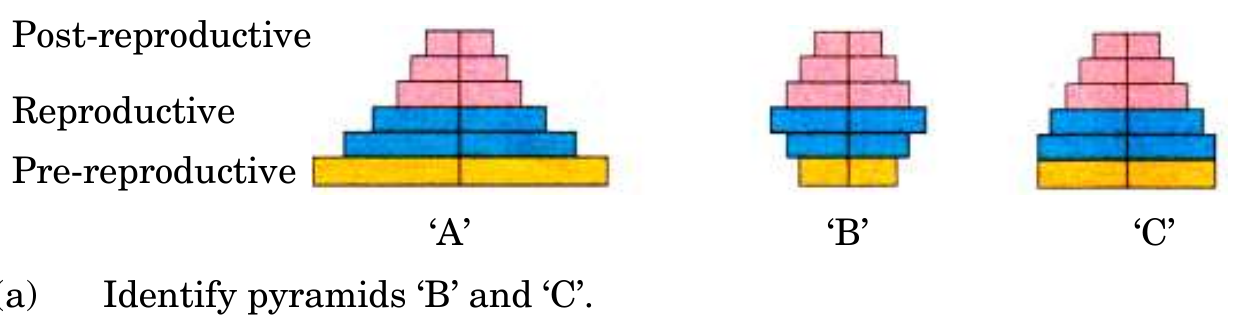
(a) Identify pyramids 'B' and 'C'.
(b) Write the basis on which the above pyramids are plotted.
Solution
(a) B – stable population (bell-shaped); C – declining population (urn-shaped). (A, with a broad base, is an expanding population.)
(b) They are plotted on the basis of age distribution: the percentage of individuals of a given age or age group (pre-reproductive, reproductive and post-reproductive), for males and females, in the population.
(a) Write how parasites have evolved with adaptation to co-exist with their hosts in an ecosystem.
(b) Parasites are host specific and tend to co-evolve. How would the parasite respond if the host evolves a certain mechanism to resist or reject the parasite ?
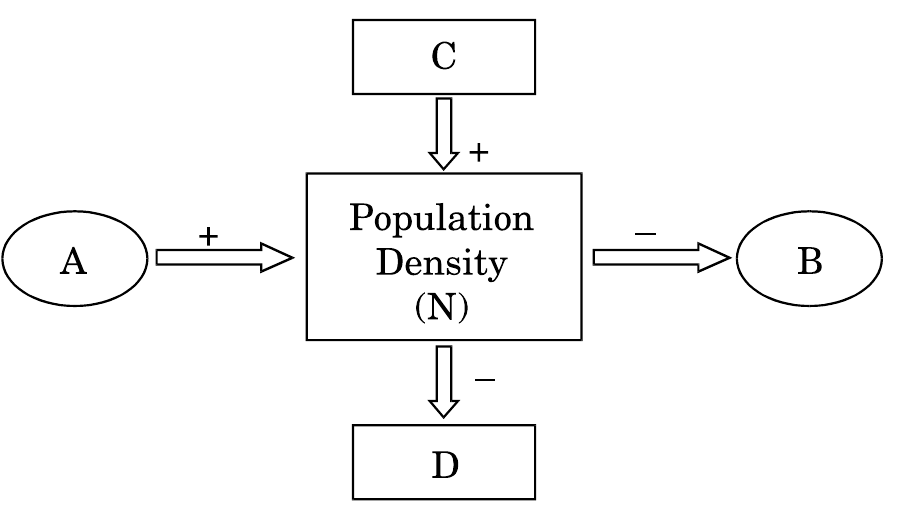
Study the schematic representation given above and answer the following questions: (a) Identify A in it. (b) Identify D in it. (c) When the population density at time t is N as shown above, write the population density at time t + 1 in the form of an equation using appropriate symbols.
Differentiate between an 'Expanding age pyramid' and a 'Stable age pyramid'. Substantiate your answer with diagrams.
Name and explain the type of interaction that exists in mycorrhizae and between cattle egret and cattle.
4 marks: case-based / source-based
The diagram below shows the distribution of two barnacle species, Chthamalus and Balanus on a rocky sea shore. When Balanus is experimentally removed, Chthamalus expands its range in lower intertidal zone.
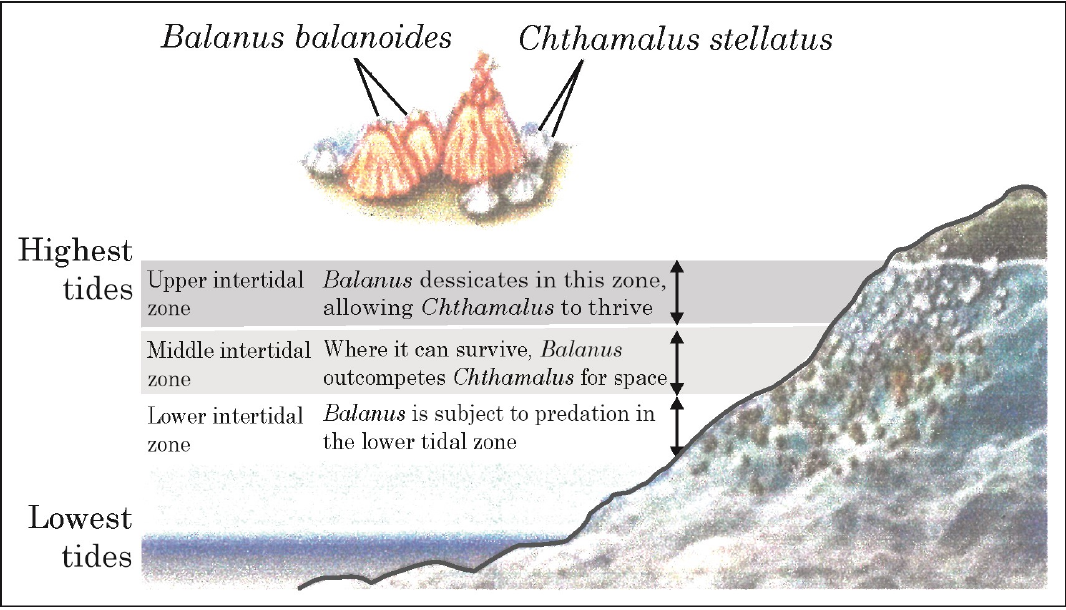
(a) Identify and define the ecological phenomenon demonstrated by this observation. (1)
OR
(a) State the principle that explains the elimination of one species. (1)
(b) Two different species can compete for the same resource. Give another example of it. (1)
(c) How do species avoid competition in nature ? Explain with an example. (2)
Solution
(a) Competitive release. A species whose distribution is restricted to a small area because a competitively superior species is present expands its range when the superior competitor is removed.
OR (a) Gause's competitive exclusion principle: two closely related species competing for the same resources cannot coexist indefinitely; the competitively inferior one is eventually eliminated.
(b) In shallow South American lakes, visiting flamingos and resident fishes compete for their common food, zooplankton. (Also: Abingdon tortoise and goats on the Galapagos.)
(c) By resource partitioning: competing species choose different times for feeding or different foraging patterns. Example: MacArthur showed that five closely related species of warblers living on the same tree avoided competition and coexisted because they foraged in different parts of the tree.
5 marks: long answer
(i) Describe the population growth curve applicable in a population of any species in nature that has limited resources at its disposal.
(ii) Give the equation of this growth curve.
(iii) Name the growth curve and depict a graphical plot for this type of population growth.
Solution
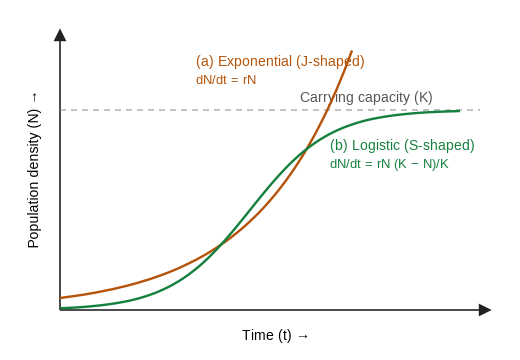
(i) No population in nature has unlimited resources, so exponential growth cannot go on. With limited resources, there is competition among individuals for them, and only the fittest survive and reproduce. The population first shows a lag phase, then phases of acceleration and deceleration. Finally it reaches an asymptote, when the population density reaches the carrying capacity (K), the maximum the habitat can support.
(ii) , where N = population density at time t, r = intrinsic rate of natural increase, K = carrying capacity.
(iii) It is the Verhulst–Pearl logistic growth curve (sigmoid, S-shaped), curve (b) below:
(i) Describe the population growth curve applicable in a population of any species in nature that has unlimited resources at its disposal.
(ii) Explain the equation of this growth curve.
(iii) Name the growth curve and depict a graphical plot for this type of population growth.
Solution
(i) When resources (food and space) are unlimited, each species can realise fully its innate potential to grow in number. The population grows in an exponential (geometric) fashion. Plotting population density against time gives a J-shaped curve.
(ii) If N is the population size, b the birth rate and d the death rate (per capita), the rate of change is
. Writing (the intrinsic rate of natural increase):
Integrated form: , where Nt = population density after time t, N0 = population density at time zero, e = base of natural logarithms (2.71828).
(iii) Exponential growth curve (J-shaped), curve (a):
(a) Compare, giving reasons, the J-shaped and S-shaped models of population growth of a species.
(b) Explain 'fitness of a species' as mentioned by Darwin.
(a) Name the two growth models that represent population growth and draw the respective growth curves they represent.
(b) State the basis for the difference in the shape of these curves.
(c) Which one of the curves represent the human population growth at present ? Do you think such a curve is sustainable ? Give reason in support of your answer.
Get every solution for all chapters
- Every board question of every chapter, each fully solved the way the board gives marks
- 19 complete board papers, each followed by its solutions
- Weightage and most-asked topics for every chapter
- Instant PDF download, colour and black & white print copies
Revising the chapter first? Complete Biology Notes for Class 12 (NCERT 2026-27, CBSE Board 2027) →
What you get in the pack
- Questions from 122 CBSE papers, 2016 to 2026: every set code available
- Complete: 2114 different questions and parts from all set codes, 13 chapters and 19 full papers
- Part A: all 13 chapters, questions sorted chapter-wise and by marks
- Year-wise weightage table and most-asked topics for every chapter
- Part B: 19 full board papers, each followed by its complete solutions
- Labelled diagrams, Punnett squares, crosses and flow charts drawn in full
- Questions on topics out of the board syllabus flagged
All chapters in this pack
- PYQ Ch 1 Sexual Reproduction in Flowering Plants
- PYQ Ch 2 Human Reproduction
- PYQ Ch 3 Reproductive Health
- PYQ Ch 4 Principles of Inheritance and Variation
- PYQ Ch 5 Molecular Basis of Inheritance
- PYQ Ch 6 Evolution
- PYQ Ch 7 Human Health and Disease
- PYQ Ch 8 Microbes in Human Welfare
- PYQ Ch 9 Biotechnology: Principles and Processes
- PYQ Ch 10 Biotechnology and its Applications
- PYQ Ch 11 Organisms and Populations
- PYQ Ch 12 Ecosystem
- PYQ Ch 13 Biodiversity and Conservation
- Board Paper 2026 Set 57-1-1 with Solutions
- Board Paper 2026 Set 57-1-2 with Solutions
- Board Paper 2026 Set 57-1-3 with Solutions
- Board Paper 2026 Set 57-2-1 with Solutions
- Board Paper 2025 Set 57-4-1 with Solutions
- Board Paper 2025 Set 57-5-1 with Solutions
- Board Paper 2024 Set 57-1-1 with Solutions
- Board Paper 2024 Set 57-2-1 with Solutions
- Board Paper 2023 Set 57-1-1 with Solutions
- Board Paper 2023 Set 57-3-1 with Solutions
- Board Paper 2022 Term 2 Set 57-2-1 with Solutions
- Board Paper 2022 Term 2 Set 57-4-1 with Solutions
- Board Paper 2020 Set 57-1-1 with Solutions
- Board Paper 2020 Set 57-2-1 with Solutions
- Board Paper 2019 Set 57-2-1 with Solutions
- Board Paper 2019 Set 57-3-1 with Solutions
- Board Paper 2018 Set 57-1 with Solutions
- Board Paper 2017 Set 57-1 with Solutions
- Board Paper 2016 Set 57-1 with Solutions