
Sexual Reproduction in Flowering Plants: Class 12 PYQs 2016–2026 with solutions
All 49 CBSE board questions asked from Sexual Reproduction in Flowering Plants in 15 board papers, with the year, set and marks of each. 26 are solved free below. The Class 12 Biology PYQ Book: Solved Board Papers 2016-2026 (CBSE) has every solution, all chapters and 19 full board papers.
Subject experts: Divya Harwani (B.Sc. Biotechnology, M.Sc. Biotechnology) and Jayant Sharma (B.Sc., B.Ed.)



Free: NCERT solutions for Class 12 Biology →
Sexual Reproduction in Flowering Plants: board weightage
Board weightage 2016–2026
| Year | 2016 | 2017 | 2018 | 2019 | 2020 | 2022 | 2023 | 2024 | 2025 | 2026 |
|---|---|---|---|---|---|---|---|---|---|---|
| Questions | 3 | 3 | 2 | 7 | 6 | – | 8 | 6 | 6 | 8 |
| Marks | 10 | 10 | 8 | 21 | 14 | – | 20 | 16 | 18 | 19 |
Most asked topics
49 questions from 15 papers. Repeated questions are shown once with every year they were asked.
Jump to: 1 mark2 marks3 marks5 marks
1 mark: MCQ and Assertion–Reason
Identify the plant in which emasculation is not required for artificial hybridization.
Solution
Answer: (D) Papaya
Papaya is dioecious: male and female flowers are on separate plants, so the female flower has no anthers to remove. It only needs bagging before pollination. Rice, wheat and pea have bisexual flowers and must be emasculated.
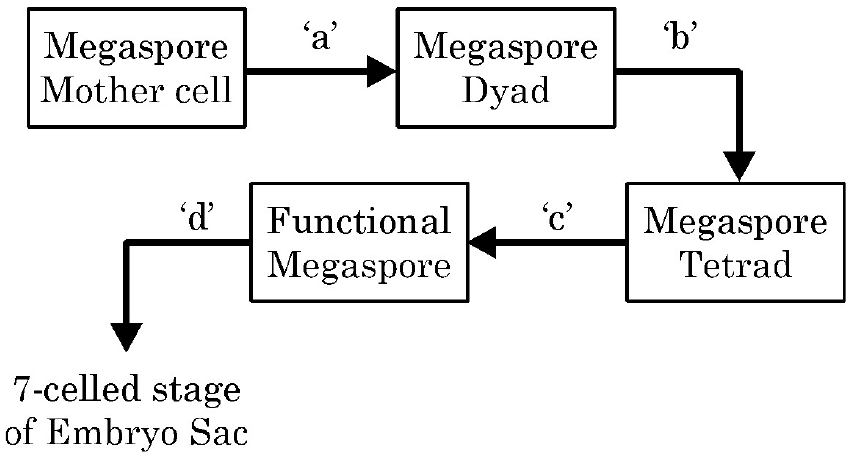
Given below are stages of embryo sac formation from megaspore mother cell. Identify the correct option for the cell division marked a, b, c and d.
Solution
Answer: (B)
Meiosis I of the MMC gives a dyad, and meiosis II gives the tetrad of megaspores. Three megaspores then degenerate without division, leaving one functional megaspore. This megaspore divides by three rounds of free-nuclear mitosis to form the 8-nucleate, 7-celled embryo sac.
Assertion (A) : Apomixis leads to production of genetically identical off-springs.
Reason (R) : Apomixis involves fertilization between two genetically similar plants.
Solution
Answer: (C) A is true but R is false.
Apomixis is the formation of seeds without fertilisation (an asexual process that mimics sexual reproduction), so the offspring are clones of the parent.
Select the statements that are true for a typical dicotyledonous embryo from the given options.
(i) It consists of an embryonal axis and scutellum.
(ii) The portion of embryonal axis above the level of cotyledon is epicotyl.
(iii) The portion of embryonal axis below the level of cotyledon is coleorhiza.
(iv) The lower end of the embryo has radicle covered with a root cap.
Solution
Answer: (D) (ii) and (iv)
A dicot embryo has an embryonal axis and two cotyledons. The scutellum and the coleorhiza are features of a monocot (grass) embryo, and the part below the cotyledons is the hypocotyl.
Select the statements that are true for pollination mechanism in flowering plants from the given options.
(i) In Vallisneria, the female flowers are pollinated by pollen grains inside the water.
(ii) In Zostera, pollen grains are released on the surface of water.
(iii) In most of the water-pollinated species, pollen grains are covered by a mucilaginous coating.
(iv) Pollination by water is quite rare and limited to about 30 genera.
Solution
Answer: (C) (iii) and (iv)
In Vallisneria, pollination happens on the surface of water. In sea-grasses such as Zostera, the female flowers stay submerged and the pollen is released inside the water.
In which of the following plants are both male and female flowers born on the same plant and the mode of pollination can be geitonogamy or xenogamy ?
Solution
Answer: (C) Maize
Maize is monoecious, with unisexual male and female flowers on the same plant. Self-pollination (autogamy) is prevented, but geitonogamy and xenogamy are both possible. Papaya, date palm and spinach are dioecious.
An angiosperm embryo sac is located within the :
Choose the option that gives the correct number of pollen grains that will be formed after 325 microspore mother cells undergo microsporogenesis.
Assertion (A) : Endosperm is completely consumed during the development of embryo in ex-albuminous seeds.
Reason (R) : Castor, pea and beans are all examples of ex-albuminous seeds.
Which of the following seeds have remained alive for the longest period ?
Self-pollination is fully ensured if
Cleistogamous flowers are self-pollinated because
2 marks: very short answer
(i) How does a farmer use dormancy of seed to his advantage ?
(ii) Differentiate between pea seed and castor seed.
Solution
(i) Dormant, dehydrated seeds can be stored for a long time. The farmer stores them and sows them to raise the crop in the next season (they are also used as food).
(ii)
| Pea seed | Castor seed |
|---|---|
| Non-albuminous (non-endospermic) | Albuminous (endospermic) |
| The endosperm is fully used up during embryo development; no endosperm is left | A part of the endosperm is left in the mature seed |
Identify A, B, C and D in the table given below :
| Terms | Part of the plant it represents |
|---|---|
| Pericarp | 'A' |
| 'B' | Cotyledon in seed of grass family |
| Embryonal axis | 'C' |
| 'D' | Remains of nucellus in a seed |
Solution
A – wall of the fruit (wall of the ripened ovary)
B – scutellum
C – the axis of the embryo that bears the radicle and plumule (epicotyl and hypocotyl)
D – perisperm (residual, persistent nucellus, e.g. black pepper, beet)
Name any two outbreeding devices that flowering plants have developed and explain how they help in encouraging cross-pollination.
Solution
Any two:
• Non-synchronised pollen release and stigma receptivity: either the pollen is released before the stigma becomes receptive, or the stigma becomes receptive much before the pollen is released, so self-pollen cannot fertilise.
• Different positions of anther and stigma: the pollen cannot reach the stigma of the same flower.
• Self-incompatibility: a genetic mechanism that stops self-pollen from fertilising the ovules by inhibiting pollen germination or pollen-tube growth in the pistil.
• Unisexual flowers: production of unisexual flowers prevents autogamy (and dioecy, as in papaya, prevents geitonogamy too).
(a) From which end of the ovule, and how does the pollen tube gain its entry into the embryo sac of a Hibiscus flower ?
(b) State the fate of the male nuclei present in the pollen tube.
Solution
(a) It enters through the micropylar end (micropyle). It then enters one of the synergids, guided by the filiform apparatus.
(b) One male nucleus fuses with the egg nucleus to form the zygote (syngamy). The other fuses with the two polar nuclei to form the primary endosperm nucleus (triple fusion).
(a) Explain the process of the development of a male gametophyte in an angiosperm.
(b) Why is it called a male gametophyte ?
Solution
(a) Each cell of the sporogenous tissue (microspore mother cell, PMC) in the anther divides by meiosis into a tetrad of four microspores. As the anther matures and dehydrates, the microspores separate and develop into pollen grains. Inside each, mitosis forms a large vegetative cell and a small generative cell.
(b) The pollen grain is haploid and forms the male gametes: its generative cell divides to form two male gametes. So it represents the male gametophyte.
(a) You are given castor and bean seeds. Which one of the two would you select to observe the endosperm ?
(b) The development of endosperm precedes that of embryo in plants. Justify.
(a) List any two characteristic features of wheat flowers that make it a good example of wind pollination.
(b) It is observed that plant breeders carrying out wheat hybridisation often take pollen grains from the 'pollen banks'. Do you agree ? Give one reason in support of your answer.
A pollen grain in angiosperm at the time of dehiscence from an anther could be 2-celled or 3-celled. Explain. How are the cells placed within the pollen grain when shed at a 2-celled stage?
A single pea plant in your kitchen garden produces pods with viable seeds, but the individual papaya plant does not. Explain.
3 marks: short answer
(a) Do all pollen grains remain viable for the same length of time ? Support your answer with two suitable examples.
(b) How are pollen grains stored in pollen banks ?
Solution
(a) No. The period of viability varies a lot and depends on temperature and humidity.
• In rice and wheat (cereals), pollen loses viability within 30 minutes of release.
• In some members of Rosaceae, Leguminosae and Solanaceae, pollen stays viable for months.
(b) Pollen is stored by cryopreservation in liquid nitrogen at –196 °C and used later in crop breeding programmes.
Draw a neat diagram of megasporangium of an angiosperm and label any six parts.
Solution
The megasporangium is the ovule (anatropous ovule, L.S.):
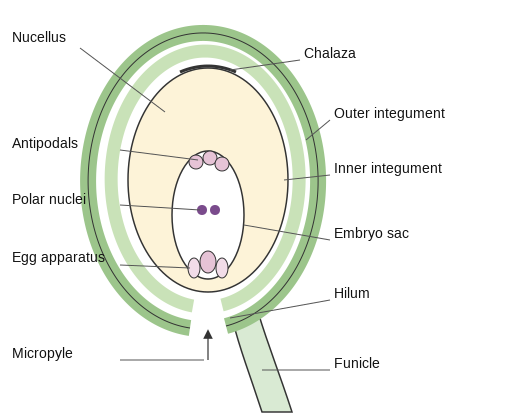
Any six labels: funicle, hilum, micropyle, outer integument, inner integument, nucellus, chalaza, embryo sac (egg apparatus, polar nuclei, antipodals).
Draw a neat diagram of enlarged view of one microsporangium of a Young anther of an angiosperm. Label the different layers of the wall and write the functions of the outermost and innermost layer.
Solution
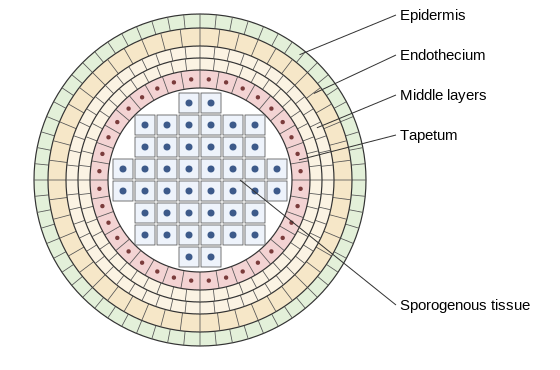
Wall layers from outside in: epidermis, endothecium, middle layers, tapetum. The centre holds the sporogenous tissue.
• Outermost layer, the epidermis: protects the anther and helps in its dehiscence to release the pollen.
• Innermost layer, the tapetum: nourishes the developing pollen grains. Its cells have dense cytoplasm and often more than one nucleus.
Given below is a flower with its characteristic features specialised for the most common type of abiotic pollination.
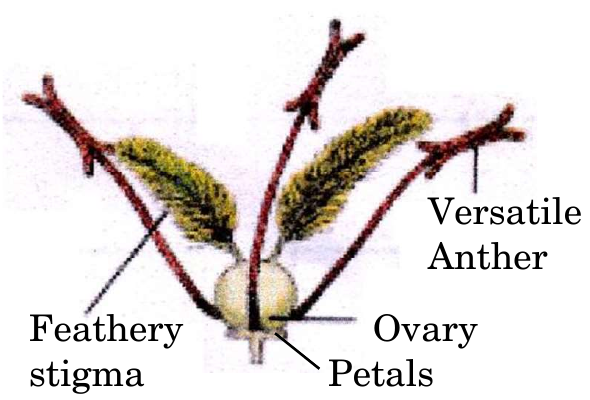
Answer the following questions based on the above diagram :
(a) Name the mode of abiotic pollination that will be adopted by the given plant species in the above picture.
(b) State the need of exposed large feathery stigmas for the flower.
(c) What will be the two important adaptations in the pollen grains of the flowers pollinated by the above mode of pollination ?
(d) What could be the probable reason for the petals being small and non-green ?
Solution
(a) Wind pollination (anemophily).
(b) Large, feathery, exposed stigmas trap the air-borne pollen grains easily.
(c) The pollen grains are light and non-sticky, so they can be carried by wind (and they are produced in very large numbers).
(d) Wind-pollinated flowers need not attract insects, birds or bats, so they have no colourful petals, nectar or scent. Small petals also do not block the flow of wind and pollen.
Many of the flowering plants producing hermaphrodite flowers have developed many devices to discourage self-pollination and to encourage cross-pollination. Given below is a picture of one such outbreeding device in a flowering plant. Study the picture and answer the questions that follow :
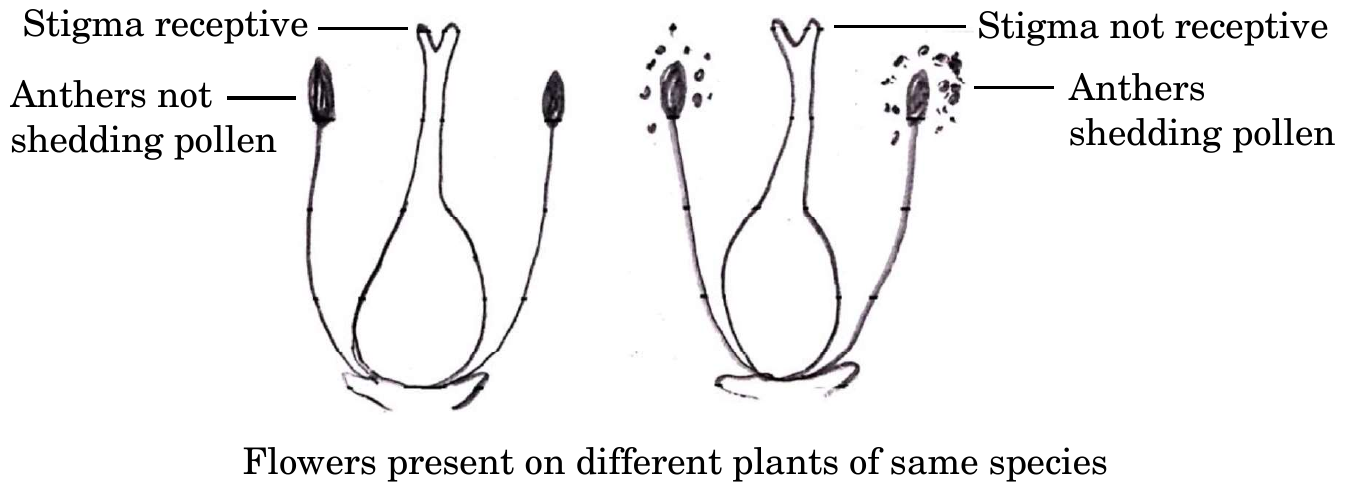
(a) Explain how the given type of pollination is advantageous to the plant.
(b) Can this flowering plant show geitonogamy ? Justify your answer.
Solution
The picture shows that pollen release and stigma receptivity are not synchronised (dichogamy), so pollen must come from a flower on another plant (cross-pollination, xenogamy).
(a) Cross-pollination brings genetically different pollen. This prevents inbreeding depression, keeps the plant vigorous and fertile (hybrid vigour), and increases genetic variability, which helps adaptation.
(b) No. Geitonogamy is transfer of pollen to the stigma of another flower on the same plant. Here, when the stigma of a flower is receptive, the anthers on that plant are not shedding pollen, and the pollen comes from flowers on different plants. So only xenogamy is possible.
Differentiate between the following : (i) Perisperm and Pericarp (ii) Syncarpous pistil and Apocarpous pistil (iii) Plumule and Radicle
Solution
| Perisperm: persistent, residual nucellus in some seeds (black pepper, beet) | Pericarp: wall of the fruit, formed from the wall of the ovary |
| Syncarpous pistil: many pistils (carpels) fused together (e.g. Papaver) | Apocarpous pistil: many pistils free from one another (e.g. Michelia) |
| Plumule: shoot tip of the embryonal axis (terminal part of the epicotyl); forms the future shoot | Radicle: root tip of the embryonal axis (terminal part of the hypocotyl); forms the future root |
Draw a schematic transverse section of a mature anther of an angiosperm. Label its epidermis, middle layers, tapetum, endothecium, sporogenous tissue and the connective.
Solution
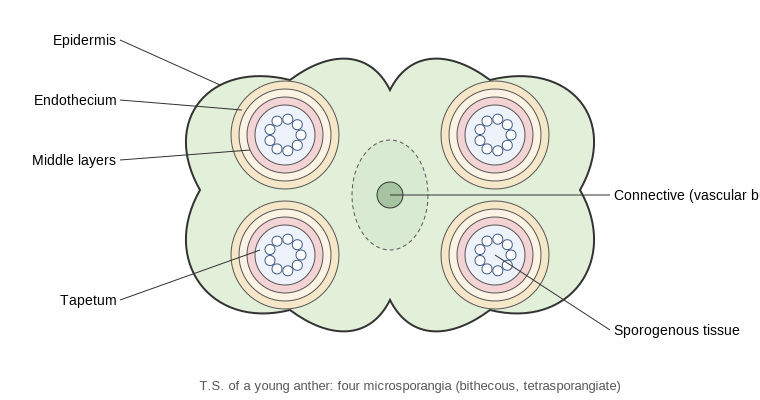
The anther is bilobed, with two microsporangia in each lobe (four in all). Each microsporangium has a wall of four layers: epidermis, endothecium, middle layers and tapetum, enclosing the sporogenous tissue. The lobes are joined by the connective, which has a vascular bundle.
Differentiate between wind pollinated and insect pollinated flowers.
Solution
| Wind-pollinated flowers | Insect-pollinated flowers |
|---|---|
| Pollen grains are light and non-sticky, produced in large numbers | Pollen grains are sticky (often covered with pollenkitt) |
| Stamens well exposed; stigma large and feathery to trap pollen | Stigma sticky; anthers and stigma placed to touch the insect |
| Flowers small, often packed in an inflorescence; usually a single ovule in each ovary | Flowers large, colourful, fragrant and rich in nectar (floral rewards) |
Draw a longitudinal section of the pistil from a flowering plant, where pollination has occurred. Label the following: (a) Stigma showing germinating pollen grains (b) Style (c) Pollen tube reaching the micropyle of the ovule (d) Embryo sac (e) Components of the egg apparatus
Solution
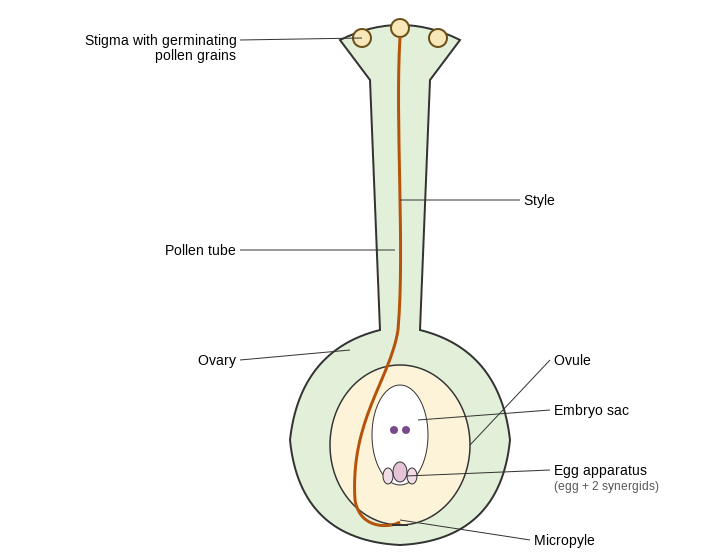
The egg apparatus consists of one egg cell and two synergids at the micropylar end of the embryo sac.
(a) Identify the figure given below and also identify the parts B, C, D and E.
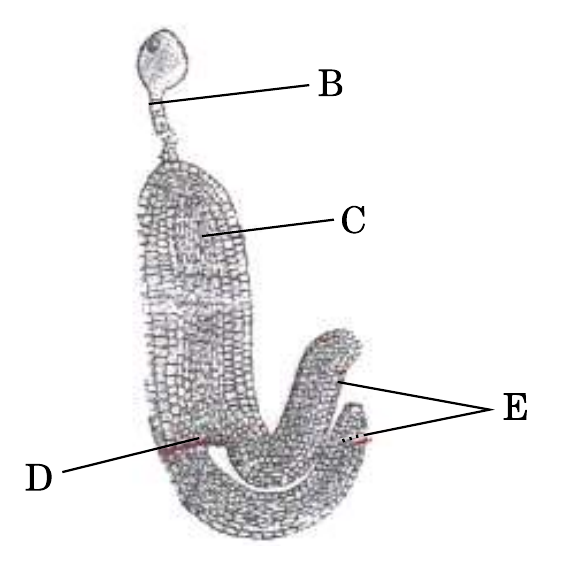
(b) State the function of E.
When and where do tapetum and synergids develop in flowering plants ? Mention their functions.
Where are the following structures present in a male gametophyte of an angiosperm ? Mention the function of each one of them. (a) Germ pore (b) Sporopollenin (c) Generative cell
Draw L.S. of an embryo of grass and label its parts.
Draw a T.S. of a young anther of an angiosperm. Label the different layers of the wall and write their functions.
Differentiate between Parthenocarpy and Parthenogenesis. Give one example of each.
(a) Can a plant flowering in Mumbai be pollinated by pollen grains of the same species growing in New Delhi ? Provide explanations to your answer.
(b) Draw the diagram of a pistil where pollination has successfully occurred. Label the parts involved in reaching the male gametes to its desired destination.
(a) Name the organic material exine of the pollen grain is made up of. How is this material advantageous to pollen grain ?
(b) Still it is observed that it does not form a continuous layer around the pollen grain. Give reason.
(c) How are 'pollen banks' useful ?
5 marks: long answer
(i) Explain the role of stigma in pollen pistil interaction.
(ii) Describe the post pollination events leading to double fertilization in angiosperms starting with 2-celled pollen grain.
Solution
(i) The pistil (stigma) can recognise whether the pollen is of the right type (compatible) or the wrong type (incompatible). It accepts compatible pollen and promotes the post-pollination events. It rejects incompatible pollen by preventing germination on the stigma or pollen-tube growth in the style. The recognition depends on chemical interactions between the pollen and the pistil.
(ii) • A compatible pollen grain germinates on the stigma and produces a pollen tube through a germ pore. The contents of the pollen grain move into the tube.
• The pollen tube grows through the tissues of the stigma and style and reaches the ovary. In a 2-celled pollen grain, the generative cell divides in the tube to form two male gametes.
• The tube enters the ovule through the micropyle, then enters one of the synergids through the filiform apparatus, which guides its entry.
• The pollen tube releases the two male gametes into the cytoplasm of the synergid.
• One male gamete fuses with the egg cell (syngamy), forming the diploid zygote.
• The other male gamete fuses with the two polar nuclei in the central cell (triple fusion), forming the triploid primary endosperm nucleus (PEN).
• Syngamy and triple fusion both occur in the embryo sac, so the process is called double fertilisation.
(i) Explain how does double fertilisation take place in a flowering plant.
(ii) Write the fate of the products of double fertilization in these plants.
Solution
(i) • The pollen tube enters one of the synergids through the filiform apparatus and releases two male gametes into its cytoplasm.
• One male gamete moves towards the egg cell and fuses with its nucleus. This is syngamy, and it forms the diploid zygote.
• The other male gamete moves towards the two polar nuclei in the central cell and fuses with them. This is triple fusion, and it forms the triploid primary endosperm nucleus (PEN); the central cell becomes the primary endosperm cell (PEC).
• Two fusions, syngamy and triple fusion, take place in one embryo sac, so the process is called double fertilisation.
(ii) • The PEC develops into the endosperm (triploid), which nourishes the developing embryo.
• The zygote develops into the embryo.
(Also: the ovules mature into seeds, the ovary into the fruit, the integuments into the seed coats, and the synergids and antipodals degenerate.)
(i) Explain the structure of a typical monocotyledonous embryo of a flowering plant.
(ii) How are multiple embryos formed in a citrus fruit ? What is the mechanism known as ?
Solution
(i) • A monocot embryo has only one cotyledon. In the grass family it is called the scutellum, and it lies to one side (laterally) of the embryonal axis.
• At its lower end, the embryonal axis has the radicle and root cap, enclosed in an undifferentiated sheath called the coleorhiza.
• The part of the axis above the level of attachment of the scutellum is the epicotyl. It has a shoot apex and a few leaf primordia, enclosed in a hollow foliar structure, the coleoptile.
(ii) In citrus, some nucellar cells surrounding the embryo sac start dividing, protrude into the embryo sac and develop into embryos. So each ovule has many embryos besides the zygotic one. The occurrence of more than one embryo in a seed is polyembryony, and the formation of these non-zygotic embryos is a form of apomixis.
(i) Explain the development of male gametophyte in an angiosperm.
(ii) Draw a labelled diagram of a three-celled male gametophyte.
Solution
(i) • Each microspore mother cell (pollen mother cell) of the sporogenous tissue undergoes meiosis to form a cluster of four microspores, the microspore tetrad (microsporogenesis).
• As the anther matures and dehydrates, the microspores separate and develop into pollen grains.
• The pollen grain is the male gametophyte. Inside it, the microspore nucleus divides by mitosis (asymmetric division) to form a large vegetative cell (with abundant food reserve and an irregular nucleus) and a small spindle-shaped generative cell, which floats in the vegetative cell's cytoplasm.
• In over 60% of angiosperms, pollen is shed at this 2-celled stage. In the rest, the generative cell divides mitotically into two male gametes before shedding (3-celled stage).
(ii) 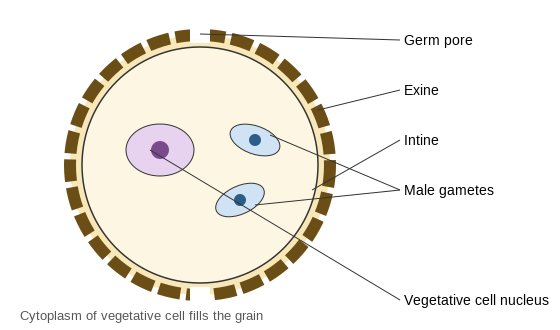
(i) Explain the process of double fertilization in an angiosperm starting from the germination of pollen grains on the stigma, mentioning the ploidy of the end products formed at the end. State the role of synergids during the course of the process.
(ii) Why does the development of endosperm precede that of the embryo ?
Solution
(i) • A compatible pollen grain germinates on the stigma and puts out a pollen tube, which grows down through the style to the ovary.
• The generative cell divides mitotically to form two male gametes.
• The pollen tube enters the ovule through the micropyle and enters one of the synergids, where it discharges the two male gametes.
• One male gamete (n) fuses with the egg (n): syngamy, forming the diploid (2n) zygote.
• The other male gamete (n) fuses with the two polar nuclei (secondary nucleus, 2n) in the central cell: triple fusion, forming the triploid (3n) primary endosperm nucleus (PEN).
• Two fusions occur in one embryo sac, hence double fertilisation.
Role of synergids: the filiform apparatus at their micropylar tip guides the entry of the pollen tube into the synergid.
(ii) The endosperm develops first so that the developing embryo gets assured nutrition from it.
Study the diagram given below showing the modes of pollination. Answer the questions that follow.
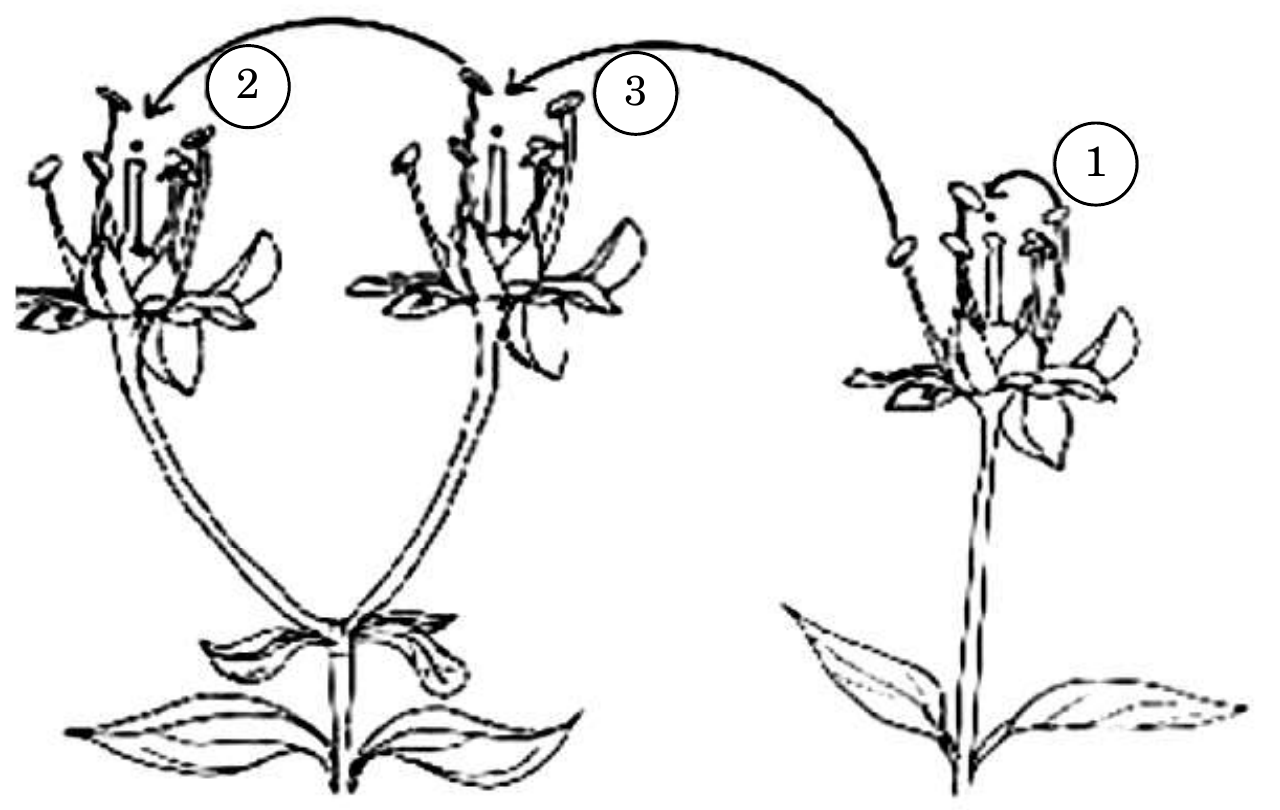
(i) The given diagram shows three methods of pollen transfer in plants. What are the technical terms used for pollen transfer methods '1', '2' and '3' ?
(ii) How do the following plants achieve pollination successfully ? (1) Water lily (2) Vallisneria
(iii) Flowering plants have developed many devices to avoid inbreeding depression. Explain one hereditary and one physiological device which helps plants to achieve this target.
Solution
(i) 1 – autogamy (pollen to the stigma of the same flower); 2 – geitonogamy (to another flower of the same plant); 3 – xenogamy (to a flower of a different plant).
(ii) (1) Water lily: its flowers rise above the water surface and are pollinated by insects or wind, as in most land plants.
(2) Vallisneria: the female flower reaches the water surface on a long stalk. The male flowers or pollen grains are released onto the surface and carried passively by water currents, and some of them reach the female flowers and the stigma.
(iii) Hereditary (genetic): self-incompatibility, a genetic mechanism that stops pollen from the same flower (or other flowers of the same plant) from fertilising the ovules by inhibiting pollen germination or pollen-tube growth in the pistil.
Physiological: pollen release and stigma receptivity are not synchronised. Either the pollen is released before the stigma becomes receptive, or the stigma becomes receptive much before the pollen is released.
(i) Double fertilisation is an event unique to all flowering plants. Explain the process.
(ii) Give a reason for the following : (1) A seed of an orange has many embryos. (2) Cashew is a false fruit but Guava is a true fruit.
(a) Explain the role of stigma in pollen-pistil interactions.
(b) Describe the post-pollination events leading to double fertilization in angiosperms, starting with a two-celled pollen grain.
(a) Describe any two devices in a flowering plant which prevent both autogamy and geitonogamy.
(b) Explain the events upto double fertilisation after the pollen tube enters one of the synergids in an ovule of an angiosperm.
(a) When a seed of an orange is squeezed, many embryos, instead of one are observed. Explain how it is possible.
(b) Are these embryos genetically similar or different? Comment.
(a) As a senior biology student you have been asked to demonstrate to the students of secondary level in your school, the procedure(s) that shall ensure cross-pollination in a hermaphrodite flower. List the different steps that you would suggest and provide reasons for each one of them.
(b) Draw a diagram of a section of a megasporangium of an angiosperm and label funiculus, micropyle, embryosac and nucellus.
Get every solution for all chapters
- Every board question of every chapter, each fully solved the way the board gives marks
- 19 complete board papers, each followed by its solutions
- Weightage and most-asked topics for every chapter
- Instant PDF download, colour and black & white print copies
Revising the chapter first? Complete Biology Notes for Class 12 (NCERT 2026-27, CBSE Board 2027) →
What you get in the pack
- Questions from 122 CBSE papers, 2016 to 2026: every set code available
- Complete: 2114 different questions and parts from all set codes, 13 chapters and 19 full papers
- Part A: all 13 chapters, questions sorted chapter-wise and by marks
- Year-wise weightage table and most-asked topics for every chapter
- Part B: 19 full board papers, each followed by its complete solutions
- Labelled diagrams, Punnett squares, crosses and flow charts drawn in full
- Questions on topics out of the board syllabus flagged
All chapters in this pack
- PYQ Ch 1 Sexual Reproduction in Flowering Plants
- PYQ Ch 2 Human Reproduction
- PYQ Ch 3 Reproductive Health
- PYQ Ch 4 Principles of Inheritance and Variation
- PYQ Ch 5 Molecular Basis of Inheritance
- PYQ Ch 6 Evolution
- PYQ Ch 7 Human Health and Disease
- PYQ Ch 8 Microbes in Human Welfare
- PYQ Ch 9 Biotechnology: Principles and Processes
- PYQ Ch 10 Biotechnology and its Applications
- PYQ Ch 11 Organisms and Populations
- PYQ Ch 12 Ecosystem
- PYQ Ch 13 Biodiversity and Conservation
- Board Paper 2026 Set 57-1-1 with Solutions
- Board Paper 2026 Set 57-1-2 with Solutions
- Board Paper 2026 Set 57-1-3 with Solutions
- Board Paper 2026 Set 57-2-1 with Solutions
- Board Paper 2025 Set 57-4-1 with Solutions
- Board Paper 2025 Set 57-5-1 with Solutions
- Board Paper 2024 Set 57-1-1 with Solutions
- Board Paper 2024 Set 57-2-1 with Solutions
- Board Paper 2023 Set 57-1-1 with Solutions
- Board Paper 2023 Set 57-3-1 with Solutions
- Board Paper 2022 Term 2 Set 57-2-1 with Solutions
- Board Paper 2022 Term 2 Set 57-4-1 with Solutions
- Board Paper 2020 Set 57-1-1 with Solutions
- Board Paper 2020 Set 57-2-1 with Solutions
- Board Paper 2019 Set 57-2-1 with Solutions
- Board Paper 2019 Set 57-3-1 with Solutions
- Board Paper 2018 Set 57-1 with Solutions
- Board Paper 2017 Set 57-1 with Solutions
- Board Paper 2016 Set 57-1 with Solutions