
Era of One-Party Dominance: Class 12 PYQs 2019–2026 with solutions
All 38 CBSE board questions asked from Era of One-Party Dominance in 19 board papers, with the year, set and marks of each. 21 are solved free below. The Class 12 Political Science PYQ Book: Solved Board Papers 2016-2026 (CBSE) has every solution, all chapters and 16 full board papers.

Era of One-Party Dominance: board weightage
Board weightage 2019–2026
| Year | 2019 | 2022 | 2023 | 2024 | 2025 | 2026 |
|---|---|---|---|---|---|---|
| Questions | 3 | 1 | 1 | 11 | 15 | 8 |
| Marks | 15 | 4 | 6 | 20 | 26 | 20 |
Most asked topics
39 questions from 19 papers. Repeated questions are shown once with every year they were asked.
Jump to: 1 mark2 marks4 marks5 marks6 marks
1 mark: MCQ and Assertion–Reason
In which state was a coalition government formed in 1957 under the leadership of the CPI? (A) West Bengal (B) Kerala (C) Assam (D) Andhra Pradesh
Solution
(B) Kerala, led by E.M.S. Namboodiripad: one of the first democratically elected communist governments in the world; it was dismissed in 1959 under Article 356.
To which party did Rafi Ahmed Kidwai belong? (A) Muslim League (B) Indian National Congress (C) CPI (D) Socialist Party
Solution
(B) Indian National Congress: a Congress leader from UP and Union minister in Nehru's cabinet (Communications, later Food and Agriculture).
Which party won 16 Lok Sabha seats and came second in the first general election? (A) CPI (B) Bharatiya Jana Sangh (C) Socialist Party (D) Swatantra Party
Solution
(A) Communist Party of India (the Congress won 364 seats).
The full form of EVM: (A) Electric Voting Machine (B) Easy Voting Machine (C) Electronic Voting Machine (D) Election Voting Machine
Solution
(C) Electronic Voting Machine (the scheme prints the right words but the wrong letter, B). EVMs were used throughout the country from 2004.
In which year were the first General Elections held in India?
Solution
(D) 1952 (polling from October 1951 to February 1952; results in 1952).
Which one of the following political leaders belonged to the Communist Party of India?
Solution
(B) A.K. Gopalan. Rajagopalachari founded the Swatantra Party; Narendra Dev was a socialist; Ambedkar founded the Scheduled Castes Federation and the Republican Party.
Which party ruled Jammu and Kashmir from 1952 to 1957? (A) INC (B) National Conference (C) Swatantra Party (D) People's Democratic Front
Solution
(B) National Conference, led by Sheikh Abdullah.
Who founded the Bharatiya Jana Sangh? (A) Atal Bihari Vajpayee (B) Deen Dayal Upadhyaya (C) Balraj Madhok (D) Syama Prasad Mookerjee
Solution
(D) Syama Prasad Mookerjee (1951).
On which date was the Constitution of India adopted? (A) 24 November 1949 (B) 26 November 1949 (C) 24 January 1950 (D) 26 January 1950
Which is not true about the Bharatiya Jana Sangh? (A) reunion of India and Pakistan in Akhand Bharat (B) Hindi as official language (C) India should develop nuclear weapons (D) it advocated limited cooperation with the Congress
Which party came to power in Jammu and Kashmir in 1952? (A) INC (B) Kashmir National Congress (C) CPI (D) National Conference
In which year was the Election Commission of India set up? (A) 1949 (B) 1950 (C) 1951 (D) 1952
Which party was second in Lok Sabha seats in the first general elections? (A) Socialist Party (B) CPI (C) Bharatiya Jana Sangh (D) Swatantra Party
Assertion (A): The first general elections were postponed twice and finally held from October 1951 to February 1952. Reason (R): It was no longer possible to argue that democratic elections could not be held in conditions of poverty or lack of education. (A) both true, R explains A (B) both true, R does not explain A (C) A true, R false (D) A false, R true
In which state did a communist party first come to power through democratic elections? (A) West Bengal (B) Kerala (C) Tripura (D) Manipur
The first Chief Election Commissioner of India was: (A) S.L. Shakdhar (B) Sukumar Sen (C) K.V.K. Sundaram (D) R.K. Trivedi
2 marks: very short answer
Why did the CPI abandon the path of violent revolution in 1951?
Solution
At independence the CPI felt the transfer of power was not true freedom and encouraged violent uprisings, especially in Telangana. But it failed to get popular support, and the armed forces crushed the uprising; so in 1951 it abandoned the path of violent revolution and decided to take part in the first general elections, in which it won 16 seats and became the largest opposition party.
Show the ideology of the Jana Sangh that made it different from other parties.
Solution
The Bharatiya Jana Sangh (1951) emphasised "one country, one culture and one nation", believing India could become modern, progressive and strong on the basis of Indian culture and traditions. It called for Akhand Bharat (reunion of India and Pakistan), supported Hindi as the official language, opposed concessions to religious and cultural minorities, and argued for India developing nuclear weapons.
Highlight two features of the Congress party as a social and ideological coalition.
Solution
(i) Social coalition: it brought together diverse groups: peasants and industrialists, urban and rural people, landlords and tenants, workers and owners, upper, middle and lower castes and classes, and religious minorities. (ii) Ideological coalition: it accommodated revolutionaries and pacifists, conservatives and radicals, moderates and extremists, the right, left and centre; it tolerated factions, which let it absorb dissent and remain dominant.
"During Congress dominance, its leaders never showed any desire to form new parties." Analyse one reason.
Solution
The Congress was a social and ideological coalition that tolerated and encouraged factions: there was scope for rivalry among groups inside the party, and leaders of different interests and ideologies (socialists, conservatives, etc.) could work and compete within it. Since internal differences and ambitions were accommodated, leaders felt no need to leave and form new parties.
Highlight any two reasons for the dominance of Congress Party in the first three general elections.
Solution
(i) It had inherited the legacy of the national movement; it was seen as the party that won freedom. (ii) It was the only party with an organisation spread across the country, and had popular, charismatic leaders like Jawaharlal Nehru; its nature as a social and ideological coalition also helped.
Explain two differences between the Jana Sangh and other parties in terms of ideology.
Explain two reasons for the Congress's dominance in the first three general elections.
Why did the first general elections of 1952 become a landmark in the history of democracy all over the world?
Explain the nature of the Congress as an ideological coalition during the freedom movement.
Why was India's experiment with universal adult franchise described as "bold and risky"?
4 marks: case-based / source-based
Highlight any two differences between the ideologies of Socialist party and Communist party of India.
Solution
(i) Method: the Socialist Party believed in democratic socialism and peaceful, parliamentary means; the CPI initially believed the 1947 transfer of power was not true freedom and supported a violent uprising (Telangana), before abandoning violence and joining the 1952 elections. (ii) Ideological base: the socialists (Congress Socialist Party, formed 1934 inside the Congress, led by Narendra Dev, Lohia, JP) favoured a radical but democratic programme for workers and peasants against capitalists and landlords; the CPI (formed 1920s) was inspired by the Bolshevik revolution and Marxism-Leninism, with leaders like A.K. Gopalan, S.A. Dange and E.M.S. Namboodiripad.
"The ideology of the Bharatiya Jana Sangh was to make India a progressive and strong nation." Do you agree? Give four arguments.
Solution
Yes (as per the board): (i) it emphasised one country, one culture and one nation; (ii) it called for the reunion of India and Pakistan in an Akhand Bharat; (iii) it supported Hindi as the official language (replacing English); (iv) it opposed granting concessions to religious and cultural minorities, and advocated India developing nuclear weapons after China's 1964 test. Founded in 1951 with Syama Prasad Mookerjee as its founder-president, it was a forerunner of the BJP.
Analyse two major challenges faced by the Election Commission before conducting the first general elections.
Solution
(i) Size of the electorate and preparing the voters' list: about 17 crore eligible voters had to be registered; about 40 lakh women were registered only as "wife of" or "daughter of" someone and had to be re-entered; the elections had to be postponed twice and were held October 1951 – February 1952. (ii) Low literacy: only about 15% of voters were literate, so special methods of voting were devised: a separate ballot box for each candidate with the party symbol; over 3 lakh officers and staff were trained; delimitation of constituencies was also needed. Sukumar Sen was the first Chief Election Commissioner.
"One-party dominance did not affect the essence of Indian democracy." Two arguments.
Solution
(i) The Congress's dominance happened under democratic conditions: many parties contested elections in a free and fair atmosphere, unlike one-party systems in China, Cuba or Mexico (where dominance was by force or restrictions). (ii) Opposition parties existed and won: the CPI formed a government in Kerala in 1957; opposition parties kept democratic criticism alive, and the Congress itself accommodated diverse views and factions. So democratic institutions were maintained.
Map of India, states A–D: (i) state of communist leader A.K. Gopalan (ii) state of Rafi Ahmed Kidwai, first Minister for Communications (iii) state where the Congress was dominant from 1952 to 1967 (iv) state where the National Conference came to power in 1952. [VI: founder of the Jana Sangh; year the CPI split; Chairman of the Drafting Committee; a north-eastern state where the Congress dominated 1952–67]
Solution
(i) B – Kerala. (ii) D – Uttar Pradesh. (iii) C – Madhya Pradesh, as per the board key. (iv) A – Jammu and Kashmir. VI: Syama Prasad Mookerjee; 1964; Dr B.R. Ambedkar; Tripura / Assam / Manipur.
Keeping in mind the crucial role of politics in a democracy, which route did our national leaders decide to take in the newly independent India? Explain any two points.
Map of India, states A–D: (i) state where the first non-Congress government was formed by E.M.S. Namboodiripad (ii) state of Syama Prasad Mookerjee, founder of the Bharatiya Jana Sangh (iii) state of Jawaharlal Nehru (iv) state of former Health Minister Rajkumari Amrit Kaur. [VI: state of E.M.S.'s government; first Chief Election Commissioner; party formed by the first Indian Governor-General; state of Rajkumari Amrit Kaur]
In the given political outline map of India, four states have been marked as A, B, C and D. Identify these states on the basis of the information given below and write their correct names in your Answer Book along with the respective serial number of the information used and the concerned alphabet:
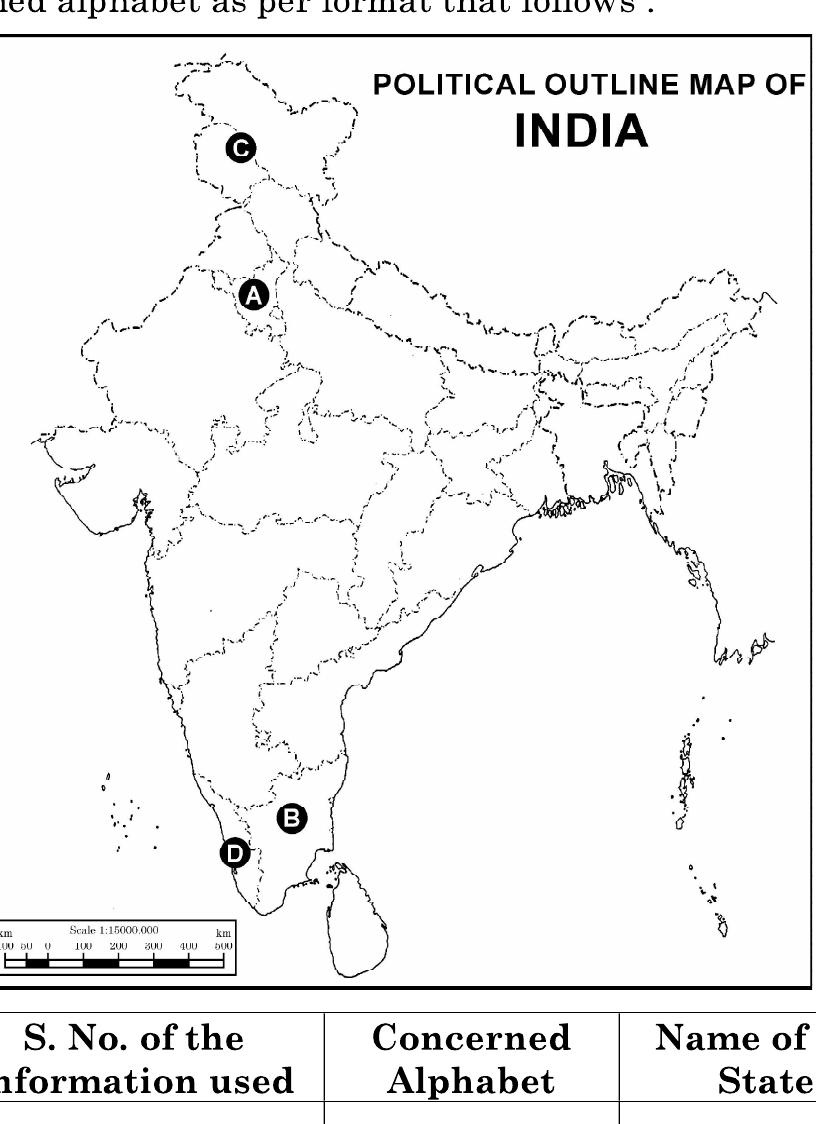
(i) The State which was not under the rule of the Congress Party in 1952.
(ii) The State where the Congress Party could not win majority in 1957.
(iii) The State from where K. Kamraj, a Veteran leader of the Congress Party, lost election in 1967.
(iv) The State from where the phrase "Aaya Ram, Gaya Ram" originated.
(For visually impaired candidates, in lieu of Q11: 11.1 In which year was the first general election completed in India? 11.2 In which State had the Congress Party not won majority in 1957? 11.3 From which State did the phrase 'Aaya Ram, Gaya Ram' originate? 11.4 Which political party remained in power at the centre from 1952 to 1967?)
Describe any four features of the ideology of the Bhartiya Jana Sangh 1951.
5 marks: long answer
Read the following passage and answer the questions given below:
India is not the only country to have experienced the dominance of one party. If we look around the world, we find many other examples of one-party dominance. But there is a crucial difference between these and the Indian experience. In the rest of the cases the dominance of one party was ensured by compromising democracy. In some countries like China, Cuba and Syria the constitution permits only a single party to rule the country.
(i) Which political party dominated the political scene of India after independence and how long? (1)
(ii) How did the one-party dominance in India differ from that of China? (2)
(iii) Highlight any two drawbacks of a single party rule. (2)
Solution
(i) The Indian National Congress, from 1952 until 1967 at the national and state levels (at the Centre until 1977).
(ii) In India the dominance of the Congress came through free and fair, competitive elections in a multi-party democracy; in China the constitution permits only one party (the Communist Party) to rule, so dominance is ensured by compromising democracy.
(iii) Any two: lack of effective opposition and choice for voters; violation of rights and suppression of dissent; corruption and nepotism; concentration of power leading to authoritarianism.
6 marks: long answer
Analyse any three reasons for the dominance of the Congress Party in Indian politics during the initial twenty years after independence.
Solution
(1) Legacy of the national movement: the Congress was seen as the inheritor of the freedom struggle; many leaders of the movement (Nehru, Patel) were Congress candidates. (2) Organisational network: it was the only party with an organisation spread across the country, down to the local level, even before elections; other parties were just being formed. (3) Social and ideological coalition: the Congress accommodated diverse groups, classes, castes, religions and ideologies (revolutionaries and pacifists, conservatives and radicals, rural and urban, landlords and peasants); its factions tolerated each other, and it absorbed dissent, so it dominated under the first-past-the-post system, winning most seats with less than half the votes.
Highlight any three major reasons for the dominance of Congress Party in the first three general elections after independence.
Solution
(1) Legacy of the national movement: the Congress was seen as the inheritor of the freedom struggle and had the most popular leaders, such as Nehru. (2) Organisation: it was the only party with an organisation spread across the country down to the local level (off-the-block advantage), while other parties were just being formed. (3) Social and ideological coalition: it accommodated all classes, castes, religions and ideologies (left and right, rural and urban), and tolerated factions, so opposition remained within the party; under first-past-the-post it won about three-fourths of the seats with less than half the votes.
Get every solution for all chapters
- Every board question of every chapter, each fully solved the way the board gives marks
- 16 complete board papers, each followed by its solutions
- Weightage and most-asked topics for every chapter
- Instant PDF download, colour and black & white print copies
Revising the chapter first? Complete Political Science Notes for Class 12 (CBSE 2026-27) →
What you get in the pack
- CBSE Class 12 Political Science board papers 2016 to 2026 (all 143 sets, main and compartment; 16 in full)
- All 15 chapters and 16 full board papers complete
- Part A: all 15 chapters, questions sorted chapter-wise and by marks
- Year-wise weightage table and most-asked topics for every chapter
- Part B: each full board paper followed by its complete solutions
- Point-wise answers; passage, cartoon and map questions with images
- Questions on chapters out of the board syllabus are flagged
All chapters in this pack
- PYQ Ch 1 The End of Bipolarity
- PYQ Ch 2 Contemporary Centres of Power
- PYQ Ch 3 Contemporary South Asia
- PYQ Ch 4 International Organisations
- PYQ Ch 5 Security in the Contemporary World
- PYQ Ch 6 Environment and Natural Resources
- PYQ Ch 7 Globalisation
- PYQ Ch 8 Challenges of Nation-Building
- PYQ Ch 9 Era of One-Party Dominance
- PYQ Ch 10 Politics of Planned Development
- PYQ Ch 11 India's External Relations
- PYQ Ch 12 Challenges to and Restoration of the Congress System
- PYQ Ch 13 The Crisis of Democratic Order
- PYQ Ch 14 Regional Aspirations
- PYQ Ch 15 Recent Developments in Indian Politics
- Board Paper 2026 Set 59-1-1 with Solutions
- Board Paper 2026 Set 59-1-2 with Solutions
- Board Paper 2026 Set 59-1-3 with Solutions
- Board Paper 2026 Set 59-2-1 with Solutions
- Board Paper 2025 Set 59-1-1 with Solutions
- Board Paper 2025 Set 59-2-1 with Solutions
- Board Paper 2025 Set 59-4-1 with Solutions
- Board Paper 2024 Set 59-1-1 with Solutions
- Board Paper 2024 Set 59-2-1 with Solutions
- Board Paper 2023 Set 59-1-1 with Solutions
- Board Paper 2022 Term 2 Set 59-1-1 with Solutions
- Board Paper 2020 Set 59-1-1 with Solutions
- Board Paper 2019 Set 59-1-2 with Solutions
- Board Paper 2018 Set 59-1 with Solutions
- Board Paper 2017 Set 59-1 with Solutions
- Board Paper 2016 Set 59-1 with Solutions