
The Crisis of Democratic Order: Class 12 PYQs 2019–2026 with solutions
All 34 CBSE board questions asked from The Crisis of Democratic Order in 19 board papers, with the year, set and marks of each. 18 are solved free below. The Class 12 Political Science PYQ Book: Solved Board Papers 2016-2026 (CBSE) has every solution, all chapters and 16 full board papers.

The Crisis of Democratic Order: board weightage
Board weightage 2019–2026
| Year | 2019 | 2022 | 2023 | 2024 | 2025 | 2026 |
|---|---|---|---|---|---|---|
| Questions | 2 | 2 | 3 | 8 | 10 | 9 |
| Marks | 8 | 6 | 8 | 24 | 32 | 20 |
Most asked topics
34 questions from 19 papers. Repeated questions are shown once with every year they were asked.
Jump to: 1 mark2 marks4 marks6 marks
1 mark: MCQ and Assertion–Reason
Match: (a) Congress for Democracy (b) Garibi Hatao (c) student movement led by Morarji Desai (d) Total Revolution — (i) Gujarat (ii) Jayaprakash Narayan (iii) Jagjivan Ram (iv) Indira Gandhi. (A) a-i, b-ii, c-iv, d-iii (B) a-iv, b-iii, c-i, d-ii (C) a-iii, b-iv, c-i, d-ii (D) a-ii, b-i, c-iii, d-iv
Solution
(C) a-iii, b-iv, c-i, d-ii: Jagjivan Ram formed the Congress for Democracy (1977); Indira Gandhi's slogan "Garibi Hatao" (1971); Morarji Desai's fast supported the Gujarat students' movement (1974–75); JP called for "Total Revolution".
Arrange chronologically: (i) declaration of National Emergency on grounds of internal disturbance (ii) railway strike led by George Fernandes (iii) sixth general election (iv) doctrine of "basic structure" in the Kesavananda Bharati case. (A) iv, ii, i, iii (B) i, iii, iv, ii (C) iii, ii, i, iv (D) iv, iii, ii, i
Solution
(A) iv, ii, i, iii: Kesavananda Bharati (April 1973) → railway strike (May 1974) → Emergency (25 June 1975) → sixth Lok Sabha election (March 1977).
In which year did the Railways, the largest public sector undertaking, go on strike? (A) 1974 (B) 1973 (C) 1972 (D) 1971
Solution
(A) 1974, under George Fernandes; the government declared it illegal and broke it.
The Supreme Court's decision of 24 June 1975 in Indira Gandhi's case: (A) her election was invalid (B) she misused officials, against the basic structure (C) she was ordered to resign (D) a partial stay on the High Court order: she could remain an MP but could not take part in Lok Sabha proceedings
Solution
(D) The Allahabad High Court had set aside her election on 12 June 1975; the Supreme Court's partial stay let her stay an MP but not vote; the Emergency was declared the next night (25 June).
Assertion (A): The government suspended press freedom and imposed censorship during the 1975 Emergency. Reason (R): Newspapers protested against censorship by showing only cartoons. (A) both correct, R explains A (B) both correct, R does not explain A (C) A incorrect, R correct (D) A correct, R incorrect
Solution
(D) Censorship was imposed; but newspapers protested by leaving blank spaces where news had been censored (e.g. Indian Express, Statesman), not by printing only cartoons; Shankar's Weekly closed down.
On which basis was the Emergency declared in 1975? (A) internal disturbance (B) external threat (C) armed rebellion (D) external aggression
Who led the "People's March" to Parliament in 1975? (A) Jagjivan Ram (B) S.K. Patil (C) Charu Majumdar (D) Jayaprakash Narayan
Students of which two states agitated against rising food prices in 1974? (A) UP and Bihar (B) Rajasthan and Bihar (C) Bihar and Gujarat (D) Bihar and MP
Who gave a call for a nationwide Railway Strike in 1974?
Assertion (A): In May 1977, the Janata Party government appointed a Commission of Inquiry headed by Justice J.C. Shah.
Reason (R): The Commission was appointed to inquire into the reasons for declaring Emergency, by the Indira Gandhi Government.
2 marks: very short answer
Name any four parties that merged to form the Janata Party in 1977.
Solution
(i) Bharatiya Jana Sangh, (ii) Congress (O), (iii) Bharatiya Lok Dal (Bharatiya Kranti Dal), (iv) the Socialist Party. The Congress for Democracy of Jagjivan Ram also merged soon after the elections.
Which two reasons did the government give for declaring the Emergency in 1975?
Solution
(i) A threat of internal disturbance (Article 352): the opposition's call for a nationwide satyagraha and asking the army and police not to obey "illegal and immoral" orders. (ii) A grave crisis of law and order, with agitations threatening to stop the government from functioning, and the government said it needed extraordinary powers to bring benefits to the poor.
Explain two reasons for the split in the Janata Party in 1979.
Solution
(i) Leadership rivalry among Morarji Desai, Charan Singh and Jagjivan Ram; Charan Singh's group left and Desai resigned. (ii) The party lacked direction, leadership and a common programme; it was united only against the Emergency, and its government could not bring a fundamental change from Congress policies.
State two effects of imposing the National Emergency.
Analyse the concept of 'Total Revolution' as visualized by Jai Prakash Narayan in 1975.
Evaluate the impact of national emergency declared in June, 1975.
4 marks: case-based / source-based
In the given political outline map of India, four states have been marked as A, B, C and D. Identify these on the basis of the information given below and write their correct names in your answer book along with their respective serial number of the information used and the concerned alphabet:
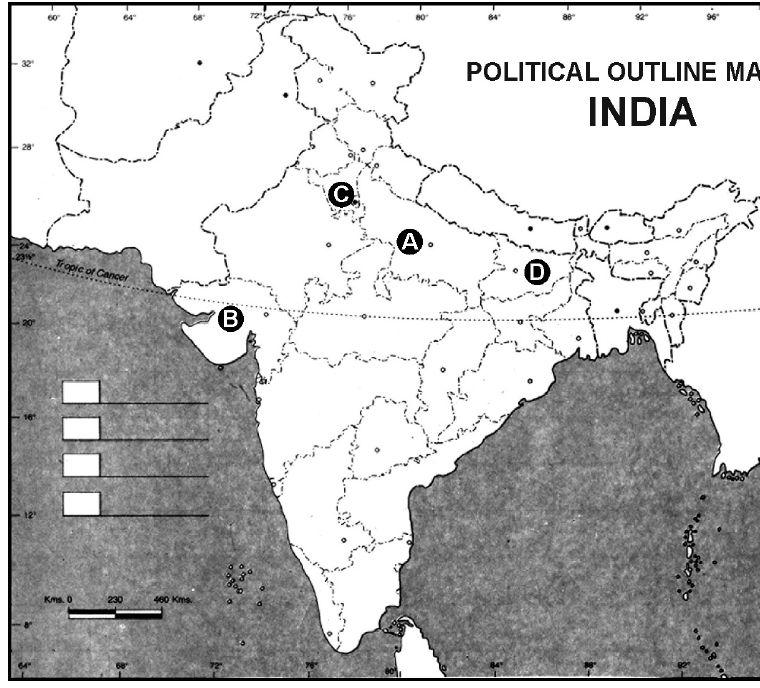
(i) The state related to student movement against inflation and corruption in 1974.
(ii) The state related to the farmer's leader Chaudhary Charan Singh.
(iii) The state related to Congress leader Jag Jeevan Ram.
(iv) The state where Congress could not win even a single Lok Sabha seat in 1977 elections.
(For Visually Impaired Candidates, in lieu of Q26: (i) Write the name of first Prime Minister of Janta Party Government. (ii) In which year, was the National Emergency imposed in India by Indira Gandhi government? (iii) Name the leader who announced a nationwide Satyagraha at Ram Lila Maidan before the declaration of National Emergency. (iv) Name the political party that won the Lok Sabha Election in 1977.)
Solution
(i) B – Gujarat (the Navnirman students' movement began in Gujarat in January 1974; Bihar's movement followed in March). (ii) A – Uttar Pradesh. (iii) D – Bihar. (iv) C – Haryana (Congress lost every seat in Bihar, UP, Delhi, Haryana and Punjab). VI: Morarji Desai; 1975 (25 June); Jayaprakash Narayan; Janata Party.
Explain four steps taken by the government to control the opposition to the Emergency (1975).
Solution
(i) Preventive detention: a large number of opposition leaders and workers (JP, Morarji Desai, Vajpayee, Advani and others) were arrested under laws like MISA. (ii) Press censorship: newspapers needed prior approval to publish; electricity to newspaper offices was cut on the first night. (iii) Bans on organisations like the RSS and Jamaat-e-Islami; protests, strikes and agitations were banned. (iv) Fundamental rights, including the right to move court for their restoration, were suspended; the 42nd Amendment made many changes; there were also excesses like forced sterilisation and slum demolition.
Was the Emergency of 1975 necessary? Two arguments.
Solution
Students may argue either way. Yes (government's view): (i) the opposition's agitations, calls for the army and police not to obey "illegal" orders and constant protests threatened law and order and stability; (ii) the government needed extraordinary powers to implement its pro-poor programme (Twenty-Point Programme). No (critics' view): (i) agitations were peaceful and part of democracy; the Emergency was declared to save Indira Gandhi's position after the Allahabad High Court verdict; (ii) it led to massive misuse of power: arrests, press censorship, suspension of rights, forced sterilisation; the Shah Commission later found many excesses.
Describe the role of Jayaprakash Narayan in national politics.
Solution
(i) JP, a former socialist who had left active politics for Sarvodaya work, agreed to lead the Bihar students' movement (1974) on condition that it remain non-violent and not be limited to Bihar. (ii) He demanded the dismissal of the Congress government in Bihar and called for "Total Revolution": social, economic and political change. (iii) In 1975 he led a people's march to Parliament, one of the largest rallies in the capital, and announced a nationwide satyagraha for Indira Gandhi's resignation. (iv) He opposed the Emergency, was jailed, and became the symbol of restoring democracy; he united the opposition into the Janata Party.
Describe two reasons for the victory of the Janata Party in the 1977 Lok Sabha elections.
Solution
(i) The opposition made the election a referendum on the Emergency, with the slogan "save democracy", highlighting its excesses (preventive detention, censorship, forced sterilisation). (ii) The opposition merged into the Janata Party, so non-Congress votes were not divided; Jagjivan Ram's defection weakened the Congress, and north Indian middle classes and others moved away from the Congress.
Explain any two lessons learnt from the emergency imposed in 1975.
Solution
(i) It is extremely difficult to do away with democracy in India: people value it, as the 1977 vote against the Emergency showed. (ii) It brought out ambiguities in the emergency provisions, which were later corrected: "internal disturbance" was replaced by "armed rebellion", and the President can declare an emergency only on the written advice of the cabinet (44th Amendment). (iii) It made people aware of their civil liberties and of the importance of a free press and judiciary; the courts became active in protecting rights, and civil liberties organisations emerged.
Explain any two reasons that the government gave for imposing national emergency in 1975.
Solution
(i) A large number of agitations (Gujarat, Bihar, JP's movement) were destabilising the government; the opposition called for a nationwide satyagraha and asked the army, police and officials not to obey "illegal" orders, threatening law and order. (ii) Strikes like the railway strike (1974) and constant protests made it hard for the government to function and to carry out its pro-poor programme.
Passage: for the first time since independence the Congress was defeated; it won only 154 seats; the Janata Party and allies won 330; the Congress lost every seat in Bihar, UP, Delhi, Haryana and Punjab. (i) Which general election is referred to? (A) 4th (B) 5th (C) 6th (D) 7th (ii) The total number of Lok Sabha seats elected: (A) 540 (B) 541 (C) 542 (D) 543 (iii) Deputy Prime Minister after the Janata victory: (A) Charan Singh (B) Vajpayee (C) Advani (D) Chandra Shekhar (iv) The state where the Congress won only one seat: (A) Gujarat (B) West Bengal (C) Rajasthan (D) Jammu and Kashmir
Solution
(i) (C) 6th (1977). (ii) (D) 543, as per the board key (in 1977 there were 542 seats). (iii) (A) Chaudhary Charan Singh (Jagjivan Ram also became Deputy PM in 1979). (iv) (C) Rajasthan, as per the board key (the Congress won one seat each in Rajasthan and Madhya Pradesh).
Explain two reasons that led to mid-term Lok Sabha elections in 1980.
Describe the objectives and means of the 1974 Bihar students' movement led by Jayaprakash Narayan.
In the given political outline map of India, four States have been marked as A, B, C and D. Identify these States on the basis of the information given below and write their correct names in your answer-book along with the respective serial number of the information used and the concerned alphabets given in the map:
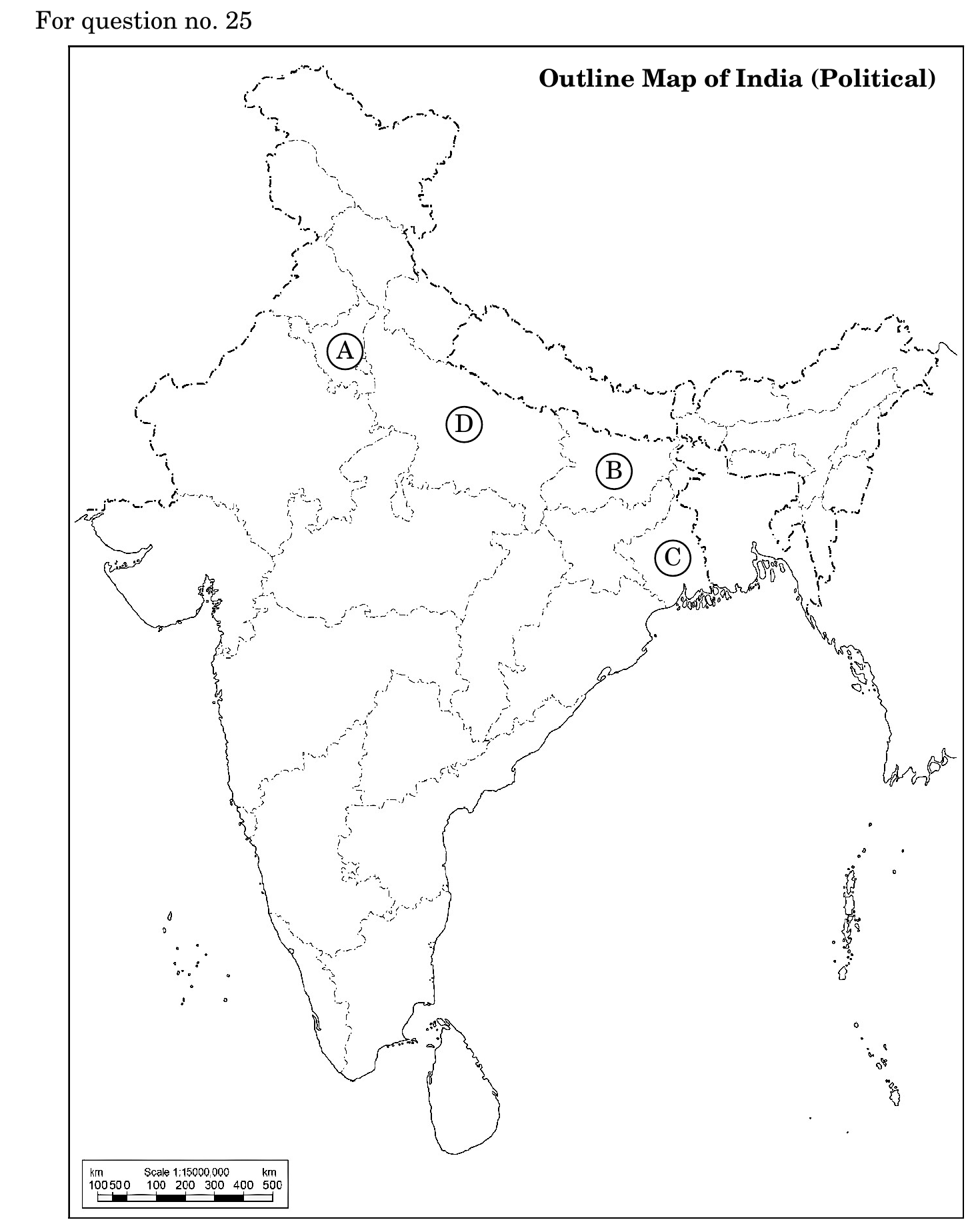
(i) The State related to former Prime Minister Chaudhary Charan Singh.
(ii) The State to which former Deputy Prime Minister Jagjivan Ram belonged.
(iii) The State where the Naxalites were very active.
(iv) A State where the Congress party could not win even a single seat in the Lok Sabha elections in 1977.
(For Visually Impaired Candidates, in lieu of Q25: 25.1 Name the State where the Naxalites were very active. 25.2 Name the State to which former Prime Minister Chaudhary Charan Singh belonged. 25.3 Name a State from where the Congress Party could win only one seat in the 1977 Lok Sabha elections. 25.4 Name the State where Morarji Desai led the Students' Movement in 1974–75.)
Cartoon: a woman leader holding a placard "I toppled Janata Government", while Janata leaders say "That's a lie! Everybody knows we all worked for two years and brought it down!" (i) Identify the leader who claims to have toppled the Janata government. (ii) Identify the Prime Minister of the Janata government shown. (iii) Highlight two reasons for the defeat of the Janata Party in 1980. [VI: two reasons for the Congress defeat in 1977; party that won in 1977; PM before the Congress won in 1980]
Highlight two lessons learnt from the Emergency of 1975.
Highlight four consequences of the Emergency.
Describe four circumstances that led to protests against the Congress government in 1974–75.
Describe any four excesses made by the Union Government during the period of emergency imposed in 1975.
6 marks: long answer
Analyse any three reasons for the declaration of Emergency in 1975.
Solution
(1) Economic context: after the 1971 war with Bangladesh and the oil crisis, prices rose sharply, there was unemployment and food shortage; expectations raised by "Garibi Hatao" were not fulfilled, causing discontent. (2) Gujarat and Bihar movements (1974): students' agitations against price rise and corruption, joined by opposition parties; Jayaprakash Narayan led the movement in Bihar and called for "Total Revolution"; Morarji Desai led the Gujarat agitation. (3) Conflict with the judiciary: the Allahabad High Court (12 June 1975) declared Indira Gandhi's election invalid; the Supreme Court allowed her only conditional stay. (4) The opposition led by JP organised a rally at the Ramlila Maidan (25 June 1975) demanding her resignation and called on the army, police and government employees not to obey "illegal and immoral orders"; the government declared an Emergency the same night on grounds of internal disturbance.
Describe any three events that led to the imposition of emergency in 1975.
Solution
(1) Economic crisis and public agitations: after 1971, prices rose and there was unemployment; students' movements in Gujarat (January 1974) and Bihar (March 1974) against price rise, food scarcity and corruption, the latter led by Jayaprakash Narayan, who called for 'Total Revolution'. (2) The railway strike (May 1974) led by George Fernandes, and the government's conflict with the judiciary (e.g. supersession of judges). (3) The Allahabad High Court verdict (12 June 1975) declared Indira Gandhi's election invalid; the opposition led by JP organised a rally at the Ramlila Maidan (25 June 1975) demanding her resignation and asked the army, police and government employees not to obey "illegal and immoral orders". The government declared an internal Emergency the same night.
Get every solution for all chapters
- Every board question of every chapter, each fully solved the way the board gives marks
- 16 complete board papers, each followed by its solutions
- Weightage and most-asked topics for every chapter
- Instant PDF download, colour and black & white print copies
Revising the chapter first? Complete Political Science Notes for Class 12 (CBSE 2026-27) →
What you get in the pack
- CBSE Class 12 Political Science board papers 2016 to 2026 (all 143 sets, main and compartment; 16 in full)
- All 15 chapters and 16 full board papers complete
- Part A: all 15 chapters, questions sorted chapter-wise and by marks
- Year-wise weightage table and most-asked topics for every chapter
- Part B: each full board paper followed by its complete solutions
- Point-wise answers; passage, cartoon and map questions with images
- Questions on chapters out of the board syllabus are flagged
All chapters in this pack
- PYQ Ch 1 The End of Bipolarity
- PYQ Ch 2 Contemporary Centres of Power
- PYQ Ch 3 Contemporary South Asia
- PYQ Ch 4 International Organisations
- PYQ Ch 5 Security in the Contemporary World
- PYQ Ch 6 Environment and Natural Resources
- PYQ Ch 7 Globalisation
- PYQ Ch 8 Challenges of Nation-Building
- PYQ Ch 9 Era of One-Party Dominance
- PYQ Ch 10 Politics of Planned Development
- PYQ Ch 11 India's External Relations
- PYQ Ch 12 Challenges to and Restoration of the Congress System
- PYQ Ch 13 The Crisis of Democratic Order
- PYQ Ch 14 Regional Aspirations
- PYQ Ch 15 Recent Developments in Indian Politics
- Board Paper 2026 Set 59-1-1 with Solutions
- Board Paper 2026 Set 59-1-2 with Solutions
- Board Paper 2026 Set 59-1-3 with Solutions
- Board Paper 2026 Set 59-2-1 with Solutions
- Board Paper 2025 Set 59-1-1 with Solutions
- Board Paper 2025 Set 59-2-1 with Solutions
- Board Paper 2025 Set 59-4-1 with Solutions
- Board Paper 2024 Set 59-1-1 with Solutions
- Board Paper 2024 Set 59-2-1 with Solutions
- Board Paper 2023 Set 59-1-1 with Solutions
- Board Paper 2022 Term 2 Set 59-1-1 with Solutions
- Board Paper 2020 Set 59-1-1 with Solutions
- Board Paper 2019 Set 59-1-2 with Solutions
- Board Paper 2018 Set 59-1 with Solutions
- Board Paper 2017 Set 59-1 with Solutions
- Board Paper 2016 Set 59-1 with Solutions