
Regional Aspirations: Class 12 PYQs 2019–2026 with solutions
All 42 CBSE board questions asked from Regional Aspirations in 18 board papers, with the year, set and marks of each. 22 are solved free below. The Class 12 Political Science PYQ Book: Solved Board Papers 2016-2026 (CBSE) has every solution, all chapters and 16 full board papers.

Regional Aspirations: board weightage
Board weightage 2019–2026
| Year | 2019 | 2022 | 2023 | 2024 | 2025 | 2026 |
|---|---|---|---|---|---|---|
| Questions | 3 | – | 3 | 13 | 12 | 11 |
| Marks | 13 | – | 4 | 36 | 54 | 52 |
Most asked topics
42 questions from 18 papers. Repeated questions are shown once with every year they were asked.
Jump to: 1 mark2 marks4 marks5 marks6 marks
1 mark: MCQ and Assertion–Reason
Assertion (A): In 1979 the All Assam Students' Union (AASU) led an anti-foreigner movement. Reason (R): The movement was against illegal migration and against faulty voters' lists. (A) both true, R explains A (B) both true, R does not explain A (C) A true, R false (D) A false, R true
Solution
(A) AASU opposed illegal migration (especially from Bangladesh) and the inclusion of foreigners in voters' lists, which is why it led the anti-foreigner movement.
In which state are the Khasi Hills? (A) Meghalaya (B) Manipur (C) Mizoram (D) Tripura
Solution
(A) Meghalaya (Khasi, Garo and Jaintia hills).
Which region of India is referred to as the "Seven Sisters"? (A) North-East (B) South-West (C) North-West (D) South-East
Solution
(A) North-East: Assam, Meghalaya, Arunachal Pradesh, Nagaland, Manipur, Mizoram and Tripura.
Which movement was not started by people of the North-East to express regional aspirations? (A) against outsiders (B) for greater autonomy (C) to form a union of North-East states (D) for secession
Solution
(C) The North-East saw demands for autonomy, movements for secession (Nagaland, Mizoram) and movements against outsiders (Assam), but not a movement for a union of north-eastern states.
Assertion (A): The Mizo National Front started an armed campaign for independence. Reason (R): After independence the Mizo hills were made an autonomous district within Assam. (A) both correct, R explains A (B) both correct, R does not explain A (C) A correct, R incorrect (D) A incorrect, R correct
The Karbi community belongs to which state? (A) Manipur (B) Assam (C) Arunachal Pradesh (D) Nagaland
From the following options, choose the set of States that belong to North-East India only.
Arrange the following in the chronological order:
(i) Pakistan sent tribal infiltrators to Kashmir.
(ii) Sheikh Abdullah became Prime Minister of Jammu and Kashmir.
(iii) The Punjab Accord was signed by Longowal and Rajiv Gandhi.
(iv) Jammu and Kashmir was a Princely State.
2 marks: very short answer
"The demands of various regional aspirations during 1980s was a step towards nation building." Support the statement with argument.
Solution
India took a democratic approach: regional demands were not treated as anti-national but settled through negotiation, which made the people of those regions partners in the nation. E.g. the Rajiv Gandhi–Longowal accord (1985) for Punjab, the Assam Accord (1985) on outsiders and the Mizo Accord (1986) brought these regions back into normal democratic politics, strengthening national unity.
How has the geographical location of the North-East affected the expression of its regional demands?
Solution
The North-East is linked to the rest of India by a narrow corridor (about 22 km wide, the "chicken's neck") and borders China, Myanmar, Bangladesh and Bhutan. Its geographical isolation, complex social character and backwardness compared with other regions, and the large flow of migrants across international borders, produced complicated demands: autonomy, secession (Nagaland, Mizoram) and movements against outsiders (Assam). With about 4% of India's population on about 7% of its area, the region also felt neglected.
"Regionalism is not as dangerous as communalism." Justify.
Solution
Regionalism expresses the demands of the people of a region for their development and identity within the country; in a democracy these can be accommodated through negotiation and federal arrangements (new states, autonomy), so they can even strengthen unity. Communalism is based on hatred and the vested interests of one religious community against another; it divides society, causes violence and threatens secularism and national unity itself.
Assess the result of Secessionist Movement in Mizoram.
Solution
After about two decades of insurgency (from 1966), everyone was a loser: the violence brought only loss of life and property. Laldenga, the MNF leader, returned from exile in Pakistan and negotiated with the Rajiv Gandhi government; the Mizo Accord (1986) made Mizoram a full state with special powers, the MNF gave up the secessionist struggle, and Laldenga became Chief Minister. Today Mizoram is one of the most peaceful places in the region, showing that negotiation, not violence, solves problems.
Assess the democratic approach adopted by India to regional aspirations.
Mention two provisions of the Punjab Accord (Rajiv Gandhi–Harchand Singh Longowal, 1985).
Name any four regional parties which have ever formed their government in any State.
Analyse the main reason for limiting the Dravidian Movement from the whole of South India to Tamil Nadu only.
4 marks: case-based / source-based
"India has accepted expressions of regional aspirations to strengthen the national integrity." Support the statement with two examples.
Solution
(i) New states were created to meet regional aspirations: linguistic states after 1956, and Chhattisgarh, Uttarakhand and Jharkhand in 2000; this satisfied people and strengthened integration. (ii) Regional parties and movements (AASU and AGP in Assam, Mizo National Front in Mizoram) were allowed to contest elections and form governments; accords with them brought peace.
Do you agree that the Assam accord was successful in establishing peace and stability in the State? Support your answer with any two arguments.
Solution
Yes: (i) under the 1985 accord with AASU, foreigners who entered Assam during and after the Bangladesh war were to be identified and deported, ending a six-year agitation; (ii) AASU and the Asom Gana Sangram Parishad formed the Asom Gana Parishad, which won power in 1985, bringing the movement into democratic politics. (One can also argue No: the immigration problem was not fully solved and the "outsider" issue remains alive in Assam.)
Map of India with states A–D: (i) the state of Dravidian movement leader E.V. Ramasami Naicker (ii) the state whose formation was supported by Master Tara Singh (iii) the state where the movement against outsiders was started by students (iv) the state for which Rajiv Gandhi and Laldenga signed a peace accord. [VI: article on J&K abolished in 2019; a regional party of J&K; year Arunachal Pradesh became a state; leader of the MNF]
Solution
(i) D – Tamil Nadu. (ii) B – Punjab (Punjabi Suba, 1966). (iii) C – Assam (AASU, 1979). (iv) A – Mizoram (Mizo Accord, 1986). VI: Article 370; National Conference / PDP; 1987; Laldenga.
Passage: India's democratic approach to diversity: democracy allows political expression of regional aspirations, does not see them as anti-national, and gives regional issues attention in policy-making. (24.1) Which period is seen as one of grooming regional aspirations for autonomy? (A) 1960s (B) 1970s (C) 1980s (D) 1990s (24.2) Which diversity is dominant in India? (A) social (B) political (C) cultural (D) regional (24.3) How does democracy deal with regional problems? (A) regular negotiations (B) strong steps (C) elections (D) economic measures (24.4) Which joined the Indian Union in 1975? (A) Goa (B) Sikkim (C) Puducherry (D) an island
Solution
(24.1) (C) 1980s (Punjab, Assam, Mizoram, Kashmir). (24.2) (A) social diversity, as per the board key. (24.3) (A) through regular negotiations. (24.4) (B) Sikkim.
In the given political outline map of India, four States have been marked as A, B, C and D. Identify these States on the basis of the information given below and write their correct names in your answer-book along with the respective serial number of the information used and the concerned alphabets given in the map:
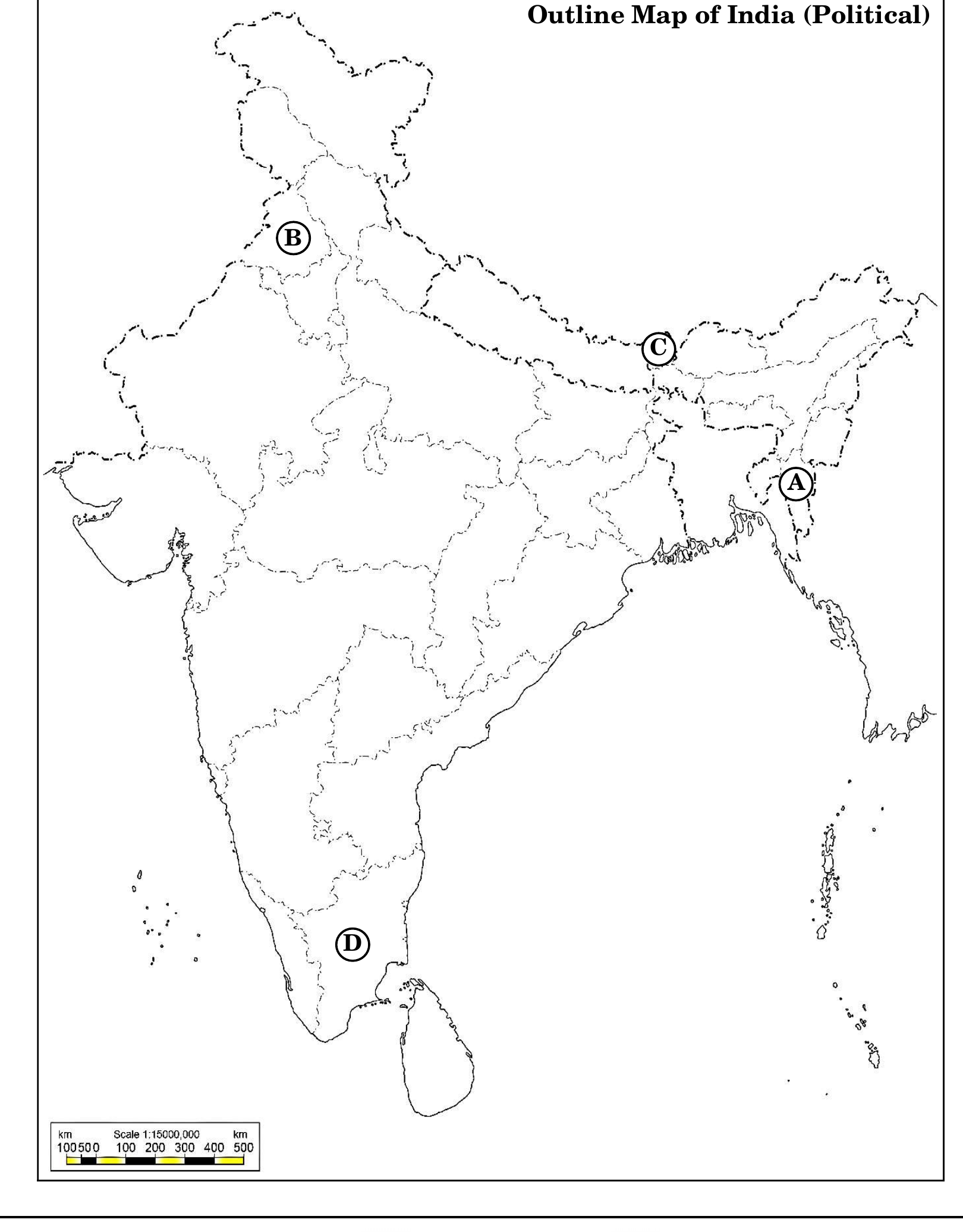
(i) The State related to Rajiv Gandhi – Longowal Accord
(ii) The State which merged with India in May 1975
(iii) The State to which social reformer E.V. Ramasami belonged
(iv) The State to which Chief Minister Laldenga belonged
(For Visually Impaired Candidates, in lieu of Q25: 25.1 Name the state to which the Rajiv Gandhi – Longowal Accord was related. 25.2 Name the state which joined the Union of India in May 1975. 25.3 Which state did Chief Minister Laldenga belong to? 25.4 Name the state to which social reformer E.V. Ramasami belonged.)
Solution
(i) B – Punjab. (ii) C – Sikkim. (iii) D – Tamil Nadu. (iv) A – Mizoram.
Suggest two steps to strengthen national integration and unity.
"The best way to respond to regional aspirations is through democratic negotiation rather than suppression." Justify with examples.
"Regional aspirations and their accommodation are an integral part of Indian democratic politics." Support with two arguments.
How did India address the regional aspirations of the people? Two examples.
Describe the events in Sikkim from independence to its merger with India.
5 marks: long answer
In the political outline map of India given above, five states have been marked as (A), (B), (C), (D) and (E). Identify these states on the basis of information given below and write their correct names in your answer book along with the respective serial number of the information used and the concerned alphabet in the Map:
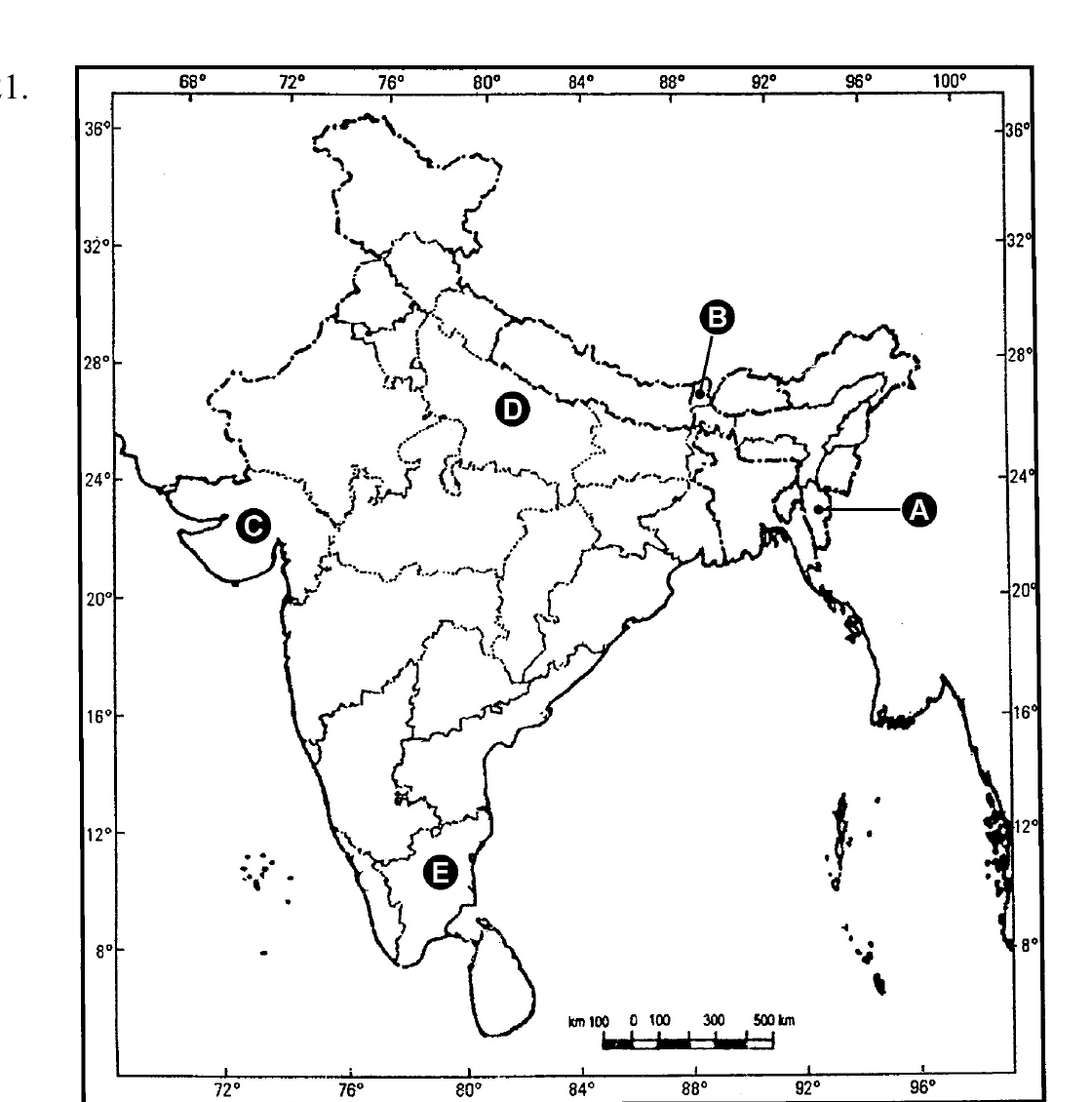
(i) The state where a violent incident took place at Godhara in 2002.
(ii) The state which was earlier known as Madras.
(iii) The state which has the maximum number of seats in India in its Legislative Assembly.
(iv) The state to which Laldenga belonged.
(v) The state which integrated with India in 1975 as 22nd State of India.
Solution
| Information | Alphabet | State |
|---|---|---|
| (i) | C | Gujarat |
| (ii) | E | Tamil Nadu |
| (iii) | D | Uttar Pradesh |
| (iv) | A | Mizoram |
| (v) | B | Sikkim |
6 marks: long answer
Explain the efforts of the Punjab government and the Government of India to foster peace in Punjab.
Solution
(i) Rajiv Gandhi–Longowal Accord (Punjab Accord), July 1985: Chandigarh to be transferred to Punjab, a commission to settle the Punjab–Haryana boundary, a tribunal on sharing Ravi-Beas waters, compensation and better treatment for victims of militancy, and withdrawal of the AFSPA. (ii) Violence continued, so the Centre and state used security forces to end militancy; President's rule continued till 1992. (iii) Elections in 1992 restored the democratic process; by the mid-1990s peace returned; the Akali Dal and others formed governments, and the focus shifted to economic development.
Explain the main factors behind demands for autonomy by the north-eastern states.
Solution
(i) At independence the region (except Manipur and Tripura) was one state, Assam; non-Assamese people felt the Assam government was imposing the Assamese language, leading to protests. (ii) Major tribal communities wanted separation; they formed the Eastern India Tribal Union (1960); later Nagaland, Meghalaya, Mizoram, Manipur, Tripura and Arunachal Pradesh were created. (iii) Communities like the Bodos, Karbis and Dimasas demanded separate states or autonomy through movements and insurgency; the government gave autonomous district councils under the Sixth Schedule. (iv) Geographical isolation and backwardness strengthened feelings of neglect.
Describe three developments in Punjab that led to dissatisfaction and violence.
Solution
(i) Anandpur Sahib Resolution (1973): passed by the Akali Dal, it asked for regional autonomy and redefining Centre–state relations and asserted a Sikh identity; it was seen as a plea for a separate Sikh nation. (ii) Rise of militancy: a section of the movement turned to armed insurgency demanding Khalistan; militants made the Golden Temple their headquarters. (iii) Operation Blue Star (June 1984) and its aftermath: the army action damaged the Golden Temple and hurt Sikh sentiments; Indira Gandhi was assassinated (31 October 1984) and anti-Sikh riots in Delhi and elsewhere killed over 2,000 people; militancy continued till the 1990s.
Describe three measures the Union government can take to address regional movements and demands.
Solution
(i) Democratic negotiation: treat regional aspirations as part of democratic politics and settle them by dialogue and accords (Punjab, Mizo, Assam accords). (ii) Power sharing: give regions a role in decision-making through federalism, autonomy (Sixth Schedule councils) or new states. (iii) Economic development of backward regions to reduce feelings of neglect, while respecting diversity and avoiding imposition.
"Regional aspirations and demands are part and parcel of democratic politics." Support with three examples.
Solution
Democracy allows people to express regional identities and demands; India dealt with them democratically: (i) Linguistic states (1956) and later states (Gujarat, Maharashtra 1960; Haryana 1966; Chhattisgarh, Jharkhand, Uttarakhand 2000) met regional demands. (ii) Accords: the Mizo Accord (1986) made Laldenga's MNF part of democratic politics; the Punjab (1985) and Assam (1985) accords. (iii) Regional parties like the DMK, AGP, Akali Dal, TDP and National Conference won elections and became part of state and national governments. Thus regional aspirations strengthened rather than weakened democracy.
Suggest three measures to strengthen "unity in diversity" in India.
Solution
(i) Respect for diversity: protect linguistic, cultural and religious rights; avoid imposing one language or culture. (ii) Power sharing and federalism: give regions autonomy and a voice in national decisions, and settle disputes by dialogue. (iii) Balanced economic development: remove regional imbalances, so no region feels neglected; promote national symbols, education and exchanges (e.g. Ek Bharat Shreshtha Bharat).
"Regional demands show that India adopted a democratic approach to accommodate diversity." Justify.
Solution
(i) Democratic politics allows parties and groups to address people on the basis of their regional identity, aspirations and problems; it does not treat them as anti-national. (ii) Regional issues get attention and accommodation in policy-making: in the 1980s militancy erupted in Punjab, the North-East was troubled, students agitated in Assam and Kashmir was on the boil, yet the government settled many issues through negotiation (Punjab Accord, Assam Accord). (iii) Mizoram is the best example of a political settlement ending a secessionist movement; new states (Jharkhand, Uttarakhand, Chhattisgarh, Telangana) met regional demands.
Examine three problems related to Jammu and Kashmir.
Solution
(i) External dispute: Pakistan has always claimed the Kashmir valley because of its Muslim majority; it sponsored a tribal invasion in 1947, and part of the state came under Pakistan's illegal occupation (PoK); this has led to wars. (ii) Internal dispute over autonomy: the special status under Article 370 and demands for more autonomy; its abrogation in 2019 was opposed by some sections. (iii) Insurgency and terrorism from 1989, sponsored from across the border, led to violence and the large-scale migration of Kashmiri Pandits; there are also regional tensions among Jammu, Kashmir and Ladakh.
Analyse three reasons for the movement against outsiders in Assam (1979–1985).
Analyse three reasons for unrest and violence in Punjab (1967–1985).
Assess the reasons for the Dravidian movement and its outcomes.
Why is the period since 1980 known for the rise of regional aspirations? Assess India's response to them.
Analyse any three reasons for the movement against outsiders in Assam from 1979 to 1985.
"Regional aspirations are very much a part of democratic politics." Justify the statement.
Analyse any three main causes of unrest in Jammu and Kashmir.
Get every solution for all chapters
- Every board question of every chapter, each fully solved the way the board gives marks
- 16 complete board papers, each followed by its solutions
- Weightage and most-asked topics for every chapter
- Instant PDF download, colour and black & white print copies
Revising the chapter first? Complete Political Science Notes for Class 12 (CBSE 2026-27) →
What you get in the pack
- CBSE Class 12 Political Science board papers 2016 to 2026 (all 143 sets, main and compartment; 16 in full)
- All 15 chapters and 16 full board papers complete
- Part A: all 15 chapters, questions sorted chapter-wise and by marks
- Year-wise weightage table and most-asked topics for every chapter
- Part B: each full board paper followed by its complete solutions
- Point-wise answers; passage, cartoon and map questions with images
- Questions on chapters out of the board syllabus are flagged
All chapters in this pack
- PYQ Ch 1 The End of Bipolarity
- PYQ Ch 2 Contemporary Centres of Power
- PYQ Ch 3 Contemporary South Asia
- PYQ Ch 4 International Organisations
- PYQ Ch 5 Security in the Contemporary World
- PYQ Ch 6 Environment and Natural Resources
- PYQ Ch 7 Globalisation
- PYQ Ch 8 Challenges of Nation-Building
- PYQ Ch 9 Era of One-Party Dominance
- PYQ Ch 10 Politics of Planned Development
- PYQ Ch 11 India's External Relations
- PYQ Ch 12 Challenges to and Restoration of the Congress System
- PYQ Ch 13 The Crisis of Democratic Order
- PYQ Ch 14 Regional Aspirations
- PYQ Ch 15 Recent Developments in Indian Politics
- Board Paper 2026 Set 59-1-1 with Solutions
- Board Paper 2026 Set 59-1-2 with Solutions
- Board Paper 2026 Set 59-1-3 with Solutions
- Board Paper 2026 Set 59-2-1 with Solutions
- Board Paper 2025 Set 59-1-1 with Solutions
- Board Paper 2025 Set 59-2-1 with Solutions
- Board Paper 2025 Set 59-4-1 with Solutions
- Board Paper 2024 Set 59-1-1 with Solutions
- Board Paper 2024 Set 59-2-1 with Solutions
- Board Paper 2023 Set 59-1-1 with Solutions
- Board Paper 2022 Term 2 Set 59-1-1 with Solutions
- Board Paper 2020 Set 59-1-1 with Solutions
- Board Paper 2019 Set 59-1-2 with Solutions
- Board Paper 2018 Set 59-1 with Solutions
- Board Paper 2017 Set 59-1 with Solutions
- Board Paper 2016 Set 59-1 with Solutions