
Contemporary South Asia: Class 12 PYQs 2019–2026 with solutions
All 54 CBSE board questions asked from Contemporary South Asia in 19 board papers, with the year, set and marks of each. 28 are solved free below. The Class 12 Political Science PYQ Book: Solved Board Papers 2016-2026 (CBSE) has every solution, all chapters and 16 full board papers.

Contemporary South Asia: board weightage
Board weightage 2019–2026
| Year | 2019 | 2022 | 2023 | 2024 | 2025 | 2026 |
|---|---|---|---|---|---|---|
| Questions | 3 | 3 | 2 | 18 | 15 | 14 |
| Marks | 12 | 6 | 10 | 41 | 56 | 44 |
Most asked topics
55 questions from 19 papers. Repeated questions are shown once with every year they were asked.
Jump to: 1 mark2 marks4 marks6 marks
1 mark: MCQ and Assertion–Reason
Which country is not a member of SAARC? (A) Nepal (B) China (C) Maldives (D) Sri Lanka
Solution
(B) China (it is only an observer). SAARC's eight members: India, Pakistan, Bangladesh, Nepal, Bhutan, Sri Lanka, Maldives, Afghanistan.
In which year was a multi-party system introduced in the Maldives? (A) 2008 (B) 2007 (C) 2006 (D) 2005
Solution
(D) 2005: the Maldives parliament voted unanimously to allow multi-party politics in June 2005; the Maldivian Democratic Party then dominated politics.
Assertion (A): In April 2006 there were massive countrywide pro-democracy protests in Nepal. Reason (R): In 2002 the king abolished parliament and dismissed the government. (A) both true, R explains A (B) both true, R does not explain A (C) A true, R false (D) A false, R true
Solution
(B) as per the board key. Both statements are true; the 2006 movement arose from the whole struggle against the monarchy (including the Maoist insurgency and the king's 2005 takeover), not just the 2002 dissolution.
Match: 1. General Zia-ul-Haq 2. Ziaur Rahman 3. Rajapaksa 4. Seven Party Alliance — (i) Bangladesh (ii) Nepal (iii) Pakistan (iv) Sri Lanka. (A) 1-i, 2-iii, 3-iv, 4-ii (B) 1-iv, 2-ii, 3-i, 4-iii (C) 1-iii, 2-i, 3-iv, 4-ii (D) 1-iii, 2-iv, 3-ii, 4-i
Solution
(C) 1-iii, 2-i, 3-iv, 4-ii: Zia-ul-Haq, military ruler of Pakistan (1977); Ziaur Rahman, Bangladesh; Rajapaksa, Sri Lanka; the Seven Party Alliance led Nepal's 2006 movement.
Statement I: Nepal was a Hindu kingdom in the past and then a constitutional monarchy for many years. Statement II: The pro-democracy forces achieved their first major victory in 2006 when the king was forced to restore the House of Representatives. (A) both true (B) both false (C) I true, II false (D) I false, II true
Solution
(A) Both true, as per the board key. (Strictly, the first victory came in 1990 when the king accepted a democratic constitution; 2006 was the decisive victory.)
Which event made South Asia a sudden focus of global attention after the Cold War? (A) Bangladesh war 1971 (B) Sri Lanka's ethnic conflict (C) India and Pakistan both became nuclear powers (D) Kargil conflict
Solution
(C) The nuclear tests by India and Pakistan in May 1998 drew world attention to the region.
Which one of the following countries is not included in 'South Asia'?
Solution
(B) China. South Asia comprises the seven SAARC founder states (India, Pakistan, Bangladesh, Sri Lanka, Nepal, Bhutan and Maldives), with Afghanistan sometimes included; China is a major neighbouring power in East Asia, not part of South Asia.
Arrange the following rulers of Pakistan in the chronological order as per the period of their rule:
(i) General Zia-ul-Haq
(ii) Benazir Bhutto
(iii) General Musharraf
(iv) Zulfikar Ali Bhutto
SAARC is a major ___ initiative by South Asian states to evolve mutual cooperation. (A) political (B) military (C) international (D) regional
Assertion (A): The king, with the army's help, retained full control over the government and restricted democracy in Nepal. Reason (R): The king accepted the demand for a new democratic constitution in 2001 in the wake of a strong pro-democracy movement. (A) both true, R explains A (B) both true, R does not explain A (C) A true, R false (D) A false, R true
Which statement about Sri Lanka's ethnic conflict is false? (A) politics favoured the Sinhalese (B) Tamil interests were neglected (C) the LTTE was supported by SAARC countries (D) the problem involved Sinhalese and Tamils
Match: (a) the first country to liberalise its economy in South Asia (b) earlier had a Sultan as head of state, now a republic (c) a land-locked country (d) where the military prevailed over pro-democracy groups — (i) Maldives (ii) India (iii) Pakistan (iv) Nepal. (A) a-iii, b-i, c-ii, d-iv (B) a-ii, b-i, c-iii, d-iv (C) a-ii, b-i, c-iv, d-iii (D) a-iv, b-ii, c-iii, d-i
Which developing country was the first to successfully control its rate of population growth? (A) India (B) Pakistan (C) Nepal (D) Sri Lanka
2 marks: very short answer
How does the natural insularity of South Asian region determine its cultural distinctiveness? Explain.
Solution
South Asia is naturally insulated: the Himalayas in the north and the Indian Ocean, Arabian Sea and Bay of Bengal in the south, west and east. This isolation from the rest of Asia let the region develop its own linguistic, social and cultural distinctiveness: shared languages, festivals, food, social rituals and religious traditions that are common across the subcontinent and different from neighbouring regions.
Assess the impact of outside powers on South Asian countries.
Solution
Outside powers have strongly influenced South Asia: (i) China's strategic partnership with Pakistan is an irritant for India, and it is building ties with other neighbours; (ii) after the Cold War the USA became an important actor: it has close ties with both India and Pakistan and works as a moderator in Indo-Pak relations, while economic reforms and its large Indian diaspora increase its stake. Such involvement can help peace but also complicates regional rivalries.
Name any four military rulers of Pakistan.
Solution
(i) General Ayub Khan (1958), (ii) General Yahya Khan (1969), (iii) General Zia-ul-Haq (1977), (iv) General Pervez Musharraf (1999).
Highlight one basic difference between democracy in Sri Lanka and in India.
Solution
Sri Lankan democracy has been dominated by the interests of the majority Sinhala community; laws and policies (like "Sinhala only", preference in jobs and education) favoured them and discriminated against Tamils, leading to ethnic conflict. In India the Constitution guarantees equal rights to all citizens, protects minorities, and accommodates linguistic and cultural diversity through federalism.
India–Pakistan relations seem a story of endemic conflict. Suggest two measures to curb tensions.
Solution
(i) Confidence-building measures to reduce the risk of war: hotlines, advance notice of military exercises, talks at all levels. (ii) People-to-people contact and trade: bus and rail links, trade, sports, cultural exchanges; social activists and prominent personalities can build an atmosphere of friendship; disputes like Kashmir and water should be resolved peacefully through dialogue (the "ASEAN Way").
Explain any two factors that are responsible for Pakistan's failure in building a stable democracy.
Solution
(i) Social dominance of the military, the clergy and the landowning aristocracy has repeatedly overthrown elected governments and set up military rule (Ayub Khan, Zia-ul-Haq, Musharraf). (ii) The conflict with India made pro-military groups more powerful, as they claimed political parties and democracy were flawed and the country's security would suffer; also, the lack of international support for democracy: the US and Western countries encouraged military rule for their own reasons (war on communism, war on terror).
Highlight any two features of the Constitution of Bangladesh.
Solution
Bangladesh drafted its constitution in 1972 (after independence in 1971), declaring faith in (i) secularism and democracy and (ii) socialism. (In 1975 Sheikh Mujib amended it to shift to a presidential form and abolished all parties except the Awami League; parliamentary democracy was restored after 1991.)
Which party won all the seats in East Pakistan in the 1970 elections, and under whose leadership?
Why did the people of East Pakistan resent the domination of West Pakistan?
Show with the help of any two examples the interference of military in the administration of Pakistan.
Highlight any two reasons for the ethnic conflict in Sri Lanka.
Name any four countries that are included in 'South Asia'.
Suggest any two measures to improve relations between India and Pakistan.
4 marks: case-based / source-based
Read the passage given below carefully and answer the questions that follow:
The South Asian Association for Regional Co-operation (SAARC) is a major regional initiative by the South Asian states to evolve co-operation through multilateral means. It began in 1985. Unfortunately due to persisting political differences, SAARC has not had much success. SAARC members signed the South Asian Free Trade Agreement (SAFTA) in 2002 which promised the formation of a free trade zone for the whole of South Asia.
(i) Which one of the following South Asian countries is not a founder member of South Asian Association for Regional Co-operation (SAARC)? (A) Nepal (B) Bhutan (C) Afghanistan (D) Bangladesh
(ii) The external power that affects the South Asian Countries the most is: (A) United States of America (B) Russia (C) France (D) Britain
(iii) The major objective of South Asian Association for Regional Co-operation is – (A) to become a contemporary centre of power in the World. (B) to establish a common currency for the regional organisation for its economic development. (C) to solve all regional conflicts without interference of external powers. (D) to co-operate member states for economic growth, social progress and cultural development through multilateral means.
(iv) Which one of the following is NOT a core objective of South Asian Free Trade Agreement (SAFTA)? (A) To establish a common currency for SAARC nations. (B) To promote and enhance mutual trade and economic co-operation. (C) To reduce custom duties and non-tariff barriers. (D) To create a free trade area among member states.
Solution
(i) (C) Afghanistan (joined in 2007). (ii) (A) USA. (iii) (D) cooperation among members through multilateral means. (iv) (A) a common currency is not a SAFTA objective.
Describe two areas of cooperation and two reasons for conflict between India and Pakistan.
Solution
Cooperation: (i) the Indus Waters Treaty (1960), brokered by the World Bank, has survived wars; (ii) confidence-building measures: bus service, trade, cultural exchange, visits and agreements to reduce the risk of war. Conflict: (i) the Kashmir issue (wars of 1947–48, 1965, Kargil 1999); (ii) control of the Siachen glacier, the arms race (nuclear tests 1998), and terrorism.
Two areas of cooperation and two reasons for conflict between India and Nepal.
Solution
Cooperation: (i) the open border lets citizens travel and work without visas or passports; (ii) close trade, scientific cooperation, natural resources, electricity generation and water management. Conflict: (i) India's concern over Nepal's ties with China; (ii) India worried about the Maoist movement and anti-India groups, while Nepal sees India as interfering in its internal affairs, the river waters issue and transit.
Explain the reasons for the ethnic conflict in Sri Lanka and its impact on India.
Solution
Reasons: (i) Sri Lankan politics was dominated by the Sinhala majority, hostile to the Tamils (many of whom migrated from India); "Sinhala only" policies and discrimination in jobs and education; (ii) this led to Tamil nationalism and, from 1983, the militant LTTE's armed struggle for a separate Tamil Eelam. Impact on India: (i) Tamils in India pressed the government to protect Sri Lankan Tamils, and refugees came to Tamil Nadu; (ii) India sent the Indian Peace Keeping Force (1987) under an accord, but it got into fights with the LTTE, was unpopular in Sri Lanka and withdrew in 1989; Rajiv Gandhi was later killed by an LTTE bomber (1991).
Explain four reasons for good relations between Nepal and India.
Solution
(i) Open border: citizens travel and work in each other's country without visas or passports. (ii) Close cultural and religious ties (Hindu and Buddhist heritage, family links). (iii) Strong trade, scientific cooperation, common natural resources, electricity and water management. (iv) India supports Nepal's democracy and development and gives aid in disasters (e.g. 2015 earthquake).
Cartoon: "I am always good at calculation — Musharraf": equations showing President Musharraf and General Musharraf. (i) Message of the uppermost equation (ii) message of the middle line (iii) message of the lowest line (iv) message of the whole cartoon. [VI: first military ruler of Pakistan; year Bangladesh came into existence; leader of the elected government 1971–77; regional organisation of South Asia]
Solution
(i) A President without being the General is zero: in Pakistan civilian authority has little value without the army's backing. (ii) A General without being President is effective and has some value (the army is powerful). (iii) A General who is also President has the most value and power. (iv) In Pakistan military power dominates: generals seize political power and add the presidency to their army post to enhance it (as Ayub Khan, Zia-ul-Haq and Musharraf did), weakening democracy. VI: General Ayub Khan; 1971; Zulfikar Ali Bhutto; SAARC.
How is SAARC a major regional initiative to evolve cooperation through multilateral means?
Solution
(i) SAARC was set up in 1985 by the South Asian states to evolve cooperation through multilateral means, building mutual harmony and understanding. (ii) It signed SAFTA (2004), in force from 2006, promising a free trade zone for the whole region by lowering trade tariffs. (iii) It promotes economic development of members and reduces their dependence on non-regional powers. (iv) Though political differences (especially India–Pakistan) limited its success, and smaller neighbours fear Indian domination of their markets, India believes freer trade will help all and improve political relations.
"Despite a mixed record, the people of South Asia share the aspiration for democracy." Justify with two arguments.
Solution
(i) Surveys (State of Democracy in South Asia) show widespread support for democracy among ordinary people in all these countries, cutting across classes and religions. (ii) People prefer democracy over any other form of government and support its institutions; people in Nepal, Bangladesh, Pakistan and Maldives have repeatedly struggled against monarchy and military rule to restore democracy.
Study the cartoon given below and answer the questions based on it:
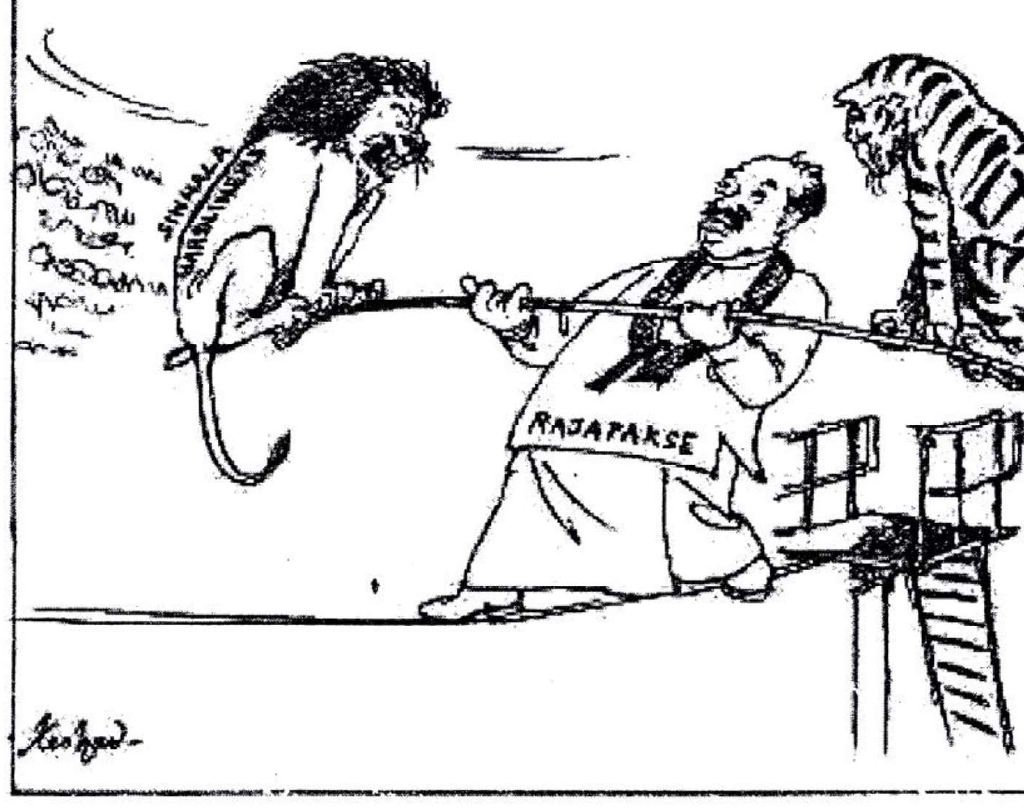
(i) Which community is being represented by the 'Lion' sitting on the one end of the stick? (A) Buddhists (B) Christians (C) Sinhalas (D) Tamils
(ii) What is the meaning of 'LTTE' written on the Tiger shown in the cartoon? (A) Liberation Tigers of the Eelam (B) Liberation Tamils of the Eelam (C) Liberation Tigers of Tamil Eelam (D) Liberty Tigers of Tamil Eelam
(iii) Which community in Sri Lanka had felt discriminated? (A) Tamils (B) Sinhalas (C) Buddhists (D) Christians
(iv) Which problem is being depicted by the cartoon? (A) Economic imbalance (B) Political instability (C) Regional conflict (D) Ethnic conflict
(For Visually Impaired Candidates, in lieu of Q26: 26.1 Name the two important communities of Sri Lanka. 26.2 What was the main issue of conflict between these two communities? Explain. 26.3 How did India help Sri Lanka to maintain peace? 26.4 Name the two countries that tried to bring the warring groups back to negotiations in Sri Lanka.)
Solution
(i) (C) Sinhalas. (ii) (C) Liberation Tigers of Tamil Eelam. (iii) (A) Tamils. (iv) (D) Ethnic conflict. VI: Sinhalas and Tamils; the Sinhala-dominated government discriminated against Tamils, who demanded autonomy and then a separate Tamil Eelam; India sent the IPKF (1987) under an accord; Norway and Iceland brought the groups back to talks.
Analyse the relations between India and Bangladesh.
Solution
Differences: sharing of the Ganga and Brahmaputra waters; Bangladesh's denial of illegal immigration into India; support to anti-India groups; refusal to let Indian troops pass through its territory to the North-East; decision not to export natural gas to India; a feeling that India behaves like a regional bully. Cooperation: Bangladesh is part of India's Look East policy; cooperation on disaster management and environment; the Land Boundary Agreement (2015) exchanged enclaves; trade, transport and communication links are growing. Overall, relations have improved.
Analyse the transition from monarchy to democracy in Nepal.
Passage on SAFTA: it aims at lowering tariffs; some neighbours fear it is a way for India to "invade" their markets; India sees real benefits; some in India think it is not worth the trouble because of bilateral agreements with Bhutan, Nepal and Sri Lanka. (i) SAFTA came into effect from: (A) 1 January 2004 (B) 1 January 2005 (C) 1 January 2006 (D) 1 January 2007 (ii) SAFTA is related to: (A) SAARC (B) ASEAN (C) EU (D) NAM (iii) The spirit behind SAFTA: (A) friendship and solidarity (B) free trade across borders (C) resolve cross-border issues by discussion (D) challenge superpowers (iv) SAFTA promised: (A) a free trade zone (B) a peaceful environment (C) a strong organisation (D) a cultural organisation
Suggest two measures to improve India's relations with Pakistan.
Suggest two measures to improve India–China relations.
Describe two factors behind Sri Lanka's economic growth despite internal conflicts.
Cartoon: Sri Lankan President Rajapaksa on a tightrope, pulled between a lion and a tiger. (i) Which community does the tiger represent? (ii) Which community does the lion represent? (iii) What did Rajapaksa's balancing act aim at? [VI: two main communities of Sri Lanka; expansion of LTTE; year of Sri Lanka's independence; country that mediated in the ethnic conflict]
Explain two main challenges faced by Pakistan in establishing a successful democracy.
"SAARC is a major regional initiative in South Asia to evolve cooperation through multilateral means." Justify with two examples.
Study the cartoon given below and answer the questions that follow:
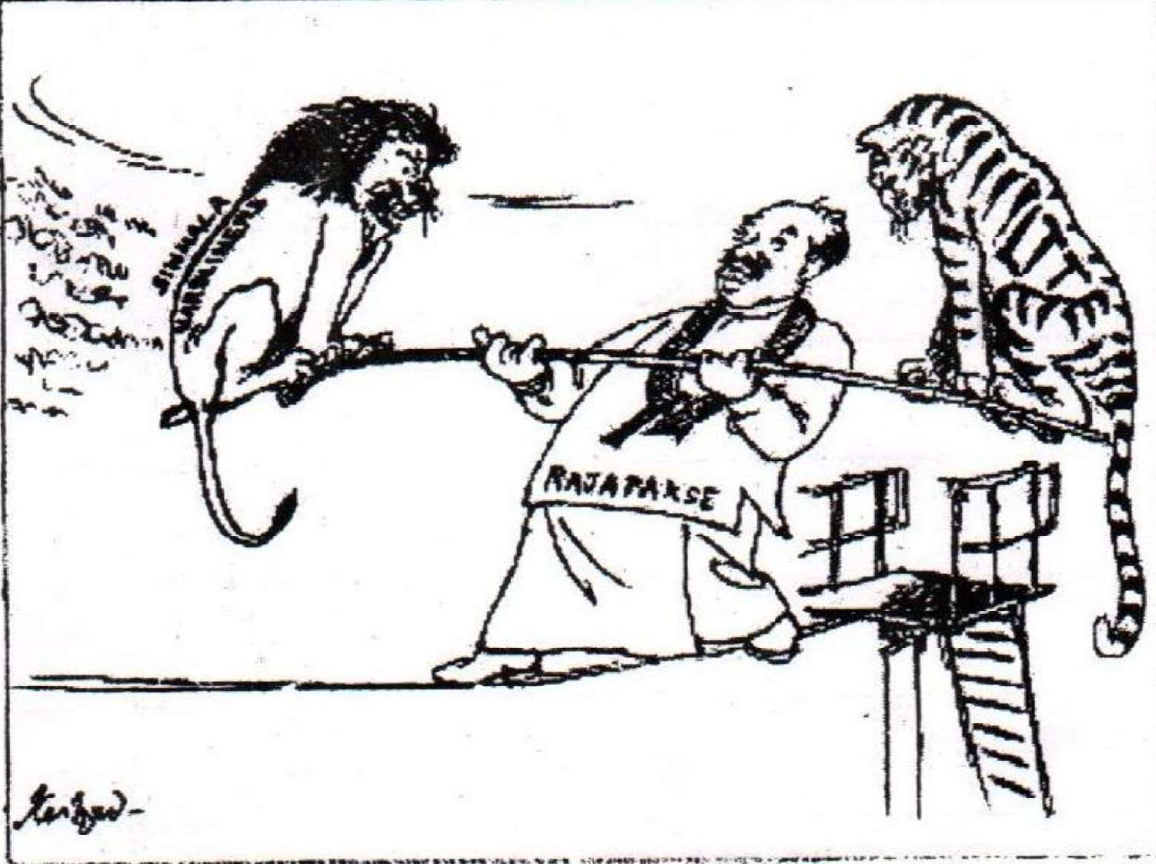
(i) The tiger sitting on the right-hand side represents which organisation? (a) Liberation Tigers of Tamil Eelam (b) Liberal Tigers of Tamil Estate (c) Liberation Tigers of Tamil East (d) Liberal Tigers of Tamil Eelam
(ii) The conflict in Sri Lanka from 1983 onwards was based on which of the following? (a) Discrimination by the government between political parties (b) Discrimination by the government between two communities (c) Discrimination by the government between two regions (d) Discrimination by the government between two religions
(iii) Which one of the following statements about Sri Lankan crisis is true? (a) India did not interfere in the crisis and kept away from the problem. (b) India asked the United Nations to resolve the problem. (c) India signed an Accord with Sri Lanka and got involved in the solution to the problem. (d) India snapped its diplomatic relations with Sri Lanka during the crisis.
(iv) What message does the cartoon convey? (a) Sri Lankan government managed to balance the two rival groups. (b) Both the groups were against the government. (c) The government treated both the communities equally. (d) It was very difficult to maintain balance between the two rival groups.
(For Visually Impaired Candidates, in lieu of Q26: 26.1 In Sri Lanka, there was a conflict between: (a) two communities (b) two regions (c) two religions (d) two ideologies. 26.2 In 1989, India sent troops to Sri Lanka, named as: (a) Indian Peace Groups (b) Indian Peace Keeping Force (c) Indian Peace Workers (d) Indian Troops for Tamils. 26.3 Name the group of Tamils who fought against the army of Sri Lanka: (a) Indian Tamils (b) LTTE (c) Tamils for Democracy (d) Tamil United Front. 26.4 In spite of conflict, Sri Lanka has registered: (a) rise in its economy and development (b) fall in its economy (c) rise in the population (d) fall in its trade.)
Explain any two factors that have contributed to Pakistan's failure in building a stable democracy.
6 marks: long answer
Describe the sequence of events that established democracy in Nepal.
Solution
(i) Nepal was a Hindu kingdom and then a constitutional monarchy; the king kept real power. (ii) A strong pro-democracy movement in 1990 forced the king to accept a new democratic constitution, but democratic governments were short-lived and troubled. (iii) In the 1990s the Maoists launched an armed insurgency against the monarchy and the ruling elite; in 2002 the king abolished parliament and dismissed the government. (iv) In April 2006 a massive countrywide movement (the Seven Party Alliance, Maoists, social groups) forced the king to restore the House of Representatives; (v) monarchy was abolished in 2008 and Nepal became a federal democratic republic; a new constitution was adopted in 2015.
Describe the events that ended military rule and established democracy in Bangladesh.
Solution
(i) After independence (1971), Sheikh Mujibur Rahman's government adopted a constitution declaring secular, democratic socialism; in 1975 he amended it to a presidential system, abolished all parties except his Awami League; he was assassinated in a military uprising in August 1975. (ii) Ziaur Rahman formed the BNP and won elections in 1979; he was assassinated, and General H.M. Ershad took over in a military coup (1982) and later became president. (iii) Mass protests, joined by students, forced Ershad to step down in 1990; elections were held in 1991, and since then representative democracy based on multi-party elections has worked in Bangladesh.
Explain two commonalities and two differences between Bangladesh and Pakistan in their democratic experiences.
Solution
Commonalities: (i) Both have Muslim-majority populations and were one country till 1971. (ii) Both have seen military takeovers (Pakistan: Ayub, Yahya, Zia, Musharraf; Bangladesh: Ziaur Rahman, Ershad) and strong pro-democracy movements. Differences: (i) The US and Western countries have encouraged military rule in Pakistan, not so in Bangladesh; Pakistan's army remains very powerful. (ii) Pakistan is a nuclear state, Bangladesh is not; Bangladesh has had continuous multi-party elections since 1991 and its constitution declared secularism and democracy, while Pakistan was declared an Islamic republic and democracy there has been interrupted repeatedly.
Explain two issues of cooperation and two of confrontation between India and Bangladesh.
Solution
Cooperation: (i) Bangladesh is part of India's Look East / Act East policy, linking to South-east Asia; (ii) the Ganga water-sharing treaty (1996), cooperation in disaster management and environment, the Land Boundary Agreement (2015) exchanging enclaves, and growing trade. Confrontation: (i) illegal migration into India, which Bangladesh denies, and support to anti-India groups; (ii) Bangladesh's refusal to let Indian troops move through its territory to the North-East, and its decision not to export natural gas to India; river water sharing (Teesta).
Describe two areas of cooperation and two of conflict among SAARC members.
Describe three events showing that the people of South Asian countries want democracy.
"Despite various problems, the people in all the South Asian countries share the aspiration and support for democracy." Justify the statement with any three suitable examples.
Explain the ethnic conflict in Sri Lanka and any two consequences of it. (2 + 4 = 6)
Get every solution for all chapters
- Every board question of every chapter, each fully solved the way the board gives marks
- 16 complete board papers, each followed by its solutions
- Weightage and most-asked topics for every chapter
- Instant PDF download, colour and black & white print copies
Revising the chapter first? Complete Political Science Notes for Class 12 (CBSE 2026-27) →
What you get in the pack
- CBSE Class 12 Political Science board papers 2016 to 2026 (all 143 sets, main and compartment; 16 in full)
- All 15 chapters and 16 full board papers complete
- Part A: all 15 chapters, questions sorted chapter-wise and by marks
- Year-wise weightage table and most-asked topics for every chapter
- Part B: each full board paper followed by its complete solutions
- Point-wise answers; passage, cartoon and map questions with images
- Questions on chapters out of the board syllabus are flagged
All chapters in this pack
- PYQ Ch 1 The End of Bipolarity
- PYQ Ch 2 Contemporary Centres of Power
- PYQ Ch 3 Contemporary South Asia
- PYQ Ch 4 International Organisations
- PYQ Ch 5 Security in the Contemporary World
- PYQ Ch 6 Environment and Natural Resources
- PYQ Ch 7 Globalisation
- PYQ Ch 8 Challenges of Nation-Building
- PYQ Ch 9 Era of One-Party Dominance
- PYQ Ch 10 Politics of Planned Development
- PYQ Ch 11 India's External Relations
- PYQ Ch 12 Challenges to and Restoration of the Congress System
- PYQ Ch 13 The Crisis of Democratic Order
- PYQ Ch 14 Regional Aspirations
- PYQ Ch 15 Recent Developments in Indian Politics
- Board Paper 2026 Set 59-1-1 with Solutions
- Board Paper 2026 Set 59-1-2 with Solutions
- Board Paper 2026 Set 59-1-3 with Solutions
- Board Paper 2026 Set 59-2-1 with Solutions
- Board Paper 2025 Set 59-1-1 with Solutions
- Board Paper 2025 Set 59-2-1 with Solutions
- Board Paper 2025 Set 59-4-1 with Solutions
- Board Paper 2024 Set 59-1-1 with Solutions
- Board Paper 2024 Set 59-2-1 with Solutions
- Board Paper 2023 Set 59-1-1 with Solutions
- Board Paper 2022 Term 2 Set 59-1-1 with Solutions
- Board Paper 2020 Set 59-1-1 with Solutions
- Board Paper 2019 Set 59-1-2 with Solutions
- Board Paper 2018 Set 59-1 with Solutions
- Board Paper 2017 Set 59-1 with Solutions
- Board Paper 2016 Set 59-1 with Solutions