
Challenges of Nation-Building: Class 12 PYQs 2019–2026 with solutions
All 42 CBSE board questions asked from Challenges of Nation-Building in 18 board papers, with the year, set and marks of each. 23 are solved free below. The Class 12 Political Science PYQ Book: Solved Board Papers 2016-2026 (CBSE) has every solution, all chapters and 16 full board papers.

Challenges of Nation-Building: board weightage
Board weightage 2019–2026
| Year | 2019 | 2022 | 2023 | 2024 | 2025 | 2026 |
|---|---|---|---|---|---|---|
| Questions | 2 | – | 2 | 11 | 13 | 15 |
| Marks | 7 | – | 12 | 54 | 54 | 40 |
Most asked topics
43 questions from 18 papers. Repeated questions are shown once with every year they were asked.
Jump to: 1 mark2 marks4 marks6 marks
1 mark: MCQ and Assertion–Reason
Which one of the following is the reason that led to the formation of Andhra state in 1952?
Solution
(C) Potti Sriramulu died after a 56-day fast for a separate Andhra state; the violent protests that followed forced Nehru to announce the formation of Andhra state in December 1952.
Which one of the following statements is NOT correct about the princely states?
Solution
(B) is not correct: almost all states signed the Instrument of Accession, but Junagadh, Hyderabad, Kashmir and Manipur were difficult cases, so not all accepted at once.
Match states with the states they were carved from: 1. Gujarat 2. Haryana 3. Meghalaya 4. Chhattisgarh — (i) Assam (ii) Bombay (iii) Madhya Pradesh (iv) Punjab. (A) 1-i, 2-iii, 3-iv, 4-ii (B) 1-ii, 2-iv, 3-i, 4-iii (C) 1-iii, 2-iv, 3-i, 4-ii (D) 1-ii, 2-i, 3-iv, 4-iii
Solution
(B) 1-ii, 2-iv, 3-i, 4-iii: Gujarat from Bombay (1960), Haryana from Punjab (1966), Meghalaya from Assam (1972), Chhattisgarh from Madhya Pradesh (2000).
The States Reorganisation Commission was appointed in 1953: (A) for administrative efficiency (B) to end complexities of colonial boundaries (C) to ensure nation building (D) for demarcating state boundaries on the basis of language
Solution
(D) The SRC (Fazl Ali, K.M. Panikkar, H.N. Kunzru), set up after the Andhra agitation, recommended that state boundaries reflect the boundaries of languages; the States Reorganisation Act 1956 created 14 states and 6 union territories.
Match: 1. Sardar Patel 2. Bodhachandra Singh 3. Potti Sriramulu 4. Jawaharlal Nehru — (i) Tryst with Destiny (ii) first Deputy Prime Minister (iii) Vishalandhra movement (iv) Maharaja of a princely state. (A) 1-iii, 2-iv, 3-ii, 4-i (B) 1-ii, 2-iv, 3-iii, 4-i (C) 1-ii, 2-iii, 3-iv, 4-i (D) 1-iv, 2-iii, 3-i, 4-ii
Solution
(B) 1-ii, 2-iv, 3-iii, 4-i: Patel was the first Deputy PM; Bodhachandra Singh was the Maharaja of Manipur who signed the Instrument of Accession (1949); Potti Sriramulu fasted for a separate Andhra (Vishalandhra movement); Nehru's "Tryst with Destiny" speech.
Statement I: During the colonial period, state boundaries were drawn for administrative convenience. Statement II: After independence, redrawing of state boundaries was based on languages. (A) both true (B) both false (C) I true, II false (D) I false, II true
Solution
(A) Both true. Colonial provinces followed administrative convenience or the territory of princely states; after 1956 (SRC) most states were reorganised on linguistic lines.
Who advanced the "two-nation theory"? (A) British Government (B) Muslim League (C) Khan Abdul Ghaffar Khan (D) Lord Mountbatten
Solution
(B) The Muslim League: it argued India consisted of two "people", Hindus and Muslims.
Assertion (A): There were killings and atrocities on both sides of the border in 1947. Reason (R): The planned transfer of population had failed. (A) both true, R explains A (B) both true, R does not explain A (C) A true, R false (D) A false, R true
Assertion (A): The first challenge after independence was to keep India united. Reason (R): Deputy PM and Home Minister Sardar Patel played an important role in unifying India. (A) both true, R explains A (B) both true, R does not explain A (C) A false, R true (D) A true, R false
On the basis of which language was Andhra Pradesh formed? (A) Telugu (B) Malayalam (C) Tamil (D) Kannada
Which princely state initially opposed joining the Indian Union? (A) Baroda (B) Hyderabad (C) Mysore (D) Gwalior
Chhattisgarh was carved out of: (A) Uttar Pradesh (B) Bihar (C) Jharkhand (D) Madhya Pradesh
Justify the reorganization of states in India on language basis by giving one suitable argument.
2 marks: very short answer
Explain two commonly agreed goals of the national movement that were achieved after independence.
Solution
(i) Democracy: India would be run as a democratic government, with universal adult franchise and regular free elections. (ii) Equality and social justice: government would work for the good of all, especially the poor and socially disadvantaged groups, without discrimination of religion, caste or gender; both were written into the Constitution.
Explain the "two-nation theory" advanced by the Muslim League.
Solution
The Muslim League argued that India consisted not of one but two "people", Hindus and Muslims, who had different religions, cultures and traditions; therefore Muslims needed a separate homeland, Pakistan. The Congress opposed it, but the political developments of the 1940s, communal conflict and the British withdrawal led to Partition on this basis.
4 marks: case-based / source-based
Study the given cartoon carefully and answer the questions that follow:
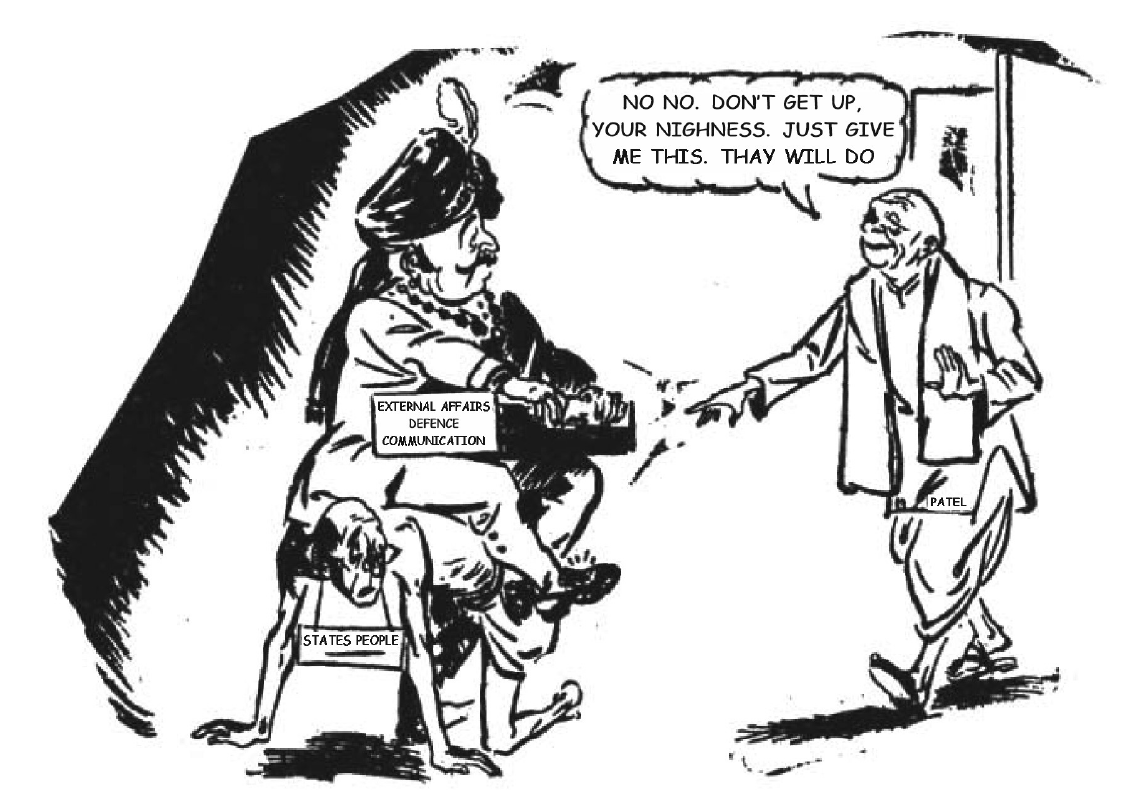
(i) Name the leader talking to the Prince in this cartoon. (1)
(ii) What does the Prince sitting on the back of a poor man indicate? (1)
(iii) What message is being conveyed by the cartoon? (2)
(For Visually Impaired Candidates, in lieu of Q25: (i) Name the speech given by Jawaharlal Nehru at the hour of midnight on 14-15 August 1947. (ii) Name the first Deputy Prime Minister of India. (iii) Explain the two nation theory.)
Solution
(i) Sardar Vallabhbhai Patel. (ii) The rulers of princely states lived off and suppressed the ordinary, poor people of their states. (iii) Patel persuaded (and where needed pressured) the princes to sign the Instrument of Accession, freeing the people from princely rule and unifying the country. VI: (i) "Tryst with Destiny"; (ii) Sardar Vallabhbhai Patel; (iii) the Muslim League's theory that India consisted of two "people", Hindus and Muslims, so a separate country (Pakistan) was needed for Muslims.
Explain two major concerns of the government about reorganising states on linguistic lines after independence.
Solution
(i) The national leadership feared that carving out states on the basis of language might lead to disruption and disintegration of the country, especially after Partition on religious lines. (ii) It could divert attention from other social and economic challenges facing the new nation (development, refugees, security). Hence the leaders postponed it, until the Andhra movement (Potti Sriramulu) forced the issue; later, linguistic states actually strengthened democracy and national unity.
Describe four consequences of the partition of British India.
Solution
(i) Largest population transfer in history: about 80 lakh people migrated across the new border. (ii) Communal violence: between 5 and 10 lakh people were killed; minorities on both sides were attacked. (iii) Women were abducted, raped and forced to convert; families killed their own women for "honour". (iv) Division of assets and property: government employees, railways, the army, debts; refugees had to be rehabilitated (camps, new cities).
Describe four problems in the process of partition.
Solution
(i) There was no single belt of Muslim majority; Pakistan had to be in two parts, West and East. (ii) Not all Muslim-majority areas wanted Pakistan: the NWFP, led by Khan Abdul Ghaffar Khan, opposed it. (iii) Punjab and Bengal had large non-Muslim populations, so they had to be divided district by district. (iv) The problem of minorities on both sides of the border: millions were trapped, uncertain where to go, and faced violence.
Map of India, states A–D: (i) state bifurcated between India and Pakistan at Partition (ii) state created in 1966 (iii) state of Sardar Patel (iv) state of Maharaja Bodhachandra Singh. [VI: first Home Minister; year Andhra state formed; theory behind Partition; year Jharkhand was created]
Solution
(i) D – West Bengal (Bengal was divided; Punjab also was). (ii) C – Haryana. (iii) B – Gujarat. (iv) A – Manipur. VI: Sardar Patel; December 1952 (Andhra came into being on 1 October 1953); the two-nation theory; 2000.
Map of India, states A–D: (i) princely state whose ruler resisted merger with India (ii) state most affected by Partition (iii) state carved out of Madhya Pradesh (iv) state formed in 1952. [VI: a UT that was earlier a state; a state most affected by Partition; state carved from MP; state formed in 1952]
Map of India, states A–D: (i) state of Maharaja Bodhachandra Singh (ii) state created in 1966 (iii) state that was earlier part of Madhya Pradesh (iv) state created in June 2014. [VI: state carved from MP; state of Bodhachandra Singh; first Home Minister; two princely states that were initially not ready to join India]
Explain Mahatma Gandhi's role in reducing communal tension and violence at the time of Partition.
Passage: the interim government opposed the division of India into small principalities; the Muslim League wanted states to be free to adopt any course; Patel negotiated firmly but diplomatically with the princes, bringing most into the Union. (24.1) Principle followed for the division of British India in 1947: (A) administrative control (B) ethnic composition (C) religious majorities (D) equality (24.2) First Deputy Prime Minister: (A) Ambedkar (B) Patel (C) V.K. Menon (D) Khan Abdul Ghaffar Khan (24.3) Number of princely states at independence: (A) 556 (B) 566 (C) 655 (D) 565 (24.4) Which statement about princely states is NOT correct? (A) the government was ready to give autonomy to some regions (B) the ruler of Junagadh had decided to be part of independent India (C) princely states covered one-third of the land area (D) some states clearly wanted to join India
6 marks: long answer
How did the princely states pose a threat to India's national security?
Solution
(i) British India had two parts: the provinces and about 565 princely states covering one-third of the land and 28% of the people; at independence British paramountcy lapsed and the princes were legally free to join India or Pakistan or remain independent. (ii) Rulers of Travancore, Hyderabad and Bhopal announced they wanted independence; this threatened to divide India into many small countries. (iii) The princes of Junagadh, Hyderabad, Kashmir and Manipur created special difficulties; Hyderabad's Nizam was backed by the Razakars, Kashmir was attacked by Pakistan-backed raiders. Patel's firm diplomacy and the Instrument of Accession solved most cases.
Explain any four problems faced during the partition of India.
Solution
(i) No single belt of Muslim majority: there were two areas, West and East, so Pakistan was split into two parts. (ii) Not all Muslim-majority areas wanted to join Pakistan, e.g. the NWFP under Khan Abdul Ghaffar Khan. (iii) Punjab and Bengal had very large non-Muslim populations, so they had to be divided district by district. (iv) The problem of minorities on both sides: massive violence, about 80 lakh people displaced, 5–10 lakh killed, women abducted and forced to convert; division of property, staff and assets.
Describe three circumstances in which the States Reorganisation Commission was set up.
Solution
(i) After independence the challenge was to draw internal boundaries so that the linguistic and cultural plurality of the country was reflected without affecting national unity; colonial boundaries had been drawn for administrative convenience. (ii) The national movement (Congress, Nagpur session 1920) had promised linguistic states, but after Partition leaders feared that linguistic division could lead to separatism, so they postponed it. (iii) Protests in Telugu-speaking areas demanding Vishalandhra; Potti Sriramulu's death after a 56-day fast led to violent protests, and Andhra state was announced in December 1952; this spurred similar demands elsewhere, so the SRC was appointed in 1953 (report 1955; Act 1956).
Describe the circumstances and events that led to Manipur's accession to India in 1949.
Solution
(i) A few days before independence, the Maharaja of Manipur, Bodhachandra Singh, signed the Instrument of Accession on the assurance that Manipur's internal autonomy would be maintained. (ii) Under public pressure he held elections in June 1948 on universal adult franchise, and Manipur became a constitutional monarchy: the first part of India to hold elections under universal adult franchise. (iii) In the legislative assembly there were sharp differences: the state Congress wanted merger with India, other parties opposed it. (iv) The Government of India pressured the Maharaja into signing a Merger Agreement in September 1949, without consulting the elected assembly; this caused resentment in Manipur that is still felt.
Describe any four consequences of the partition of British India in 1947.
Solution
(i) The most abrupt, unplanned and tragic transfer of population in history: about 80 lakh people crossed the border. (ii) Violence: between 5 and 10 lakh people killed in communal riots; cities divided into "areas" for each community. (iii) Women were targets: about 68,000 abducted, raped and forced to convert; families killed their own women for "honour". (iv) Division of assets and liabilities: financial assets, government employees, railways and the army were divided; hatred between communities grew, and the trauma left deep scars.
Describe any four events related to the princely state of Hyderabad prior to its accession to India.
Solution
(i) Hyderabad was the largest princely state, ruled by the Nizam (one of the richest men in the world), who wanted independence and signed a standstill agreement in November 1947. (ii) A people's movement grew against his oppressive rule, led by the Communists and the Hyderabad Congress, especially of peasants in the Telangana region and women. (iii) The Nizam unleashed the Razakars, a para-military force that murdered, raped and looted, especially targeting non-Muslims. (iv) In September 1948 the Indian army moved in (Operation Polo); after a few days the Nizam surrendered, and Hyderabad acceded to India.
Explain two reasons for setting up the States Reorganisation Commission and the basis on which new states were created.
Solution
(i) After independence the challenge was to draw internal boundaries so that the linguistic and cultural plurality of the country was reflected without affecting national unity. (ii) Colonial boundaries were drawn for administrative convenience or followed princely states, not language; the national movement had promised linguistic states; after the Andhra agitation and Potti Sriramulu's death (1952), similar demands rose everywhere, so the SRC was set up in 1953. Basis: its report (1955) accepted that state boundaries should reflect the boundaries of languages; the States Reorganisation Act (1956) created 14 states and 6 union territories.
Explain three challenges India faced at independence.
Solution
(i) To shape a nation that was united yet accommodative of diversity: many languages, cultures and religions; after Partition, unity was the first concern. (ii) To establish democracy: a representative democracy based on the parliamentary form, with fundamental rights and universal adult franchise had to be made to work. (iii) To ensure development and well-being of the entire society, not only some sections: equality, social justice, removing poverty and unemployment (Directive Principles).
Describe any three major challenges that independent India faced immediately after independence.
Solution
(i) Shaping a united nation that accommodated diversity: many languages, cultures and religions; Partition and the integration of about 565 princely states made unity the first concern. (ii) Establishing democracy: making a parliamentary system with fundamental rights and universal adult franchise work in a poor, largely illiterate country. (iii) Development and well-being of the whole society: removing poverty, unemployment and inequality (Directive Principles), planning for economic growth with social justice.
Describe the role played by Mahatma Gandhi to reduce communal violence that erupted in many parts of India at the time of the partition in 1947.
Describe the difficulties India faced in getting all princely states to merge into the Union.
Describe the events that led to the accession of Hyderabad.
Describe three major challenges India faced at independence in 1947.
Describe three major difficulties in the way of the partition of British India in 1947.
Describe three problems faced during the process of partition.
Highlight any three challenges faced by India after independence.
Highlight the role of Sardar Vallabhbhai Patel to bring the Princely States into the Indian Union. Support your answer with the help of any three examples.
Explain any six consequences of the partition of India in 1947.
Get every solution for all chapters
- Every board question of every chapter, each fully solved the way the board gives marks
- 16 complete board papers, each followed by its solutions
- Weightage and most-asked topics for every chapter
- Instant PDF download, colour and black & white print copies
Revising the chapter first? Complete Political Science Notes for Class 12 (CBSE 2026-27) →
What you get in the pack
- CBSE Class 12 Political Science board papers 2016 to 2026 (all 143 sets, main and compartment; 16 in full)
- All 15 chapters and 16 full board papers complete
- Part A: all 15 chapters, questions sorted chapter-wise and by marks
- Year-wise weightage table and most-asked topics for every chapter
- Part B: each full board paper followed by its complete solutions
- Point-wise answers; passage, cartoon and map questions with images
- Questions on chapters out of the board syllabus are flagged
All chapters in this pack
- PYQ Ch 1 The End of Bipolarity
- PYQ Ch 2 Contemporary Centres of Power
- PYQ Ch 3 Contemporary South Asia
- PYQ Ch 4 International Organisations
- PYQ Ch 5 Security in the Contemporary World
- PYQ Ch 6 Environment and Natural Resources
- PYQ Ch 7 Globalisation
- PYQ Ch 8 Challenges of Nation-Building
- PYQ Ch 9 Era of One-Party Dominance
- PYQ Ch 10 Politics of Planned Development
- PYQ Ch 11 India's External Relations
- PYQ Ch 12 Challenges to and Restoration of the Congress System
- PYQ Ch 13 The Crisis of Democratic Order
- PYQ Ch 14 Regional Aspirations
- PYQ Ch 15 Recent Developments in Indian Politics
- Board Paper 2026 Set 59-1-1 with Solutions
- Board Paper 2026 Set 59-1-2 with Solutions
- Board Paper 2026 Set 59-1-3 with Solutions
- Board Paper 2026 Set 59-2-1 with Solutions
- Board Paper 2025 Set 59-1-1 with Solutions
- Board Paper 2025 Set 59-2-1 with Solutions
- Board Paper 2025 Set 59-4-1 with Solutions
- Board Paper 2024 Set 59-1-1 with Solutions
- Board Paper 2024 Set 59-2-1 with Solutions
- Board Paper 2023 Set 59-1-1 with Solutions
- Board Paper 2022 Term 2 Set 59-1-1 with Solutions
- Board Paper 2020 Set 59-1-1 with Solutions
- Board Paper 2019 Set 59-1-2 with Solutions
- Board Paper 2018 Set 59-1 with Solutions
- Board Paper 2017 Set 59-1 with Solutions
- Board Paper 2016 Set 59-1 with Solutions