
Contemporary Centres of Power: Class 12 PYQs 2019–2026 with solutions
All 45 CBSE board questions asked from Contemporary Centres of Power in 19 board papers, with the year, set and marks of each. 25 are solved free below. The Class 12 Political Science PYQ Book: Solved Board Papers 2016-2026 (CBSE) has every solution, all chapters and 16 full board papers.

Contemporary Centres of Power: board weightage
Board weightage 2019–2026
| Year | 2019 | 2022 | 2023 | 2024 | 2025 | 2026 |
|---|---|---|---|---|---|---|
| Questions | 1 | 4 | 2 | 12 | 16 | 12 |
| Marks | 5 | 16 | 8 | 49 | 56 | 42 |
Most asked topics
47 questions from 19 papers. Repeated questions are shown once with every year they were asked.
Jump to: 1 mark2 marks4 marks5 marks6 marks
1 mark: MCQ and Assertion–Reason
Given below are two statements:
Statement-I: The economic policies implemented by China helped to break the stagnation of its economy.
Statement-II: Economic development of China also increased environmental degradation and corruption.
In the light of above statements, choose the correct answer from the options given below:
Solution
(A) Both statements are true. China's open-door reforms from 1978 ended economic stagnation and made it the fastest-growing economy, but growth also brought rising unemployment, environmental degradation and corruption.
Which measure was adopted by China to solve its economic crisis?
Solution
(C) China did not go for shock therapy; it opened its economy step by step: privatisation of agriculture (1982), then industry (1998), special economic zones and foreign investment.
Assertion (A): The European Union has its own flag, anthem, founding date and currency. Reason (R): The EU has a major influence in economic, political and military fields. (A) both true, R explains A (B) both true, R does not explain A (C) A false, R true (D) A true, R false
Solution
(B) Both true, but its influence does not explain why it has state-like symbols; the symbols reflect its political integration.
Which country was not a founder of ASEAN? (A) Singapore (B) Indonesia (C) China (D) Thailand
Solution
(C) China. ASEAN (Bangkok Declaration, 1967) was founded by Indonesia, Malaysia, Philippines, Singapore and Thailand.
Arrange chronologically: (i) formation of the European Economic Community (ii) establishment of ASEAN (iii) privatisation of agriculture in China (iv) India's war with China. (A) i, iii, ii, iv (B) iv, ii, iii, i (C) ii, iv, i, iii (D) ii, i, iv, iii
Solution
The correct order is i, iv, ii, iii: EEC (1957) → India–China war (1962) → ASEAN (1967) → privatisation of agriculture in China (1982). None of the options is correct, so the board gave 1 mark to every candidate who attempted it.
Which was the third largest economy of the world in 2017? (A) Germany (B) France (C) South Korea (D) Japan
Solution
(D) Japan (after the US and China).
In the ASEAN logo, the ten stalks of paddy represent the ten South-east Asian countries bound together in: (A) fraternity and liberty (B) friendship and solidarity (C) peace and friendship (D) solidarity and cooperation
The economy of South Korea was the ___ largest in the world in 2017: (A) 5th (B) 8th (C) 11th (D) 14th
The 'ASEAN Way' is a form of interaction that is _______.
Which one of the following countries is not a founder-member of ASEAN?
Match: 1. European currency 2. Special Economic Zone 3. a permanent member of the UNSC 4. a regional organisation — (i) France (ii) ASEAN (iii) Euro (iv) China. (A) 1-iii, 2-iv, 3-i, 4-ii (B) 1-iii, 2-i, 3-ii, 4-iv (C) 1-ii, 2-i, 3-iv, 4-iii (D) 1-iv, 2-ii, 3-iii, 4-i
2 marks: very short answer
How can the economy of the European Union pose a threat to the US economy?
Solution
The EU is the world's second biggest economy (after the US, by some measures larger), with GDP over $17 trillion in 2016; its currency, the euro, can challenge the dominance of the US dollar; its share of world trade is three times larger than that of the US, giving it more power in trade disputes with the US and China; its economic power influences neighbouring countries in Europe, Asia and Africa and it is important in the WTO.
State two main objectives of ASEAN.
Solution
(i) To accelerate economic growth and through that achieve social progress and cultural development. (ii) To promote regional peace and stability based on the rule of law and the principles of the UN Charter.
Why is the EU considered an effective regional organisation? Two reasons.
Solution
(i) Economic power: it is one of the biggest economies, its currency the euro can challenge the dollar, and its share of world trade is much larger than that of the US. (ii) Political, diplomatic and military influence: France is a permanent member of the UNSC; its combined armed forces are the second largest in the world.
State two objectives of ASEAN.
Solution
(i) To accelerate economic growth and through it social progress and cultural development. (ii) To promote regional peace and stability based on the rule of law and UN principles.
Highlight any two important features of the 'ASEAN way'.
Explain any two steps taken by the US that aided the integration of the European States after the Second World War.
Explain the 'Vision 2020' of the regional organization 'ASEAN'.
4 marks: case-based / source-based
Analyse the 'ASEAN way' as a unique initiative of promoting peace in South-east Asian Countries.
Solution
The ASEAN Way is a form of interaction that is informal, non-confrontational and cooperative, respecting national sovereignty. It helped members settle disputes by negotiation; ASEAN mediated an end to the Cambodian conflict and the East Timor crisis, and set up the ASEAN Regional Forum (1994) for security and foreign-policy coordination.
Determine the contribution of 'ASEAN security community' in its promotion of economic progress.
Solution
The Security Community rests on the conviction that territorial disputes should not escalate into armed conflict; by 2003 members had agreements to uphold peace, neutrality, cooperation and non-interference. This stable environment let ASEAN grow faster than the US, EU or Japan and move towards a free trade area for investment, labour and services; the US and China have negotiated FTAs with it.
Cartoon: an Indian leader facing the rise of East Asia, saying "We'll have to get used to it". (i) Name two countries of East Asia. (ii) Identify the leader. (iii) Explain "We'll have to get used to it". [VI: one country that resisted the euro; two new EU members; two objectives of the ASEAN Regional Forum]
Solution
(i) Any two: Japan, South Korea, China, Taiwan, Mongolia. (ii) Dr Manmohan Singh. (iii) After 1991 India had to redefine its relations; it adopted the Look East (now Act East) policy to build close ties with fast-growing East Asian economies; the sentence means India has to accept and compete with the rise of East Asia, working with these countries for trade and investment. VI: Denmark or Sweden (also the UK); new members such as Croatia, Bulgaria, Romania; ARF (1994) aims to promote dialogue on political and security issues and to build confidence and preventive diplomacy in the Asia-Pacific.
Analyse the basis for projecting that China will overtake the US as the largest economy.
Solution
(i) China has been the fastest-growing economy since the reforms and the driver of East Asian growth. (ii) Its huge population, landmass, resources and location add to its power. (iii) The open-door policy (1978) brought foreign capital and technology; privatisation of agriculture (1982) and industry (1998). (iv) SEZs, foreign trade and FDI gave it the largest foreign exchange reserves; it joined the WTO (2001). On these grounds it is projected to overtake the US by about 2040.
"Not everyone in China received the benefits of reforms." Analyse two reasons.
Solution
(i) Unemployment rose: nearly 100 million people are looking for jobs; female employment and working conditions are as bad as in 18th–19th century Europe. (ii) Inequality grew between rural and urban residents and between coastal and inland provinces; environmental degradation and corruption also increased.
Cartoon: China shown as a bicycle with a dollar in the rear wheel. (i) Why is the cycle chosen for China? (A) China is the largest user of cycles (B) symbol of the Communist Party (C) shows poverty (D) cycling as a sport (ii) What does the dollar in the rear wheel show? (A) influence of the US economy on China (B) fifty percent partnership (C) dependence of China on the US economy (D) US aid to China (iii) Which economy was initially popular in China? (A) capitalist (B) liberal (C) socialist (D) mixed (iv) The most appropriate message: (A) China is open only to the US economy (B) China has established trade relations with the US (C) China works only with Europe (D) China adopted the dollar [VI: two countries bordering China; leader who announced the open-door policy; year industry was privatised; a symbol of China]
Solution
(i) (A) China is the largest user of bicycles. (ii) (A) the influence of the US economy on China. (iii) (C) Socialist. (iv) (B) China has established trade relations with the US (its growth is driven partly by US trade and investment). VI: India, Nepal (also Russia, Pakistan, Mongolia, etc.); Deng Xiaoping; 1998; the dragon / Great Wall.
Cartoon: China as a bicycle with a dollar in the rear wheel. (i) Why a cycle for China? (A) largest user of cycles (B) Communist Party symbol (C) poverty (D) sport (ii) What does the dollar in the rear wheel show? (A) influence of the US economy on China (B) fifty-fifty partnership (C) China's dependence on the US (D) US aid (iii) China's initial form of economy: (A) capitalist (B) liberal (C) socialist (D) mixed (iv) The best message: (A) open only to the US (B) China has established trade relations with the US (C) works only with Europe (D) adopted the dollar [VI: a founder of ASEAN; year the EU was established; country that ended isolation by ties with the US; third largest economy]
Explain the economic policies adopted by China that led to the rise of its economy.
South Korea emerged as an economic power between the 1960s and 1980s ("Miracle on the Han River"). Explain two reasons.
Assess the economic importance of the European Union.
Analyse the role of the European Union as a supranational organisation with the help of examples.
5 marks: long answer
Study the cartoon given above carefully and answer the following questions:
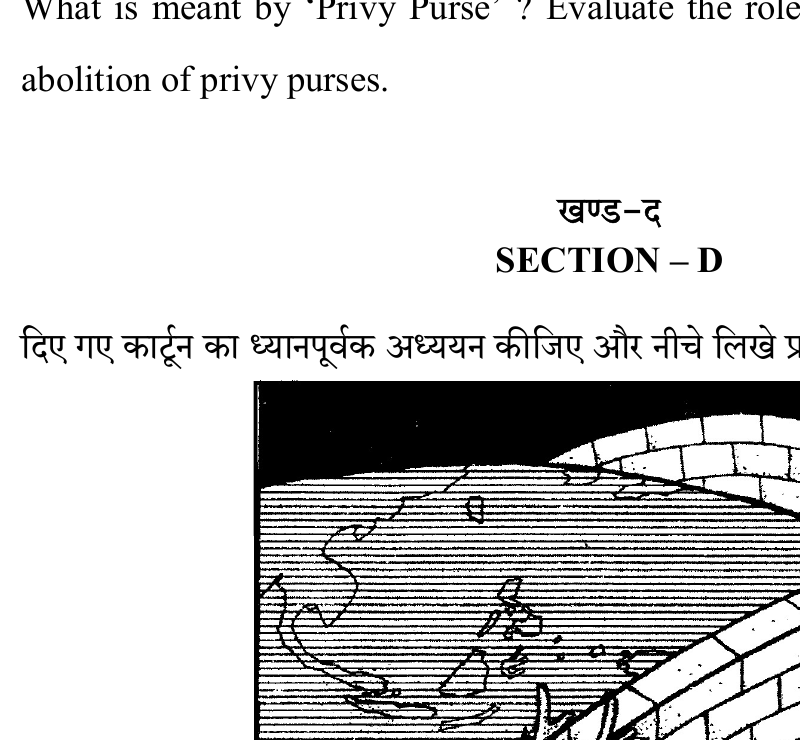
(i) Which part of this cartoon is related to China? (1)
(ii) Assess the strength of China on the basis of the cartoon. (2)
(iii) "China may be the next superpower in the world." Justify the statement with two arguments. (2)
(For Visually Impaired Candidates: 20.1 In your opinion, where does China stand as an economic power? 20.2 Assess any two conditions which make the United States of America, a super power. 20.3 "China may be the next superpower in the world." Justify the statement with two arguments.)
Solution
(i) The Great Wall of China and the dragon breaking out of it.
(ii) China has been the fastest-growing economy since its reforms of 1978; its large population, land mass, resources, regional location and political influence add to its power; it is projected to overtake the US as the world's largest economy (by about 2040).
(iii) Any two: (a) its economic growth makes it the engine of East Asian growth, giving it great influence in regional affairs; (b) it is the most important destination for foreign direct investment and has huge foreign exchange reserves to invest abroad; (c) its entry into the WTO (2001) lets it shape the future world economic order; its military is also expanding. VI: 20.1 China is the fastest-growing major economy, likely to become the largest; 20.2 US hard power (military dominance), structural power (economic dominance) and soft power (cultural and ideological influence); 20.3 as (iii).
6 marks: long answer
Explain any four factors that led Japan to emerge as a new centre of power even after the atomic bombings.
Solution
(i) Technology: Japan is a leader in high-technology products (Sony, Panasonic, Canon, Suzuki, Honda, Toyota, Mazda). (ii) Economic strength: despite few natural resources and importing most raw materials, it became the world's third/fourth largest economy; it joined the OECD in 1964. (iii) Global role: it is the second largest contributor to the UN budget and a G-7 member; (iv) its military expenditure is among the highest in the world despite Article 9 of its constitution renouncing war; and its stable democracy and skilled workforce.
Explain any four policies adopted by China to accelerate its economic growth.
Solution
(i) Open-door policy (1978) under Deng Xiaoping: foreign capital and technology invited. (ii) Privatisation of agriculture (1982) and of industry (1998), step by step rather than shock therapy. (iii) Special Economic Zones with trade barriers removed. (iv) Joining the WTO in 2001 and attracting the largest foreign direct investment; state control kept while markets grew.
Analyse four decisions of the Chinese leadership that led to the rise of China's economy.
Solution
(i) End of isolation: relations with the US (1972) ended China's political and economic isolation. (ii) Four modernisations (agriculture, industry, science and technology, military) announced by Zhou Enlai (1973). (iii) Open-door policy (1978) under Deng Xiaoping: foreign investment and technology; Special Economic Zones. (iv) Step-by-step privatisation: agriculture (1982), industry (1998), not shock therapy; trade barriers removed in SEZs; it joined the WTO (2001).
Analyse four reasons that make the EU an influential regional organisation.
Solution
(i) Economic power: one of the biggest economies, with the euro as a rival to the dollar; its share of world trade is three times that of the US. (ii) Political and diplomatic influence: France is a permanent member of the UNSC, and some EU members are non-permanent members; it influences US policies and has diplomatic, economic and trade ties with China and others. (iii) Military strength: its combined armed forces are the second largest in the world, with the second highest defence spending; two members (Britain until 2020, France) have nuclear weapons. (iv) Supranational organisation: common flag, anthem, currency and institutions; it is a leader in technology, space and communications and in giving development aid.
Explain two contentious issues between China and India and suggest two measures to resolve them.
Solution
Issues: (i) Tibet: China's annexation (1950) and India's asylum to the Dalai Lama (1959). (ii) Boundary dispute: Aksai Chin and Arunachal Pradesh (NEFA), leading to the 1962 war and later standoffs; China's close ties with Pakistan are another irritant. Measures: (i) Resolve border issues through negotiation and bilateral talks between diplomats and special representatives, with confidence-building measures. (ii) Increase trade, economic collaboration, transport and communication links and people-to-people contact (tourism, students) to build trust; cooperate in BRICS and SCO.
"ASEAN took steps to establish an ASEAN Community on three pillars." Explain these pillars.
Solution
In 2003 ASEAN set up an ASEAN Community with three pillars: (i) ASEAN Security Community: based on the conviction that territorial disputes should not escalate into armed confrontation; members agreed to uphold peace, neutrality, cooperation and non-interference; the ASEAN Regional Forum (1994) coordinates security and foreign policy. (ii) ASEAN Economic Community: aims to create a common market and production base and aid social and economic development; it is building a free trade area for investment, labour and services. (iii) ASEAN Socio-Cultural Community: promotes cooperation in culture, education, health and identity, building a caring and sharing community.
Explain any three factors that make the European Union an effective regional organisation.
Solution
(i) Economic influence: the second (by some measures the largest) economy in the world; its currency, the euro, can threaten the dollar; its share of world trade is three times that of the US. (ii) Political and diplomatic influence: France is a permanent member of the UNSC; the EU uses diplomacy, economic investment and negotiation (e.g. dialogue with China on human rights and environment). (iii) Military and technology: its combined armed forces are the second largest, with the second highest defence spending; France has nuclear weapons; it is the world's second most important source of space and communications technology.
Explain any three changes made in China that raised the growth of its economy.
Solution
(i) China ended its isolation by establishing relations with the US in 1972. (ii) Premier Zhou Enlai's "four modernisations" (agriculture, industry, science and technology, military), 1973. (iii) Deng Xiaoping's open-door policy (1978): foreign capital and technology; privatisation of agriculture (1982) and industry (1998); SEZs; WTO membership (2001). These step-by-step changes made it the fastest-growing economy.
"ASEAN is rapidly growing into a very important regional organisation." Justify.
Analyse four objectives of establishing regional organisations.
While China's economy has improved dramatically, why has not everyone received the benefits of reforms? Three reasons.
Describe the evolution of the EU from an economic union to an increasingly political one.
Evaluate the strength of European Union as the most effective regional organisation on the basis of any three facts.
Explain any four steps taken by China to develop its economy. (4 × 1½ = 6)
Explain any four factors that make the European Union a strong organization. (4 × 1½ = 6)
Get every solution for all chapters
- Every board question of every chapter, each fully solved the way the board gives marks
- 16 complete board papers, each followed by its solutions
- Weightage and most-asked topics for every chapter
- Instant PDF download, colour and black & white print copies
Revising the chapter first? Complete Political Science Notes for Class 12 (CBSE 2026-27) →
What you get in the pack
- CBSE Class 12 Political Science board papers 2016 to 2026 (all 143 sets, main and compartment; 16 in full)
- All 15 chapters and 16 full board papers complete
- Part A: all 15 chapters, questions sorted chapter-wise and by marks
- Year-wise weightage table and most-asked topics for every chapter
- Part B: each full board paper followed by its complete solutions
- Point-wise answers; passage, cartoon and map questions with images
- Questions on chapters out of the board syllabus are flagged
All chapters in this pack
- PYQ Ch 1 The End of Bipolarity
- PYQ Ch 2 Contemporary Centres of Power
- PYQ Ch 3 Contemporary South Asia
- PYQ Ch 4 International Organisations
- PYQ Ch 5 Security in the Contemporary World
- PYQ Ch 6 Environment and Natural Resources
- PYQ Ch 7 Globalisation
- PYQ Ch 8 Challenges of Nation-Building
- PYQ Ch 9 Era of One-Party Dominance
- PYQ Ch 10 Politics of Planned Development
- PYQ Ch 11 India's External Relations
- PYQ Ch 12 Challenges to and Restoration of the Congress System
- PYQ Ch 13 The Crisis of Democratic Order
- PYQ Ch 14 Regional Aspirations
- PYQ Ch 15 Recent Developments in Indian Politics
- Board Paper 2026 Set 59-1-1 with Solutions
- Board Paper 2026 Set 59-1-2 with Solutions
- Board Paper 2026 Set 59-1-3 with Solutions
- Board Paper 2026 Set 59-2-1 with Solutions
- Board Paper 2025 Set 59-1-1 with Solutions
- Board Paper 2025 Set 59-2-1 with Solutions
- Board Paper 2025 Set 59-4-1 with Solutions
- Board Paper 2024 Set 59-1-1 with Solutions
- Board Paper 2024 Set 59-2-1 with Solutions
- Board Paper 2023 Set 59-1-1 with Solutions
- Board Paper 2022 Term 2 Set 59-1-1 with Solutions
- Board Paper 2020 Set 59-1-1 with Solutions
- Board Paper 2019 Set 59-1-2 with Solutions
- Board Paper 2018 Set 59-1 with Solutions
- Board Paper 2017 Set 59-1 with Solutions
- Board Paper 2016 Set 59-1 with Solutions