
Recent Developments in Indian Politics: Class 12 PYQs 2019–2026 with solutions
All 63 CBSE board questions asked from Recent Developments in Indian Politics in 19 board papers, with the year, set and marks of each. 32 are solved free below. The Class 12 Political Science PYQ Book: Solved Board Papers 2016-2026 (CBSE) has every solution, all chapters and 16 full board papers.

Recent Developments in Indian Politics: board weightage
Board weightage 2019–2026
| Year | 2019 | 2022 | 2023 | 2024 | 2025 | 2026 |
|---|---|---|---|---|---|---|
| Questions | 2 | 3 | 4 | 16 | 21 | 19 |
| Marks | 7 | 14 | 9 | 62 | 74 | 62 |
Most asked topics
65 questions from 19 papers. Repeated questions are shown once with every year they were asked.
Jump to: 1 mark2 marks4 marks6 marks
1 mark: MCQ and Assertion–Reason
Arrange the following events in chronological order:
(i) Assassination of former Prime Minister Rajiv Gandhi.
(ii) Formation of the First Non-Congress coalition government at the centre.
(iii) Sixteenth Lok Sabha elections.
(iv) The Mandal Commission gave its recommendations.
Solution
(C) iv, ii, i, iii: Mandal Commission report (1980) → National Front coalition government (1989; the board treats it as the first non-Congress coalition, though the first non-Congress government was the Janata Party in 1977) → Rajiv Gandhi assassinated (May 1991) → 16th Lok Sabha election (2014).
Identify the political party which has had a continuous growth in its Lok Sabha seats in the General Elections from 2009 to 2019.
Solution
(B) BJP: 116 seats (2009) → 282 (2014) → 303 (2019).
Which was the last state toured by Rajiv Gandhi for his election campaign in May 1991? (A) Tamil Nadu (B) Karnataka (C) Kerala (D) Andhra Pradesh
Solution
(A) Tamil Nadu: he was assassinated at Sriperumbudur on 21 May 1991 by an LTTE suicide bomber.
The alliance that has formed the government at the Centre the maximum number of times: (A) UPA (B) National Front (C) United Front (D) NDA
Solution
(D) NDA: 1998, 1999, 2014, 2019 and 2024. The UPA governed twice (2004, 2009); the National Front (1989) and United Front (1996) once each.
Which party/alliance decided to implement the Mandal Commission recommendations? (A) INC (B) National Front (C) United Front (D) Janata Party
Solution
(B) National Front government of V.P. Singh (August 1990).
The party with Gandhian socialism along with cultural nationalism as its ideology: (A) Socialist Party (B) Janata Party (C) National Conference (D) BJP
Solution
(D) Bharatiya Janata Party (founded 1980), which adopted "Gandhian Socialism" initially and later "cultural nationalism" (Hindutva).
The BJP-led alliance of 2019 is known as: (A) UPA (B) United Front (C) NDA (D) Democratic Coalition
Solution
(C) National Democratic Alliance.
Who led the central government after the 1999 Lok Sabha elections? (A) Narasimha Rao (B) Atal Bihari Vajpayee (C) Manmohan Singh (D) Deve Gowda
Solution
(B) Atal Bihari Vajpayee (NDA government, 1999–2004).
During the tenure of which Prime Minister were the new economic reforms started?
Solution
(C) Rajiv Gandhi, as per the board key (following NCERT, which says the changes in economic policy began under him). Note: the major New Economic Policy of 1991 was launched by P.V. Narasimha Rao's government with Manmohan Singh as Finance Minister.
Choose the correct name of the alliance made by the Indian National Congress in the elections of 2004.
The alliance formed by the Congress in the 2004 elections: (A) NDA (B) UPA (C) National Front (D) United Front
Which party embraced "Gandhian socialism" as its ideology? (A) BJP (B) CPI (C) National Conference (D) Socialist Party
Which Prime Minister radically changed the direction of the Indian economy? (A) Vajpayee (B) Chandra Shekhar (C) V.P. Singh (D) P.V. Narasimha Rao
The Prime Minister who led the National Front government in 1989: (A) Chandra Shekhar (B) V.P. Singh (C) Narasimha Rao (D) Deve Gowda
Arrange the following Prime Ministers of India in the chronological order as per their period of rule:
(i) H.D. Deve Gowda
(ii) Chandra Shekhar
(iii) P.V. Narsimha Rao
(iv) V.P. Singh
Match List-I with the List-II and choose the correct option:
| List-I | List-II |
|---|---|
| 1. Clear majority in the 17th Lok Sabha | (i) National Front Government |
| 2. Implementation of the recommendations of the Mandal Commission | (ii) United Front Government |
| 3. Prime Minister H.D. Deve Gowda | (iii) United Progressive Alliance Government |
| 4. Prime Minister Manmohan Singh | (iv) National Democratic Alliance |
Who among the following was the first Prime Minster to start economic reforms in India?
Explain the meaning of 'Coalition Government'.
2 marks: very short answer
Analyse the main reason for the formation of coalition governments after 1989.
Solution
After 1989 the dominance of the Congress ended and no single party could win a majority in the Lok Sabha because votes were split among national, regional and caste-based parties (Mandal politics). To form a stable government and avoid repeated mid-term elections, parties had to combine: National Front (1989), United Front (1996), NDA (1998), UPA (2004).
Analyse two factors that changed the nature of coalition governments at the Centre after 2014.
Solution
(i) A single party won a clear majority: the BJP alone won 282 seats (2014) and 303 (2019), so the NDA became a coalition dominated by one party rather than dependent on partners ("surplus majority coalition"). (ii) Regional parties remained partners in the NDA and shared power, but their bargaining power reduced; in 2024 the BJP (240 seats) again depended more on allies.
Analyse two major problems of Indian politics from 1989 to 1999.
Solution
(i) Political instability: no party won a majority; there were frequent coalition governments and elections in 1989, 1991, 1996, 1998 and 1999. (ii) Social tensions: the Mandal agitation over OBC reservations (1990) and the Ayodhya dispute (demolition of the Babri Masjid, December 1992) led to communal riots; the economic crisis of 1991 and the assassination of Rajiv Gandhi (1991) added to the problems.
Explain two immediate consequences of implementing the Mandal Commission recommendations in August 1990.
Solution
(i) Violent anti-Mandal protests broke out in many parts of north India, mainly by upper-caste students; some even attempted self-immolation. (ii) The decision was challenged in the Supreme Court (Indira Sawhney case), which upheld it in 1992 (with a creamy-layer exclusion); politically, OBC-based parties grew stronger and the issue reshaped Indian politics ("Mandal vs Mandir").
Name any four Prime Ministers who ruled for less than a year.
Solution
(i) V.P. Singh (December 1989 – November 1990), (ii) Chandra Shekhar (1990–91), (iii) H.D. Deve Gowda (1996–97), (iv) I.K. Gujral (1997–98); also Charan Singh (1979–80) and Atal Bihari Vajpayee (13 days in 1996).
Explain any two changes that came in Indian politics after 2014 as compared to the period 1989 to 2014.
Solution
(i) Single-party majority: from 1989 to 2014 no party won a majority and coalitions were led by parties dependent on allies; in 2014 and 2019 the BJP alone won a majority, ending the era of coalition dependence (the NDA became a "surplus majority coalition"). (ii) Some describe a new one-party dominance ("BJP system") with politics focused on development and governance, while the Congress declined sharply; regional parties remained important but with reduced bargaining power.
Assess two advantages of coalition governments at the Centre.
Highlight two recommendations of the Mandal Commission.
Explain two advantages of coalition governments.
In which year was the first coalition government formed in India and why?
Why did the first coalition government at the Centre in India not prove to be stable? Analyse the major reason.
4 marks: case-based / source-based
Explain any four differences between governments formed after the first three general elections and the coalition governments after 1989.
Solution
(i) Single-party Congress governments vs multi-party coalitions. (ii) Stable governments that completed full terms vs often unstable governments (e.g. 1989–91, 1996–98). (iii) Dominance of national parties vs a key role for regional parties. (iv) Policies decided by one party vs a common minimum programme negotiated by allies, with more consultation.
Explain any four advantages of coalition governments in Indian politics.
Solution
(i) Wider representation of regions, castes and interests. (ii) Consensus through a common minimum programme, so decisions are more balanced. (iii) Checks arbitrary power of a single party. (iv) Strengthens federalism, as regional parties share power at the Centre.
Passage: the defeat of the Congress in 1989 ended its dominance, without another party taking its place; an era of multi-party coalitions began. (i) In which year did the Congress first face a setback and lose power in some states? (A) 1962 (B) 1967 (C) 1971 (D) 1977 (ii) Which party/alliance formed the first coalition government in December 1989? (A) National Conference (B) National Front (C) INC (D) United Front (iii) Which regional party never formed a government in any state? (A) BSP (B) DMK (C) Bharatiya Kranti Dal (D) Shiromani Akali Dal (iv) The largest party in the Lok Sabha after the 1989 elections: (A) National Front (B) INC (C) BJP (D) Janata Party
Solution
(i) (B) 1967. (ii) (B) National Front (V.P. Singh). (iii) (C) Bharatiya Kranti Dal, as per the board key. (Note: Charan Singh led a coalition government in UP in 1967 after leaving the Congress; the BKD itself was formed afterwards.) (iv) (B) Indian National Congress (197 seats), though it did not form the government.
Explain two reasons for the long phase of coalition politics since 1989.
Solution
(i) No single party got a majority: the Congress was the largest party in 1989 but could not form a government; the National Front formed a coalition. (ii) Decline of Congress dominance and the rise of regional parties and parties representing Dalits and backward castes split votes, making coalitions necessary.
Explain the role of OBCs in Indian politics.
Solution
(i) Support for the Congress among many backward classes declined, creating space for non-Congress parties based on OBC support. (ii) This found national expression in the Janata Party government (1977); parties like the Bharatiya Kranti Dal and Samyukta Socialist Party had a strong OBC base. (iii) In the 1980s the Janata Dal brought together groups with OBC support. (iv) The Mandal implementation (1990) shaped OBC politics; parties like the SP, RJD and JD(U) emerged, and OBCs gained greater share in power.
Map of India, states A–D: (i) state where Rajiv Gandhi was assassinated (ii) state where Karpoori Thakur was Chief Minister (iii) state where the UPA won most Lok Sabha seats in 2004 (iv) state where the BSP achieved a breakthrough in 1989 and 1991. [VI: (25.4) the alliance that formed the government in 1989]
Solution
(i) D – Tamil Nadu (Sriperumbudur). (ii) A – Bihar. (iii) B – Andhra Pradesh (as per the board key). (iv) C – Uttar Pradesh. VI: Tamil Nadu; Bihar; Uttar Pradesh; National Front.
Explain two developments in Indian politics after 1989 that had a long-lasting impact.
The given cartoon is related to the era of coalition governments. Study the cartoon and answer the questions that follow:
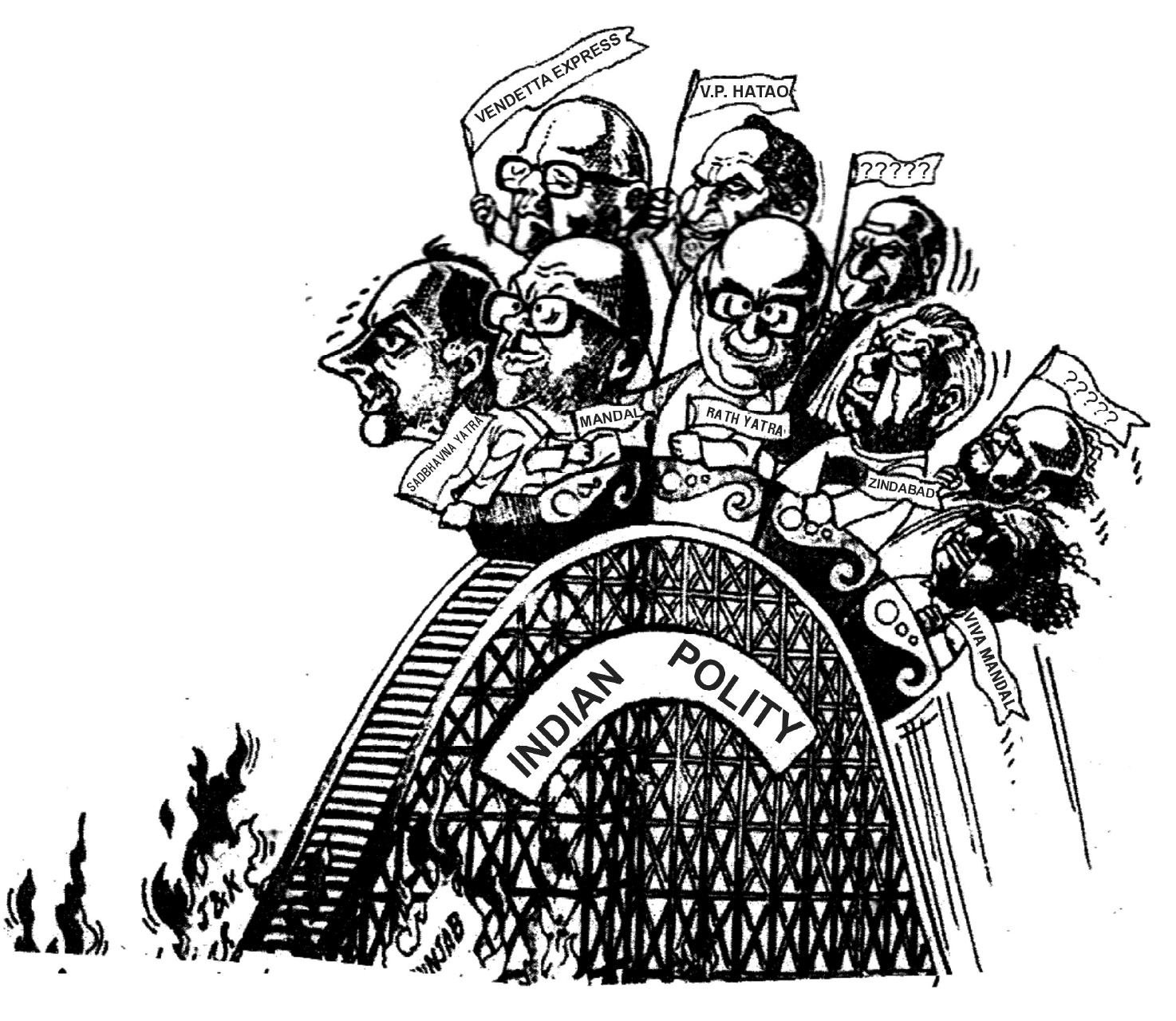
(i) Identify and name the leader who is holding the placard 'Rath Yatra'. (1)
(ii) Which political party organised the 'Rath Yatra'? (1)
(iii) Identify and name any two Prime Ministers shown in the cartoon who led the coalition governments. (2)
(For Visually Impaired Candidates, in lieu of Q26: 26.1 Which coalition government decided to implement the recommendations of the Mandal Commission and why? 26.2 Name the first Non-Congress Prime Minister of India. 26.3 Name the Prime Minister who headed a coalition government from May 1996 to June 1996.)
How did coalition governments prove a boon for democracy in India?
Why were people in favour of a stable government at the Centre in 2014? Two reasons.
Passage: the rise of Dalit political organisations in the 1980s; BAMCEF formed in 1978 (not an ordinary trade union; it favoured political power to the "bahujan": SC, ST, OBC and minorities), from which came the DS4 and later the BSP. (i) Full form of BAMCEF: (A) Bahujan and Minority Communities Employees Federation (B) Bahujan and Minority Communities Employees Foundation (C) Backward and Minority Communities Employees Federation (D) Backward and Minority Communities Employees Foundation (ii) Year the BSP was formed: (A) 1981 (B) 1984 (C) 1989 (D) 1991 (iii) Founder of the BSP: (A) B.R. Ambedkar (B) Mayawati (C) Mulayam Singh (D) Kanshi Ram (iv) State of the BSP's first government: (A) Punjab (B) Haryana (C) UP (D) Rajasthan
In the given political outline map of India, four States/Union Territories have been marked as A, B, C and D. Identify these States/Union Territories on the basis of the information given below and write their correct names in your answer-book along with the respective serial number of the information used and the concerned alphabets given in the map:
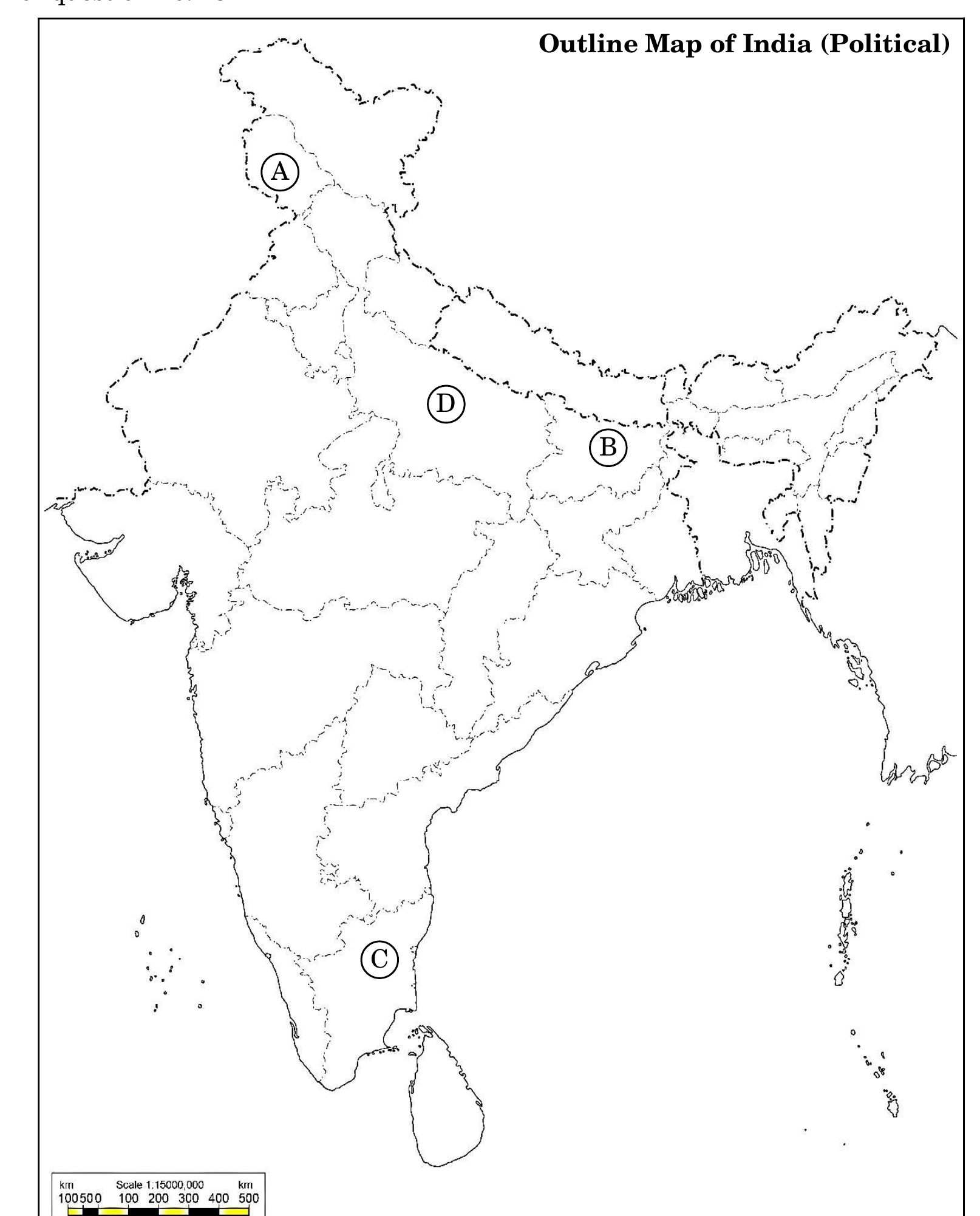
(i) The State to which the Chairman of the Mandal Commission, B.P. Mandal, belonged.
(ii) The State where Bahujan Samaj Party formed its first government.
(iii) The Union Territory which was constituted in 2019.
(iv) The State from which the political party Dravida Munnetra Kazhagam originated.
(For Visually Impaired Candidates, in lieu of Q25: 25.1 Name the founder leader of the Bahujan Samaj Party. 25.2 Who was the first Non-Congress Prime Minister of India? 25.3 B.P. Mandal, the chairman of Mandal Commission belonged to which State of India? 25.4 Which Union Territory was constituted in 2019?)
6 marks: long answer
Describe any four factors responsible for the rise of coalition governments at the centre after the year 1989.
Solution
(i) Decline of the Congress: after 1989 the Congress lost its dominant position and no party won a majority. (ii) Rise of regional parties that won many seats and became necessary partners. (iii) Mandal politics: the rise of OBC-based parties (e.g. Janata Dal, SP, RJD) after 1990 fragmented votes. (iv) Rise of the BJP and new issues (Ayodhya) changed alignments, leading to coalitions such as the National Front (1989), United Front (1996), NDA (1998) and UPA (2004).
Describe any four issues on which a broad agreement has emerged among most political parties.
Solution
(i) New economic policy: most parties support liberalisation. (ii) Acceptance of the political and social claims of backward castes, including reservations in education and jobs for OBCs. (iii) Acceptance of the role of state-level parties in national governance. (iv) Pragmatism over ideology: alliances are formed for power without ideological agreement.
How did the Mandal Commission recommendations try to solve the problems of OBCs?
Solution
(i) The Second Backward Classes Commission (Mandal Commission, 1978, chaired by B.P. Mandal) was set up by the Janata government to investigate the extent of educational and social backwardness and recommend ways of identifying backward classes. (ii) In 1980 it found that backward classes had very low presence in educational institutions and public employment. (iii) It recommended 27% reservation for OBCs in educational institutions and government jobs, plus land reform and other measures. (iv) The V.P. Singh government (August 1990) implemented reservation in central government jobs; after protests, the Supreme Court upheld it (Indira Sawhney case, 1992). This gave OBCs representation and a political identity, leading to their rise in politics.
Examine three grounds on which regional parties support coalition governments at the Centre.
Solution
(i) To avoid instability and mid-term elections and to share power at the Centre. (ii) To get their regional demands and interests heard and fulfilled at the national level. (iii) Agreement on broad issues like the new economic policies and power-sharing despite ideological differences.
State four major political happenings of the 1990s with a widespread impact.
Solution
(i) End of Congress dominance and the start of the era of coalitions (1989 onwards). (ii) Mandal issue: implementation of OBC reservations (1990) and the rise of backward-class politics. (iii) New economic policy (1991): liberalisation and structural adjustment under Narasimha Rao. (iv) Ayodhya dispute: demolition of the Babri Masjid (December 1992), the rise of the BJP and communal tensions; also the assassination of Rajiv Gandhi (1991).
Describe four issues on which most parties broadly agree.
Solution
(i) Agreement on new economic policies. (ii) Acceptance of the political and social claims of backward castes. (iii) Acceptance of the role of state-level parties in governance. (iv) Emphasis on pragmatism rather than ideology and on alliances without ideological agreement.
Describe three major developments in Indian politics in the last decade of the 20th century.
Solution
(i) Decline of the Congress system and the era of coalitions (1989 onwards): National Front, United Front, NDA. (ii) Mandal issue: implementation of OBC reservation (1990) and the rise of backward-class politics. (iii) New economic policy (1991): liberalisation and globalisation. (iv) Ayodhya dispute and the demolition of the Babri Masjid (1992), with communal riots and the rise of the BJP; and the assassination of Rajiv Gandhi (1991).
Describe three recommendations of the Mandal Commission to solve the problems of OBCs.
Solution
The Mandal Commission (1979–80) found OBCs had very low presence in education and public jobs and recommended: (i) 27% reservation of seats in educational institutions for OBCs; (ii) 27% reservation in government jobs for OBCs; (iii) land reform and other measures to improve their condition and identify backward classes by social and educational criteria.
"On many crucial issues, a broad agreement has emerged among most political parties in India." Support the statement with any three examples.
Solution
(i) Agreement on new economic policies: most parties support liberalisation, though they differ on details. (ii) Acceptance of the political and social claims of backward castes: all parties support reservations in education and jobs and ensure OBC share in power. (iii) Acceptance of the role of state-level parties in national governance: the distinction between state and national parties matters less. (iv) Pragmatism over ideology: alliances without ideological agreement (e.g. NDA, UPA).
"The decision of the National Front government to implement the recommendations of the Mandal Commission helped in shaping the politics of Other Backward Classes (OBCs)." Support the statement with three examples or arguments.
Solution
(i) OBC communities became more aware of their identity and were mobilised in politics. (ii) Many parties emerged that sought better opportunities for OBCs in education and employment, e.g. the Samajwadi Party, RJD, Janata Dal; the BSP built Dalit-OBC support. (iii) It raised the question of OBC share in power and adequate representation in administration; all parties began to give OBCs tickets and posts, changing the social base of leadership in north India.
Describe four political developments in India between 1988 and 1993.
Solution
(i) Defeat of the Congress in 1989 and the end of its dominance; the National Front government of V.P. Singh. (ii) Implementation of the Mandal report (1990) and the rise of OBC politics. (iii) New economic policy (1991), liberalisation under Narasimha Rao. (iv) Assassination of Rajiv Gandhi (May 1991); the Congress returned as the largest party; and the demolition of the Babri Masjid (December 1992), followed by riots.
Describe four consequences of the era of coalition governments (1989–2004).
Describe four new trends in Indian politics in the 1990s.
Describe four developments after 1989 with long-lasting impact on Indian politics.
Describe four major developments in Indian politics since 1989.
Describe three issues on which a general consensus has emerged among most parties.
Explain three issues on which a consensus has emerged among most parties.
Explain three benefits of coalition governments since 1989.
"Amid severe competition and conflicts after 1989, a consensus emerged among most parties." Explain three points of consensus.
Highlight any three areas where consensus has emerged among most of the political parties in India after 1989.
Highlight any two major changes that took place in Indian politics after 2014 and also name any two welfare programmes that made women the real beneficiaries. (2 × 2 + 2 × 1 = 6)
Assess any three benefits of the coalition governments in India since 1989.
Get every solution for all chapters
- Every board question of every chapter, each fully solved the way the board gives marks
- 16 complete board papers, each followed by its solutions
- Weightage and most-asked topics for every chapter
- Instant PDF download, colour and black & white print copies
Revising the chapter first? Complete Political Science Notes for Class 12 (CBSE 2026-27) →
What you get in the pack
- CBSE Class 12 Political Science board papers 2016 to 2026 (all 143 sets, main and compartment; 16 in full)
- All 15 chapters and 16 full board papers complete
- Part A: all 15 chapters, questions sorted chapter-wise and by marks
- Year-wise weightage table and most-asked topics for every chapter
- Part B: each full board paper followed by its complete solutions
- Point-wise answers; passage, cartoon and map questions with images
- Questions on chapters out of the board syllabus are flagged
All chapters in this pack
- PYQ Ch 1 The End of Bipolarity
- PYQ Ch 2 Contemporary Centres of Power
- PYQ Ch 3 Contemporary South Asia
- PYQ Ch 4 International Organisations
- PYQ Ch 5 Security in the Contemporary World
- PYQ Ch 6 Environment and Natural Resources
- PYQ Ch 7 Globalisation
- PYQ Ch 8 Challenges of Nation-Building
- PYQ Ch 9 Era of One-Party Dominance
- PYQ Ch 10 Politics of Planned Development
- PYQ Ch 11 India's External Relations
- PYQ Ch 12 Challenges to and Restoration of the Congress System
- PYQ Ch 13 The Crisis of Democratic Order
- PYQ Ch 14 Regional Aspirations
- PYQ Ch 15 Recent Developments in Indian Politics
- Board Paper 2026 Set 59-1-1 with Solutions
- Board Paper 2026 Set 59-1-2 with Solutions
- Board Paper 2026 Set 59-1-3 with Solutions
- Board Paper 2026 Set 59-2-1 with Solutions
- Board Paper 2025 Set 59-1-1 with Solutions
- Board Paper 2025 Set 59-2-1 with Solutions
- Board Paper 2025 Set 59-4-1 with Solutions
- Board Paper 2024 Set 59-1-1 with Solutions
- Board Paper 2024 Set 59-2-1 with Solutions
- Board Paper 2023 Set 59-1-1 with Solutions
- Board Paper 2022 Term 2 Set 59-1-1 with Solutions
- Board Paper 2020 Set 59-1-1 with Solutions
- Board Paper 2019 Set 59-1-2 with Solutions
- Board Paper 2018 Set 59-1 with Solutions
- Board Paper 2017 Set 59-1 with Solutions
- Board Paper 2016 Set 59-1 with Solutions