
CBSE Class 12 Political Science Question Paper 2026 (59/1/1) with Solutions
The complete CBSE Class 12 Political Science board paper of 2026, Q.P. code 59/1/1: all 30 questions exactly as set, with marks. 18 solutions are free below. The Class 12 Political Science PYQ Book: Solved Board Papers 2016-2026 (CBSE) solves all 16 papers in full and sorts every question chapter-wise.

Question paper
Jump to: Question paperSolutions
2026 · Q.P. Code 59/1/1
Maximum marks: 80
Section A: Multiple choice questions (1 mark each)
Given below are two statements:
Statement-I: The economic policies implemented by China helped to break the stagnation of its economy.
Statement-II: Economic development of China also increased environmental degradation and corruption.
In the light of above statements, choose the correct answer from the options given below:
Which one of the following is the reason that led to the formation of Andhra state in 1952?
Which measure was adopted by China to solve its economic crisis?
Identify the State with which the phrase 'Aaya Ram, Gaya Ram' is related to.
Given below are two statements marked as Assertion (A) and Reason (R). Read these statements carefully and choose the correct answer from the options (A), (B), (C) and (D) given below:
Assertion (A): All over the world, the old 'welfare state' is getting more importance.
Reason (R): Due to globalisation, the state withdraws from many of its earlier welfare functions and the market has become the prime determinant of economic and social priorities.
Which one of the following statements is NOT correct about the princely states?
Match List-I with List-II correctly and choose the correct answer from the codes given below:
| List-I | List-II |
|---|---|
| (a) Violation of Human Rights | (i) Britain |
| (b) 'Mad-Cow' disease | (ii) Chemical weapons convention |
| (c) Disarmament Treaty | (iii) World Trade Centre in America |
| (d) 9/11 terrorist attack | (iv) Iraq's invasion of Kuwait |
Arrange the following events in chronological order:
(i) Assassination of former Prime Minister Rajiv Gandhi.
(ii) Formation of the First Non-Congress coalition government at the centre.
(iii) Sixteenth Lok Sabha elections.
(iv) The Mandal Commission gave its recommendations.
Choose the name of the Prime Minister who abolished 'Privy Purse'.
Choose the statement that best describes the concept of globalisation.
Identify the political party which has had a continuous growth in its Lok Sabha seats in the General Elections from 2009 to 2019.
Nuclear non-proliferation Treaty refers to:
Section B: Short answer (2 marks each)
Highlight any two objectives of establishing Planning Commission.
How does the natural insularity of South Asian region determine its cultural distinctiveness? Explain.
Explain any two human activities responsible for degradation of environment.
On what grounds can globalisation be considered a multi-dimensional concepts? Explain with example.
Describe any two challenges faced by India during the term of Prime Minister Lal Bahadur Shastri.
"The demands of various regional aspirations during 1980s was a step towards nation building." Support the statement with argument.
Section C: Short answer (4 marks each)
Highlight any two differences between the ideologies of Socialist party and Communist party of India.
Highlight any two traditional measures which may be used by different countries to maintain their national security.
Describe any four initiatives taken across the world to create awareness about the protection of the environment.
(a) "India has accepted expressions of regional aspirations to strengthen the national integrity." Support the statement with two examples.
(b) Do you agree that the Assam accord was successful in establishing peace and stability in the State? Support your answer with any two arguments.
(a) Analyse the 'ASEAN way' as a unique initiative of promoting peace in South-east Asian Countries.
(b) Determine the contribution of 'ASEAN security community' in its promotion of economic progress.
Section D: Passage, map and cartoon based (4 marks each)
Read the passage given below carefully and answer the questions that follow:
The South Asian Association for Regional Co-operation (SAARC) is a major regional initiative by the South Asian states to evolve co-operation through multilateral means. It began in 1985. Unfortunately due to persisting political differences, SAARC has not had much success. SAARC members signed the South Asian Free Trade Agreement (SAFTA) in 2002 which promised the formation of a free trade zone for the whole of South Asia.
(i) Which one of the following South Asian countries is not a founder member of South Asian Association for Regional Co-operation (SAARC)? (A) Nepal (B) Bhutan (C) Afghanistan (D) Bangladesh
(ii) The external power that affects the South Asian Countries the most is: (A) United States of America (B) Russia (C) France (D) Britain
(iii) The major objective of South Asian Association for Regional Co-operation is – (A) to become a contemporary centre of power in the World. (B) to establish a common currency for the regional organisation for its economic development. (C) to solve all regional conflicts without interference of external powers. (D) to co-operate member states for economic growth, social progress and cultural development through multilateral means.
(iv) Which one of the following is NOT a core objective of South Asian Free Trade Agreement (SAFTA)? (A) To establish a common currency for SAARC nations. (B) To promote and enhance mutual trade and economic co-operation. (C) To reduce custom duties and non-tariff barriers. (D) To create a free trade area among member states.
Study the given cartoon carefully and answer the questions that follow:
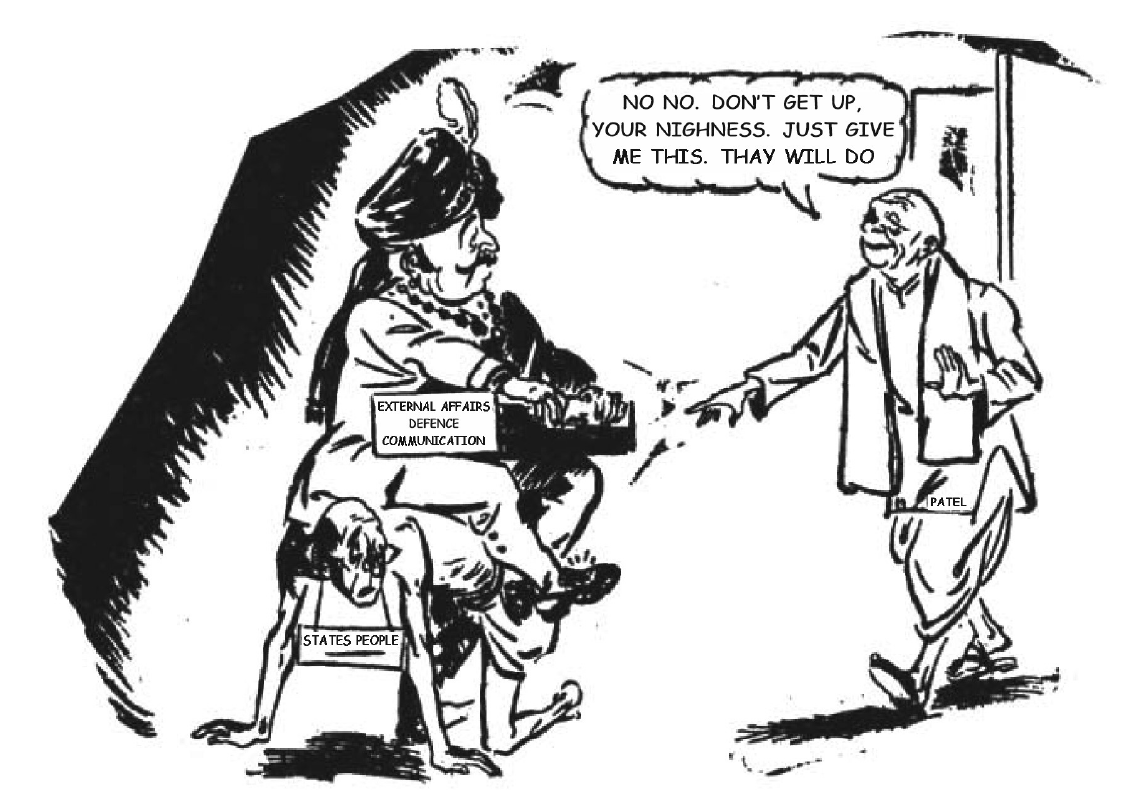
(i) Name the leader talking to the Prince in this cartoon. (1)
(ii) What does the Prince sitting on the back of a poor man indicate? (1)
(iii) What message is being conveyed by the cartoon? (2)
(For Visually Impaired Candidates, in lieu of Q25: (i) Name the speech given by Jawaharlal Nehru at the hour of midnight on 14-15 August 1947. (ii) Name the first Deputy Prime Minister of India. (iii) Explain the two nation theory.)
In the given political outline map of India, four states have been marked as A, B, C and D. Identify these on the basis of the information given below and write their correct names in your answer book along with their respective serial number of the information used and the concerned alphabet:
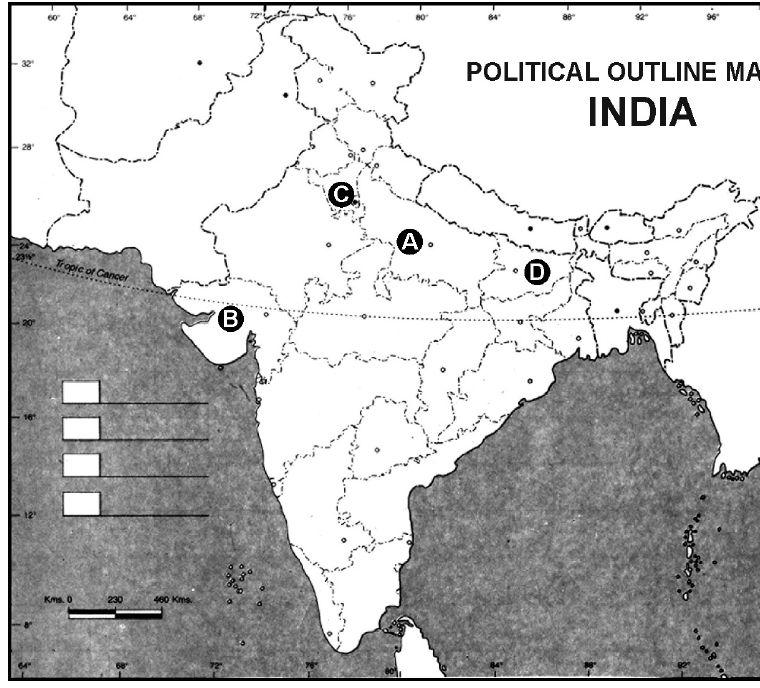
(i) The state related to student movement against inflation and corruption in 1974.
(ii) The state related to the farmer's leader Chaudhary Charan Singh.
(iii) The state related to Congress leader Jag Jeevan Ram.
(iv) The state where Congress could not win even a single Lok Sabha seat in 1977 elections.
(For Visually Impaired Candidates, in lieu of Q26: (i) Write the name of first Prime Minister of Janta Party Government. (ii) In which year, was the National Emergency imposed in India by Indira Gandhi government? (iii) Name the leader who announced a nationwide Satyagraha at Ram Lila Maidan before the declaration of National Emergency. (iv) Name the political party that won the Lok Sabha Election in 1977.)
Section E: Long answer (6 marks each)
(a) Explain the composition and one function of any three organs of the United Nations. (3 + 3 = 6)
(b) Name any three agencies of the United Nations and explain one function of each. (3 + 3 = 6)
(a) Analyse any three reasons for the disintegration of the Soviet Union.
(b) Examine any three consequences of the Shock therapy.
(a) "India's Foreign Policy has been successful in saving its 'National Interests'." Support the statement with three arguments.
(b) "India's Foreign Policy is as per the principles of International Peace and Security as laid down in Article 51 of the Indian Constitution." Justify the statement with three examples.
(a) Describe any four factors responsible for the rise of coalition governments at the centre after the year 1989.
(b) Describe any four issues on which a broad agreement has emerged among most political parties.
Solutions: CBSE 2026 · 59/1/1
(A) Both statements are true. China's open-door reforms from 1978 ended economic stagnation and made it the fastest-growing economy, but growth also brought rising unemployment, environmental degradation and corruption.
(C) China did not go for shock therapy; it opened its economy step by step: privatisation of agriculture (1982), then industry (1998), special economic zones and foreign investment.
(C) A is false, R is true. Under globalisation the old welfare state is giving way to a more minimalist state; the market, not the state, increasingly sets priorities.
(A) a-iv, b-i, c-ii, d-iii. Iraq's invasion of Kuwait (human rights abuses), mad-cow disease spread from Britain, the Chemical Weapons Convention (1992) is a disarmament treaty, and 9/11 struck the World Trade Centre, New York.
(D) Indira Gandhi. After the Supreme Court struck down her 1970 order, the 26th Amendment (1971) abolished privy purses.
(B) BJP: 116 seats (2009) → 282 (2014) → 303 (2019).
The Planning Commission (set up March 1950 by a simple resolution, PM as chairman) aimed at: (i) planned economic development by using national resources efficiently through Five Year Plans; (ii) poverty alleviation and social justice, reducing the concentration of wealth in a few hands and distributing material resources for the common good. (Also: industrialisation, modernisation, raising the standard of living.)
(i) Deforestation: cutting trees for agriculture, timber and urban growth destroys habitats and biodiversity and causes soil erosion. (ii) Burning fossil fuels and industrial pollution: emissions from factories and vehicles pollute air and raise greenhouse gases, causing global warming. (Also: overuse of resources, chemical fertilisers, rising population, urbanisation.)
(i) Economic and food crisis: the effects of the 1962 war with China, failed monsoons and drought caused a serious food shortage. (ii) War with Pakistan (1965): Shastri led the country during the war and signed the Tashkent Agreement (1966); he gave the slogan "Jai Jawan, Jai Kisan".
(i) Method: the Socialist Party believed in democratic socialism and peaceful, parliamentary means; the CPI initially believed the 1947 transfer of power was not true freedom and supported a violent uprising (Telangana), before abandoning violence and joining the 1952 elections. (ii) Ideological base: the socialists (Congress Socialist Party, formed 1934 inside the Congress, led by Narendra Dev, Lohia, JP) favoured a radical but democratic programme for workers and peasants against capitalists and landlords; the CPI (formed 1920s) was inspired by the Bolshevik revolution and Marxism-Leninism, with leaders like A.K. Gopalan, S.A. Dange and E.M.S. Namboodiripad.
(i) The Club of Rome published Limits to Growth (1972), warning of resource depletion as population grows. (ii) UNEP and other agencies held international conferences and promoted studies for a coordinated response. (iii) The Brundtland Report, Our Common Future (1987), warned that traditional patterns of development were not sustainable. (iv) The Earth Summit, Rio de Janeiro (1992) produced conventions on climate change, biodiversity, forestry and Agenda 21. (Also the Kyoto Protocol 1997, Paris Agreement.)
Yes: (i) under the 1985 accord with AASU, foreigners who entered Assam during and after the Bangladesh war were to be identified and deported, ending a six-year agitation; (ii) AASU and the Asom Gana Sangram Parishad formed the Asom Gana Parishad, which won power in 1985, bringing the movement into democratic politics. (One can also argue No: the immigration problem was not fully solved and the "outsider" issue remains alive in Assam.)
The Security Community rests on the conviction that territorial disputes should not escalate into armed conflict; by 2003 members had agreements to uphold peace, neutrality, cooperation and non-interference. This stable environment let ASEAN grow faster than the US, EU or Japan and move towards a free trade area for investment, labour and services; the US and China have negotiated FTAs with it.
(i) Sardar Vallabhbhai Patel. (ii) The rulers of princely states lived off and suppressed the ordinary, poor people of their states. (iii) Patel persuaded (and where needed pressured) the princes to sign the Instrument of Accession, freeing the people from princely rule and unifying the country. VI: (i) "Tryst with Destiny"; (ii) Sardar Vallabhbhai Patel; (iii) the Muslim League's theory that India consisted of two "people", Hindus and Muslims, so a separate country (Pakistan) was needed for Muslims.
(i) General Assembly: all 193 members, one vote each; important decisions by two-thirds majority. Function: approves the budget, elects non-permanent Security Council members and, on its recommendation, appoints the Secretary-General. (ii) Security Council: 15 members: 5 permanent with veto (US, UK, France, Russia, China) and 10 non-permanent elected for two years. Function: maintains international peace and security; its decisions bind all members; it can authorise sanctions or military action. (iii) International Court of Justice (The Hague): 15 judges elected for 9 years by the General Assembly and Security Council. Function: settles legal disputes between states and gives advisory opinions. (Also the Secretariat, headed by the Secretary-General, chosen for 5 years, runs day-to-day work; ECOSOC, 54 members elected for 3 years, coordinates economic and social work.)
(i) Political and economic weakness: the system became bureaucratic and authoritarian, with one-party rule, no freedom of speech and stagnation; it failed to meet people's aspirations. (ii) Huge military spending in the arms race and on satellite states in Eastern Europe and Afghanistan led to economic stagnation and severe consumer shortages; people learned the West was far ahead. (iii) Gorbachev's reforms (perestroika and glasnost) raised expectations; people wanted faster change while party members felt they were losing power, so the system collapsed. (iv) Rise of nationalism and the desire for sovereignty in republics like the Baltic states, Ukraine and Georgia was the most immediate cause.
(i) Through non-alignment India kept its sovereignty and an independent foreign policy, avoiding Cold War blocs. (ii) It obtained aid and support from both blocs: economic and technical help from the US and the USSR, and the Indo-Soviet Treaty (1971) during the Bangladesh war. (iii) It maintained cordial relations with neighbours (Nepal, Bhutan, Sri Lanka) and, through Panchsheel and its nuclear policy of a credible minimum deterrent, protected its security.
(i) Decline of the Congress: after 1989 the Congress lost its dominant position and no party won a majority. (ii) Rise of regional parties that won many seats and became necessary partners. (iii) Mandal politics: the rise of OBC-based parties (e.g. Janata Dal, SP, RJD) after 1990 fragmented votes. (iv) Rise of the BJP and new issues (Ayodhya) changed alignments, leading to coalitions such as the National Front (1989), United Front (1996), NDA (1998) and UPA (2004).
Get every solution for all 16 papers
- Every board question of every chapter, each fully solved the way the board gives marks
- 16 complete board papers, each followed by its solutions
- Weightage and most-asked topics for every chapter
- Instant PDF download, colour and black & white print copies
Revising the chapter first? Complete Political Science Notes for Class 12 (CBSE 2026-27) →
What you get in the pack
- CBSE Class 12 Political Science board papers 2016 to 2026 (all 143 sets, main and compartment; 16 in full)
- All 15 chapters and 16 full board papers complete
- Part A: all 15 chapters, questions sorted chapter-wise and by marks
- Year-wise weightage table and most-asked topics for every chapter
- Part B: each full board paper followed by its complete solutions
- Point-wise answers; passage, cartoon and map questions with images
- Questions on chapters out of the board syllabus are flagged
All chapters in this pack
- PYQ Ch 1 The End of Bipolarity
- PYQ Ch 2 Contemporary Centres of Power
- PYQ Ch 3 Contemporary South Asia
- PYQ Ch 4 International Organisations
- PYQ Ch 5 Security in the Contemporary World
- PYQ Ch 6 Environment and Natural Resources
- PYQ Ch 7 Globalisation
- PYQ Ch 8 Challenges of Nation-Building
- PYQ Ch 9 Era of One-Party Dominance
- PYQ Ch 10 Politics of Planned Development
- PYQ Ch 11 India's External Relations
- PYQ Ch 12 Challenges to and Restoration of the Congress System
- PYQ Ch 13 The Crisis of Democratic Order
- PYQ Ch 14 Regional Aspirations
- PYQ Ch 15 Recent Developments in Indian Politics
- Board Paper 2026 Set 59-1-1 with Solutions
- Board Paper 2026 Set 59-1-2 with Solutions
- Board Paper 2026 Set 59-1-3 with Solutions
- Board Paper 2026 Set 59-2-1 with Solutions
- Board Paper 2025 Set 59-1-1 with Solutions
- Board Paper 2025 Set 59-2-1 with Solutions
- Board Paper 2025 Set 59-4-1 with Solutions
- Board Paper 2024 Set 59-1-1 with Solutions
- Board Paper 2024 Set 59-2-1 with Solutions
- Board Paper 2023 Set 59-1-1 with Solutions
- Board Paper 2022 Term 2 Set 59-1-1 with Solutions
- Board Paper 2020 Set 59-1-1 with Solutions
- Board Paper 2019 Set 59-1-2 with Solutions
- Board Paper 2018 Set 59-1 with Solutions
- Board Paper 2017 Set 59-1 with Solutions
- Board Paper 2016 Set 59-1 with Solutions