
Outcomes of Democracy: Class 10 PYQs 2017–2026 with solutions
All 35 CBSE board questions asked from Outcomes of Democracy in 16 board papers, with the year, set and marks of each. 19 are solved free below. The Class 10 SST PYQ Book: Solved Board Papers 2016-2026 (CBSE) has every solution, all chapters and 17 full board papers.
Subject expert: Vikas Chandrawal, M.A. History · 8 years teaching


Free: NCERT solutions for Class 10 SST →
Outcomes of Democracy: board weightage
Board weightage 2017–2026
| Year | 2016 | 2017 | 2018 | 2019 | 2020 | 2022 | 2023 | 2024 | 2025 | 2026 |
|---|---|---|---|---|---|---|---|---|---|---|
| Questions | – | 3 | 2 | 4 | 2 | 4 | 5 | 6 | 5 | 4 |
| Marks | – | 9 | 10 | 16 | 10 | 15 | 21 | 22 | 23 | 6 |
Most asked topics
35 questions from 16 papers. Repeated questions are shown once with every year they were asked.
Jump to: 1 mark2 marks3 marks5 marks
1 mark: MCQ and Assertion–Reason
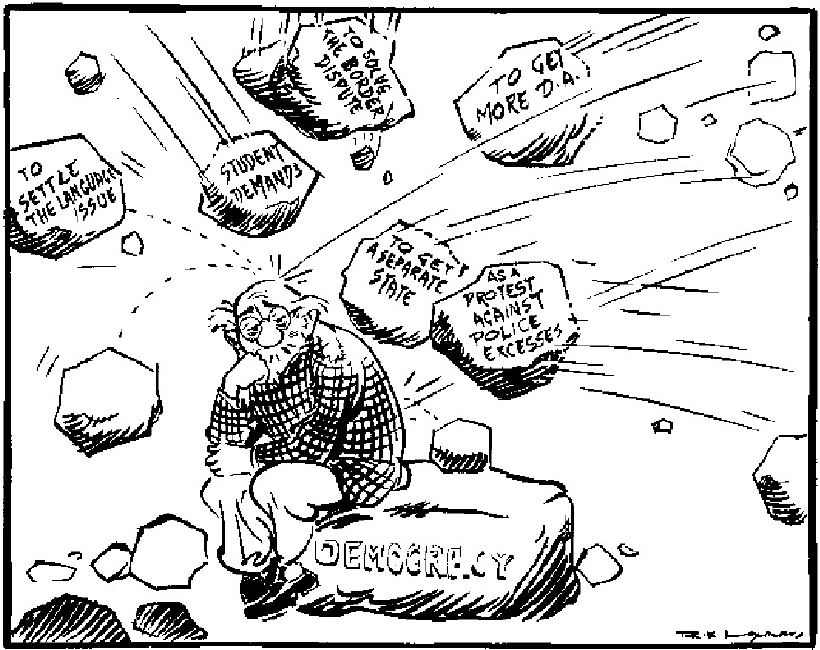
Look at the given picture carefully and choose the most appropriate option: Which of the following is a strength of democracy highlighted in the cartoon?
Solution
Answer: (D)
The rocks hurled at "democracy" are the many demands of people (language, separate state, more DA, students' demands). A democracy has to listen to and accommodate such demands peacefully.
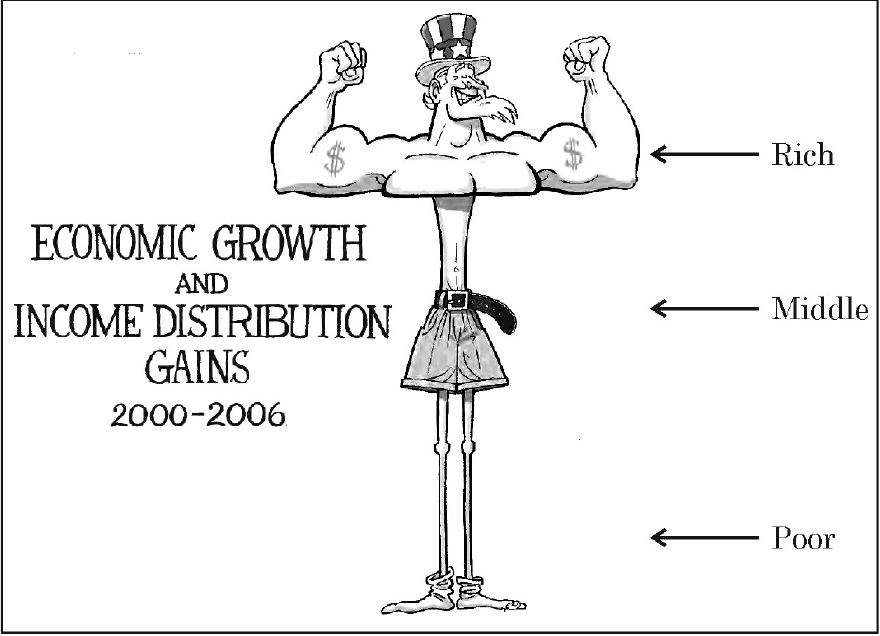
Look at the given cartoon carefully and answer the question that follow: Which of the following concepts is best illustrated in the cartoon?
Solution
Answer: (C)
The figure has huge muscular arms (the rich), a thin waist (middle class) and stick legs (the poor): gains from growth have gone mostly to the rich, showing uneven distribution of wealth.
Which one of the following is a fundamental principle of democracy?
Solution
Answer: (C)
Read the following characteristics of democracy: I. Free and fair elections; II. Equality before law; III. Dignity of a person; IV. Majority rule.
Which type of government is likely to be more acceptable to the people in the world?
Explain the meaning of democracy.
2 marks: very short answer
Differentiate between democracy and dictatorship.
Solution
| Democracy | Dictatorship |
|---|---|
| People elect their rulers in free and fair elections held regularly. | People have no role in choosing the ruler; elections are not held or are not free and fair. |
| The government is accountable to the citizens, and people enjoy rights and freedoms. | Power lies with one person or a small group that is not accountable; rights and freedoms are not guaranteed. |
"Democracy is a better form of government compared with any other alternative." Examine the statement.
Solution
1. Democracy promotes equality among citizens, enhances the dignity of the individual and gives citizens the right to choose and change their rulers, so it is a legitimate government.
2. It improves the quality of decision-making through discussion, provides a method to resolve conflicts peacefully and allows room to correct mistakes.
Mention the two conditions that democracy must fulfil in order to achieve a harmonious social life.
3 marks: short answer
"That democratic system of government is considered good in which maximum number of citizens are made stakeholders in political power." Explain the statement with suitable arguments.
Solution
1. In a democracy people are the source of all political power and rule themselves through institutions of self-government.
2. When more citizens participate in decision-making, the government becomes accountable and transparent, and public opinion shapes policies.
3. Sharing power reduces conflict between social groups and gives legitimacy to the government, which keeps the political order stable.
"Democracy's ability to generate its own support is itself an outcome that cannot be ignored." Analyse the statement with three examples.
Solution
1. Over a hundred countries of the world claim and practise some kind of democratic politics; people want to be ruled by representatives they elect.
2. Surveys show overwhelming support for democracy in South Asian countries, including India, even among ordinary citizens.
3. People's complaints about democracy are themselves a testimony to its success: citizens have become aware and critical, and expect more from their governments, showing that democracy has their support.
"Democracy is the best way to accommodate social division." Justify the statement.
Solution
1. Democracies develop procedures to conduct their competition peacefully, which reduces the possibility of social tensions becoming explosive or violent.
2. Democracy usually develops harmonious social life: no society can fully and permanently resolve conflicts among groups, but democracy learns to respect differences and to negotiate them. Belgium is a good example of successful accommodation of differences among ethnic groups.
3. Democracy requires that the majority always works with the minority, and that rule by majority does not become rule by a religious, racial or linguistic majority community; every citizen must have a chance to be in the majority at some time. Non-democratic regimes tend to ignore or suppress internal social differences (for example Sri Lanka's majoritarian policies caused civil war).
"Complaints are treated as testimony to the success of democracy." Support the statement with examples.
On the basis of which values will it be a fair expectation that democracy should produce a harmonious social life? Explain.
5 marks: long answer
Explain any five bases for assessing the outcomes of democracy.
Solution
1. It produces a government that is accountable to citizens.
2. It is responsive to the needs and expectations of citizens.
3. It promotes equality among citizens and enhances the dignity of the individual (women, disadvantaged castes).
4. It improves the quality of decision-making through deliberation and negotiation.
5. It provides a method to resolve conflicts, accommodates social diversity and allows room to correct mistakes.
Explain any five values of democracy.
Solution
1. Equality: all citizens have equal rights and opportunities.
2. Freedom: citizens are free to express themselves.
3. Participation: citizens choose their leaders and take part in the political process.
4. Dignity and respect for every individual, and accommodation of social diversity.
5. Transparency and accountability: citizens have the right and means to examine the process of decision-making, and the government is responsive to them.
How is democracy better than other types of government? Analyse.
Solution
1. It promotes equality among citizens.
2. It enhances the dignity of the individual.
3. It improves the quality of decision-making through discussion.
4. It provides a method to resolve conflicts and accommodates social diversity.
5. It allows room to correct mistakes, and it is accountable, responsive and legitimate.
Analyse the role of democracy in reducing inequality and poverty.
Solution
1. Democracy is based on political equality; every individual has equal weight in electing representatives.
2. It strengthens the claims of disadvantaged and discriminated groups for equal status and opportunity, and discourages discrimination on the basis of economic status, religion or language.
3. Democratic governments make special provisions such as reservations in education and jobs for weaker sections.
4. They run poverty-eradication and employment programmes, for example MGNREGA.
5. However, economic inequality has not ended: a small number of the ultra-rich enjoy a large share of wealth, and democracy needs to do more to reduce poverty.
Democracy is a better form of govt. than dictatorship. Analyse.
Solution
1. Democracy promotes equality among citizens; in a dictatorship power lies with one person or group.
2. It enhances the dignity of the individual, including women and disadvantaged castes.
3. It improves the quality of decision-making through discussion and negotiation.
4. It is accountable and responsive to citizens and provides a peaceful method to resolve conflicts.
5. It allows room to correct mistakes and is a legitimate government chosen by the people; a dictatorship is not accountable to anyone.
Democracy accommodates social diversities. Analyse.
Solution
1. No society can fully and permanently resolve conflicts among groups, but democracies develop procedures to accommodate them through negotiation.
2. Democracy ensures that the majority works with the minority, so that governments represent the general view.
3. Majority does not always mean the same religion or language group; rule by majority must not become rule by the majority community.
4. Every citizen must have a chance of being in the majority at some point; if anyone is barred from power because of birth, democracy ceases to be accommodative.
5. Belgium's power-sharing arrangements are an example of accommodating social differences peacefully.
Analyse the importance of democracy in accommodation of social diversity.
Solution
1. Democracies develop procedures to conduct competition among groups, which reduces the chance of tensions becoming explosive or violent.
2. No society can permanently resolve conflicts between groups, but democracy teaches us to respect differences and negotiate harmony; Belgium successfully negotiated differences among its ethnic groups.
3. Democracy is not simply rule by majority opinion; the majority has to work with the minority so that the government represents the general view.
4. Rule by majority must not become rule by the majority community in terms of religion, race or language.
5. Every citizen must have a chance of being in the majority at some point; this ability to handle social differences is a definite advantage of democracy.
Analyse the importance of democracy in reducing poverty and inequality.
Solution
1. Democracies are based on political equality: universal adult franchise gives every individual equal weight in electing representatives.
2. Democracy enhances the dignity of individuals by treating them as citizens, not subjects, and strengthens the claims of disadvantaged groups for equal status and opportunity.
3. It improves decision-making through debate and allows room to correct mistakes in policies.
4. Governments run schemes to reduce disparity, such as employment guarantee and food security programmes.
5. Reservations in education and jobs have helped uplift marginalised sections. (Yet economic inequality persists, so democracy must do more.)
Analyse the conditions under which democracies accommodate social diversities.
Solution
1. Democracies develop procedures to conduct competition among groups, which reduces the chance of tensions becoming violent; Belgium successfully negotiated differences among its ethnic groups.
2. No society can permanently resolve conflicts, but democracy teaches respect for differences and ways of negotiating harmony.
3. Democracy is not simply rule by majority opinion; the majority always needs to work with the minority so that governments represent the general view.
4. Rule by majority must not become rule by the majority community in terms of religion, race or language.
5. Every citizen must have a chance of being in the majority at some point; if someone is barred from being in the majority because of birth, democratic rule ceases to be accommodative.
Analyse the conditions under which democracies promote dignity and freedom of citizens.
Solution
1. Every individual wants respect from fellow beings; the passion for respect and freedom is the basis of democracy.
2. Democracies throughout the world have recognised the dignity and freedom of citizens in principle, though they are achieved in different degrees.
3. Equal treatment of women is a necessary ingredient of a democratic society; women's long struggles have earned them more respect and equal treatment.
4. Democracy has strengthened the claims of disadvantaged and discriminated castes for equal status and opportunity.
5. People have developed awareness and the ability to look critically at power holders; complaints about democracy themselves show that citizens expect more from it.
"Democracy stands much superior to any other forms of governments in promoting dignity and freedom of the individual." Support the statement with arguments.
Solution
1. Every individual wants respect from fellow beings; the passion for respect and freedom is the basis of democracy.
2. Democracies throughout the world have recognised dignity and freedom in principle, and conflicts often arise when people feel they are not treated with respect.
3. Equal treatment and respect of women are necessary ingredients of a democratic society; women's struggles have earned them more respect.
4. Democracy in India has strengthened the claims of disadvantaged and discriminated castes for equal status and opportunity; untouchability is legally banned.
5. Democracy guarantees rights and values them, and handles social differences, divisions and conflicts peacefully.
"Democracy produces an accountable, responsive and legitimate government." Support the statement with arguments.
"Democracy is a better form of government than any other alternative." Analyse the statement.
Analyse the reasons for the overwhelming support for the idea of democracy all over the world.
'Democratic system is better than any other form of governments.' Support the statement with examples.
"Democracy is based on political equality." Support the statement with examples.
"Democracies do not appear to be very successful in reducing economic inequalities." Justify the statement.
"Democracy is a better form of government than any other form of government." Justify the statement.
"Democracy stands much superior to any other form of government in promoting dignity and freedom of the individual." Justify this statement.
"Democracies lead to peaceful and harmonious life among citizens." Justify this statement.
Describe any five characteristics of democracy.
Get every solution for all chapters
- Every board question of every chapter, each fully solved the way the board gives marks
- 17 complete board papers, each followed by its solutions
- Weightage and most-asked topics for every chapter
- Instant PDF download, colour and black & white print copies
Revising the chapter first? Complete Social Science Notes for Class 10 (NCERT 2026-27) →
What you get in the pack
- Questions from 126 CBSE papers, 2016 to 2026: every set code available
- Complete: 2341 different questions and parts from all set codes, 20 chapters and 17 full papers
- Part A: all 20 chapters of History, Geography, Pol Science and Economics, sorted by marks
- Year-wise weightage table and most-asked topics for every chapter
- Part B: 17 full board papers, each followed by its complete answers, for timed practice
- Answers written to the marking-scheme points; map questions with the paper's map and every place named
- Questions on topics outside the 2026-27 board exam flagged; only the current syllabus in Part A
All chapters in this pack
- PYQ History 1 The Rise of Nationalism in Europe
- PYQ History 2 Nationalism in India
- PYQ History 3 The Making of a Global World
- PYQ History 5 Print Culture and the Modern World
- PYQ Geography 1 Resources and Development
- PYQ Geography 2 Forest and Wildlife Resources
- PYQ Geography 3 Water Resources
- PYQ Geography 4 Agriculture
- PYQ Geography 5 Minerals and Energy Resources
- PYQ Geography 6 Manufacturing Industries
- PYQ Geography 7 Lifelines of National Economy (Map)
- PYQ Pol Science 1 Power-sharing
- PYQ Pol Science 2 Federalism
- PYQ Pol Science 3 Gender, Religion and Caste
- PYQ Pol Science 4 Political Parties
- PYQ Pol Science 5 Outcomes of Democracy
- PYQ Economics 1 Development
- PYQ Economics 2 Sectors of the Indian Economy
- PYQ Economics 3 Money and Credit
- PYQ Economics 4 Globalisation and the Indian Economy
- Board Paper 2026 Set 32-4-1 with Solutions
- Board Paper 2026 Set 32-5-1 with Solutions
- Board Paper 2025 Set 32-1-1 with Solutions
- Board Paper 2025 Set 32-2-1 with Solutions
- Board Paper 2024 Set 32-2-1 with Solutions
- Board Paper 2024 Set 32-4-1 with Solutions
- Board Paper 2023 Set 32-2-1 with Solutions
- Board Paper 2023 Set 32-4-1 with Solutions
- Board Paper 2022 Term 2 Set 32-1-1 with Solutions
- Board Paper 2022 Term 2 Set 32-3-1 with Solutions
- Board Paper 2020 Set 32-1-1 with Solutions
- Board Paper 2020 Set 32-4-1 with Solutions
- Board Paper 2019 Set 32-2-1 with Solutions
- Board Paper 2019 Set 32-4-1 with Solutions
- Board Paper 2018 Set 32-1 with Solutions
- Board Paper 2017 Set 32-1 with Solutions
- Board Paper 2016 Set 32-1 with Solutions