
CBSE Class 10 Social Studies Question Paper 2020 (32/4/1) with Solutions
The complete CBSE Class 10 Social Studies board paper of 2020, Q.P. code 32/4/1: all 35 questions exactly as set, with marks. 24 solutions are free below. The Class 10 SST PYQ Book: Solved Board Papers 2016-2026 (CBSE) solves all 17 papers in full and sorts every question chapter-wise.
Subject expert: Vikas Chandrawal, M.A. History · 8 years teaching


Free: NCERT solutions for Class 10 SST →
Question paper
Jump to: Question paperSolutions
2020 · Q.P. Code 32/4/1
Maximum marks: 80
Section A · 1 mark each
Who among the following was proclaimed as the first German Emperor in 1871?
Why were some of the Muslim political organisations in India lukewarm in their response to the Civil Disobedience Movement? Give the main reason.
Why were manuscripts not widely used in India before the age of print?
(a) Who was the author of 'Hind Swaraj'?
(b) Who was the author of the novel 'Anandmath'?
Fill in the blank: Young Italy was formed by ______.
'Vellum' is
Who among the following said that "Printing is the ultimate gift of God and the greatest one"?
Fill in the blanks (resources on the basis of exhaustibility): (A) ______ – Solar and Wind energy; (B) ______ – Mineral and Fossil fuels.
(a) Name the sea-port that was developed to relieve growing pressure on the Mumbai port.
not in 2026-27 syllabus(b) Name the sea-port that was developed to relieve growing pressure on the Kolkata port.
not in 2026-27 syllabusIn which of the following States is Narora Nuclear Power Plant located?
Choose the correctly matched pair:
(A) Kalol Oil-fields – Gujarat
(B) Bauxite Mines – Maharashtra
(C) Chandrapur Thermal Power Plant – Odisha
(D) Mayurbhanj Iron Ore Mines – Jharkhand
Fill in the blanks: 'Gobar gas plants' provide twin benefits to the farmers in the form of ______ and ______.
Which of the following is the majority group in Sri Lanka?
(a) Why is power sharing desirable? Explain one reason.
(b) Why is there a need to give space to diverse social groups in the administration of a democratic country? Give any one reason.
Under which of the following is power shared in the 'Community Government' of Belgium?
(a) "Caste system is still prevalent in the Indian society." Suggest any one measure to abolish it.
(b) "Sometimes elections are all about caste in India." How can this situation be avoided?
Choose the correctly matched option:
(A) Farmers who depend only on rain for growing crops – More days of work and better wages
(B) Landless rural labourers – Higher support prices for their crops
(C) Prosperous farmers from Punjab – Regular wages
(D) An Adivasi from Narmada Valley – To fulfil livelihood
Which State has the lowest net attendance ratio at Secondary stage? (Haryana 61, Kerala 83, Bihar 43.)
Suggest any one way to increase the income of Indian industrial workers.
(a) Why is the tertiary sector becoming so important in India? Explain the main reason.
(b) Explain the main advantage of organised sector in respect of employment.
Section B · 3 marks each
Read the extract given below and answer the questions that follow:
Swaraj in the Plantations. Workers too had their own understanding of Mahatma Gandhi and the notion of Swaraj. For plantation workers in Assam, freedom meant the right to move freely in and out of the confined space in which they were enclosed, and it meant retaining a link with the village from which they had come. Under the Inland Emigration Act of 1859, plantation workers were not permitted to leave the tea gardens without permission, and in fact they were rarely given such permission. When they heard of the Non-Cooperation Movement, thousands of workers defied the authorities, left the plantations and headed home. They believed that Gandhi Raj was coming and everyone would be given land in their own villages. They, however, never reached their destination. Stranded on the way by a railway and steamer strike, they were caught by the police and brutally beaten up.
(21.1) Explain the understanding of 'Swaraj' for plantation workers in Assam. (1)
(21.2) Explain the Inland Emigration Act of 1859 as a barrier to freedom of plantation workers. (1)
(21.3) Explain the main outcome of the participation of workers in the Non-Cooperation Movement. (1)
(a) Explain the three types of movement or flows identified by the international economists in the nineteenth century.
not in 2026-27 syllabus(b) Why did textile exports from India not decline in the late eighteenth century? Explain.
not in 2026-27 syllabus(a) Describe the importance of an equitable distribution of resources in the society.
(b) Describe the need of resources for human survival.
"Rail transport suffers from certain problems in India." Support the statement with examples.
not in 2026-27 syllabusDescribe any three characteristics of distribution of power between the Centre and States in India.
(a) Describe the ways of discrimination faced by women in India.
(b) Describe the changes in castes and caste system in modern India.
On what bases is the criterion used by the United Nations Development Programme (UNDP) for measuring development different from the one used by the World Bank? Explain.
(a) "There is need for protection and support for the workers in the unorganised sector." Evaluate this statement.
(b) "Activities in the private sector are guided by the main motive to earn profit." Evaluate this statement.
Section C · 5 marks each
(a) Why is it said that the 1830s were the years of great hardship in Europe? Explain.
(b) How did nationalism aligned with imperialism become the cause of the First World War? Explain.
Analyse any five features of Commercial Farming.
Describe the necessity of political parties in democracy.
"Democracy is based on political equality." Support the statement with examples.
(a) "Self Help Groups (SHGs) are the building blocks of organisation of the rural poor." Support the statement with examples.
(b) "The use of money spans a very large part of our everyday life." Support the statement with examples.
Read the following sources:
Source A – Foreign Trade and the Integration of Markets. With the opening of trade, goods travel from one market to another. Choice of goods in the markets rises. Prices of similar goods in the two markets tend to become equal. And, producers in the two countries now closely compete against each other even though they are separated by thousands of miles. Foreign trade thus results in connecting the markets or integration of markets in different countries.
Source B – Globalisation. Besides the movements of goods, services, investments and technology, there is one more way in which the countries can be connected. This is through the movement of people between countries. People usually move from one country to another in search of better income, better jobs or better education. In the past few decades, however, there has not been much increase in the movement of people between countries due to various restrictions.
Source C – World Trade Organisation. Though WTO is supposed to allow free trade for all, in practice, it is seen that the developed countries have unfairly retained trade barriers. On the other hand, WTO rules have forced the developing countries to remove trade barriers. An example of this is the current debate on trade in agricultural products.
(34.1) How does foreign trade integrate markets? (1)
(34.2) How is globalisation expanding human activity across regions and continents? (2)
(34.3) "The actions and methods of the WTO have evoked strong debate." Elucidate your views on the statement. (2)
Section D · Map (6 marks)
(a)(A) Two places A and B are marked on the given political outline map of India. Identify them:
(A) The place where Gandhiji violated the salt law.
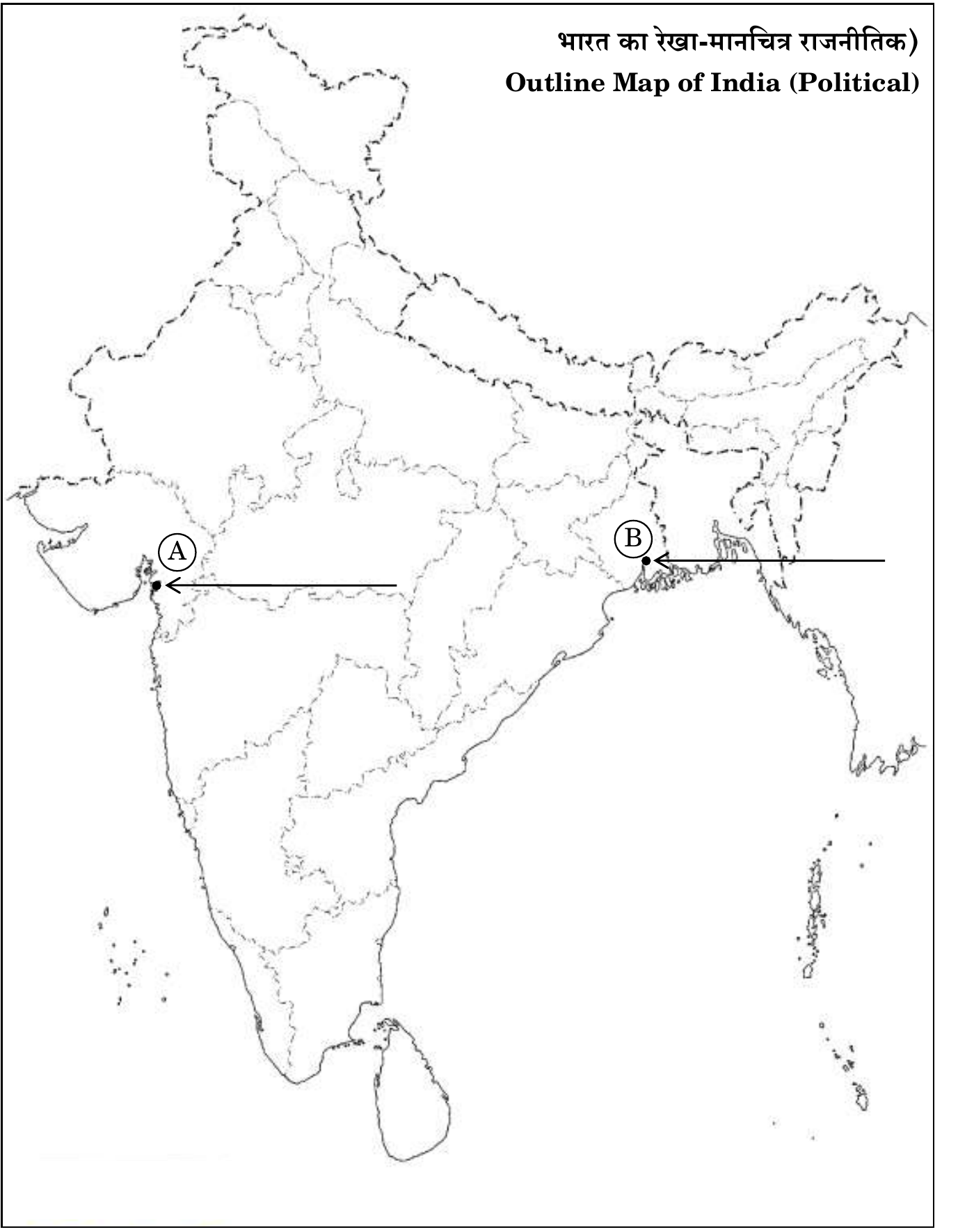
(a)(B) The place where the Indian National Congress Session was held.
(b) Locate and label any four of the following: (i) Hirakud – Dam; (ii) Kanpur – Cotton Textile Industrial Centre; (iii) Kandla – Sea-port; (iv) Salem – Iron and Steel Plant; (v) Amritsar (Raja Sansi) – International Airport; (vi) Hyderabad – Software Technology Park.
Solutions: CBSE 2020 · 32/4/1
Answer: (A) William I, the Prussian king, proclaimed German Emperor at Versailles in January 1871.
Manuscripts were expensive and fragile; they had to be handled carefully and could not be read easily because the script was written in different styles.
Bankim Chandra Chattopadhyay.
Answer: (C)
(A) Renewable resources; (B) Non-renewable resources.
Haldia port.
Answer: (A)
Chandrapur thermal power plant is in Maharashtra and Mayurbhanj iron ore mines in Odisha.
Answer: (C) Sinhalese (about 74% of the population)
So that no group feels alienated: when minority and diverse groups share power, conflict and the threat to national unity are reduced, and the government becomes more legitimate.
Spread education and awareness, and strictly enforce the constitutional ban on untouchability and caste discrimination.
Answer: (D)
An Adivasi of the Narmada valley wants to keep his land and forest-based livelihood. (Landless labourers want more days of work and better wages; prosperous farmers want higher support prices.)
Enforce minimum wage laws and provide skill training so that workers can move to better-paid jobs in the organised sector.
Employment is regular and secure, with fixed hours, paid leave, provident fund and other benefits under government rules.
1. Flow of trade: largely trade in goods such as cloth or wheat.
2. Flow of labour: migration of people in search of employment.
3. Flow of capital: movement of capital for short-term or long-term investments over long distances. The three flows were closely interwoven.
1. Resources are unequally distributed: a few rich people and countries control most of them, leaving others poor.
2. Indiscriminate use by a few has caused depletion and environmental problems such as global warming and pollution.
3. Equitable distribution is essential for sustained quality of life, peace and sustainable development for all, including future generations.
1. Many passengers travel without tickets, and railway property is damaged during protests.
2. Laying railway lines is difficult in hilly terrain, deserts, swamps and forests; the Konkan Railway faces landslides.
3. Railways also face problems of old infrastructure, overcrowding and pulling of chains to stop trains, which cause delays and losses.
1. The literacy rate among women is lower than among men; parents prefer to spend more on sons' education.
2. Women are paid less than men for the same work and hold fewer highly paid jobs; most of their household work is unpaid.
3. Sex-selective abortion has led to a declining child sex ratio, and women face domestic violence and are unsafe in public places.
1. The World Bank uses per capita income to classify countries as rich, middle-income or low-income.
2. The UNDP's Human Development Report compares countries on the basis of health (life expectancy), education (mean and expected years of schooling) and per capita income.
3. Income alone does not show whether people get basic needs; HDI gives a fuller picture (for example Sri Lanka ranks above India on HDI).
1. In the private sector, ownership of assets and delivery of services are in the hands of private individuals and companies (for example Tata Steel, Reliance Industries).
2. They charge for every service, and even basic facilities like private schools and hospitals charge high fees.
3. So things needed by society as a whole, such as cheap electricity, roads and healthcare for the poor, are not provided by the private sector at reasonable cost; the government has to provide them.
1. By the last quarter of the 19th century, nationalism no longer kept its idealistic liberal-democratic sentiment; it became a narrow creed with limited ends.
2. The major European powers manipulated nationalist aspirations of subject peoples to further their own imperialist aims.
3. The Balkans, a region of ethnic variation under the Ottoman Empire, became explosive as its subject nationalities broke away and declared independence; they were jealous of one another and each wanted more territory.
4. Russia, Germany, England and Austria-Hungary competed for control of the Balkans as part of their rivalry over trade, colonies and naval and military might.
5. This led to a series of wars in the region and finally to the First World War in 1914.
1. Without parties every candidate would be independent, and no one could promise major policy changes to the people.
2. Elected representatives would be accountable only to their constituencies, and no one would be responsible for how the country runs.
3. Large societies need representative democracy, and parties gather different views on issues and present them to the government.
4. Parties bring representatives together so that a responsible government can be formed.
5. They provide a mechanism to support or restrain the government, make policies and justify or oppose them; parties are a necessary condition for democracy.
1. SHGs organise the rural poor, especially women, into groups of 15–20 members from one neighbourhood, who meet and save regularly.
2. Members take small loans from the group at interest lower than moneylenders charge.
3. After a year or two of regular saving, the group gets bank loans in its name, without collateral, to create self-employment.
4. Loans are used to release mortgaged land, buy seeds and raw materials, and acquire assets like sewing machines, handlooms and cattle.
5. The group decides on loans and is responsible for repayment; SHGs make women financially self-reliant and give them a platform to discuss social issues.
34.1 Goods travel from one market to another, choice rises and prices of similar goods tend to become equal; producers in distant countries compete closely, so markets get connected.
34.2 (i) Goods, services, investments and technology move rapidly between countries, linking production and markets across continents.
(ii) People also move between countries in search of better income, jobs or education, though this movement is restricted.
34.3 (i) The WTO is supposed to allow free trade for all, but developed countries have unfairly retained trade barriers while forcing developing countries to remove theirs.
(ii) For example, rich countries give huge subsidies to their farmers, so their cheap farm products hurt farmers in developing countries; hence developing countries demand fair rules.
B – Calcutta (Kolkata), West Bengal (special session, September 1920).
Get every solution for all 17 papers
- Every board question of every chapter, each fully solved the way the board gives marks
- 17 complete board papers, each followed by its solutions
- Weightage and most-asked topics for every chapter
- Instant PDF download, colour and black & white print copies
Revising the chapter first? Complete Social Science Notes for Class 10 (NCERT 2026-27) →
What you get in the pack
- Questions from 126 CBSE papers, 2016 to 2026: every set code available
- Complete: 2341 different questions and parts from all set codes, 20 chapters and 17 full papers
- Part A: all 20 chapters of History, Geography, Pol Science and Economics, sorted by marks
- Year-wise weightage table and most-asked topics for every chapter
- Part B: 17 full board papers, each followed by its complete answers, for timed practice
- Answers written to the marking-scheme points; map questions with the paper's map and every place named
- Questions on topics outside the 2026-27 board exam flagged; only the current syllabus in Part A
All chapters in this pack
- PYQ History 1 The Rise of Nationalism in Europe
- PYQ History 2 Nationalism in India
- PYQ History 3 The Making of a Global World
- PYQ History 5 Print Culture and the Modern World
- PYQ Geography 1 Resources and Development
- PYQ Geography 2 Forest and Wildlife Resources
- PYQ Geography 3 Water Resources
- PYQ Geography 4 Agriculture
- PYQ Geography 5 Minerals and Energy Resources
- PYQ Geography 6 Manufacturing Industries
- PYQ Geography 7 Lifelines of National Economy (Map)
- PYQ Pol Science 1 Power-sharing
- PYQ Pol Science 2 Federalism
- PYQ Pol Science 3 Gender, Religion and Caste
- PYQ Pol Science 4 Political Parties
- PYQ Pol Science 5 Outcomes of Democracy
- PYQ Economics 1 Development
- PYQ Economics 2 Sectors of the Indian Economy
- PYQ Economics 3 Money and Credit
- PYQ Economics 4 Globalisation and the Indian Economy
- Board Paper 2026 Set 32-4-1 with Solutions
- Board Paper 2026 Set 32-5-1 with Solutions
- Board Paper 2025 Set 32-1-1 with Solutions
- Board Paper 2025 Set 32-2-1 with Solutions
- Board Paper 2024 Set 32-2-1 with Solutions
- Board Paper 2024 Set 32-4-1 with Solutions
- Board Paper 2023 Set 32-2-1 with Solutions
- Board Paper 2023 Set 32-4-1 with Solutions
- Board Paper 2022 Term 2 Set 32-1-1 with Solutions
- Board Paper 2022 Term 2 Set 32-3-1 with Solutions
- Board Paper 2020 Set 32-1-1 with Solutions
- Board Paper 2020 Set 32-4-1 with Solutions
- Board Paper 2019 Set 32-2-1 with Solutions
- Board Paper 2019 Set 32-4-1 with Solutions
- Board Paper 2018 Set 32-1 with Solutions
- Board Paper 2017 Set 32-1 with Solutions
- Board Paper 2016 Set 32-1 with Solutions