
Nationalism in India: Class 10 PYQs 2016–2026 with solutions
All 66 CBSE board questions asked from Nationalism in India in 17 board papers, with the year, set and marks of each. 34 are solved free below. The Class 10 SST PYQ Book: Solved Board Papers 2016-2026 (CBSE) has every solution, all chapters and 17 full board papers.
Subject expert: Vikas Chandrawal, M.A. History · 8 years teaching


Free: NCERT solutions for Class 10 SST →
Nationalism in India: board weightage
Board weightage 2016–2026
| Year | 2016 | 2017 | 2018 | 2019 | 2020 | 2022 | 2023 | 2024 | 2025 | 2026 |
|---|---|---|---|---|---|---|---|---|---|---|
| Questions | 6 | 5 | 4 | 8 | 10 | 8 | 8 | 9 | 10 | 8 |
| Marks | 14 | 15 | 12 | 24 | 14 | 20 | 24 | 21 | 18 | 14 |
Most asked topics
76 questions from 17 papers. Repeated questions are shown once with every year they were asked.
Jump to: 1 mark2 marks3 marks4 marks5 marks
1 mark: MCQ and Assertion–Reason
Arrange the following events in chronological order and choose the correct option:
I. Second Round Table Conference
II. Formation of Depressed Class Association
III. Lahore Session of Indian National Congress
IV. Formation of Awadh Kisan Sabha
Solution
Answer: (C) IV, III, II, I
Awadh Kisan Sabha (October 1920) → Lahore Session of the INC (December 1929) → Depressed Classes Association (1930) → Second Round Table Conference (December 1931).
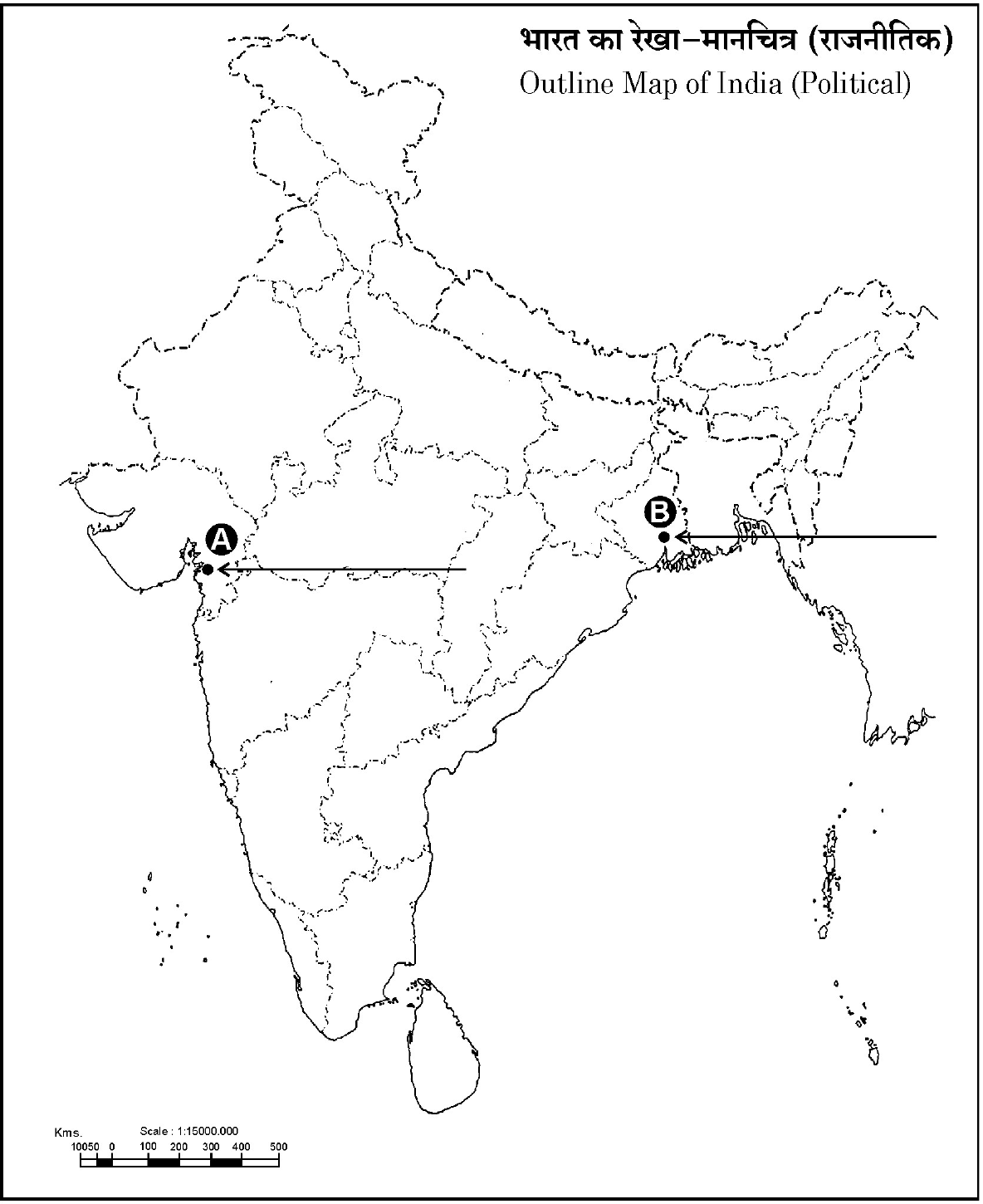
Two places 'A' and 'B' have been marked on the given political outline map of India. Identify them with the help of the following information and write their correct names on the lines drawn near them:
A. The place where Gandhiji broke the Salt Law.
Solution
A – Dandi (on the Gujarat coast, south of Surat). Gandhiji reached Dandi on 6 April 1930 at the end of the Salt March from Sabarmati and broke the salt law by making salt from seawater.
B. The place where the session of Indian National Congress was held. (Map of Q9.)
Solution
B – Calcutta (Kolkata), West Bengal. The special session of September 1920 at Calcutta accepted Gandhiji's Non-Cooperation programme.
Arrange the following events in chronological order and choose the correct option:
I. Salt Satyagraha
II. Kheda Satyagraha
III. Rowlatt Satyagraha
IV. Ahmedabad Mill Workers Satyagraha
Solution
Answer: (B) II, IV, III, I
Kheda (1917, early 1918) → Ahmedabad mill workers (1918) → Rowlatt Satyagraha (1919) → Salt Satyagraha (1930).
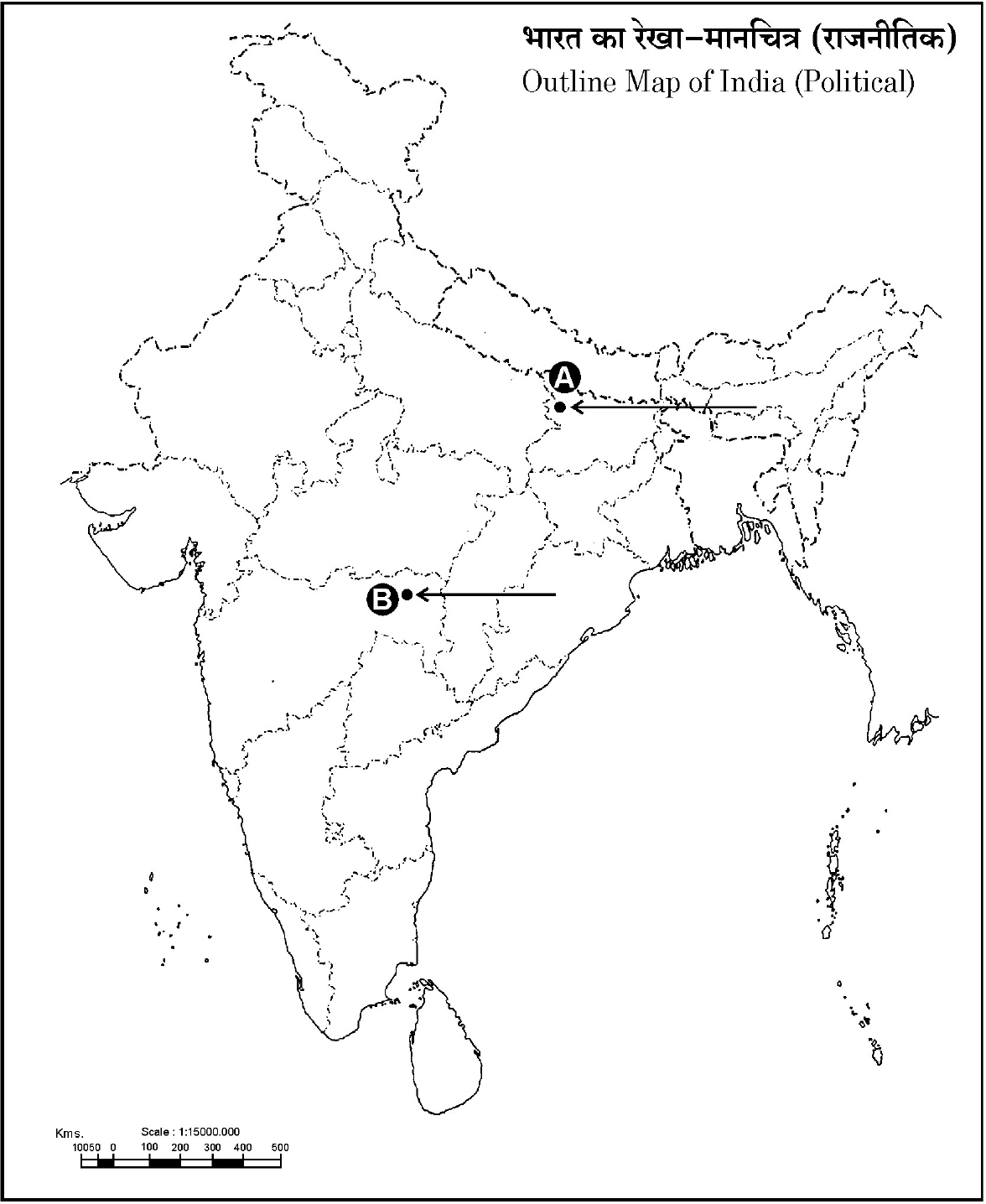
Two places (a) and (b) have been marked on the given political outline map of India. Identify them with the help of the following information and write their correct names on the lines drawn near them.
(a) The place where Gandhiji launched satyagraha, for the Indigo planters.
Solution
A – Champaran, in north-western Bihar near the Nepal border. In 1917 Gandhiji went there to inspire peasants against the oppressive plantation system of indigo cultivation.
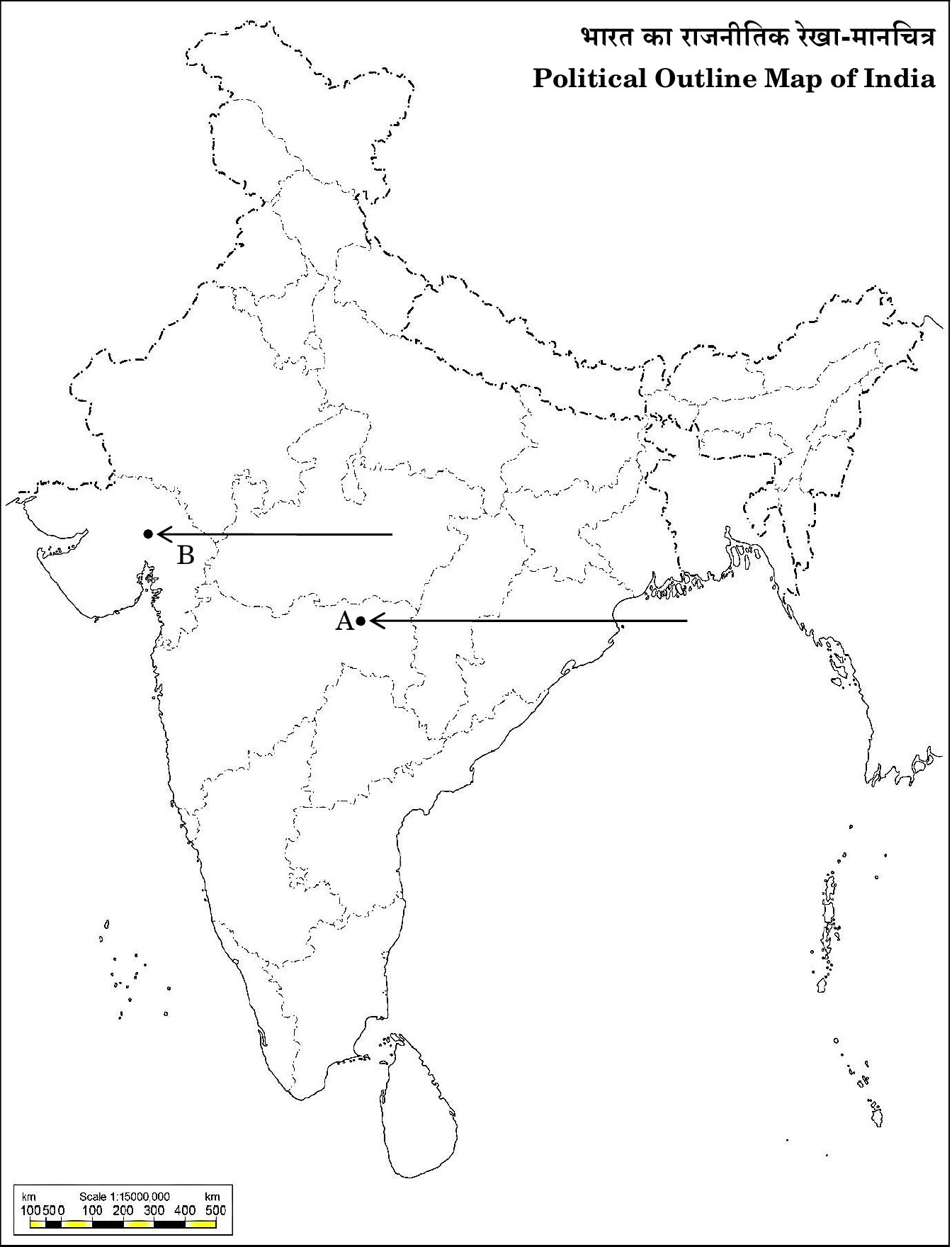
Two places A and B have been marked on the given political outline map of India. Identify them with the help of the following information and write their correct names on the lines drawn near them:
A. The place where the session of Indian National Congress was held in 1920.
Solution
A – Nagpur (Maharashtra, centre of India), where the December 1920 session adopted Non-Cooperation. (Calcutta, the other 1920 session, was also accepted for visually impaired candidates.)
B. The place where Gandhiji started Dandi March.
Solution
B – Sabarmati Ashram, Ahmedabad (Gujarat). The march began on 12 March 1930 and covered 240 miles to Dandi.
B. The place where Jallianwala Bagh incident took place.
Solution
B – Amritsar, Punjab, where General Dyer's troops fired on a peaceful gathering on 13 April 1919.
(ii) The place where the Indian National Congress Session was held in 1920.
Solution
B – Calcutta (Kolkata), West Bengal (special session, September 1920). The December 1920 session was at Nagpur.
Choose the correct option, related to the founders of the 'Swaraj Party' within the Congress.
Solution
Answer: (C) C.R. Das and Motilal Nehru
They formed the Swaraj Party in 1922–23 to argue for a return to council politics.
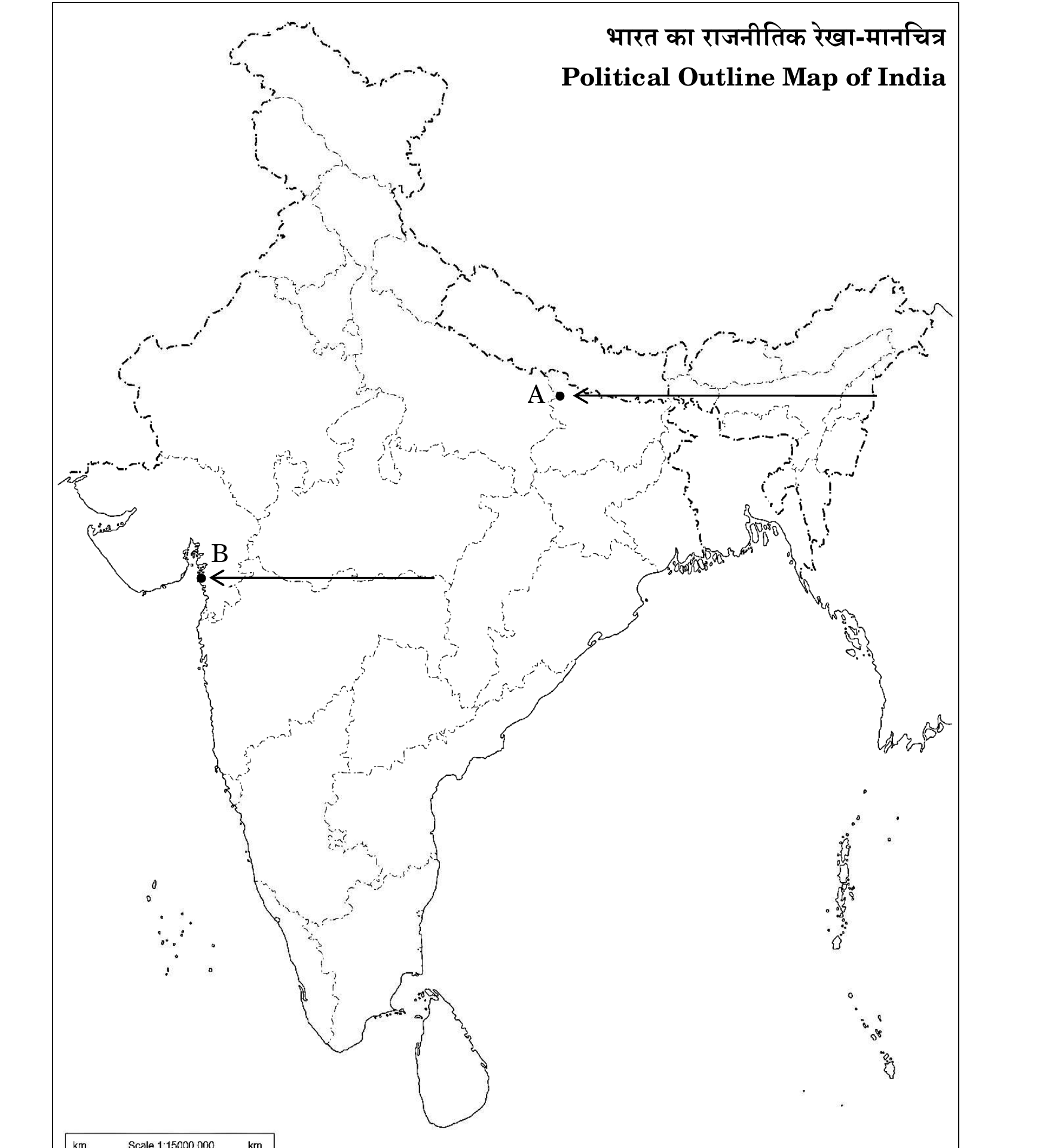
Two places 'A' and 'B' have been marked on the given political outline map of India. Identify them:
A. The place where Gandhiji started Satyagraha for indigo peasants.
Solution
A – Champaran, north-western Bihar.
B. The place where Gandhiji broke the Salt Law.
Solution
B – Dandi, on the Gujarat coast.
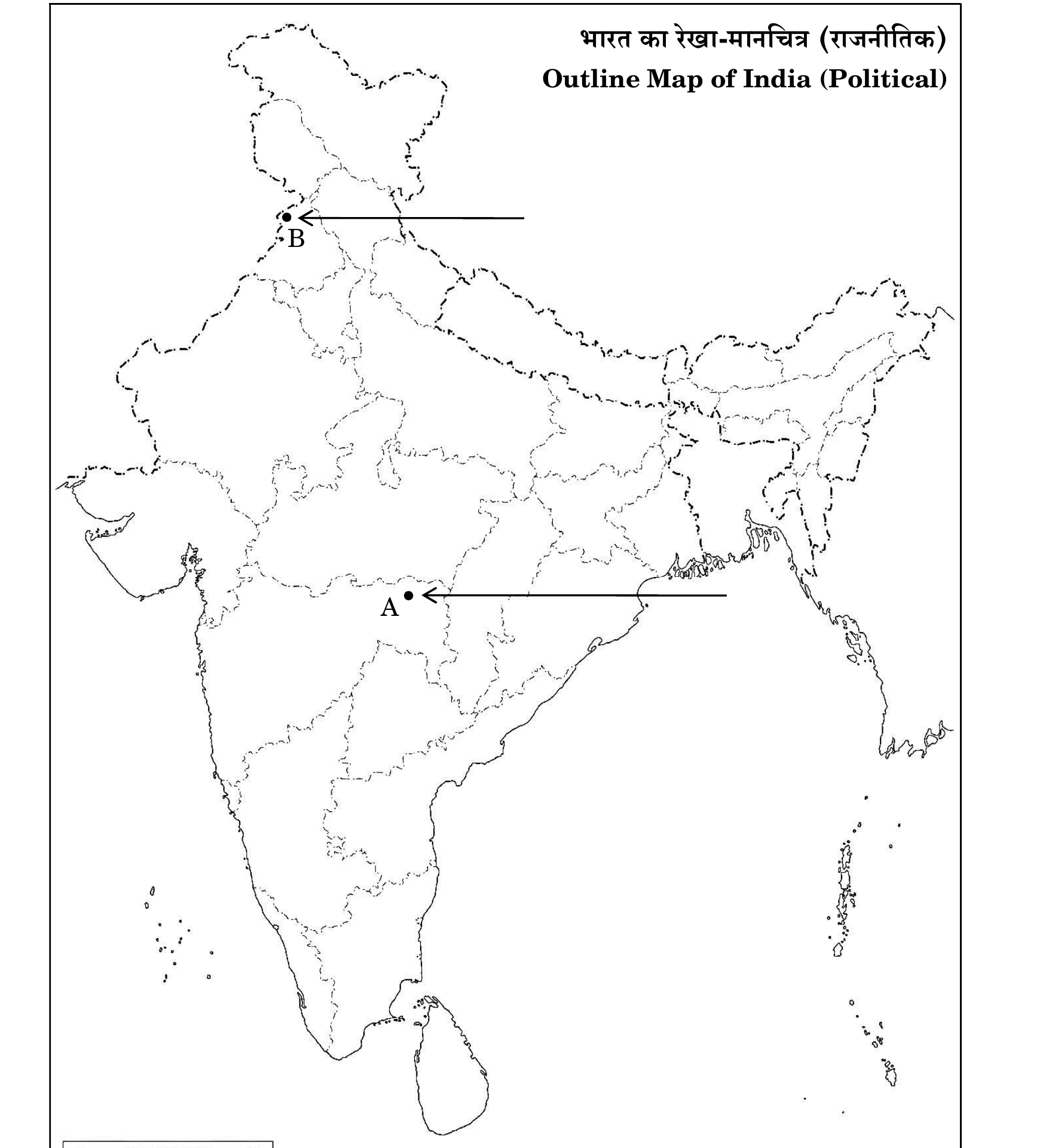
Two places A and B have been marked on the given political outline map of India. Identify them:
(i) The place where the session of the Indian National Congress was held in December, 1920.
Solution
A – Nagpur, Maharashtra.
(ii) The place where Jallianwala Bagh incident occurred.
Solution
B – Amritsar, Punjab.
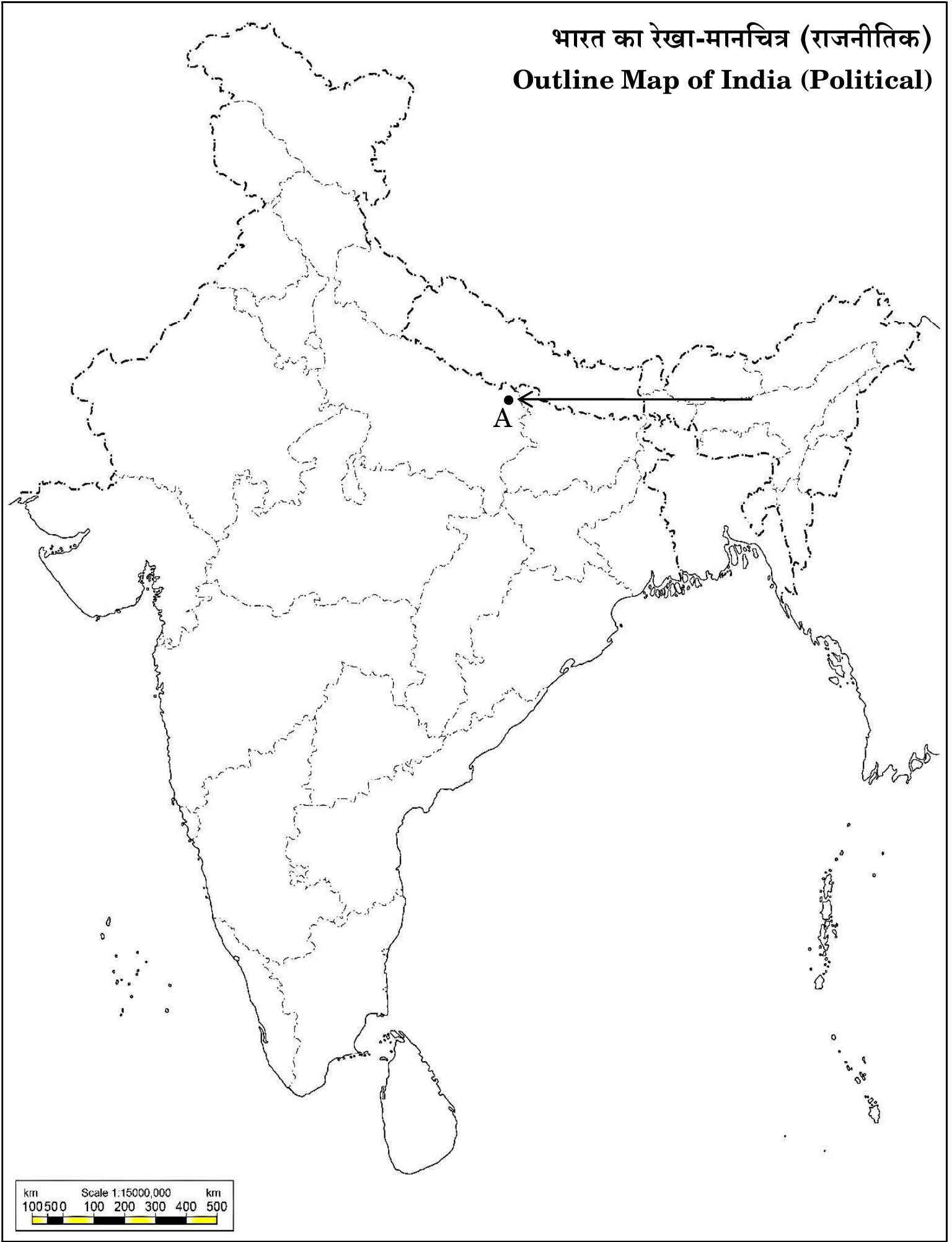
On the given political outline map of India, identify the place marked as A with the help of the following information: A. The place where Non-Cooperation Movement was called off due to violence.
Solution
A – Chauri Chaura, in the Gorakhpur district of eastern Uttar Pradesh (February 1922).
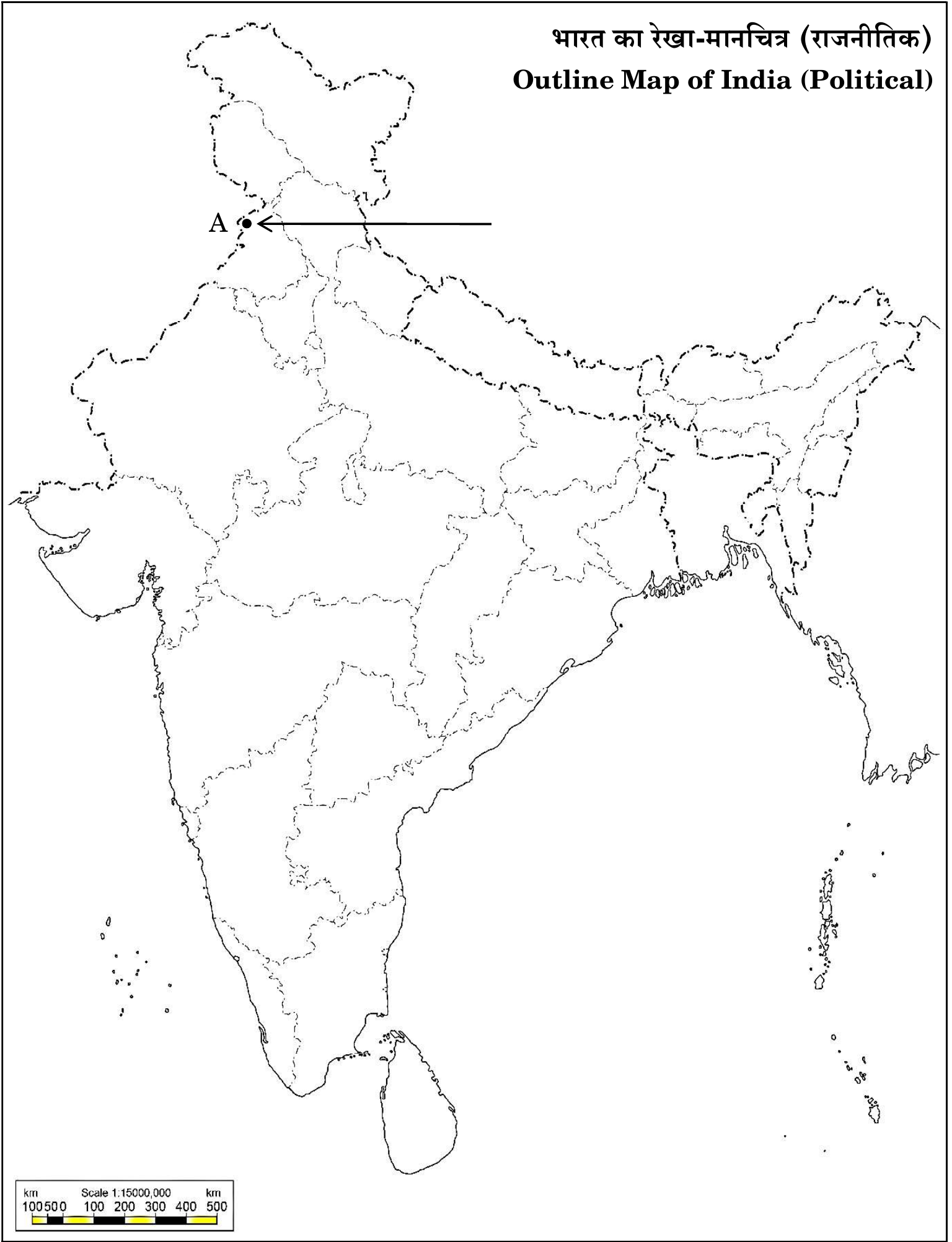
On the given political outline map of India, identify the place marked as A: A. The place where Jallianwala Bagh massacre took place.
Why was the Inland Emigration Act of 1859 troublesome for plantation workers?
Two features 'A' and 'B' are marked on the given political outline map of India. Identify them:
(A) The place where the Indian National Congress Session was held.
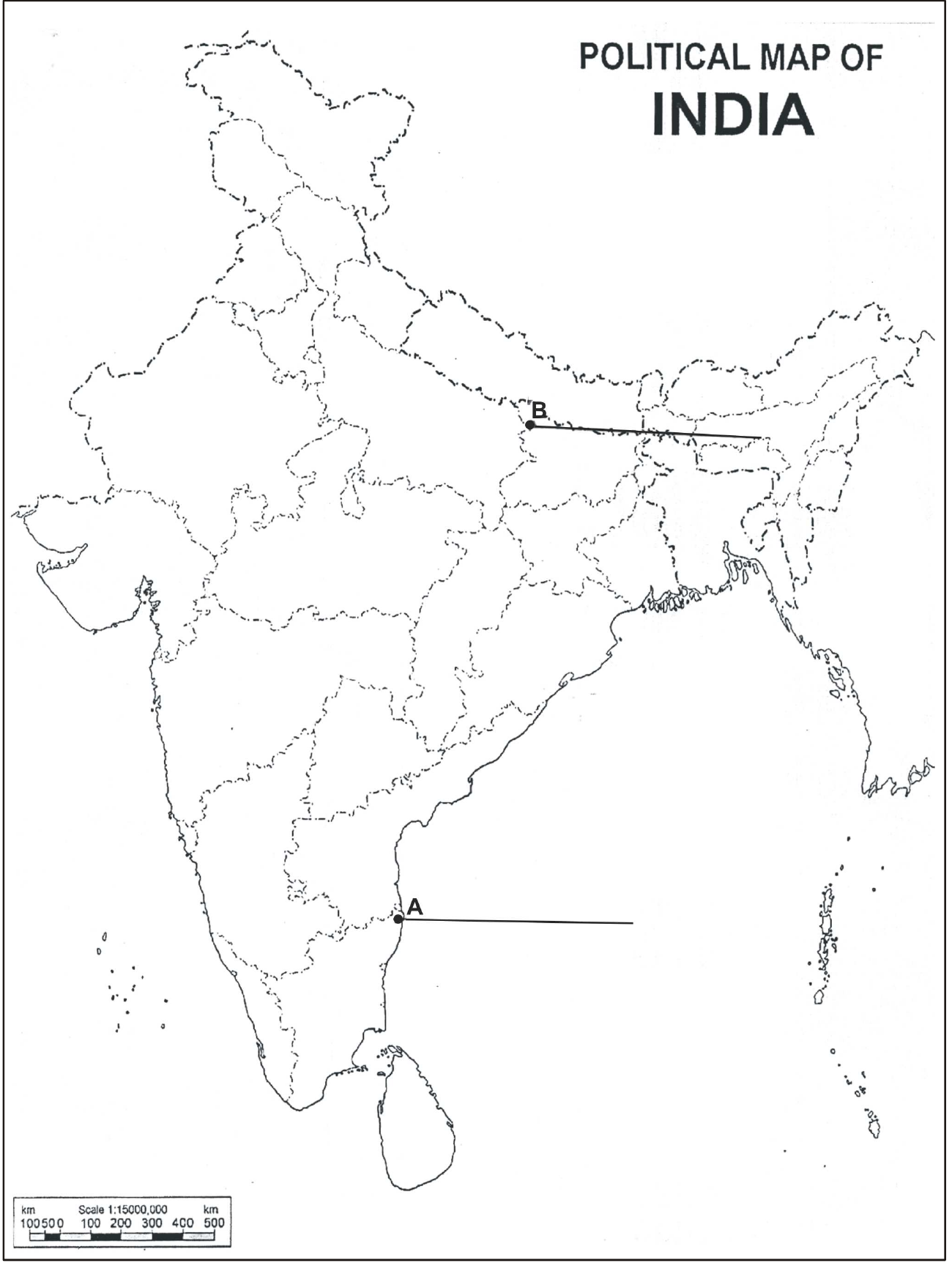
(B) The place where the movement of Indigo planters was started.
Why were some of the Muslim political organisations in India lukewarm in their response to the Civil Disobedience Movement? Give the main reason.
Who was the author of 'Hind Swaraj'?
Who was the author of the novel 'Anandmath'?
Two places A and B are marked on the given political outline map of India. Identify them:
(A) The place where Gandhiji violated the salt law.
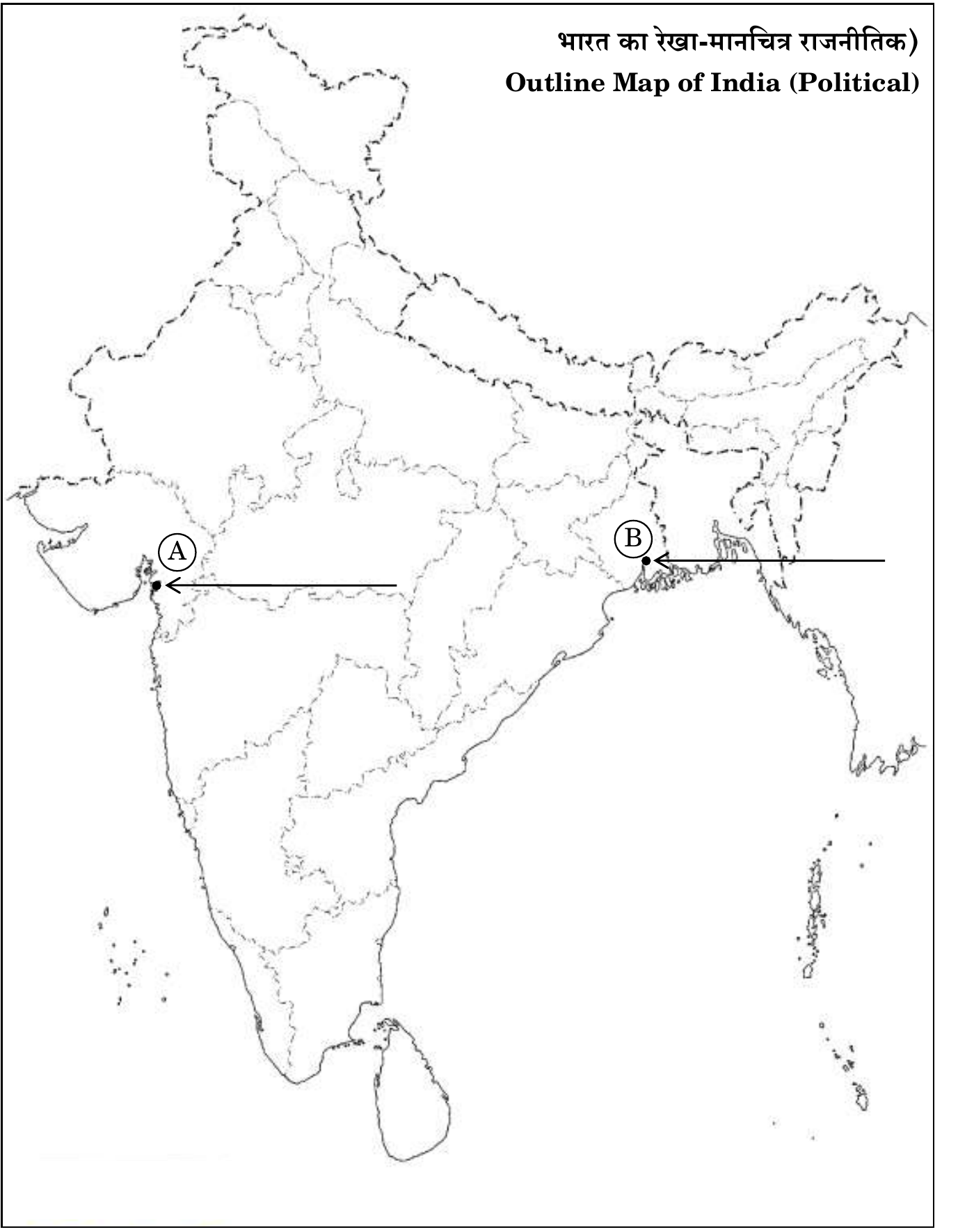
(b) The place where Gandhiji violated the salt law.
(b) The place from where Gandhiji organised Satyagraha in favour of Indigo planters.
(b) The place where Gandhiji organised 'Satyagraha' in favour of cotton mill workers.
Name the writer of the book 'Hind Swaraj'.
Three features A, B and C are marked on the given political outline map of India. Identify them:
A. The place where cotton mill workers organised Satyagraha.
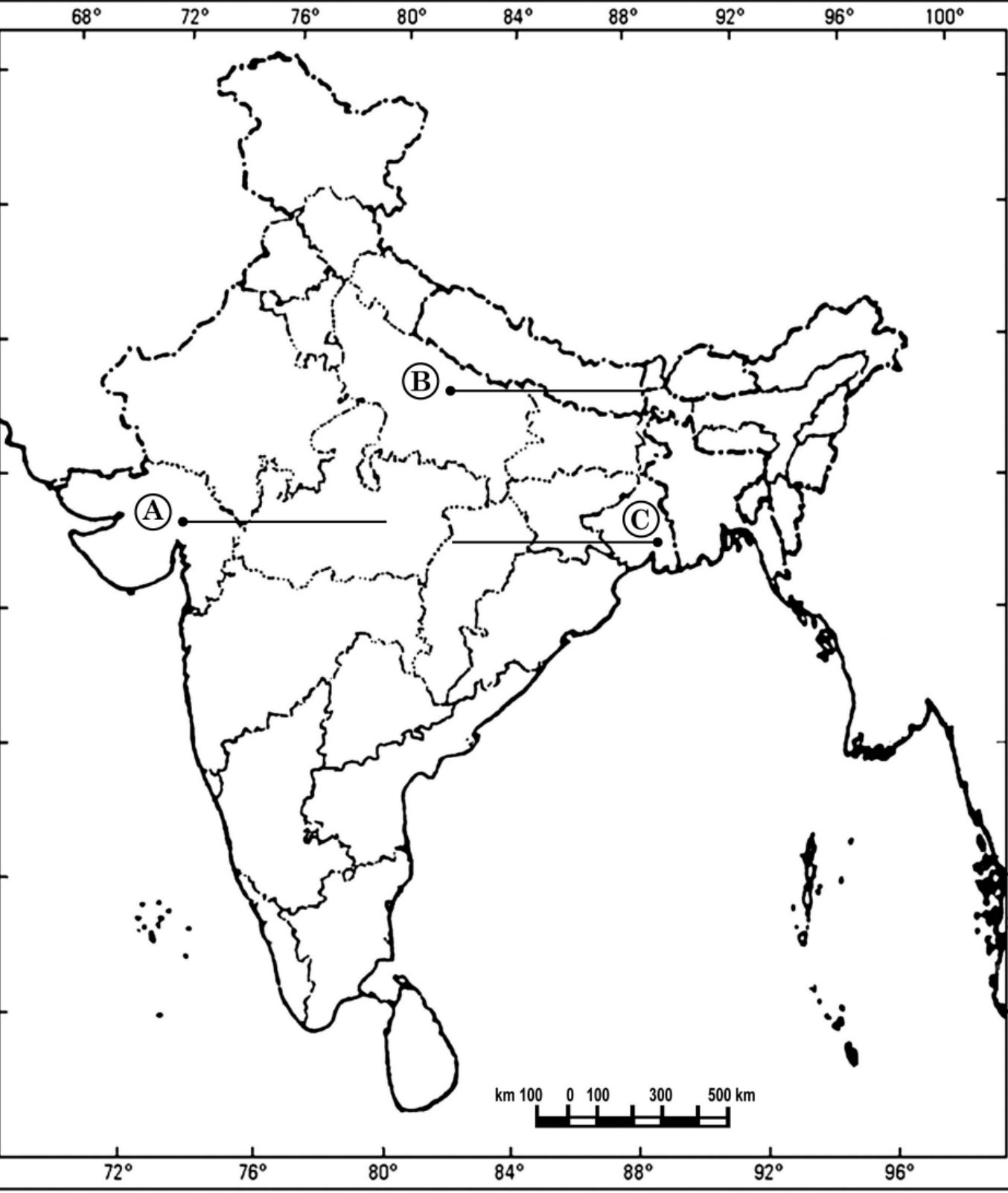
B. The place related to the calling off the Non-Cooperation Movement.
2 marks: very short answer
Explain the role of anti-colonial movement in the rise of 'modern nationalism' in India.
Solution
1. People began discovering their unity in the process of their struggle against colonialism; the shared sense of being oppressed tied many different groups together.
2. Mass movements such as Non-Cooperation, Civil Disobedience and Quit India brought peasants, workers, tribals, women and the middle classes into one national struggle, under the Congress led by Gandhiji.
Why did Gandhiji say 'Satyagraha is pure soul force'? Explain by giving two arguments.
Solution
1. Satyagraha is based on truth, and truth is the very substance of the soul; so it is soul force and not physical force.
2. A satyagrahi does not inflict pain on the adversary or seek his destruction; with non-violence he appeals to the conscience of the oppressor. Non-violence is the supreme dharma.
How did reinterpretation of history become a means of creating a sense of nationalism by the end of the nineteenth century in India? Explain.
Solution
1. The British portrayed Indians as backward and primitive, incapable of self-rule. In response, Indians looked into the past and wrote about ancient India's glorious achievements in art, architecture, science, mathematics, religion, law, philosophy, crafts and trade.
2. These histories showed a later decline under colonial rule and urged readers to take pride in the past and struggle to change the miserable conditions under British rule.
How did symbols and icons contribute to create a feeling of nationalism among the people in the national movement of India? Explain.
Why did Indian merchants and industrialists support the Civil Disobedience Movement? Explain.
Mention the views of Mahatma Gandhi on Satyagraha.
3 marks: short answer
"Tribal peasants interpreted the message of Mahatma Gandhi and the idea of 'Swaraj' in yet another way." Explain the statement in the context of Non-Cooperation Movement.
Solution
1. In the Gudem Hills of Andhra Pradesh a militant guerrilla movement spread in the early 1920s. The colonial government had closed large forest areas and stopped people from grazing cattle and collecting fuelwood and fruit, denying their traditional rights.
2. When the government forced them to do begar (unpaid labour) for road building, they revolted under Alluri Sitaram Raju, who said he was inspired by the Non-Cooperation Movement and asked people to wear khadi and give up drinking.
3. But he believed India could be liberated only by force, not non-violence. The rebels attacked police stations and fought a guerrilla war for swaraj; Raju was executed in 1924 and became a folk hero.
Why did Mahatma Gandhi decide to withdraw the Non-Cooperation Movement? Analyse any three reasons.
Solution
1. The movement was turning violent in many places; at Chauri Chaura (February 1922) a mob set fire to a police station, killing policemen.
2. Gandhiji felt that satyagrahis needed to be properly trained before they would be ready for mass struggles.
3. Some Congress leaders were tired of mass struggles and wanted to contest elections to the provincial councils set up under the Government of India Act 1919; C.R. Das and Motilal Nehru formed the Swaraj Party for this.
How did people belonging to different communities, regions or language groups develop a sense of collective belonging in the National Movement? Explain with examples.
Solution
1. Images like Bharat Mata (Bankim Chandra's Vande Mataram, Abanindranath Tagore's painting) helped people identify with the nation.
2. Folklore: Rabindranath Tagore and Natesa Sastri collected folk tales and songs to revive national identity.
3. Flags and history: the Swadeshi tricolour and Gandhiji's Swaraj flag became symbols of defiance, and nationalists reinterpreted history to show India's glorious past.
"Workers had their own understanding of Mahatma Gandhi and the notion of 'Swaraj'." Explain the statement with examples.
Solution
1. For plantation workers in Assam, freedom meant the right to move freely in and out of the confined space in which they were enclosed and to keep a link with their villages.
2. Under the Inland Emigration Act of 1859, they were not allowed to leave the tea gardens without permission, which they rarely got.
3. When they heard of the Non-Cooperation Movement, thousands defied the authorities and headed home, believing that 'Gandhi Raj' was coming and everyone would get land in their own village.
"It was essential to preserve folk tradition in order to discover one's national identity and restore a sense of pride in one's past." Support the statement in reference to India.
Solution
1. In late 19th-century India, nationalists began recording folk tales sung by bards and toured villages to gather folk songs and legends.
2. They believed these tales gave a true picture of traditional culture that had been corrupted and damaged by outside forces.
3. Rabindranath Tagore led the movement for folk revival in Bengal, and Natesa Sastri published a collection of Tamil folk tales, The Folklore of Southern India; this helped Indians rediscover their identity and take pride in their past.
"Mahatma Gandhi found, in 'salt', a powerful symbol that could unite the nation." Support the statement with three arguments.
Solution
1. Salt was consumed by the rich and the poor alike; it was one of the most essential items of food.
2. The tax on salt and the government monopoly over its production revealed the most oppressive face of British rule.
3. In 1930 Gandhiji sent eleven demands to Viceroy Irwin, including abolition of the salt tax; when ignored, he started the Salt March from Sabarmati to Dandi (240 miles) and broke the salt law on 6 April 1930. People across the country joined, marking the start of the Civil Disobedience Movement.
Read the source given below and answer the questions that follow:
The Movement in the Towns. The movement started with middle-class participation in the cities. Thousands of students left government-controlled schools and colleges, headmasters and teachers resigned, and lawyers gave up their legal practices. The council elections were boycotted in most provinces except Madras, where the Justice Party, the party of the non-Brahmans, felt that entering the council was one way of gaining some power – something that usually only Brahmans had access to. The effects of non-cooperation on the economic front were more dramatic. Foreign goods were boycotted, liquor shops picketed, and foreign cloth burnt in huge bonfires. The import of foreign cloth halved between 1921 and 1922, its value dropping from Rs. 102 crore to Rs. 57 crore. In many places merchants and traders refused to trade in foreign goods or finance foreign trade. As the boycott movement spread, and people began discarding imported clothes and wearing only Indian ones, production of Indian textile mills and handlooms went up.
21.1 Explain the role of 'Justice Party' in boycotting of council elections. (1)
21.2 How was the effects of 'non-cooperation on the economic front' dramatic? (1)
21.3 Explain the effect of 'Boycott' movement on 'foreign textile trade.' (1)
Solution
21.1 The Justice Party, the party of non-Brahmans in Madras, did not boycott the elections; it felt entering the council was a way to gain power that usually only Brahmans had.
21.2 Foreign goods were boycotted, liquor shops picketed and foreign cloth burnt in huge bonfires; merchants refused to trade in foreign goods.
21.3 The import of foreign cloth halved between 1921 and 1922 (from ₹ 102 crore to ₹ 57 crore), and production of Indian textile mills and handlooms went up.
Read the extract given below and answer the questions that follow:
Swaraj in the Plantations. Workers too had their own understanding of Mahatma Gandhi and the notion of Swaraj. For plantation workers in Assam, freedom meant the right to move freely in and out of the confined space in which they were enclosed, and it meant retaining a link with the village from which they had come. Under the Inland Emigration Act of 1859, plantation workers were not permitted to leave the tea gardens without permission, and in fact they were rarely given such permission. When they heard of the Non-Cooperation Movement, thousands of workers defied the authorities, left the plantations and headed home. They believed that Gandhi Raj was coming and everyone would be given land in their own villages. They, however, never reached their destination. Stranded on the way by a railway and steamer strike, they were caught by the police and brutally beaten up.
(21.1) Explain the understanding of 'Swaraj' for plantation workers in Assam. (1)
(21.2) Explain the Inland Emigration Act of 1859 as a barrier to freedom of plantation workers. (1)
(21.3) Explain the main outcome of the participation of workers in the Non-Cooperation Movement. (1)
Why did Gandhiji decide to withdraw the 'Non-Cooperation Movement' in February, 1922? Explain any three reasons.
Evaluate the role of business classes in the 'Civil Disobedience Movement'.
On the political outline map of India, three features A, B and C are marked. Identify them: (i) The city associated with the Jallianwala Bagh incident. (ii) The place where the Indian National Congress session was held. (iii) The place where Gandhiji violated the Salt Law.
What type of flag was designed during the 'Swadeshi Movement' in Bengal? Explain its main features.
"The plantation workers in Assam had their own understanding of Mahatma Gandhi and the notion of Swaraj." Support the statement with arguments.
4 marks: case-based / source-based
Read the given source carefully and answer the questions that follow:
Quit India Movement. The failure of the Cripps Mission and the effects of World War II created widespread discontentment in India. This led Gandhiji to launch a movement calling for complete withdrawal of the British from India. The Congress Working Committee, in its meeting in Wardha on 14 July 1942, passed the historic 'Quit India' resolution demanding the immediate transfer of power to Indians and quit India. On 8th August 1942 in Bombay, the All India Congress Committee endorsed the resolution which called for a non-violent mass struggle on the widest possible scale throughout the country. It was on this occasion that Gandhiji delivered the famous 'Do or Die' speech. The call for 'Quit India' almost brought the state machinery to a standstill in large parts of the country as people voluntarily threw themselves into the thick of the movement. People observed hartals, and demonstrations and processions were accompanied by national songs and slogans. The movement was truly a mass movement which brought into its ambit thousands of ordinary people, namely students, workers and peasants. It also saw the active participation of leaders, namely, Jayprakash Narayan, Aruna Asaf Ali and Ram Manohar Lohia and many women such as Matangini Hazra in Bengal, Kanaklata Barua in Assam and Rama Devi in Orissa. The British responded with much force, yet it took more than a year to suppress the movement.
8.1 How did the failure of the Cripps Mission contribute to the launch of the Quit India Movement? (1)
8.2 Why was Gandhiji's call for 'the Quit India' considered historic? (1)
8.3 Explain the role of women in making the Quit India Movement more inclusive. (2)
Solution
8.1 The failure of the Cripps Mission, together with the hardships of World War II, created widespread discontent in India. Gandhiji responded by launching a movement demanding complete withdrawal of the British.
8.2 The call, given with the 'Do or Die' speech on 8 August 1942, almost brought the state machinery to a standstill as people all over the country voluntarily joined the movement.
8.3 (i) Women leaders such as Aruna Asaf Ali, Matangini Hazra (Bengal), Kanaklata Barua (Assam) and Rama Devi (Orissa) took an active part and led protests.
(ii) Ordinary women joined hartals, demonstrations and processions in large numbers, which made it a true mass movement.
Read the given source carefully and answer the questions that follow:
The sense of collective belonging. As the national movement developed, nationalist leaders became more and more aware of such icons and symbols in unifying people and inspiring in them a feeling of nationalism. Another means of creating a feeling of nationalism was through reinterpretation of history. By the end of the nineteenth century many Indians began feeling that to instill a sense of pride in the nation, Indian history had to be thought about differently. The British saw Indians as backward and primitive, incapable of governing themselves. In response, Indians began looking into the past to discover India's great achievements. They wrote about the glorious developments in ancient times when art and architecture, science and mathematics, religion and culture, law and philosophy, crafts and trade had flourished. This glorious time, in their view, was followed by a history of decline, when India was colonised. These nationalist histories urged the readers to take pride in India's great achievements in the past and struggle to change the miserable conditions of life under British rule.
8.1 How did icons help to unite Indians during the freedom struggle? (1)
8.2 Why did nationalists feel the need to rewrite Indian history? (1)
8.3 How did nationalist histories portray India's past and present? (2)
Solution
8.1 Icons such as Bharat Mata and symbols such as the national flag gave people a shared image of the nation; devotion to them came to be seen as proof of one's nationalism.
8.2 The British portrayed Indians as backward and primitive and incapable of self-rule; nationalists rewrote history to show India's great achievements and instil pride.
8.3 (i) They described a glorious ancient past in which art, architecture, science, mathematics, religion, law, philosophy, crafts and trade flourished.
(ii) This was followed by a period of decline under colonial rule, and readers were urged to take pride in the past and struggle to change the miserable conditions of the present.
Read the case given below carefully and answer the questions that follow:
The Independence Day Pledge, 26 January, 1930. 'We believe that it is the inalienable right of the Indian people, as of any other people, to have freedom and to enjoy the fruits of their toil and have the necessities of life, so that they may have full opportunities of growth. We believe also that if any government deprives a people of these rights and oppresses them, the people have a further right to alter it or to abolish it. The British Government in India has not only deprived the Indian people of their freedom but has based itself on the exploitation of the masses, and has ruined India economically, politically, culturally, and spiritually. We believe, therefore, that India must sever the British connection and attain Purna Swaraj or Complete Independence.'
(11.1) Why was freedom considered an inalienable right of the Indian people? (1)
(11.2) Why was Purna Swaraj considered essential by the people of India? (1)
(11.3) Explain the significance of the Lahore Session of Congress (1929–30). (2)
Read the case given below carefully and answer the questions that follow:
The Sense of Collective Belonging. This sense of collective belonging came partly through the experience of united struggles. But there were also a variety of cultural processes through which nationalism captured people's imagination. History and fiction, folklore and songs, popular prints and symbols, all played a part in the making of nationalism. The identity of the nation, as you know, is most often symbolised in a figure or image. This helps create an image with which people can identify the nation. It was in the twentieth century, with the growth of nationalism, that the identity of India came to be visually associated with the image of Bharat Mata. The image was first created by Bankim Chandra Chattopadhyay. In the 1870s he wrote 'Vande Mataram' as a hymn to the motherland. Later it was included in his novel Anandamath and widely sung during the Swadeshi movement in Bengal. Moved by the Swadeshi movement, Abanindranath Tagore painted his famous image of Bharat Mata. In this painting, Bharat Mata is portrayed as an ascetic figure; she is calm, composed, divine and spiritual. In subsequent years, the image of Bharat Mata acquired many different forms, as it circulated in popular prints, and was painted by different artists. Devotion to this mother figure came to be seen as evidence of one's nationalism.
(11.1) How did the 'nation' become a reality in the minds of people? (1)
(11.2) How did nationalism capture the people's imagination? (1)
(11.3) How did people belonging to different groups develop a sense of collective belonging? (2)
5 marks: long answer
"The Gandhian idea of Satyagraha, emphasized the power of truth and struggle against injustice." Explain the statement with examples.
Solution
1. Satyagraha emphasised the power of truth and the need to search for truth; if the cause was true and the struggle against injustice, physical force was not needed.
2. Without seeking vengeance or being aggressive, a satyagrahi could win the battle through non-violence, by appealing to the conscience of the oppressor.
3. Champaran (1917): Gandhiji inspired peasants to struggle against the oppressive indigo plantation system.
4. Kheda (1917): he organised a satyagraha to support peasants who could not pay revenue because of crop failure and plague.
5. Ahmedabad (1918): he organised a satyagraha among cotton mill workers. Later the Rowlatt Satyagraha (1919) became a nationwide movement.
How did people belonging to different communities, regions and language groups develop a sense of collective belonging in the late-nineteenth century India? Explain with examples.
Solution
1. United struggles: the experience of fighting colonialism together tied different groups together.
2. History and fiction, folklore and songs: Rabindranath Tagore and Natesa Sastri collected folk tales and songs to revive the nation's identity.
3. Images: Bharat Mata, created by Bankim Chandra Chattopadhyay (Vande Mataram, in Anandamath) and painted by Abanindranath Tagore, became an image people identified with.
4. Icons and symbols: the Swadeshi tricolour flag and Gandhiji's Swaraj flag with the spinning wheel; holding the flag during marches became a symbol of defiance.
5. Reinterpretation of history: nationalists wrote about India's glorious ancient achievements and urged people to take pride in the past and fight British rule.
Analyse the role of the business classes in Civil Disobedience Movement.
Solution
1. Indian merchants and industrialists had made huge profits during the First World War and wanted to expand their business; they reacted against colonial policies that restricted business activities.
2. They wanted protection against imports of foreign goods and a rupee–sterling exchange ratio that would discourage imports.
3. To organise business interests they formed the Indian Industrial and Commercial Congress (1920) and FICCI (1927), led by industrialists like Purshottamdas Thakurdas and G.D. Birla.
4. They attacked colonial control over the Indian economy and supported the Civil Disobedience Movement when it was launched, giving financial assistance and refusing to buy or sell imported goods.
5. However, after the failure of the Round Table Conference they were less enthusiastic, as they feared the spread of militant activities and the growing influence of socialism among the young members of the Congress.
Analyse the role of women in Civil Disobedience Movement.
Solution
1. An important feature of the movement was the large-scale participation of women.
2. During Gandhiji's Salt March, thousands of women came out of their homes to listen to him.
3. They participated in protest marches, manufactured salt, and picketed foreign cloth and liquor shops.
4. Many went to jail; in urban areas they came from high-caste families, and in rural areas from rich peasant households.
5. Moved by Gandhiji's call, they began to see service to the nation as a sacred duty. But Gandhiji believed women's duty was to look after home and hearth, and the Congress was reluctant to give women positions of authority within the organisation.
Examine the progress of the Civil Disobedience Movement in the countryside.
Solution
1. Rich peasant communities like the Patidars of Gujarat and the Jats of Uttar Pradesh were active; as producers of commercial crops they were hard hit by the trade depression and falling prices, and could not pay the revenue demand.
2. The government's refusal to reduce revenue led to widespread resentment; these rich peasants organised their communities and joined the boycott programmes. For them swaraj was a struggle against high revenues, and they were disappointed when the movement was called off in 1931 without revenue being revised.
3. Poorer peasants were not just interested in lower revenue; many were tenants who could not pay rent and wanted unpaid rent to be remitted.
4. They joined radical movements often led by Socialists and Communists; the Congress was unwilling to support 'no rent' campaigns for fear of upsetting rich peasants and landlords.
5. So the relationship between the poor peasants and the Congress remained uncertain, and the movement in the countryside meant different things to different groups.
Analyze the ways through which people of different communities developed a sense of collective belonging in India.
Solution
1. The identity of India came to be visually associated with Bharat Mata: Bankim Chandra Chattopadhyay wrote Vande Mataram (1870s, later in Anandamath), and Abanindranath Tagore painted Bharat Mata as a calm, divine ascetic figure.
2. Nationalists revived Indian folklore: Rabindranath Tagore and Natesa Sastri collected folk tales, songs and legends to discover national identity and restore pride in the past.
3. During the Swadeshi movement a tricolour flag (red, green, yellow) was designed with eight lotuses for the provinces and a crescent moon for Hindus and Muslims.
4. By 1921 Gandhiji had designed the Swaraj flag with a spinning wheel; carrying the flag during marches became a symbol of defiance.
5. Nationalists reinterpreted history, writing about India's glorious ancient achievements and urging people to struggle against British rule.
How had the 'First World War' created economic problems in India? Explain with examples.
Solution
1. The war led to a huge increase in defence expenditure, financed by war loans and increased taxes.
2. Customs duties were raised and income tax was introduced.
3. Prices increased sharply, doubling between 1913 and 1918, causing extreme hardship to common people.
4. Villages were forced to supply soldiers, and forced recruitment in rural areas caused widespread anger.
5. Crops failed in many parts of India in 1918–19 and 1920–21, causing acute food shortages, and an influenza epidemic killed 12–13 million people.
How had a variety of cultural processes developed a sense of collective belongingness in India during the 19th century? Explain with examples.
Why did Mahatma Gandhi start the 'Civil Disobedience Movement'? How did this movement unite the country? Explain.
Why did Mahatma Gandhi launch the 'Non-Cooperation Movement'? How did this movement unite the country? Explain.
How did Non-Cooperation movement start with participation of middle class people in the cities? Explain its impact on the economic front.
Why was Congress reluctant to allow women to hold any position of authority within the organisation? How did women participate in Civil Disobedience Movement? Explain.
How did the Colonial Government repress the 'Civil Disobedience Movement'? Explain.
Why did Mahatma Gandhi decide to call off the Civil Disobedience Movement? Explain.
Get every solution for all chapters
- Every board question of every chapter, each fully solved the way the board gives marks
- 17 complete board papers, each followed by its solutions
- Weightage and most-asked topics for every chapter
- Instant PDF download, colour and black & white print copies
Revising the chapter first? Complete Social Science Notes for Class 10 (NCERT 2026-27) →
What you get in the pack
- Questions from 126 CBSE papers, 2016 to 2026: every set code available
- Complete: 2341 different questions and parts from all set codes, 20 chapters and 17 full papers
- Part A: all 20 chapters of History, Geography, Pol Science and Economics, sorted by marks
- Year-wise weightage table and most-asked topics for every chapter
- Part B: 17 full board papers, each followed by its complete answers, for timed practice
- Answers written to the marking-scheme points; map questions with the paper's map and every place named
- Questions on topics outside the 2026-27 board exam flagged; only the current syllabus in Part A
All chapters in this pack
- PYQ History 1 The Rise of Nationalism in Europe
- PYQ History 2 Nationalism in India
- PYQ History 3 The Making of a Global World
- PYQ History 5 Print Culture and the Modern World
- PYQ Geography 1 Resources and Development
- PYQ Geography 2 Forest and Wildlife Resources
- PYQ Geography 3 Water Resources
- PYQ Geography 4 Agriculture
- PYQ Geography 5 Minerals and Energy Resources
- PYQ Geography 6 Manufacturing Industries
- PYQ Geography 7 Lifelines of National Economy (Map)
- PYQ Pol Science 1 Power-sharing
- PYQ Pol Science 2 Federalism
- PYQ Pol Science 3 Gender, Religion and Caste
- PYQ Pol Science 4 Political Parties
- PYQ Pol Science 5 Outcomes of Democracy
- PYQ Economics 1 Development
- PYQ Economics 2 Sectors of the Indian Economy
- PYQ Economics 3 Money and Credit
- PYQ Economics 4 Globalisation and the Indian Economy
- Board Paper 2026 Set 32-4-1 with Solutions
- Board Paper 2026 Set 32-5-1 with Solutions
- Board Paper 2025 Set 32-1-1 with Solutions
- Board Paper 2025 Set 32-2-1 with Solutions
- Board Paper 2024 Set 32-2-1 with Solutions
- Board Paper 2024 Set 32-4-1 with Solutions
- Board Paper 2023 Set 32-2-1 with Solutions
- Board Paper 2023 Set 32-4-1 with Solutions
- Board Paper 2022 Term 2 Set 32-1-1 with Solutions
- Board Paper 2022 Term 2 Set 32-3-1 with Solutions
- Board Paper 2020 Set 32-1-1 with Solutions
- Board Paper 2020 Set 32-4-1 with Solutions
- Board Paper 2019 Set 32-2-1 with Solutions
- Board Paper 2019 Set 32-4-1 with Solutions
- Board Paper 2018 Set 32-1 with Solutions
- Board Paper 2017 Set 32-1 with Solutions
- Board Paper 2016 Set 32-1 with Solutions