
CBSE Class 10 Social Studies Question Paper 2022 (32/3/1, Term 2) with Solutions
The complete CBSE Class 10 Social Studies board paper of 2022, Q.P. code 32/3/1 · Term 2: all 13 questions exactly as set, with marks. 9 solutions are free below. The Class 10 SST PYQ Book: Solved Board Papers 2016-2026 (CBSE) solves all 17 papers in full and sorts every question chapter-wise.
Subject expert: Vikas Chandrawal, M.A. History · 8 years teaching


Free: NCERT solutions for Class 10 SST →
Question paper
Jump to: Question paperSolutions
2022 · Q.P. Code 32/3/1 · Term 2
Maximum marks: 40
In 2022 CBSE held the board exam in two terms. Term 1 (Nov–Dec 2021) was an MCQ paper; this is the Term 2 written paper (40 marks, 2 hours), which covered the second half of the syllabus.
Section A · Very short answer (2 marks each)
Mention the views of Mahatma Gandhi on Satyagraha.
Explain the major concerns of Jute Textile industry.
Mention the two conditions that democracy must fulfil in order to achieve a harmonious social life.
Analyse the situation in which credit pushes the borrower into a situation from which recovery is painful.
Read the following table: The Indian Railway network — Broad Gauge (1.676 m): route 63,491 km, running track 89,521 km, total track 1,17,560 km; Metre Gauge (1.000 m): 3,200, 3,462, 3,775; Narrow Gauge (0.762 and 0.610 m): 1,751, 1,752, 1,901; Total: 68,442, 94,735, 1,23,236.
(5.1) Which gauge covers maximum of track length in hilly areas in India? (1)
(5.2) Which gauge has the highest length in India? (1)
Section B · Short answer (3 marks each)
(a) Examine the debate that took place in the World Trade Organisation for the developing countries.
not in 2026-27 syllabus(b) Examine the steps taken by the Central and State governments to attract foreign companies to invest in India.
not in 2026-27 syllabus"Mahatma Gandhi found, in 'salt', a powerful symbol that could unite the nation." Support the statement with three arguments.
"Democracy's ability to generate its own support is itself an outcome that cannot be ignored." Analyse the statement with three examples.
Section C · Long answer (5 marks each)
(a) "Political parties have become omnipresent in democracies all over the world." Explain the statement with examples.
(b) "There are various reforms taken to strengthen parties in India so that they perform their function well." Explain the statement with examples.
(a) How are 'self-help groups' the building blocks of the rural poor? Explain with examples.
(b) How does the credit vary substantially between formal and informal lenders? Explain with examples.
Section D · Case-based (4 marks each)
Read the case given below carefully and answer the questions that follow:
The Sense of Collective Belonging. This sense of collective belonging came partly through the experience of united struggles. But there were also a variety of cultural processes through which nationalism captured people's imagination. History and fiction, folklore and songs, popular prints and symbols, all played a part in the making of nationalism. The identity of the nation, as you know, is most often symbolised in a figure or image. This helps create an image with which people can identify the nation. It was in the twentieth century, with the growth of nationalism, that the identity of India came to be visually associated with the image of Bharat Mata. The image was first created by Bankim Chandra Chattopadhyay. In the 1870s he wrote 'Vande Mataram' as a hymn to the motherland. Later it was included in his novel Anandamath and widely sung during the Swadeshi movement in Bengal. Moved by the Swadeshi movement, Abanindranath Tagore painted his famous image of Bharat Mata. In this painting, Bharat Mata is portrayed as an ascetic figure; she is calm, composed, divine and spiritual. In subsequent years, the image of Bharat Mata acquired many different forms, as it circulated in popular prints, and was painted by different artists. Devotion to this mother figure came to be seen as evidence of one's nationalism.
(11.1) How did the 'nation' become a reality in the minds of people? (1)
(11.2) How did nationalism capture the people's imagination? (1)
(11.3) How did people belonging to different groups develop a sense of collective belonging? (2)
Read the case given below carefully and answer the questions that follow:
National Thermal Power Corporation (NTPC) shows the way. NTPC is a major power providing corporation in India. It has ISO certification for EMS (Environment Management System) 14001. The corporation has a proactive approach for preserving the natural environment and resources like water, oil, gas and fuels in places where it is setting up power plants. This has been possible through: (a) Optimum utilisation of equipment adopting latest techniques and upgrading existing equipment. (b) Minimising waste generation by maximising ash utilisation. (c) Providing green belts for nurturing ecological balance and addressing the question of special purpose vehicles for afforestation. (d) Reducing environmental pollution through ash pond management, ash water recycling system and liquid waste management. (e) Ecological monitoring, reviews and online database management for all its power stations.
(12.1) Examine the concept of sustainable development. (1)
(12.2) What is the idea behind ISO certification? (1)
(12.3) Examine the proactive approach of National Thermal Power Corporation (NTPC). (2)
Section E · Map (3 marks)
(i) On the given political outline map of India, identify the place marked as A: A. The place where Jallianwala Bagh massacre took place.
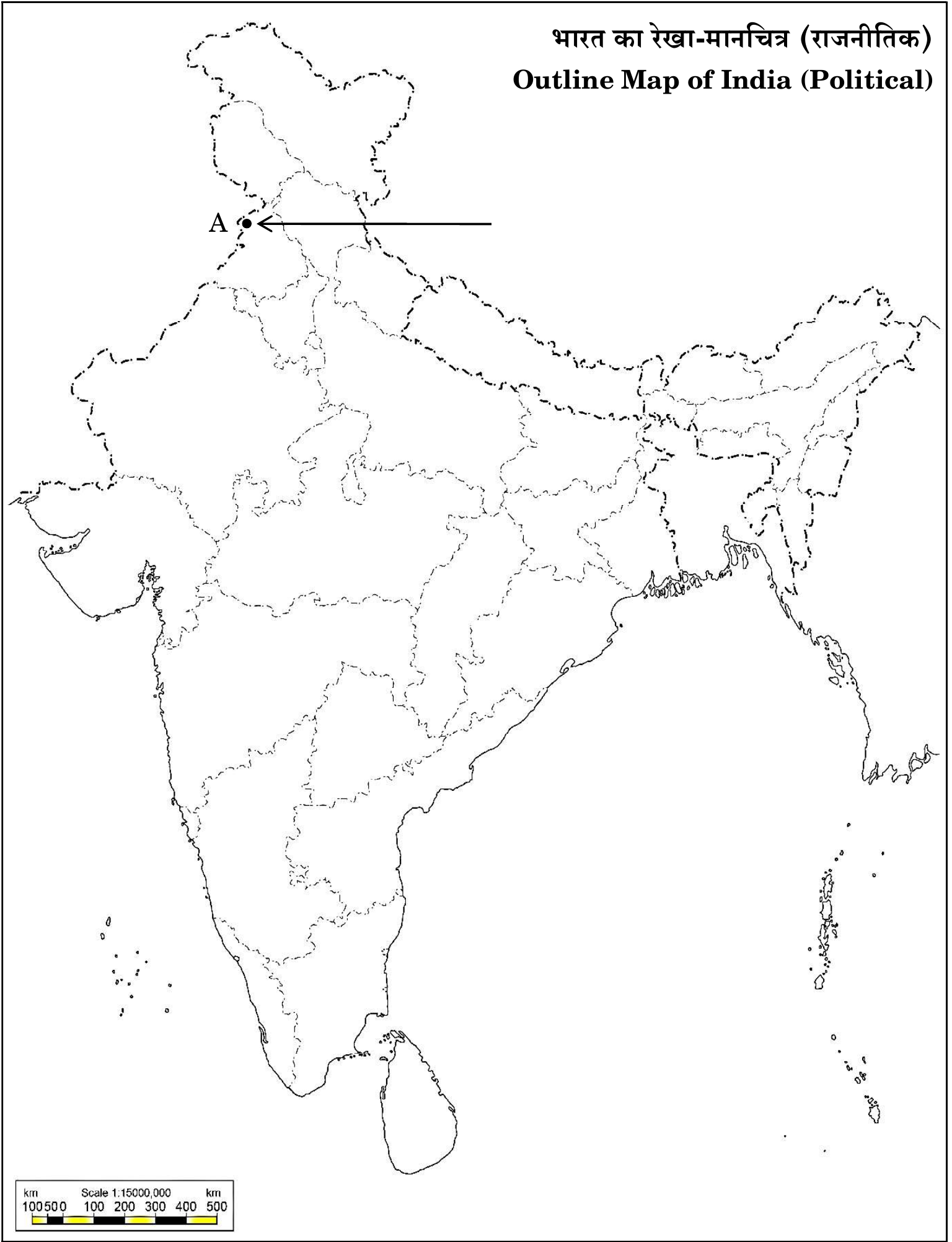
(ii)(a) On the same given map of India, locate and label: (a) (I) Singrauli Thermal Plant OR (II) Mumbai Software Technology Park
(ii)(b) Kolkata (Netaji Subhash Chandra Bose) International Airport
Solutions: CBSE 2022 · 32/3/1 · Term 2
1. Satyagraha emphasised the power of truth and the need to search for truth. If the cause was true and the struggle against injustice, physical force was not needed to fight the oppressor.
2. Without seeking vengeance or being aggressive, a satyagrahi could win the battle through non-violence, by appealing to the conscience of the oppressor; this dharma of non-violence could unite all Indians.
1. Majority rule does not mean the rule of a majority community; the majority must always work with the minority, so that governments function to represent the general view.
2. Rule by majority must not become rule by the majority community in terms of religion, race or language; every citizen should have a chance of being in the majority at some point.
5.1 Narrow gauge (mostly laid in hilly areas, such as Darjeeling and Shimla).
5.2 Broad gauge (1,17,560 km total track).
1. Special Economic Zones (SEZs) with world-class facilities, electricity, water, roads, transport, storage and recreation, are being set up.
2. Companies that set up units in SEZs do not have to pay taxes for an initial period of five years.
3. Labour laws have been made flexible, allowing companies to employ workers on short-term contracts when there is intense pressure of work.
1. Over a hundred countries of the world claim and practise some kind of democratic politics; people want to be ruled by representatives they elect.
2. Surveys show overwhelming support for democracy in South Asian countries, including India, even among ordinary citizens.
3. People's complaints about democracy are themselves a testimony to its success: citizens have become aware and critical, and expect more from their governments, showing that democracy has their support.
1. The anti-defection law: an MLA or MP who changes party loses the seat, which has reduced defections (though it has increased the power of party leaders).
2. The Supreme Court order requiring every candidate to file an affidavit giving details of property and criminal cases, which has made information public.
3. The Election Commission order requiring parties to hold organisational elections and file income-tax returns.
4. Suggestions: a law to regulate internal affairs of parties, a minimum number of tickets (about one-third) for women, and state funding of elections.
5. Pressure from people, the media and movements can also force parties to reform; people can join parties directly to change them.
1. Formal lenders (banks, cooperatives) are supervised by the RBI; informal lenders (moneylenders, traders, landlords, relatives) are not supervised by anyone.
2. Formal lenders charge lower interest; informal lenders charge much higher interest, so a larger part of the borrower's earnings goes to repaying the loan.
3. Formal loans require collateral and documentation, which poor households often cannot provide, so they depend on informal lenders.
4. Informal lenders may use unfair means to recover money (for example a farmer forced to sell land or work for the lender), leading to debt traps.
5. In rural India most of the poor still borrow from informal sources, while rich households get most of their loans from formal sources; this is why formal credit must be expanded to the poor.
12.1 Development that takes place without damaging the environment, so that development in the present does not compromise the needs of future generations.
12.2 ISO 14001 certifies that the organisation follows an effective Environment Management System, keeping its operations within international environmental standards.
12.3 (i) It preserves natural resources by optimum use of equipment with the latest techniques, and minimises waste by maximising ash utilisation.
(ii) It reduces pollution through ash pond management, ash-water recycling and liquid waste management, and provides green belts and ecological monitoring at all its power stations.
Singrauli, on the border of Madhya Pradesh and Uttar Pradesh; or Mumbai, Maharashtra.
Get every solution for all 17 papers
- Every board question of every chapter, each fully solved the way the board gives marks
- 17 complete board papers, each followed by its solutions
- Weightage and most-asked topics for every chapter
- Instant PDF download, colour and black & white print copies
Revising the chapter first? Complete Social Science Notes for Class 10 (NCERT 2026-27) →
What you get in the pack
- Questions from 126 CBSE papers, 2016 to 2026: every set code available
- Complete: 2341 different questions and parts from all set codes, 20 chapters and 17 full papers
- Part A: all 20 chapters of History, Geography, Pol Science and Economics, sorted by marks
- Year-wise weightage table and most-asked topics for every chapter
- Part B: 17 full board papers, each followed by its complete answers, for timed practice
- Answers written to the marking-scheme points; map questions with the paper's map and every place named
- Questions on topics outside the 2026-27 board exam flagged; only the current syllabus in Part A
All chapters in this pack
- PYQ History 1 The Rise of Nationalism in Europe
- PYQ History 2 Nationalism in India
- PYQ History 3 The Making of a Global World
- PYQ History 5 Print Culture and the Modern World
- PYQ Geography 1 Resources and Development
- PYQ Geography 2 Forest and Wildlife Resources
- PYQ Geography 3 Water Resources
- PYQ Geography 4 Agriculture
- PYQ Geography 5 Minerals and Energy Resources
- PYQ Geography 6 Manufacturing Industries
- PYQ Geography 7 Lifelines of National Economy (Map)
- PYQ Pol Science 1 Power-sharing
- PYQ Pol Science 2 Federalism
- PYQ Pol Science 3 Gender, Religion and Caste
- PYQ Pol Science 4 Political Parties
- PYQ Pol Science 5 Outcomes of Democracy
- PYQ Economics 1 Development
- PYQ Economics 2 Sectors of the Indian Economy
- PYQ Economics 3 Money and Credit
- PYQ Economics 4 Globalisation and the Indian Economy
- Board Paper 2026 Set 32-4-1 with Solutions
- Board Paper 2026 Set 32-5-1 with Solutions
- Board Paper 2025 Set 32-1-1 with Solutions
- Board Paper 2025 Set 32-2-1 with Solutions
- Board Paper 2024 Set 32-2-1 with Solutions
- Board Paper 2024 Set 32-4-1 with Solutions
- Board Paper 2023 Set 32-2-1 with Solutions
- Board Paper 2023 Set 32-4-1 with Solutions
- Board Paper 2022 Term 2 Set 32-1-1 with Solutions
- Board Paper 2022 Term 2 Set 32-3-1 with Solutions
- Board Paper 2020 Set 32-1-1 with Solutions
- Board Paper 2020 Set 32-4-1 with Solutions
- Board Paper 2019 Set 32-2-1 with Solutions
- Board Paper 2019 Set 32-4-1 with Solutions
- Board Paper 2018 Set 32-1 with Solutions
- Board Paper 2017 Set 32-1 with Solutions
- Board Paper 2016 Set 32-1 with Solutions