
Print Culture and the Modern World: Class 10 PYQs 2018–2026 with solutions
All 36 CBSE board questions asked from Print Culture and the Modern World in 13 board papers, with the year, set and marks of each. 19 are solved free below. The Class 10 SST PYQ Book: Solved Board Papers 2016-2026 (CBSE) has every solution, all chapters and 17 full board papers.
Subject expert: Vikas Chandrawal, M.A. History · 8 years teaching


Free: NCERT solutions for Class 10 SST →
Print Culture and the Modern World: board weightage
Board weightage 2018–2026
| Year | 2016 | 2017 | 2018 | 2019 | 2020 | 2022 | 2023 | 2024 | 2025 | 2026 |
|---|---|---|---|---|---|---|---|---|---|---|
| Questions | – | – | 2 | 4 | 9 | – | 5 | 4 | 5 | 7 |
| Marks | – | – | 4 | 8 | 9 | – | 12 | 10 | 11 | 15 |
Most asked topics
36 questions from 13 papers. Repeated questions are shown once with every year they were asked.
1 mark: MCQ and Assertion–Reason
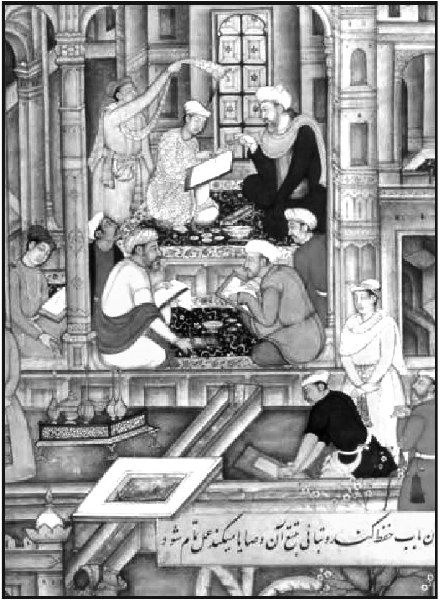
The given painting is from the sixteenth century from Mughal India. Identify the work shown in this painting from the following options:
Solution
Answer: (D) Book making
The painting shows calligraphers, illustrators and binders at work in a royal workshop (kitabkhana) of the Mughal court, where manuscripts were copied and illustrated by hand.
Which one of the following pairs is correctly matched?
(A) Ram Chaddha – Bengal Gazette
(B) Gangadhar Bhattacharya – Kesari
(C) Jyotiba Phule – Gulamgiri
(D) Rashsundari Devi – Padmarg
Solution
Answer: (C) Jyotiba Phule – Gulamgiri
Phule wrote about the injustices of the caste system in Gulamgiri (1871). Ram Chaddha wrote Istri Dharm Vichar, Gangadhar Bhattacharya published the Bengal Gazette, Kesari was Tilak's paper, and Rashsundari Devi wrote Amar Jiban.
Which one of the following pairs is correctly matched?
(A) Bal Gangadhar Tilak – Gulamgiri
(B) Jyotiba Phule – Amar Jiban
(C) Raja Rammohan Roy – Sambad Kaumudi
(D) Tarabai Shinde – Istri Dharam Vichar
Solution
Answer: (C)
Raja Rammohan Roy published Sambad Kaumudi from 1821. Gulamgiri is by Jyotiba Phule, Amar Jiban by Rashsundari Debi, and Istri Dharm Vichar by Ram Chaddha (Tarabai Shinde wrote Stripurush Tulana).
The author of 'Book of Marvels' is:
Solution
Answer: (A) Marco Polo (the board awarded the mark to all candidates who attempted it)
Marco Polo's 'Book of Marvels' on China was one of the travel books that became popular in Europe after printing spread.
Assume you are doing research on 15th century print culture. Which of the following would be the most significant advantage for your research?
Solution
Answer: (D)
Gutenberg's press (1430s–1448) produced books much faster and with uniform, accurate text, replacing slow and error-prone hand copying.
Read the following characteristics of 'Jikji' of Korea carefully and choose the correct option:
I. It is one of the oldest existing printed books in the world.
II. It contains the main beliefs of Christianity.
III. Its second volume is available in the National Library of France.
IV. It was inscribed on the UNESCO Memory of the World Register in 2001.
Solution
Answer: (C)
Jikji (1377) is among the world's oldest books printed with movable metal type. It contains the essential teachings of Zen Buddhism, not Christianity.
Which one of the following pairs is correctly matched? (Author – Book)
(A) Jyotiba Phule – Amar Jiban
(B) Sudarshan Chakra – Sachhi Kavitayen
(C) Rash Sundari Debi – Gulamgiri
(D) Kashi Baba – Chhote aur Bade ka Sawal
Solution
Answer: (B) or (D) (the board accepted both)
Sudarshan Chakra wrote Sacchi Kavitayan and Kashi Baba, a Kanpur mill worker, wrote Chhote Aur Bade Ka Sawal (1938). Amar Jiban is by Rashsundari Debi and Gulamgiri by Jyotiba Phule.
Who among the following said – "Printing is the ultimate gift of God and the greatest one."?
Solution
Answer: (A) Martin Luther
Luther's Ninety-Five Theses (1517) were printed and read widely, which led to the Protestant Reformation; he was deeply grateful to print.
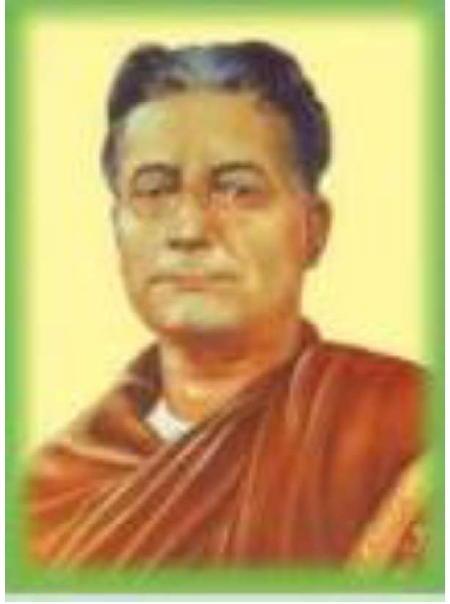
Look at the picture given below. Identify the name of the senior litterateur shown in the image and choose the correct option.
Solution
Answer: (c) Lakshminath Bezbaruah
The picture of this senior Assamese litterateur appears on the cover of the Bengali novel 'Bharat Mata' in the NCERT chapter on print culture.
Which one of the following aspects was common among the writings of Kailashbashini Debi, Tarabai Shinde and Pandita Ramabai?
Solution
Answer: (b)
They wrote with passion and anger about the miserable lives of upper-caste Hindu women, especially widows, who were imprisoned at home.
Why was the Vernacular Press Act passed in 1878?
Solution
Because vernacular newspapers had become assertively nationalist after 1857; the Act gave the government extensive rights to censor reports and editorials in the vernacular press.
Why was 'Gulamgiri' book written by Jyotiba Phule in 1871?
Fill in the blank: Buddhist missionaries from China introduced hand-printing technology into ______ around A.D. 768–770.
By 1448, Gutenberg perfected the system of printing. The first book he printed was the ______.
Why was reading of manuscript not easy in India?
Who were called 'Chapmen'?
Why were manuscripts not widely used in India before the age of print?
'Vellum' is
Who among the following said that "Printing is the ultimate gift of God and the greatest one"?
Why was printing of textbooks sponsored by the Imperial State in China?
Why had Englishmen demanded a clamp down on the 'Vernacular Press' in the 19th century?
Why did the Roman Catholic Church impose control over publishers and booksellers?
3 marks: short answer
Evaluate the role of print in the French Revolution.
Solution
1. Print popularised the ideas of Enlightenment thinkers such as Voltaire and Rousseau, who attacked the sacred authority of the Church and the despotic power of the state and argued for the rule of reason.
2. Print created a new culture of dialogue and debate. All values, norms and institutions were re-evaluated by a public that had become aware of the power of reason.
3. By the 1780s there was an outpouring of literature, cartoons and caricatures mocking the royalty and its morality, showing the monarchy absorbed in pleasure while common people suffered. This helped turn people against the monarchy.
Evaluate the role of Buddhist Missionaries in printing culture.
Solution
1. Buddhist missionaries from China introduced hand-printing technology into Japan around AD 768–770.
2. The oldest Japanese book, printed in AD 868, is the Buddhist Diamond Sutra, with six sheets of text and woodcut illustrations.
3. Printing then spread to textiles, playing cards and paper money, and by the late 18th century Edo (Tokyo) had libraries and bookshops full of hand-printed books on many subjects.
"Print culture created the favourable conditions for the French Revolution." Explain the statement with examples.
Solution
1. Print popularised the ideas of Enlightenment thinkers like Voltaire and Rousseau, who argued for the rule of reason and attacked the authority of the Church and the despotic power of the state.
2. Print created a new culture of dialogue and debate in which values, norms and institutions were questioned and re-evaluated, and ideas of social revolution came into being.
3. By the 1780s literature, cartoons and caricatures mocked the royalty and its morality and showed the hardships of common people; circulating underground, this literature turned people against the monarchy.
"Throughout the nineteenth century, there were a series of innovations in printing technology." Explain the statement with examples.
Solution
1. By the mid-19th century Richard M. Hoe of New York perfected the power-driven cylindrical press, which could print 8,000 sheets per hour.
2. In the late 19th century the offset press was developed, which could print up to six colours at a time.
3. From the early 20th century electrically operated presses sped up printing; better paper feeding, plates, automatic paper reels and photoelectric colour controls transformed the look of printed texts.
How did print come into existence in Europe? Explain.
Solution
1. In the 11th century Chinese paper reached Europe via the silk route, making it possible to produce manuscripts written by scribes.
2. In 1295 Marco Polo returned to Italy from China with knowledge of woodblock printing; Italians began producing books with woodblocks and the technology spread through Europe.
3. The breakthrough came when Johann Gutenberg of Strasbourg developed the first known printing press in the 1430s; the first book he printed was the Bible.
How did access to books create a new culture of reading? Explain.
How had the printing press created a new culture of reading in Europe? Explain with examples.
"Issues of caste discrimination began to be written about in many printed tracts and essays in India in the late nineteenth century." Support the statement with two suitable examples.
"The 'Print Revolution' had transformed the lives of people changing their relationship to information and knowledge." Analyse the statement.
4 marks: case-based / source-based
Read the given source and answer the questions that follow:
Print and Censorship. The power of the printed word is most often seen in the way governments seek to regulate and suppress print. The colonial government kept continuous track of all books and newspapers published in India and passed numerous laws to control the press. During the First World War, under the Defence of India Rules, 22 newspapers had to furnish securities. Of these, 18 shut down rather than comply with government orders. The Sedition Committee Report under Rowlatt in 1919 further strengthened controls that led to imposition of penalties on various newspapers. At the outbreak of the Second World War, the Defence of India Act was passed, allowing censoring of reports of war-related topics. All reports about the Quit India movement came under its purview. In August 1942, about 90 newspapers were suppressed.
34.1 Explain the meaning of 'censor'. (1)
34.2 Why did the colonial administration keep an eye on books and newspapers? (1)
34.3 Why did Gandhiji start a nationwide Satyagraha against the Rowlatt Act? Explain any two reasons. (2)
Solution
34.1 To censor is to examine books, newspapers and reports and suppress or ban whatever the government considers objectionable, for example writing critical of its policies.
34.2 Vernacular newspapers and books criticised colonial misrule and spread nationalist ideas, creating a sense of unity among Indians.
34.3 (i) The Rowlatt Act (1919) gave the government enormous powers to repress political activities.
(ii) It allowed detention of political prisoners without trial for two years, even though Indian members of the Imperial Legislative Council opposed it.
Read the given source and answer the questions that follow:
Print Culture and the French Revolution. Many historians have argued that print culture created the conditions within which French Revolution occurred. First: print popularised the ideas of the Enlightenment thinkers. Collectively, their writings provided a critical commentary on tradition, superstition and despotism. They argued for the rule of reason rather than custom, and demanded that everything be judged through the application of reason and rationality. They attacked the sacred authority of the Church and the despotic power of the state, thus eroding the legitimacy of a social order based on tradition. The writings of Voltaire and Rousseau were read widely; and those who read these books saw the world through new eyes, eyes that were questioning, critical and rational. Second: print created a new culture of dialogue and debate. All values, norms and institutions were re-evaluated and discussed by a public that had become aware of the power of reason, and recognised the need to question existing ideas and beliefs. Within this public culture, new ideas of social revolution came into being.
34.1 What impact did the ideas of Enlightenment thinkers have on society? (1)
34.2 How did print culture affect religion in France? (1)
34.3 How did print culture contribute to the social revolution in France? (2)
Solution
34.1 Their writings criticised tradition, superstition and despotism, and taught people to judge everything by reason and rationality rather than custom.
34.2 Enlightenment writers attacked the sacred authority of the Church, and readers began to see the world with questioning, critical eyes.
34.3 (i) Print created a new culture of dialogue and debate in which all values, norms and institutions were re-evaluated by a public aware of the power of reason.
(ii) People recognised the need to question existing ideas, and new ideas of social revolution came into being.
Read the following source and answer the questions that follow:
Print and Censorship. The power of the printed word is most often seen in the way governments seek to regulate and suppress print. The colonial government kept continuous track of all books and newspapers published in India and passed numerous laws to control the press. During the First World War, under the Defense of India Rules, 22 newspapers had to furnish securities. Of these, 18 shut down rather than comply with government orders. The Sedition Committee Report under Rowlatt in 1919 further strengthened controls that led to imposition of penalties on various newspapers. At the outbreak of the Second World War, the Defense of India Act was passed, allowing censoring of reports of war-related topics. All reports about the Quit India Movement came under its purview. In August 1942, about 90 newspapers were suppressed.
34.1 What method did the colonial government employ to keep track of Indian newspapers? (1)
34.2 How did the colonial government's laws affect the press? (1)
34.3 Analyse the impact of 'Sedition Committee' on Newspapers. (2)
Solution
34.1 It kept continuous track of all books and newspapers published in India and passed numerous laws to control the press, such as the Defence of India Rules.
34.2 Newspapers had to furnish securities, many shut down (18 of 22 during the First World War), and war-related and Quit India reports were censored.
34.3 (i) The Sedition Committee Report under Rowlatt (1919) further strengthened controls on the press.
(ii) This led to penalties being imposed on various newspapers, which curbed nationalist writing.
Read the given source and answer the questions that follow:
After the Revolt of 1857, the attitude to freedom of the press changed. Enraged Englishmen demanded a clamp down on the 'native' press. As vernacular newspapers became assertively nationalist, the colonial government began debating measures of stringent control. In 1878, the Vernacular Press Act was passed, modelled on the Irish Press Laws. It provided the government with extensive rights to censor reports and editorials in the vernacular press. From now on the government kept regular track of the vernacular newspapers published in different provinces. When a report was judged as seditious, the newspaper was warned, and if the warning was ignored, the press was liable to be seized and the printing machinery confiscated.
34.1 On which rule was the 'Vernacular Press Act' based? (1)
34.2 Why did the attitude of the British change towards the freedom of press after the Revolt of 1857? Explain. (1)
34.3 Explain any two impacts of passing the 'Vernacular Press Act'. (2)
Read the given source and answer the questions that follow:
Why Newspapers? 'Krishnaji Trimbuck Ranade inhabitant of Poona intends to publish a Newspaper in the Marathi Language with a view of affording useful information on every topic of local interest. It will be open for free discussion on subjects of general utility, scientific investigation and the speculations connected with the antiquities, statistics, curiosities, history and geography of the country and of the Deccan especially... the patronage and support of all interested in the diffusion of knowledge and Welfare of the People is earnestly solicited.' (Bombay Telegraph and Courier, 6 January, 1849)
'The task of the native newspapers and political associations is identical to the role of the Opposition in the House of Commons in Parliament in England. That is of critically examining government policy to suggest improvements, by removing those parts that will not be to the benefit of the people, and also by ensuring speedy implementation. These associations ought to carefully study the particular issues, gather diverse relevant information on the nation as well as on what are the possible and desirable improvements, and this will surely earn it considerable influence.' (Native Opinion, 3 April, 1870)
(I) Explain the main reason of publishing newspaper by Krishnaji? (1)
(II) How was the task of native newspaper and political association seen identical to the role of opposition? (1)
(III) Analyze the reasons of popularity of newspapers during 19th century. (2)
Get every solution for all chapters
- Every board question of every chapter, each fully solved the way the board gives marks
- 17 complete board papers, each followed by its solutions
- Weightage and most-asked topics for every chapter
- Instant PDF download, colour and black & white print copies
Revising the chapter first? Complete Social Science Notes for Class 10 (NCERT 2026-27) →
What you get in the pack
- Questions from 126 CBSE papers, 2016 to 2026: every set code available
- Complete: 2341 different questions and parts from all set codes, 20 chapters and 17 full papers
- Part A: all 20 chapters of History, Geography, Pol Science and Economics, sorted by marks
- Year-wise weightage table and most-asked topics for every chapter
- Part B: 17 full board papers, each followed by its complete answers, for timed practice
- Answers written to the marking-scheme points; map questions with the paper's map and every place named
- Questions on topics outside the 2026-27 board exam flagged; only the current syllabus in Part A
All chapters in this pack
- PYQ History 1 The Rise of Nationalism in Europe
- PYQ History 2 Nationalism in India
- PYQ History 3 The Making of a Global World
- PYQ History 5 Print Culture and the Modern World
- PYQ Geography 1 Resources and Development
- PYQ Geography 2 Forest and Wildlife Resources
- PYQ Geography 3 Water Resources
- PYQ Geography 4 Agriculture
- PYQ Geography 5 Minerals and Energy Resources
- PYQ Geography 6 Manufacturing Industries
- PYQ Geography 7 Lifelines of National Economy (Map)
- PYQ Pol Science 1 Power-sharing
- PYQ Pol Science 2 Federalism
- PYQ Pol Science 3 Gender, Religion and Caste
- PYQ Pol Science 4 Political Parties
- PYQ Pol Science 5 Outcomes of Democracy
- PYQ Economics 1 Development
- PYQ Economics 2 Sectors of the Indian Economy
- PYQ Economics 3 Money and Credit
- PYQ Economics 4 Globalisation and the Indian Economy
- Board Paper 2026 Set 32-4-1 with Solutions
- Board Paper 2026 Set 32-5-1 with Solutions
- Board Paper 2025 Set 32-1-1 with Solutions
- Board Paper 2025 Set 32-2-1 with Solutions
- Board Paper 2024 Set 32-2-1 with Solutions
- Board Paper 2024 Set 32-4-1 with Solutions
- Board Paper 2023 Set 32-2-1 with Solutions
- Board Paper 2023 Set 32-4-1 with Solutions
- Board Paper 2022 Term 2 Set 32-1-1 with Solutions
- Board Paper 2022 Term 2 Set 32-3-1 with Solutions
- Board Paper 2020 Set 32-1-1 with Solutions
- Board Paper 2020 Set 32-4-1 with Solutions
- Board Paper 2019 Set 32-2-1 with Solutions
- Board Paper 2019 Set 32-4-1 with Solutions
- Board Paper 2018 Set 32-1 with Solutions
- Board Paper 2017 Set 32-1 with Solutions
- Board Paper 2016 Set 32-1 with Solutions