
The Rise of Nationalism in Europe: Class 10 PYQs 2016–2026 with solutions
All 41 CBSE board questions asked from The Rise of Nationalism in Europe in 15 board papers, with the year, set and marks of each. 22 are solved free below. The Class 10 SST PYQ Book: Solved Board Papers 2016-2026 (CBSE) has every solution, all chapters and 17 full board papers.
Subject expert: Vikas Chandrawal, M.A. History · 8 years teaching


Free: NCERT solutions for Class 10 SST →
The Rise of Nationalism in Europe: board weightage
Board weightage 2016–2026
| Year | 2016 | 2017 | 2018 | 2019 | 2020 | 2022 | 2023 | 2024 | 2025 | 2026 |
|---|---|---|---|---|---|---|---|---|---|---|
| Questions | 3 | 2 | 1 | 4 | 7 | – | 5 | 7 | 7 | 5 |
| Marks | 9 | 8 | 5 | 8 | 23 | – | 9 | 16 | 23 | 21 |
Most asked topics
41 questions from 15 papers. Repeated questions are shown once with every year they were asked.
Jump to: 1 mark2 marks3 marks5 marks
1 mark: MCQ and Assertion–Reason
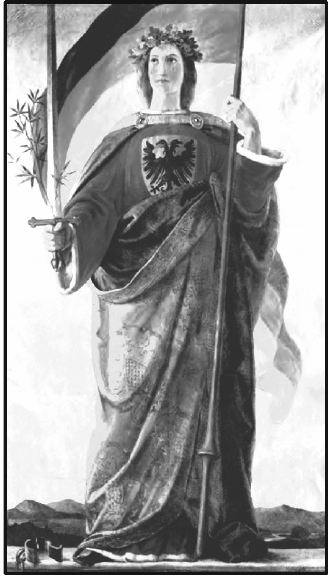
Identify this image of the allegorical figure of a European nation during the nineteenth century from the following options:
Solution
Answer: (D) Germania
Germania, painted by Philip Veit (1848), wears a crown of oak leaves (the German oak stands for heroism) and holds a sword and the black-red-gold flag.
Which one of the following regions became a part of unified Italy in 1866?
Solution
Answer: (B) Venetia
Venetia was added to Italy in 1866 (after the Austro-Prussian War); the Papal States followed in 1870.
'Potato famine' was related to which of the following countries?
Solution
Answer: (B) Ireland
When potato blight destroyed the crop in 1845–49, about one million people died of starvation in Ireland and double that number emigrated.
Arrange the following events in chronological order and choose the correct option:
I. Defeat of Napoleon in the battle of Leipzig
II. Beginning of struggle for Greek independence
III. Formation of customs union Zollverein
IV. Signing of Treaty of Vienna
Solution
Correct order: I, IV, II, III, which is not among the options; the board awarded the mark to all candidates.
Leipzig (1813) → Treaty of Vienna (1815) → Greek war of independence begins (1821) → Zollverein (1834).
The German philosopher 'Johann Gottfried' belonged to which one of the following schools of thought?
Solution
Answer: (C) Romanticist
Johann Gottfried Herder held that true German culture was to be discovered among the common people (das volk), through folk songs, folk poetry and folk dances.
Assertion (A): 'The Act of Union 1707' between England and Scotland resulted in the formation of 'United Kingdom of Great Britain'.
Reason (R): England wanted to impose its influence on Scotland.
Solution
Answer: (A)
The Act of Union was the result of England's growing power and its wish to dominate Scotland; Scotland's culture and institutions were then suppressed.
Arrange the following events in chronological order:
I. Treaty of Constantinople
II. Habsburgs granted autonomy to Hungary
III. Balkan Conflict
IV. Napoleonic Civil Code
Solution
Answer: (C) IV, I, II & III
Napoleonic Code (1804) → Treaty of Constantinople (1832) → autonomy to Hungary (1867) → Balkan conflict (from 1871, leading to the First World War).
Arrange the following incidents in chronological order:
I. French Revolution
II. Napoleon's invasion of Italy
III. Unification of Italy
IV. Vienna Peace Treaty
Solution
Answer: (A) I, II, IV, III
French Revolution (1789) → Napoleon's invasion of Italy (1796–97) → Treaty of Vienna (1815) → unification of Italy (1861).
Which one of the following ideologies were the European Governments driven by after the defeat of Napoleon in 1815?
Arrange the following in chronological order:
(I) Napoleonic wars
(II) The Treaty of Vienna
(III) Greek Struggle for Independence
(IV) Slav Nationalism in Ottoman Empire
Which of the following revolutions is called as the first expression of 'Nationalism'?
Who among the following was proclaimed as the first German Emperor in 1871?
Fill in the blank: Young Italy was formed by ______.
Explain the aim to form 'Zollverein', a Customs Union, in 1834 in Germany.
Why did Frédéric Sorrieu present utopian vision in his prints in 1848? Explain one reason.
Who remarked "when France sneezes the rest of Europe catches cold".
2 marks: very short answer
"Conservative regimes set up in Europe in 1815 were autocratic." Support the statement by giving any two arguments.
Solution
1. They did not tolerate criticism and dissent and sought to curb activities that questioned the legitimacy of autocratic governments.
2. Most of them imposed censorship laws to control what was said in newspapers, books, plays and songs.
Analyse the role of Chief Minister Cavour who led the movement to unite the regions of Italy.
Solution
1. Cavour, the chief minister of Sardinia-Piedmont, was neither a revolutionary nor a democrat; like many educated Italian elites he spoke French better than Italian.
2. Through a tactful diplomatic alliance with France that he engineered, Sardinia-Piedmont defeated the Austrian forces in 1859, a decisive step towards unification.
Examine the ideas of liberal nationalism in Europe during the nineteenth century.
3 marks: short answer
"Ideas of national unity in the early nineteenth century Europe were closely allied to the ideology of liberalism." Examine the statement.
Solution
1. Liberalism (from the Latin liber, free) stood for freedom of the individual and equality of all before the law, and politically for government by consent: an end of autocracy, a constitution and representative government.
2. However, equality before the law did not mean universal suffrage; in revolutionary France the right to vote was granted only to property-owning men, and liberals stressed the inviolability of private property.
3. In the economic sphere it stood for freedom of markets and removal of state restrictions on goods and capital. In 1834 the Zollverein (customs union) abolished tariff barriers among German states, linking economic nationalism with national unity.
Describe the great economic hardship that prevailed in Europe during the 1930s. (The board accepted answers on the 1830s or the 1930s.)
Solution
For the 1830s (NCERT, Nationalism in Europe):
1. Europe's population increased enormously, and in most countries there were more seekers of jobs than employment.
2. People migrated from rural areas to cities to live in overcrowded slums; small producers faced stiff competition from cheap machine-made goods from England.
3. Where aristocracy still ruled, peasants struggled under feudal dues; a rise in food prices or a bad harvest led to widespread pauperism.
Describe the role of Romanticism in developing nationalist feelings among Europeans during nineteenth century.
Solution
1. Romanticism was a cultural movement that sought to develop a particular form of nationalist sentiment through art, poetry, stories and music, appealing to emotions, intuition and mystical feelings rather than reason and science.
2. Romantic artists and poets focused on a shared collective heritage and a common cultural past as the basis of a nation. The German philosopher Johann Gottfried Herder claimed that true German culture was to be discovered among the common people, das volk, through folk songs, folk poetry and folk dances.
3. Language played an important role: in Poland, after the Russian occupation, the Polish language was used as a weapon of national resistance (church gatherings, religious instruction in Polish), and Karol Kurpinski celebrated the national struggle through operas and music, turning folk dances like the polonaise and mazurka into nationalist symbols.
Describe any three economic hardships faced by Europe in the 1830s.
"The decade of 1830 had brought great economic hardship in Europe." Support the statement with arguments.
5 marks: long answer
Describe the process of unification of Germany.
Solution
1. In 1848 middle-class Germans tried to unite the regions of the German Confederation into a nation-state governed by an elected parliament (Frankfurt Parliament).
2. This liberal initiative was repressed by the monarchy and the military, supported by the large landowners (Junkers) of Prussia.
3. Prussia then took over the leadership of the movement for national unification.
4. Its chief minister, Otto von Bismarck, was the architect of the process, carried out with the help of the Prussian army and bureaucracy.
5. Three wars over seven years, with Denmark, Austria and France, ended in Prussian victory and completed unification. In January 1871 the Prussian king William I was proclaimed German Emperor at Versailles.
Describe the process of unification of Italy.
Solution
1. In the mid-19th century Italy was divided into seven states; only Sardinia-Piedmont was ruled by an Italian princely house. The north was under the Austrian Habsburgs, the centre under the Pope and the south under the Bourbon kings of Spain.
2. In the 1830s Giuseppe Mazzini worked out a programme for a unitary Italian republic and formed the secret society Young Italy.
3. After the failed uprisings of 1831 and 1848, the task fell to Sardinia-Piedmont under King Victor Emmanuel II, who sought unification through war.
4. Through a diplomatic alliance with France engineered by Chief Minister Cavour, Sardinia-Piedmont defeated the Austrian forces in 1859.
5. In 1860 armed volunteers under Giuseppe Garibaldi marched into South Italy and the Kingdom of the Two Sicilies and, with the support of local peasants, drove out the Spanish rulers. In 1861 Victor Emmanuel II was proclaimed king of united Italy.
Examine the nationalist tensions emerged in the Balkan region by the end of nineteenth century.
Solution
1. The Balkans (modern Romania, Bulgaria, Albania, Greece, Serbia and others) was a region of geographical and ethnic variation whose people were broadly called Slavs; much of it was under the Ottoman Empire.
2. The spread of romantic nationalism together with the disintegration of the Ottoman Empire made the region explosive; one by one its subject nationalities broke away and declared independence.
3. The Balkan peoples used history to claim that they had once been independent and had been subjugated by foreign powers.
4. The Balkan states were fiercely jealous of each other, and each hoped to gain more territory at the others' expense.
5. The region also became the scene of big-power rivalry: Russia, Germany, England and Austria-Hungary each tried to counter the others and extend its own control. This led to a series of wars and finally to the First World War.
Examine the role of Giuseppe Mazzini in the unification of Italy during the nineteenth century.
Solution
1. Born in Genoa in 1805, Mazzini became a member of the secret society of the Carbonari and was exiled in 1831 for attempting a revolution in Liguria.
2. In the 1830s he worked out a coherent programme for a unitary Italian republic.
3. He believed God had intended nations to be the natural units of mankind, so Italy could not remain a patchwork of small states; it had to be forged into a single unified republic.
4. He founded secret societies, Young Italy in Marseilles and Young Europe in Berne, to spread his ideas.
5. His opposition to monarchy and his vision of democratic republics frightened conservatives (Metternich called him "the most dangerous enemy of our social order"), and his ideas inspired the revolutionaries who later achieved unification.
Analyse the significance of the 'Napoleonic Code' in making the administrative system rational and efficient.
Solution
The Civil Code of 1804, the Napoleonic Code:
1. Did away with all privileges based on birth and established equality before the law.
2. Secured the right to property.
3. Simplified administrative divisions, abolished the feudal system and freed peasants from serfdom and manorial dues.
4. Removed guild restrictions in towns and improved transport and communication systems.
5. Gave peasants, artisans, workers and businessmen new freedom; uniform laws, standardised weights and measures and a common currency made the movement of goods and capital easier.
How was liberalism allied to national unity in Europe in the early decades of the 19th century? Analyse.
Solution
1. For the new middle classes, liberalism meant freedom for the individual and equality of all before the law.
2. Politically it stood for government by consent: an end to autocracy and clerical privileges, a constitution and representative government through parliament.
3. Economically it stood for freedom of markets and the abolition of state-imposed restrictions on the movement of goods and capital.
4. In the German lands, merchants travelling from Hamburg to Nuremberg had to pass 11 customs barriers, and each region had its own currency, weights and measures; such barriers were seen as obstacles to economic growth.
5. In 1834 the Zollverein, a customs union led by Prussia, abolished tariff barriers and reduced currencies from over thirty to two. It created a network of railways and linked economic interests with national unity.
How did French Revolution spread the spirit of nationalism in Europe? Explain with suitable arguments.
Solution
1. The first clear expression of nationalism came with the French Revolution of 1789, which transferred sovereignty from the monarchy to the French citizens.
2. Revolutionaries introduced ideas like la patrie (fatherland) and le citoyen (citizen), a new tricolour flag, a National Assembly, new hymns, uniform laws and French as the common language, creating a collective identity.
3. They declared it the mission of the French nation to liberate the peoples of Europe from despotism.
4. Students and educated middle classes in other European cities set up Jacobin clubs.
5. Their activities prepared the way for French armies, which moved into Holland, Belgium, Switzerland and much of Italy in the 1790s and carried the idea of nationalism abroad.
How did the Greek freedom struggle arouse nationalist sentiments in Europe? Explain with suitable arguments.
Solution
1. The Greek war of independence mobilised nationalist feelings among the educated elite across Europe.
2. Greece had been part of the Ottoman Empire since the 15th century; a struggle for independence began in 1821.
3. Greek nationalists got support from Greeks in exile and from West Europeans who admired ancient Greek culture.
4. Poets and artists lauded Greece as the cradle of European civilisation and mobilised public opinion for its struggle against a Muslim empire; the English poet Lord Byron raised funds and died fighting in 1824.
5. The Treaty of Constantinople (1832) recognised Greece as an independent nation.
"The French Revolution created a sense of collective identity among the French people." Explain the statement with suitable arguments.
Solution
1. The Revolution (1789) transferred sovereignty from the monarchy to the French citizens; the people would now constitute the nation and shape its destiny.
2. The ideas of la patrie (fatherland) and le citoyen (citizen) emphasised a united community enjoying equal rights under a constitution.
3. A new French flag, the tricolour, replaced the royal standard, and the Estates General was renamed the National Assembly.
4. New hymns were composed, oaths taken and martyrs commemorated in the name of the nation.
5. A centralised administrative system with uniform laws, internal customs duties abolished, a uniform system of weights and measures, and French as the common language bound the people together.
"The Greek war of independence mobilised nationalist feelings among the educated elite across Europe." Explain the statement with suitable arguments.
How did ideas of national unity in early nineteenth century Europe allied to the ideology of liberalism? Explain.
How did Greek war of independence mobilise nationalist feelings among the educated elite across Europe? Explain.
Why is it said that the 1830s were the years of great hardship in Europe? Explain.
How did nationalism aligned with imperialism become the cause of the First World War? Explain.
Describe the explosive conditions prevailed in Balkans after 1871 in Europe.
"The first clear expression of nationalism came with the 'French Revolution' in 1789." Examine the statement.
"Napoleon had destroyed democracy in France but in the administrative field he had incorporated revolutionary principles in order to make the whole system more rational and efficient." Analyse the statement with arguments.
Get every solution for all chapters
- Every board question of every chapter, each fully solved the way the board gives marks
- 17 complete board papers, each followed by its solutions
- Weightage and most-asked topics for every chapter
- Instant PDF download, colour and black & white print copies
Revising the chapter first? Complete Social Science Notes for Class 10 (NCERT 2026-27) →
What you get in the pack
- Questions from 126 CBSE papers, 2016 to 2026: every set code available
- Complete: 2341 different questions and parts from all set codes, 20 chapters and 17 full papers
- Part A: all 20 chapters of History, Geography, Pol Science and Economics, sorted by marks
- Year-wise weightage table and most-asked topics for every chapter
- Part B: 17 full board papers, each followed by its complete answers, for timed practice
- Answers written to the marking-scheme points; map questions with the paper's map and every place named
- Questions on topics outside the 2026-27 board exam flagged; only the current syllabus in Part A
All chapters in this pack
- PYQ History 1 The Rise of Nationalism in Europe
- PYQ History 2 Nationalism in India
- PYQ History 3 The Making of a Global World
- PYQ History 5 Print Culture and the Modern World
- PYQ Geography 1 Resources and Development
- PYQ Geography 2 Forest and Wildlife Resources
- PYQ Geography 3 Water Resources
- PYQ Geography 4 Agriculture
- PYQ Geography 5 Minerals and Energy Resources
- PYQ Geography 6 Manufacturing Industries
- PYQ Geography 7 Lifelines of National Economy (Map)
- PYQ Pol Science 1 Power-sharing
- PYQ Pol Science 2 Federalism
- PYQ Pol Science 3 Gender, Religion and Caste
- PYQ Pol Science 4 Political Parties
- PYQ Pol Science 5 Outcomes of Democracy
- PYQ Economics 1 Development
- PYQ Economics 2 Sectors of the Indian Economy
- PYQ Economics 3 Money and Credit
- PYQ Economics 4 Globalisation and the Indian Economy
- Board Paper 2026 Set 32-4-1 with Solutions
- Board Paper 2026 Set 32-5-1 with Solutions
- Board Paper 2025 Set 32-1-1 with Solutions
- Board Paper 2025 Set 32-2-1 with Solutions
- Board Paper 2024 Set 32-2-1 with Solutions
- Board Paper 2024 Set 32-4-1 with Solutions
- Board Paper 2023 Set 32-2-1 with Solutions
- Board Paper 2023 Set 32-4-1 with Solutions
- Board Paper 2022 Term 2 Set 32-1-1 with Solutions
- Board Paper 2022 Term 2 Set 32-3-1 with Solutions
- Board Paper 2020 Set 32-1-1 with Solutions
- Board Paper 2020 Set 32-4-1 with Solutions
- Board Paper 2019 Set 32-2-1 with Solutions
- Board Paper 2019 Set 32-4-1 with Solutions
- Board Paper 2018 Set 32-1 with Solutions
- Board Paper 2017 Set 32-1 with Solutions
- Board Paper 2016 Set 32-1 with Solutions