
Manufacturing Industries: Class 10 PYQs 2016–2026 with solutions
All 33 CBSE board questions asked from Manufacturing Industries in 17 board papers, with the year, set and marks of each. 18 are solved free below. The Class 10 SST PYQ Book: Solved Board Papers 2016-2026 (CBSE) has every solution, all chapters and 17 full board papers.
Subject expert: Vikas Chandrawal, M.A. History · 8 years teaching


Free: NCERT solutions for Class 10 SST →
Manufacturing Industries: board weightage
Board weightage 2016–2026
| Year | 2016 | 2017 | 2018 | 2019 | 2020 | 2022 | 2023 | 2024 | 2025 | 2026 |
|---|---|---|---|---|---|---|---|---|---|---|
| Questions | 3 | 3 | 2 | 4 | 3 | 3 | 4 | 4 | 5 | 2 |
| Marks | 9 | 11 | 8 | 16 | 9 | 8 | 5 | 14 | 21 | 2 |
Most asked topics
33 questions from 17 papers. Repeated questions are shown once with every year they were asked.
Jump to: 1 mark2 marks3 marks4 marks5 marks
1 mark: MCQ and Assertion–Reason
(iii) Software Technology Park in Tamil Nadu
Solution
Chennai (also accepted: Coimbatore, Madurai). Chennai lies on the Coromandel coast in northern Tamil Nadu.
(iii) A software technology park located in Uttar Pradesh
Solution
Noida, in western Uttar Pradesh, next to Delhi.
(iii) Iron and Steel Plant located in Jharkhand
Solution
Bokaro or Jamshedpur, in eastern Jharkhand.
(iii) Bengaluru – Software Technology Park
Solution
Bengaluru, south-eastern Karnataka.
Assertion (A): Agriculture and industry move hand in hand.
Reason (R): Industrial development is a precondition for eradication of unemployment and poverty from the country.
On the same political outline map of India, locate and label any three of the following with suitable symbols:
(i) Noida Software Technology Park
(c) Pune Software Technology Park
Fill in the blank: ______ industry is used for manufacturing aircraft, utensils and wires.
2 marks: very short answer
"Agriculture and industry move hand in hand." Support the statement with examples.
Solution
1. Agro-industries depend on agriculture for raw materials, such as cotton for textiles, sugarcane for sugar and jute for jute mills.
2. Industries in turn supply agriculture with irrigation pumps, fertilisers, insecticides, pesticides, PVC pipes, machines and tools, raising farm productivity and making production efficient.
Study the given flowchart (Fibre production → Spinning → Weaving/Knitting → Dyeing and Finishing → Garment manufacture; products: raw fibre, yarn, fabric, garments) and answer the questions that follow:
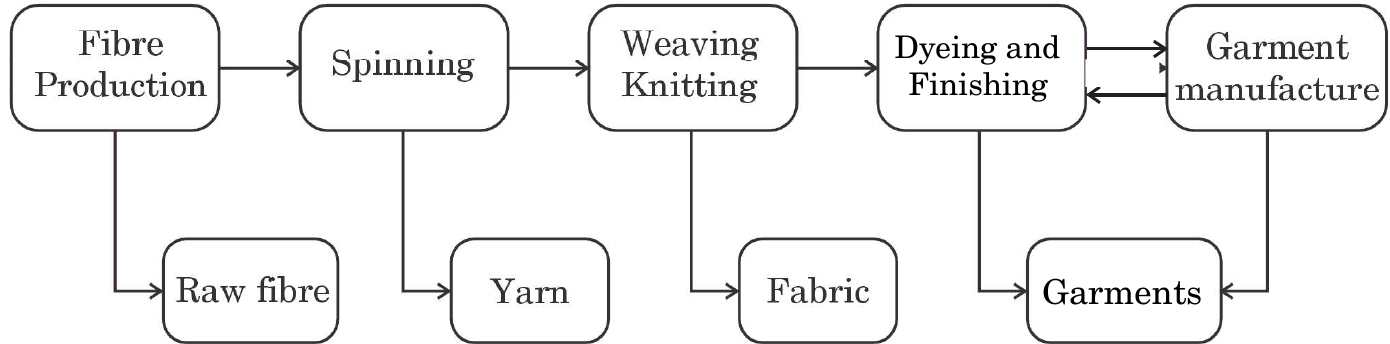
(5.1) Which is the basic material required for garment manufacturing? (1)
(5.2) Give one example of value addition in the textile industry. (1)
Solution
5.1 Raw fibre (cotton, jute, silk, wool or synthetic fibre), which is turned into yarn and fabric.
5.2 Dyeing and finishing of fabric (also spinning yarn, weaving fabric, stitching garments); each stage adds value to the raw fibre.
Explain the major concerns of Jute Textile industry.
3 marks: short answer
"India's prosperity lies in expanding and diversifying its manufacturing industries." Justify the statement.
Solution
1. Manufacturing helps modernise agriculture and reduces dependence on it by providing jobs in the secondary and tertiary sectors, which helps remove unemployment and poverty.
2. Exports of manufactured goods expand trade and bring in foreign exchange.
3. Countries that turn raw materials into a wide variety of higher-value finished goods are prosperous; industries in backward and tribal areas also reduce regional disparities.
Locate and label any three of the following: (i) Bokaro – Iron and Steel Plant; (ii) Gandhinagar – Software Technology Park; (iii) Tarapur – Nuclear Power Plant; (iv) Salal – Dam; (v) Tuticorin – Sea Port.
Solution
(i) Bokaro: Jharkhand.
(ii) Gandhinagar: Gujarat, near Ahmedabad.
(iii) Tarapur: Maharashtra coast, north of Mumbai.
(iv) Salal: on the Chenab in Jammu and Kashmir.
(v) Tuticorin: Tamil Nadu coast (east coast).
Locate and label any three of the following: (i) Tarapur – Nuclear Power Plant; (ii) Tungabhadra – Dam; (iii) Mohali – Software Technology Park; (iv) Kandla – Major Sea Port; (v) Durgapur – Iron and Steel Plant.
Solution
(i) Tarapur: Maharashtra coast, north of Mumbai.
(ii) Tungabhadra: on the Tungabhadra river at Hospet, Karnataka.
(iii) Mohali: Punjab, next to Chandigarh.
(iv) Kandla: Gulf of Kachchh, Gujarat (west coast).
(v) Durgapur: West Bengal, on the Damodar.
Locate and label the following: (i) Raja Sansi – International Airport; (ii) Bhadravati – Iron and Steel Plant; (iii) Software Technology Park of West Bengal.
Solution
(i) Raja Sansi: Amritsar, Punjab.
(ii) Bhadravati: Shivamogga district, Karnataka.
(iii) Kolkata, West Bengal.
Analyse the role of the manufacturing sector in the economic development of India.
Solution
1. Manufacturing industries help in modernising agriculture, which forms the backbone of our economy, and reduce heavy dependence of people on agricultural income by providing jobs in secondary and tertiary sectors.
2. Industrial development is a precondition for the eradication of unemployment and poverty; industries were set up in tribal and backward areas to reduce regional disparities.
3. Export of manufactured goods expands trade and commerce and brings in much-needed foreign exchange; countries that turn raw materials into a wide variety of higher-value goods are prosperous.
On the given political outline map of India locate and label: A. Naraura – Nuclear Power Plant; B. Tuticorin – Major Sea Port; C. Bhilai – Iron and Steel Plant.
Classify industries on the basis of source of raw material. How are they different from each other?
Suggest any three steps to minimise the environmental degradation caused by the industrial development in India.
On the given political outline map of India, locate and label: A. Oil Field – Digboi; B. Iron and Steel Plant – Bhilai; C. Major Sea Port – Kochi.
4 marks: case-based / source-based
Read the case given below carefully and answer the questions that follow:
National Thermal Power Corporation (NTPC) shows the way. NTPC is a major power providing corporation in India. It has ISO certification for EMS (Environment Management System) 14001. The corporation has a proactive approach for preserving the natural environment and resources like water, oil, gas and fuels in places where it is setting up power plants. This has been possible through: (a) Optimum utilisation of equipment adopting latest techniques and upgrading existing equipment. (b) Minimising waste generation by maximising ash utilisation. (c) Providing green belts for nurturing ecological balance and addressing the question of special purpose vehicles for afforestation. (d) Reducing environmental pollution through ash pond management, ash water recycling system and liquid waste management. (e) Ecological monitoring, reviews and online database management for all its power stations.
(12.1) Examine the concept of sustainable development. (1)
(12.2) What is the idea behind ISO certification? (1)
(12.3) Examine the proactive approach of National Thermal Power Corporation (NTPC). (2)
Solution
12.1 Development that takes place without damaging the environment, so that development in the present does not compromise the needs of future generations.
12.2 ISO 14001 certifies that the organisation follows an effective Environment Management System, keeping its operations within international environmental standards.
12.3 (i) It preserves natural resources by optimum use of equipment with the latest techniques, and minimises waste by maximising ash utilisation.
(ii) It reduces pollution through ash pond management, ash-water recycling and liquid waste management, and provides green belts and ecological monitoring at all its power stations.
Locate and label any four of the following with appropriate symbols on the same map: (i) Sardar Sarovar – Dam; (ii) Bhilai – Iron and Steel Plant; (iii) Pune – Software Technology Park; (iv) Kochi – Major Sea Port; (v) Indore – Cotton Textile Industry; (vi) Naraura – Nuclear Power Plant.
Solution
(i) Sardar Sarovar: on the Narmada in Gujarat, near the Madhya Pradesh–Maharashtra border.
(ii) Bhilai: central Chhattisgarh, near Durg.
(iii) Pune: western Maharashtra.
(iv) Kochi: on the Kerala coast.
(v) Indore: western Madhya Pradesh.
(vi) Narora: western Uttar Pradesh.
Locate and label any four of the following: (i) Hirakud – Dam; (ii) Kanpur – Cotton Textile Industrial Centre; (iii) Kandla – Sea-port; (iv) Salem – Iron and Steel Plant; (v) Amritsar (Raja Sansi) – International Airport; (vi) Hyderabad – Software Technology Park.
5 marks: long answer
"Manufacturing industries are considered the backbone of the economic development of a country." Justify the statement.
Solution
1. Manufacturing helps modernise agriculture by supplying machines, fertilisers and pumps, and reduces people's dependence on agriculture by providing jobs in the secondary and tertiary sectors.
2. Industrial development is a precondition for removing unemployment and poverty.
3. Export of manufactured goods expands trade and brings in foreign exchange.
4. Countries that turn their raw materials into a wide variety of higher-value finished goods are prosperous.
5. Setting up industries in tribal and backward areas helps reduce regional disparities.
"Agriculture and industries complement each other." Justify the statement.
Solution
1. Agriculture and industry are not exclusive of each other; they move hand in hand.
2. Agro-based industries (cotton, jute, sugar, vegetable oil) depend on agriculture for their raw materials.
3. Industries in turn supply agriculture with irrigation pumps, fertilisers, insecticides, pesticides, PVC pipes, machines and tools.
4. Competitive manufacturing has helped farmers increase production and made the production process more efficient.
5. Agro-industries have given a major boost to agriculture by raising its productivity and creating demand for farm produce.
Explain the role of industries in increasing air pollution and suggest measures to control it. (2 + 3 = 5)
Solution
Role (2):
1. Industries release undesirable gases such as sulphur dioxide and carbon monoxide, and particulate matter like dust, mist and smoke.
2. Smoke comes from chemical and paper factories, brick kilns, refineries and smelting plants, and from burning fossil fuels in factories that ignore pollution norms; toxic gas leaks are very hazardous.
Measures (3):
1. Increase the height of chimneys to reduce particulate matter near the ground.
2. Fit smoke stacks with electrostatic precipitators, fabric filters, scrubbers and inertial separators.
3. Use oil or gas instead of coal, and shift to renewable energy sources.
Explain the measures taken by 'National Thermal Power Corporation' to prevent environmental degradation.
Solution
1. NTPC follows a proactive approach to preserve the natural environment and resources like water, oil, gas and fuel where it sets up power plants.
2. It makes optimum use of equipment by adopting the latest techniques and upgrading existing equipment.
3. It minimises waste by maximising ash utilisation.
4. It provides green belts to maintain ecological balance and works on afforestation.
5. It reduces pollution through ash pond management, ash water recycling and liquid waste management, and carries out ecological monitoring and online database management for all its power stations.
Describe the role of manufacturing industries in the economic development of a country.
Solution
1. Manufacturing helps modernise agriculture by supplying machines, fertilisers and other inputs.
2. It reduces heavy dependence on agriculture by providing jobs in the secondary and tertiary sectors, which helps remove unemployment and poverty.
3. Setting up industries in tribal and backward areas reduces regional disparities.
4. Exports of manufactured goods expand trade and commerce and bring in foreign exchange.
5. Countries that convert raw materials into a wide variety of higher-value finished goods are prosperous; India's GDP has grown with its manufacturing sector.
Describe any five steps taken to save fresh water from industrial pollution.
How can the industrial pollution of fresh water be reduced? Explain various ways.
Explain the reasons for concentration of iron and steel industries in and around Chotanagpur region.
Why is the economic strength of a country measured by the development of manufacturing industries? Explain with examples.
Analyse the role of chemical industries in the Indian economy.
Get every solution for all chapters
- Every board question of every chapter, each fully solved the way the board gives marks
- 17 complete board papers, each followed by its solutions
- Weightage and most-asked topics for every chapter
- Instant PDF download, colour and black & white print copies
Revising the chapter first? Complete Social Science Notes for Class 10 (NCERT 2026-27) →
What you get in the pack
- Questions from 126 CBSE papers, 2016 to 2026: every set code available
- Complete: 2341 different questions and parts from all set codes, 20 chapters and 17 full papers
- Part A: all 20 chapters of History, Geography, Pol Science and Economics, sorted by marks
- Year-wise weightage table and most-asked topics for every chapter
- Part B: 17 full board papers, each followed by its complete answers, for timed practice
- Answers written to the marking-scheme points; map questions with the paper's map and every place named
- Questions on topics outside the 2026-27 board exam flagged; only the current syllabus in Part A
All chapters in this pack
- PYQ History 1 The Rise of Nationalism in Europe
- PYQ History 2 Nationalism in India
- PYQ History 3 The Making of a Global World
- PYQ History 5 Print Culture and the Modern World
- PYQ Geography 1 Resources and Development
- PYQ Geography 2 Forest and Wildlife Resources
- PYQ Geography 3 Water Resources
- PYQ Geography 4 Agriculture
- PYQ Geography 5 Minerals and Energy Resources
- PYQ Geography 6 Manufacturing Industries
- PYQ Geography 7 Lifelines of National Economy (Map)
- PYQ Pol Science 1 Power-sharing
- PYQ Pol Science 2 Federalism
- PYQ Pol Science 3 Gender, Religion and Caste
- PYQ Pol Science 4 Political Parties
- PYQ Pol Science 5 Outcomes of Democracy
- PYQ Economics 1 Development
- PYQ Economics 2 Sectors of the Indian Economy
- PYQ Economics 3 Money and Credit
- PYQ Economics 4 Globalisation and the Indian Economy
- Board Paper 2026 Set 32-4-1 with Solutions
- Board Paper 2026 Set 32-5-1 with Solutions
- Board Paper 2025 Set 32-1-1 with Solutions
- Board Paper 2025 Set 32-2-1 with Solutions
- Board Paper 2024 Set 32-2-1 with Solutions
- Board Paper 2024 Set 32-4-1 with Solutions
- Board Paper 2023 Set 32-2-1 with Solutions
- Board Paper 2023 Set 32-4-1 with Solutions
- Board Paper 2022 Term 2 Set 32-1-1 with Solutions
- Board Paper 2022 Term 2 Set 32-3-1 with Solutions
- Board Paper 2020 Set 32-1-1 with Solutions
- Board Paper 2020 Set 32-4-1 with Solutions
- Board Paper 2019 Set 32-2-1 with Solutions
- Board Paper 2019 Set 32-4-1 with Solutions
- Board Paper 2018 Set 32-1 with Solutions
- Board Paper 2017 Set 32-1 with Solutions
- Board Paper 2016 Set 32-1 with Solutions