
Minerals and Energy Resources: Class 10 PYQs 2016–2026 with solutions
All 41 CBSE board questions asked from Minerals and Energy Resources in 15 board papers, with the year, set and marks of each. 21 are solved free below. The Class 10 SST PYQ Book: Solved Board Papers 2016-2026 (CBSE) has every solution, all chapters and 17 full board papers.
Subject expert: Vikas Chandrawal, M.A. History · 8 years teaching


Free: NCERT solutions for Class 10 SST →
Minerals and Energy Resources: board weightage
Board weightage 2016–2026
| Year | 2016 | 2017 | 2018 | 2019 | 2020 | 2022 | 2023 | 2024 | 2025 | 2026 |
|---|---|---|---|---|---|---|---|---|---|---|
| Questions | 3 | 2 | – | 1 | 5 | 2 | 5 | 9 | 6 | 8 |
| Marks | 9 | 8 | – | 3 | 5 | 2 | 7 | 18 | 6 | 24 |
Most asked topics
41 questions from 15 papers. Repeated questions are shown once with every year they were asked.
Jump to: 1 mark2 marks3 marks5 marks
1 mark: MCQ and Assertion–Reason
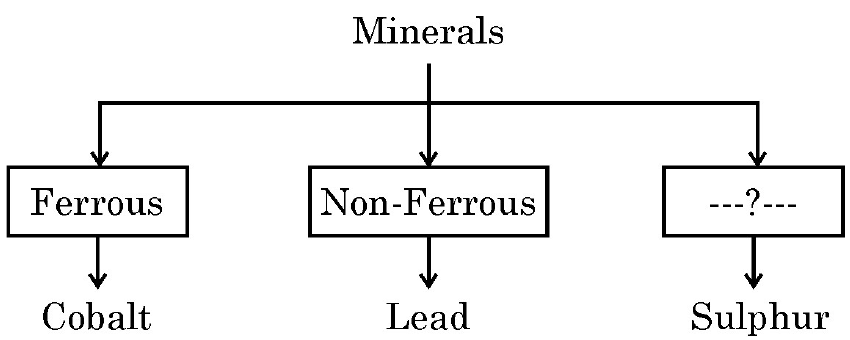
Choose the correct option to fill in the blank:
Solution
Answer: (A) Non-metallic
Cobalt (ferrous) and lead (non-ferrous) are metallic minerals; sulphur is a non-metallic mineral.
(ii) Nuclear power plant in Maharashtra
Solution
Tarapur, on the coast of Maharashtra north of Mumbai (near the Gujarat border).
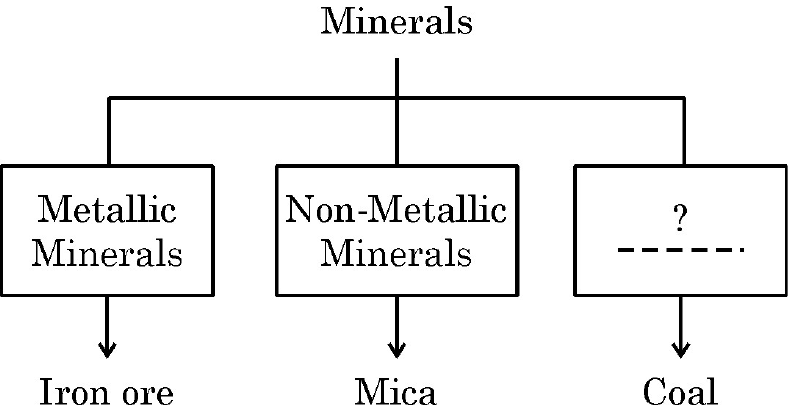
Choose the appropriate option to fill in the blank:
Solution
Answer: (C) Energy minerals
Minerals are metallic (iron ore), non-metallic (mica) or energy minerals (coal, petroleum, natural gas).
(ii) A nuclear power plant located in Gujarat
Solution
Kakrapara, near Surat in southern Gujarat.
Assertion (A): Minerals are an indispensable part of our lives.
Reason (R): All living things need minerals.
Solution
Answer: (A)
Almost everything we use, from a tiny pin to buildings and ships, is made from minerals, and all living things need minerals; R explains why they are indispensable.
Match Column I (Minerals) with Column II (Major Mines): a. Iron ore, b. Mica, c. Bauxite, d. Coal; i. Gaya, ii. Singrauli, iii. Chandrapur, iv. Maikala.
Solution
Answer: (A)
Iron ore – Chandrapur (Maharashtra); Mica – Gaya (Bihar); Bauxite – Maikala hills; Coal – Singrauli.
(ii) Atomic Power Plant located in Gujarat
Solution
Kakrapara, near Surat, Gujarat.
Assertion (A): India has enormous possibilities of production of solar energy.
Reason (R): Most of the land area of India falls under the cold zone.
Solution
Answer: (C)
India is a tropical country with abundant sunshine, so A is true. R is false: most of India lies in the tropical and subtropical zones, not the cold zone.
Match Column I (Thermal Power Plant) with Column II (State): a. Talcher, b. Ramagundam, c. Bhusawal, d. Vijayawada; i. Telangana, ii. Odisha, iii. Andhra Pradesh, iv. Maharashtra.
Solution
Answer: (A)
Talcher – Odisha; Ramagundam – Telangana; Bhusawal – Maharashtra; Vijayawada – Andhra Pradesh.
(iii) Nuclear power plant located in Uttar Pradesh
Solution
Narora, on the Ganga in western Uttar Pradesh (Bulandshahr district).
Choose the correct option to fill the blank: Non Metallic Mineral : Mica :: Energy Mineral : ______
Solution
Answer: (A) Natural Gas
Coal, petroleum and natural gas are energy minerals; bauxite, manganese and platinum are metallic.
(ii) Kalpakkam – Nuclear Power Plant
Solution
Kalpakkam, on the Tamil Nadu coast south of Chennai.
Choose the correct option for the following States' share (in percentage) in the production of 'manganese' in India from the highest to the lowest order.
Solution
Answer: (B) (as per the CBSE marking scheme, from the NCERT pie chart)
On the same political outline map of India, locate and label any three of the following with suitable symbols:
(i) Naharkatiya – Oil field
Solution
Naharkatiya, in north-eastern Assam (near Digboi).
(ii) Talcher – Major Coal Mines
(iii) Narora – Atomic Power Plant
(ii) Bailadila Iron-ore mines
(iii) Tarapur Nuclear Power Plant
Which one of the following is an example of the Ferrous Metal?
(b) Naraura Atomic Power Station
On the same given map of India, locate and label: (a) (I) Narora Nuclear Power Plant OR (II) Bengaluru Software Technology Park
On the same given map of India, locate and label: (a) (I) Singrauli Thermal Plant OR (II) Mumbai Software Technology Park
In which of the following States is Kalpakkam Nuclear Power Plant located?
Choose the correct option from columns A and B: (a) Chandrapur thermal power plant, (b) Mayurbhanj iron ore mines, (c) Kalol oil fields, (d) Bauxite mines; (i) Odisha, (ii) Amarkantak, (iii) Gujarat, (iv) Jharkhand.
In which of the following States is Narora Nuclear Power Plant located?
Choose the correctly matched pair:
(A) Kalol Oil-fields – Gujarat
(B) Bauxite Mines – Maharashtra
(C) Chandrapur Thermal Power Plant – Odisha
(D) Mayurbhanj Iron Ore Mines – Jharkhand
Fill in the blanks: 'Gobar gas plants' provide twin benefits to the farmers in the form of ______ and ______.
Why should the use of cattle cake as fuel be discouraged?
2 marks: very short answer
How is energy a basic requirement for economic development of a country? Explain with examples.
Solution
1. Every sector of the economy, agriculture, industry, transport, commercial and domestic, needs energy inputs; for example tubewells, tractors, factories, trains and household cooking.
2. The development plans implemented since independence have needed ever-increasing amounts of energy to remain operational.
3 marks: short answer
"Energy is required for all activities." Explain the statement with examples.
Solution
1. Energy is needed to cook, and to provide light and heat in homes.
2. It is needed to propel vehicles and drive machinery in industries.
3. Every sector of the economy, agriculture (tubewells, tractors), industry, transport, commerce and communication, needs energy inputs; it is a basic requirement for economic development.
"Crude oil reserves are limited all over the world. If people continue to extract it at the present rate, the reserves would last only 35–40 years more." Explain any three ways to solve this problem.
Solution
1. Use non-conventional, renewable sources of energy such as solar, wind, tidal, geothermal and biogas.
2. Use public transport instead of individual vehicles, and switch off engines and electricity when not in use.
3. Use energy-efficient vehicles and machines, and develop alternatives such as CNG, biofuels and electric vehicles.
Describe any three characteristics of the Durg-Bastar-Chandrapur Iron-ore belt in India.
'Consumption of energy in all forms has been rising all over the country. There is an urgent need to develop a sustainable path of energy development and energy saving.' Suggest and explain any three measures to solve this burning problem.
5 marks: long answer
Examine the role of petroleum as an important source of energy and describe its distribution in India. (3 + 2 = 5)
Solution
Role (3):
1. Petroleum is the next major energy source in India after coal; it provides fuel for heat and lighting.
2. It provides lubricants for machinery.
3. It provides raw materials for many industries, such as synthetic textiles, fertilisers and chemicals; refineries act as nodal industries.
Distribution (2):
1. About 63% of India's petroleum comes from Mumbai High, 18% from Gujarat and 16% from Assam. Ankeleshwar is the most important field of Gujarat.
2. Assam is the oldest oil-producing state; Digboi, Naharkatiya and Moran-Hugrijan are its main oil fields.
Examine the role of coal as an important energy resource and describe its distribution in India. (3 + 2 = 5)
Solution
Role (3):
1. Coal is the most abundantly available fossil fuel in India and provides a substantial part of the nation's energy needs.
2. It is used for power generation.
3. It supplies energy to industry and for domestic needs; India depends heavily on coal for its commercial energy.
Distribution (2):
1. Gondwana coal (metallurgical coal) is found mainly in the Damodar valley (West Bengal–Jharkhand): Jharia, Raniganj and Bokaro. The Godavari, Mahanadi, Son and Wardha valleys also have coal.
2. Lignite is found at Neyveli (Tamil Nadu), and tertiary coal in Meghalaya, Assam, Arunachal Pradesh and Nagaland.
"Conserving energy is essential for sustainable development." Support the statement with suitable arguments.
Solution
1. Energy is a basic requirement for development; every sector, agriculture, industry, transport, commercial and domestic, needs energy inputs.
2. Most of our energy comes from fossil fuels like coal and petroleum, which are non-renewable and will run out, and their prices keep rising.
3. Burning fossil fuels pollutes the air and adds to global warming, so a sustainable path of energy development is urgently needed.
4. Energy conservation and greater use of renewable sources (solar, wind, biogas, geothermal) are the twin planks of sustainable energy.
5. As citizens we can help by using public transport instead of private vehicles, switching off electricity when not in use and using power-saving devices.
"Minerals are found in various forms and types, each having distinct properties." Support the statement with suitable arguments.
Solution
1. In igneous and metamorphic rocks minerals occur in cracks, crevices, faults or joints, as smaller veins and larger lodes (tin, copper, zinc, lead).
2. In sedimentary rocks minerals occur in beds or layers formed by deposition and concentration in horizontal strata (coal, some iron ore); gypsum, potash salt and sodium salt form by evaporation in arid regions.
3. Some minerals form by decomposition of surface rocks and removal of soluble parts, leaving a residual mass of ore (bauxite).
4. Placer deposits occur as alluvial deposits in the sands of valley floors and the base of hills; they contain minerals not corroded by water, such as gold, silver, tin and platinum.
5. Ocean waters contain vast quantities of minerals, mostly too diffused to use; common salt, magnesium and bromine are obtained from them, and ocean beds are rich in manganese nodules.
"Promotion of energy conservation is important plank of sustainable energy." Explain the statement with examples.
"Energy is required for all kinds of activities." Explain this statement with examples.
Why is it necessary to conserve mineral resources? Explain any four ways to conserve mineral resources.
Explain the importance of conservation of minerals. Highlight any three measures to conserve them.
Get every solution for all chapters
- Every board question of every chapter, each fully solved the way the board gives marks
- 17 complete board papers, each followed by its solutions
- Weightage and most-asked topics for every chapter
- Instant PDF download, colour and black & white print copies
Revising the chapter first? Complete Social Science Notes for Class 10 (NCERT 2026-27) →
What you get in the pack
- Questions from 126 CBSE papers, 2016 to 2026: every set code available
- Complete: 2341 different questions and parts from all set codes, 20 chapters and 17 full papers
- Part A: all 20 chapters of History, Geography, Pol Science and Economics, sorted by marks
- Year-wise weightage table and most-asked topics for every chapter
- Part B: 17 full board papers, each followed by its complete answers, for timed practice
- Answers written to the marking-scheme points; map questions with the paper's map and every place named
- Questions on topics outside the 2026-27 board exam flagged; only the current syllabus in Part A
All chapters in this pack
- PYQ History 1 The Rise of Nationalism in Europe
- PYQ History 2 Nationalism in India
- PYQ History 3 The Making of a Global World
- PYQ History 5 Print Culture and the Modern World
- PYQ Geography 1 Resources and Development
- PYQ Geography 2 Forest and Wildlife Resources
- PYQ Geography 3 Water Resources
- PYQ Geography 4 Agriculture
- PYQ Geography 5 Minerals and Energy Resources
- PYQ Geography 6 Manufacturing Industries
- PYQ Geography 7 Lifelines of National Economy (Map)
- PYQ Pol Science 1 Power-sharing
- PYQ Pol Science 2 Federalism
- PYQ Pol Science 3 Gender, Religion and Caste
- PYQ Pol Science 4 Political Parties
- PYQ Pol Science 5 Outcomes of Democracy
- PYQ Economics 1 Development
- PYQ Economics 2 Sectors of the Indian Economy
- PYQ Economics 3 Money and Credit
- PYQ Economics 4 Globalisation and the Indian Economy
- Board Paper 2026 Set 32-4-1 with Solutions
- Board Paper 2026 Set 32-5-1 with Solutions
- Board Paper 2025 Set 32-1-1 with Solutions
- Board Paper 2025 Set 32-2-1 with Solutions
- Board Paper 2024 Set 32-2-1 with Solutions
- Board Paper 2024 Set 32-4-1 with Solutions
- Board Paper 2023 Set 32-2-1 with Solutions
- Board Paper 2023 Set 32-4-1 with Solutions
- Board Paper 2022 Term 2 Set 32-1-1 with Solutions
- Board Paper 2022 Term 2 Set 32-3-1 with Solutions
- Board Paper 2020 Set 32-1-1 with Solutions
- Board Paper 2020 Set 32-4-1 with Solutions
- Board Paper 2019 Set 32-2-1 with Solutions
- Board Paper 2019 Set 32-4-1 with Solutions
- Board Paper 2018 Set 32-1 with Solutions
- Board Paper 2017 Set 32-1 with Solutions
- Board Paper 2016 Set 32-1 with Solutions