
Sectors of the Indian Economy: Class 10 PYQs 2018–2026 with solutions
All 39 CBSE board questions asked from Sectors of the Indian Economy in 13 board papers, with the year, set and marks of each. 20 are solved free below. The Class 10 SST PYQ Book: Solved Board Papers 2016-2026 (CBSE) has every solution, all chapters and 17 full board papers.
Subject expert: Vikas Chandrawal, M.A. History · 8 years teaching


Free: NCERT solutions for Class 10 SST →
Sectors of the Indian Economy: board weightage
Board weightage 2018–2026
| Year | 2016 | 2017 | 2018 | 2019 | 2020 | 2022 | 2023 | 2024 | 2025 | 2026 |
|---|---|---|---|---|---|---|---|---|---|---|
| Questions | – | – | 2 | 2 | 10 | – | 8 | 6 | 6 | 6 |
| Marks | – | – | 4 | 10 | 18 | – | 16 | 16 | 10 | 22 |
Most asked topics
40 questions from 13 papers. Repeated questions are shown once with every year they were asked.
1 mark: MCQ and Assertion–Reason
Identify the sector of the economy on the basis of ownership with the help of following information: The government owns most of the assets. Delivery of services in the hands of government. Fair price shops is an example of it.
Solution
Answer: (B) Public Sector
In the public sector the government owns most of the assets and provides the services.
Identify the sector of economy with the help of information given in the box: Ownership of assets and delivery of services in the hands of private individuals. Activities are guided by the motive to earn profits.
Solution
Answer: (A) Private Sector
'X' lives in a town. He cultivates flowers along with animal husbandry. The work of 'X' will fall under which sector of the economy?
Solution
Answer: (A) Primary
Floriculture and animal husbandry use natural resources directly, wherever the person lives.
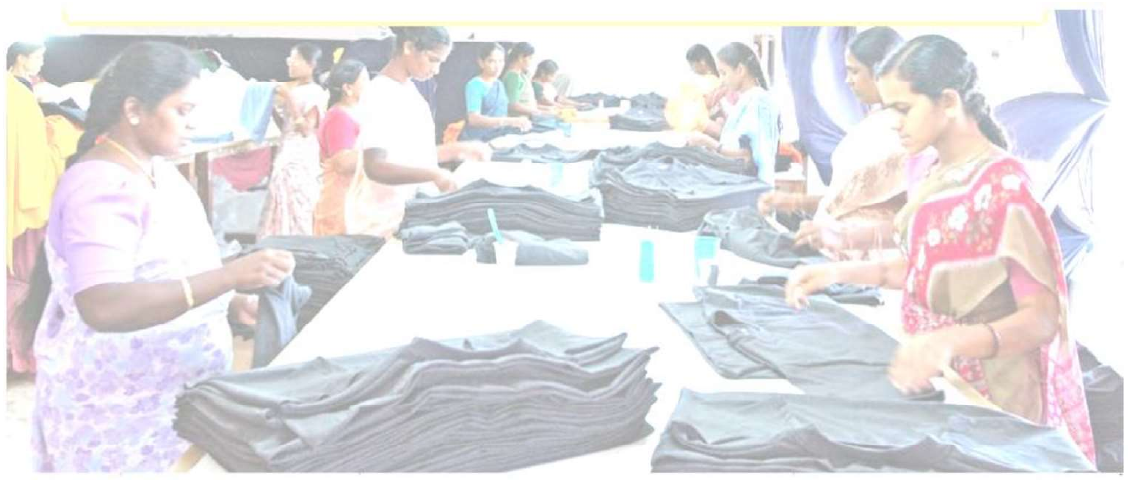
Look at the given picture and answer the question that follow: The work being done in the picture falls under which sector of the economy?
Solution
Answer: (D) Tertiary (as per the CBSE marking scheme)
The women are sorting, checking and packing finished garments, a service activity that helps goods reach the market. (Stitching the garments would be secondary.)
Rakhi has done an economic survey of her area: Farmer working in his fields – 250; Teachers teaching in school – 10; Handloom weaver working in his/her house – 70; Workers working in big factories – 140; Employees working at a hospital in the area – 60. How many people are working in the organised sector?
Solution
Answer: (D) 210
Organised: teachers (10) + factory workers (140) + hospital employees (60) = 210. Farmers and home-based weavers are in the unorganised sector.
Which one of the following pairs is correctly matched? (Sector – Example)
(A) Primary Sector – Tailor
(B) Secondary Sector – Fisherman
(C) Tertiary Sector – Astronaut
(D) Primary Sector – Courier
Solution
Answer: (C)
An astronaut provides a service. A tailor is secondary, a fisherman primary and a courier tertiary.
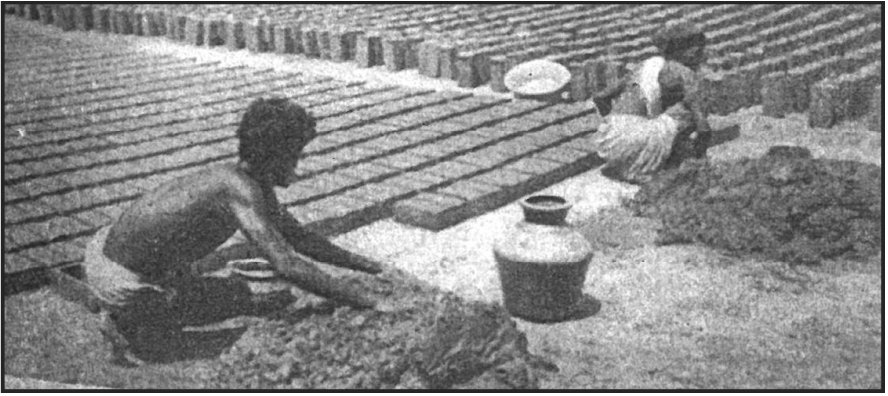
Look at the given image. The work done in the image comes under which one of the following sectors?
Solution
Answer: (C) Unorganized sector
Workers in brick kilns are casually employed, with low pay, no job security and no benefits.
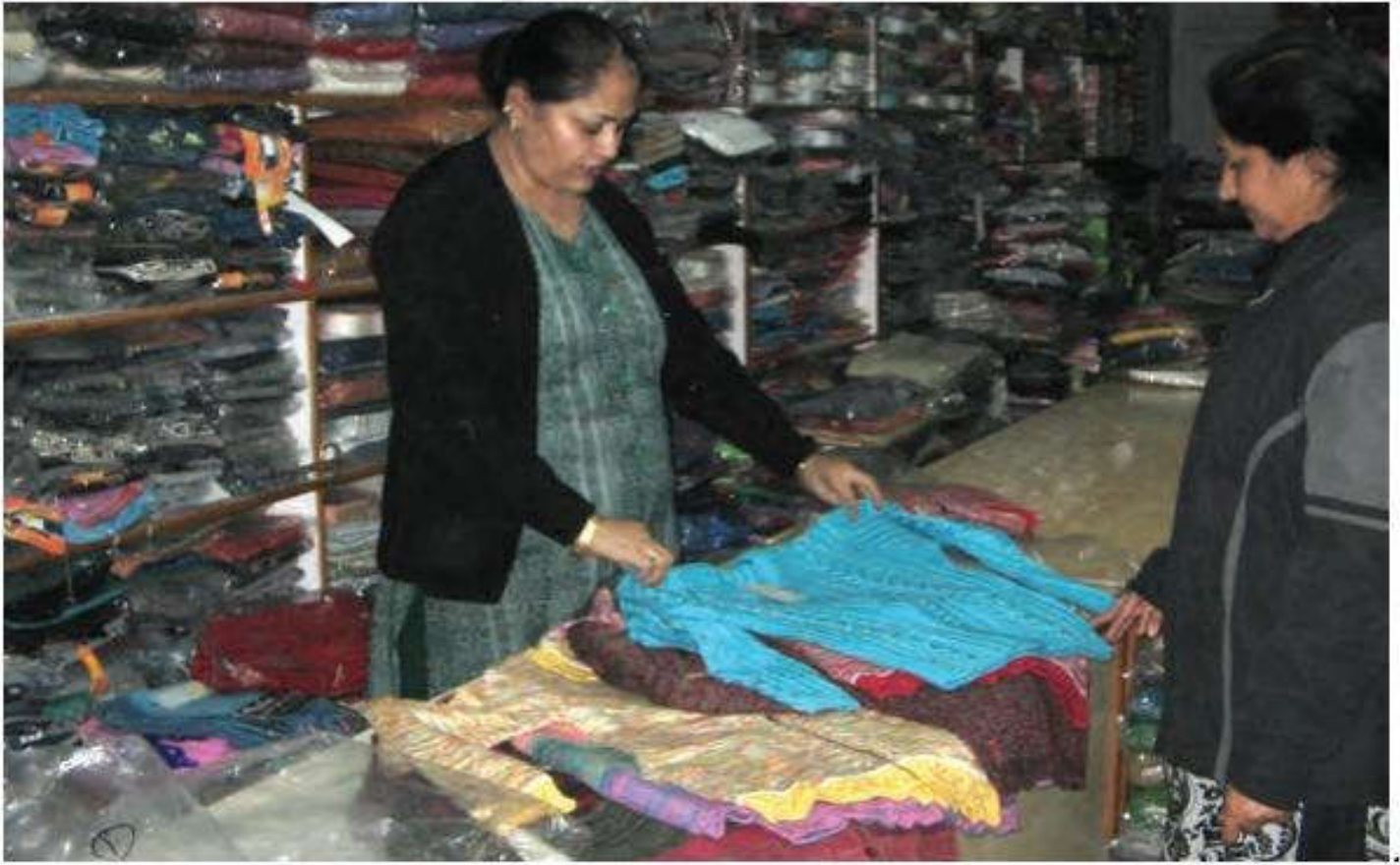
Study the following picture. The work done in the picture comes under which one of the following sectors of the economy?
Solution
Answer: (C) Tertiary
Selling clothes in a shop (trade) is a service.
Natural products being changed into other forms is known as:
Solution
Answer: (b) Secondary product
The secondary sector changes natural products into other forms through manufacturing.
Which one of the following is a feature of the unorganized sector?
Solution
Answer: (d)
The others are features of the organised sector.
Which one of the following sectors contribute highest in the GDP of India?
Which one of the following pairs is correctly matched?
(a) Primary Sector – Flower Cultivator
(b) Secondary Sector – Milk Vendor
(c) Tertiary Sector – Fisherman
(d) Manufacturing Sector – Gardener
Suggest any one way to create employment in semi-rural areas.
How is GDP calculated?
How is Public sector different from Private sector?
Suggest any one way to increase the income of Indian industrial workers.
Why is the tertiary sector becoming so important in India? Explain the main reason.
Explain the main advantage of organised sector in respect of employment.
When we produce goods by exploiting natural resources, in which category of economic sector such activities come?
3 marks: short answer
Explain the difference between public and private sector of Indian economy with example.
Solution
| Public sector | Private sector |
|---|---|
| The government owns most of the assets and provides the services. | Assets and services are owned and run by private individuals or companies. |
| The motive is public welfare, not just profit; charges are often low. | Activities are guided by the motive to earn profits. |
| Funds come from taxes and government revenue. Examples: railways, post office. | Funds are raised by the owners. Examples: Tata Steel (TISCO), Reliance Industries. |
Analyse the problem of under employment in agriculture sector in India.
Solution
1. More people are employed in agriculture than are needed; even if a few move out, production will not fall.
2. All family members work on the small plot, so everyone appears busy, but each works less than their potential; their labour effort is divided.
3. This hidden unemployment is called disguised unemployment. Creating other work, such as cold storage, honey collection or vegetable processing, can employ the extra workers gainfully.
"Tertiary sector has a pivotal role in the economy of the country." Support your answer with day-to-day examples.
Solution
1. It provides basic services every country needs, such as hospitals, schools, post offices, police, courts, banks and insurance.
2. It supports the other sectors: transport carries goods, traders sell them, banks lend money and warehouses store produce.
3. With rising incomes people demand more services like restaurants, tourism, shopping and private schools, and IT services like ATMs, call centres and software; the tertiary sector has become the largest producing sector in India.
Differentiate between primary and secondary sectors with examples.
Solution
| Primary sector | Secondary sector |
|---|---|
| Activities that directly use natural resources. | Natural products are changed into other forms through manufacturing. |
| Depends mainly on natural factors like rainfall, sunshine and climate. | Based on industrial activity in factories and workshops. |
| Example: cotton farming, dairy, fishing. | Example: cotton textile mill, sugar from sugarcane. |
Examine the rising importance of the tertiary sector in India.
Solution
1. Basic services like hospitals, schools, post and telegraph, police, courts, transport, banks and insurance are provided by the government and needed by everyone.
2. Development of agriculture and industry increases the need for services like transport, trade and storage; as incomes rise, people demand more services like restaurants, tourism and private schools.
3. New services based on information and communication technology have grown rapidly; the tertiary sector is now the largest producing sector in India.
Why is 'Tertiary Sector' becoming important in India? Explain.
Solution
1. Basic services like hospitals, schools, post offices, police, courts, banks and insurance are needed by everyone, and the development of agriculture and industry increases the demand for transport, trade and storage.
2. As incomes rise, people demand more services like tourism, shopping, private schools and hospitals.
3. New IT-based services have grown fast, helped by external demand (software, call centres) and by liberalisation and globalisation.
Why is there a need to protect workers in the Unorganized Sector? Explain.
"Tertiary sector activities help in the development of the primary and secondary sectors." Evaluate the statement.
"'Primary sector' was the most important sector of economic activity at initial stages of development." Evaluate the statement.
"There is need for protection and support for the workers in the unorganised sector." Evaluate this statement.
"Activities in the private sector are guided by the main motive to earn profit." Evaluate this statement.
Distinguish the service conditions of organized sector with that of unorganized sector.
5 marks: long answer
How are primary sectors different from secondary sectors? Explain with examples.
Solution
| Primary sector | Secondary sector |
|---|---|
| Goods are produced by exploiting natural resources directly. | Natural products are changed into other forms through manufacturing. |
| It produces raw materials. | It uses the produce of the primary sector as raw material. |
| Also called the agriculture and related sector. | Also called the industrial sector. |
| Work is done on farms, in forests, mines and seas. | Work is done in factories and workshops. |
| Examples: farming, dairy, fishing, forestry, mining. | Examples: cotton to cloth, sugarcane to sugar, brick making. |
How are organized sectors different from unorganized sectors? Explain with examples.
Solution
| Organised sector | Unorganised sector |
|---|---|
| Terms of employment are regular; jobs are secure. | Employment is not regular; workers can be removed at any time. |
| Registered and governed by laws like the Factories Act and Minimum Wages Act. | Largely outside government control; rules are not followed. |
| Fixed working hours; overtime is paid. | No fixed hours and no overtime pay. |
| Paid leave, provident fund, gratuity, medical benefits and pension. | No paid leave, provident fund, medical benefits or pension. |
| Examples: railways, post office, banks, large factories. | Examples: street vendors, domestic helpers, agricultural labourers, small workshops. |
Describe the importance of tertiary sector in the economy.
Solution
1. It provides basic services like hospitals, schools, post and telegraph, police, courts, banks and insurance that any country needs.
2. Development of agriculture and industry leads to demand for services like transport, trade and storage.
3. As income levels rise, people demand more services such as eating out, tourism, shopping, private schools and hospitals.
4. New services based on information and communication technology (internet cafés, ATMs, call centres, software) have grown rapidly.
5. In India the tertiary sector has become the largest producing sector, contributing more than half of GDP, and provides employment to many.
Describe the features of organized sector of the economy.
Solution
1. Enterprises are registered by the government and follow its rules and regulations, such as the Factories Act, Minimum Wages Act and Payment of Gratuity Act.
2. Terms of employment are regular, so workers have assured work and job security.
3. Workers work fixed hours; if they work more, they are paid overtime.
4. They get paid leave, payment during holidays, provident fund, gratuity and medical benefits.
5. They get a pension on retirement. Examples: government offices, railways, banks, large factories.
"There is a need for protection and support of the workers in the unorganised sector." Examine the statement with examples.
"Activities in private sector are guided by motive to earn profits." Examine the statement with examples.
Compare the economic activities of the private sector with that of the public sector.
Highlight the contribution of public sector in the economic development of a country.
Get every solution for all chapters
- Every board question of every chapter, each fully solved the way the board gives marks
- 17 complete board papers, each followed by its solutions
- Weightage and most-asked topics for every chapter
- Instant PDF download, colour and black & white print copies
Revising the chapter first? Complete Social Science Notes for Class 10 (NCERT 2026-27) →
What you get in the pack
- Questions from 126 CBSE papers, 2016 to 2026: every set code available
- Complete: 2341 different questions and parts from all set codes, 20 chapters and 17 full papers
- Part A: all 20 chapters of History, Geography, Pol Science and Economics, sorted by marks
- Year-wise weightage table and most-asked topics for every chapter
- Part B: 17 full board papers, each followed by its complete answers, for timed practice
- Answers written to the marking-scheme points; map questions with the paper's map and every place named
- Questions on topics outside the 2026-27 board exam flagged; only the current syllabus in Part A
All chapters in this pack
- PYQ History 1 The Rise of Nationalism in Europe
- PYQ History 2 Nationalism in India
- PYQ History 3 The Making of a Global World
- PYQ History 5 Print Culture and the Modern World
- PYQ Geography 1 Resources and Development
- PYQ Geography 2 Forest and Wildlife Resources
- PYQ Geography 3 Water Resources
- PYQ Geography 4 Agriculture
- PYQ Geography 5 Minerals and Energy Resources
- PYQ Geography 6 Manufacturing Industries
- PYQ Geography 7 Lifelines of National Economy (Map)
- PYQ Pol Science 1 Power-sharing
- PYQ Pol Science 2 Federalism
- PYQ Pol Science 3 Gender, Religion and Caste
- PYQ Pol Science 4 Political Parties
- PYQ Pol Science 5 Outcomes of Democracy
- PYQ Economics 1 Development
- PYQ Economics 2 Sectors of the Indian Economy
- PYQ Economics 3 Money and Credit
- PYQ Economics 4 Globalisation and the Indian Economy
- Board Paper 2026 Set 32-4-1 with Solutions
- Board Paper 2026 Set 32-5-1 with Solutions
- Board Paper 2025 Set 32-1-1 with Solutions
- Board Paper 2025 Set 32-2-1 with Solutions
- Board Paper 2024 Set 32-2-1 with Solutions
- Board Paper 2024 Set 32-4-1 with Solutions
- Board Paper 2023 Set 32-2-1 with Solutions
- Board Paper 2023 Set 32-4-1 with Solutions
- Board Paper 2022 Term 2 Set 32-1-1 with Solutions
- Board Paper 2022 Term 2 Set 32-3-1 with Solutions
- Board Paper 2020 Set 32-1-1 with Solutions
- Board Paper 2020 Set 32-4-1 with Solutions
- Board Paper 2019 Set 32-2-1 with Solutions
- Board Paper 2019 Set 32-4-1 with Solutions
- Board Paper 2018 Set 32-1 with Solutions
- Board Paper 2017 Set 32-1 with Solutions
- Board Paper 2016 Set 32-1 with Solutions