
CBSE Class 10 Social Studies Question Paper 2026 (32/5/1) with Solutions
The complete CBSE Class 10 Social Studies board paper of 2026, Q.P. code 32/5/1: all 38 questions exactly as set, with marks. 24 solutions are free below. The Class 10 SST PYQ Book: Solved Board Papers 2016-2026 (CBSE) solves all 17 papers in full and sorts every question chapter-wise.
Subject expert: Vikas Chandrawal, M.A. History · 8 years teaching


Free: NCERT solutions for Class 10 SST →
Question paper
Jump to: Question paperSolutions
2026 · Q.P. Code 32/5/1
Maximum marks: 80
Section A · History (20 marks)
Arrange the following events in chronological order and choose the correct option:
I. Salt Satyagraha
II. Kheda Satyagraha
III. Rowlatt Satyagraha
IV. Ahmedabad Mill Workers Satyagraha
Assertion (A): The discovery of sea routes to Asia and America shrank the pre-modern world in the sixteenth century.
Reason (R): During this period European entry into Indian ocean expanded trade.
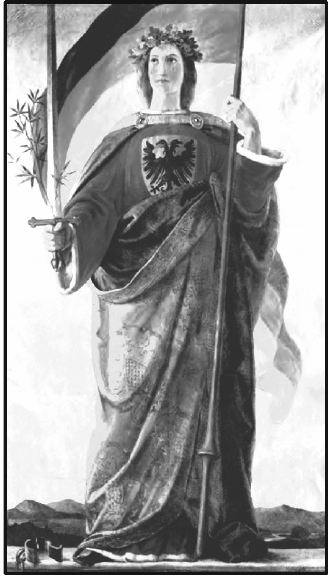
Identify this image of the allegorical figure of a European nation during the nineteenth century from the following options:
Which one of the following pairs is correctly matched?
(A) Bal Gangadhar Tilak – Gulamgiri
(B) Jyotiba Phule – Amar Jiban
(C) Raja Rammohan Roy – Sambad Kaumudi
(D) Tarabai Shinde – Istri Dharam Vichar
(a) Why did many Europeans migrate to America after sixteenth century? Explain.
(b) How did trade and long distance travel contribute to the spread of diseases during ancient period? Explain.
(a) "Print culture created the favourable conditions for the French Revolution." Explain the statement with examples.
(b) "Throughout the nineteenth century, there were a series of innovations in printing technology." Explain the statement with examples.
(a) Examine the nationalist tensions emerged in the Balkan region by the end of nineteenth century.
(b) Examine the role of Giuseppe Mazzini in the unification of Italy during the nineteenth century.
Read the given source carefully and answer the questions that follow:
The sense of collective belonging. As the national movement developed, nationalist leaders became more and more aware of such icons and symbols in unifying people and inspiring in them a feeling of nationalism. Another means of creating a feeling of nationalism was through reinterpretation of history. By the end of the nineteenth century many Indians began feeling that to instill a sense of pride in the nation, Indian history had to be thought about differently. The British saw Indians as backward and primitive, incapable of governing themselves. In response, Indians began looking into the past to discover India's great achievements. They wrote about the glorious developments in ancient times when art and architecture, science and mathematics, religion and culture, law and philosophy, crafts and trade had flourished. This glorious time, in their view, was followed by a history of decline, when India was colonised. These nationalist histories urged the readers to take pride in India's great achievements in the past and struggle to change the miserable conditions of life under British rule.
8.1 How did icons help to unite Indians during the freedom struggle? (1)
8.2 Why did nationalists feel the need to rewrite Indian history? (1)
8.3 How did nationalist histories portray India's past and present? (2)
(a) Two places (a) and (b) have been marked on the given political outline map of India. Identify them with the help of the following information and write their correct names on the lines drawn near them.
(a) The place where Gandhiji launched satyagraha, for the Indigo planters.
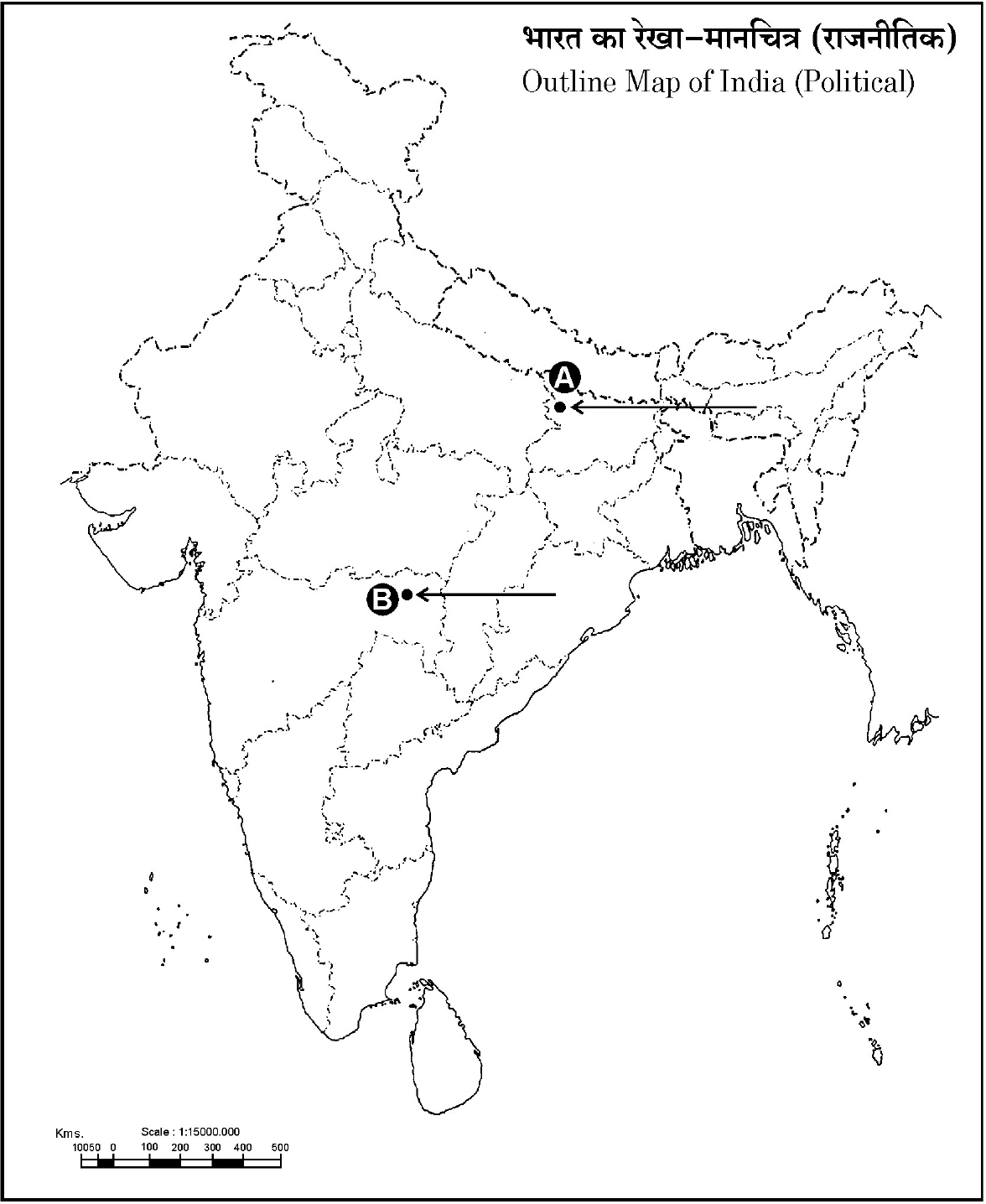
(b) The place where the session of Indian National Congress was held. (Map of Q9.)
Section B · Geography (20 marks)
Identify the soil with the help of the following informations given in the box: It is made up of extremely fine material. It is rich in soil nutrients. It is ideal for growing cotton.
In which of the following States of India, has the largest area under permanent forests?
Identify the correct option related to major crops grown in the 'Kharif' cropping season in India:
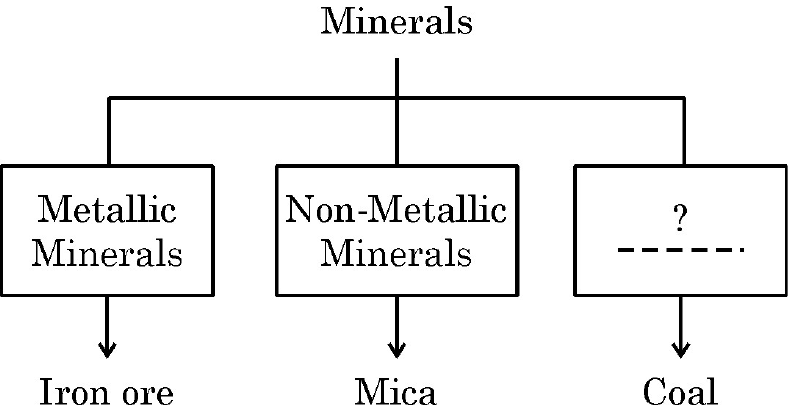
Choose the appropriate option to fill in the blank:
Which of the following is an example of 'current fallow land'?
Match Column-I (National Parks) with Column-II (States): a. Sariska, b. Sunderban, c. Corbett, d. Bandhavgarh; i. Madhya Pradesh, ii. Uttarakhand, iii. West Bengal, iv. Rajasthan.
Explain the measures made by government to improve Indian agriculture.
(a) "Conserving energy is essential for sustainable development." Support the statement with suitable arguments.
(b) "Minerals are found in various forms and types, each having distinct properties." Support the statement with suitable arguments.
Read the given source carefully and answer the questions that follow:
Pradhan Mantri Krishi Sinchayee Yojana. Floods have not only devastated life and property but also caused extensive soil erosion. Sedimentation also meant that the flood plains were deprived of silt, a natural fertilizer, further adding on to the problem of land degradation. It was also observed that the multipurpose projects induced earthquakes, caused water-borne diseases and pests and pollution resulting from excessive use of water. Irrigation has also changed the cropping pattern of many regions with farmers shifting to water intensive and commercial crops. This has great ecological consequences like salinisation of the soil. Pradhan Mantri Krishi Sinchayee Yojana has been started which ensures access to some means to protective irrigation for all agricultural farms in the country, thus bringing much desired rural prosperity. Some of the broad objectives of this programme are to enhance the physical access of water on the farm and expand cultivable area under assured irrigation (har khet ko pani), improve on farm water use efficiency to reduce wastage and increase availability both in duration and extent, irrigation and other water saving technologies (per drop more crop) and introduce sustainable water conservation practices, etc.
18.1 Explain the role of floods in land degradation. (1)
18.2 How has irrigation changed cropping pattern? (1)
18.3 Explain any two objectives of the 'Pradhan Mantri Krishi Sinchayee Yojana'. (2)
(i) On the same outline map of India given for Q. No. 9, locate and label any three of the following with suitable symbols:
(i) The dam constructed on Satluj river
(ii) A nuclear power plant located in Gujarat
(iii) A software technology park located in Uttar Pradesh
(iv) An International Airport located in Maharashtra
Section C · Political Science (20 marks)
Assertion (A): Belgium's power sharing arrangements were designed to accommodate its linguistic and cultural divisions.
Reason (R): Belgian leaders recognized the existence of regional differences and cultural diversities.
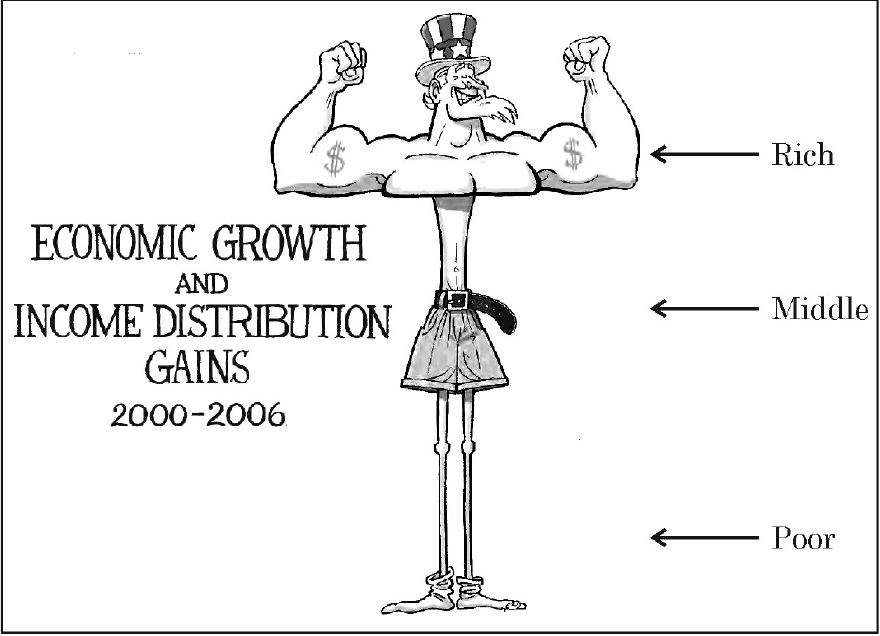
Look at the given cartoon carefully and answer the question that follow: Which of the following concepts is best illustrated in the cartoon?
Find the odd one out regarding the Political Parties of India:
Read the given statements regarding urban local government and choose the correct option:
I. Municipalities are setup in towns.
II. Big cities have Municipal Corporation.
III. Municipal chairperson is the head of Block Samiti.
IV. The officer in Municipal Corporation is called as Mayor.
Suggest two ways to improve womens' participation in sports leadership roles.
"Democracy is a better form of government compared with any other alternative." Examine the statement.
How does the 'system of three lists' function in Indian federalism? Explain with examples.
(a) Explain the importance of political parties in Indian democracy.
(b) Explain the challenges faced by the political parties in India.
Read the given source carefully and answer the questions that follow:
Forms of Power-sharing. The idea of power-sharing has emerged in opposition to the notions of undivided political power. For a long time, it was believed that all power of a government must reside in one person or group of persons located at one place. It was felt that if the power to decide is dispersed, it would not be possible to take quick decisions and to enforce them. But these notions have changed with the emergence of democracy. One basic principle of democracy is that people are the source of all political power. In a democracy, people rule themselves through institutions of self-government. In a good democratic government, due respect is given to diverse groups and views that exist in a society. Everyone has a voice in the shaping of public policies. Therefore, it follows that in a democracy, political power should be distributed among as many citizens as possible.
28.1 How does power sharing promote stability of political order? (1)
28.2 How are pressure groups part of the power sharing mechanism? (1)
28.3 How does power sharing contribute to the spirit of democracy? (2)
Section D · Economics (20 marks)
Study the given data and answer the question that follow: Comparative data of few states — Infant Mortality Rate (2020), Literacy Rate (2017-18), Net Attendance Rate (Class 1 to 5): State A: 28, 82, 73; State B: 6, 94, 94; State C: 27, 62, 69. By how many of the following points does State B's literacy rate exceeds from State A in 2017-18?
Identify the sector of economy with the help of information given in the box: Ownership of assets and delivery of services in the hands of private individuals. Activities are guided by the motive to earn profits.
Megha has taken a loan of ₹ 5 lakhs from bank to purchase a house. The annual rate on the loan is 12% and loan is to be repaid in 5 years in monthly instalments. The 12% interest charged by the bank to Megha is related to which of the following?
Which of the following is the main purpose of a trade barrier in global trade? Choose the correct option.
Which of the following is an example of a renewable resource?
Choose the correct option to fill in the blank: Infant Mortality Rate indicates the number of children that die before the age of ______ year as a proportion of 1000 live children born in that particular year.
"Advancement in technology has stimulated the globalization process." Justify the statement with suitable arguments.
Explain the role of Reserve Bank in Indian economy.
"Different persons can have different developmental goals." Explain the statement with examples.
(a) Describe the importance of tertiary sector in the economy.
(b) Describe the features of organized sector of the economy.
Solutions: CBSE 2026 · 32/5/1
Answer: (B) II, IV, III, I
Kheda (1917, early 1918) → Ahmedabad mill workers (1918) → Rowlatt Satyagraha (1919) → Salt Satyagraha (1930).
Answer: (D) Germania
Germania, painted by Philip Veit (1848), wears a crown of oak leaves (the German oak stands for heroism) and holds a sword and the black-red-gold flag.
1. Until the 19th century poverty and hunger were common in Europe; cities were crowded, deadly diseases were widespread, and religious dissenters were persecuted.
2. America offered vast lands, abundant crops and minerals, and plantations (worked by African slaves) growing cotton and sugar for European markets, so thousands fled Europe for America.
1. Print popularised the ideas of Enlightenment thinkers like Voltaire and Rousseau, who argued for the rule of reason and attacked the authority of the Church and the despotic power of the state.
2. Print created a new culture of dialogue and debate in which values, norms and institutions were questioned and re-evaluated, and ideas of social revolution came into being.
3. By the 1780s literature, cartoons and caricatures mocked the royalty and its morality and showed the hardships of common people; circulating underground, this literature turned people against the monarchy.
1. The Balkans (modern Romania, Bulgaria, Albania, Greece, Serbia and others) was a region of geographical and ethnic variation whose people were broadly called Slavs; much of it was under the Ottoman Empire.
2. The spread of romantic nationalism together with the disintegration of the Ottoman Empire made the region explosive; one by one its subject nationalities broke away and declared independence.
3. The Balkan peoples used history to claim that they had once been independent and had been subjugated by foreign powers.
4. The Balkan states were fiercely jealous of each other, and each hoped to gain more territory at the others' expense.
5. The region also became the scene of big-power rivalry: Russia, Germany, England and Austria-Hungary each tried to counter the others and extend its own control. This led to a series of wars and finally to the First World War.
8.1 Icons such as Bharat Mata and symbols such as the national flag gave people a shared image of the nation; devotion to them came to be seen as proof of one's nationalism.
8.2 The British portrayed Indians as backward and primitive and incapable of self-rule; nationalists rewrote history to show India's great achievements and instil pride.
8.3 (i) They described a glorious ancient past in which art, architecture, science, mathematics, religion, law, philosophy, crafts and trade flourished.
(ii) This was followed by a period of decline under colonial rule, and readers were urged to take pride in the past and struggle to change the miserable conditions of the present.
B – Nagpur, Maharashtra (centre of India). The December 1920 Nagpur session adopted the Non-Cooperation programme.
Answer: (B) Madhya Pradesh
Madhya Pradesh has the largest area under permanent forests, constituting 75% of its total forest area.
Answer: (C) Energy minerals
Minerals are metallic (iron ore), non-metallic (mica) or energy minerals (coal, petroleum, natural gas).
Answer: (C) a-iv, b-iii, c-ii, d-i
Sariska – Rajasthan; Sunderban – West Bengal; Corbett – Uttarakhand; Bandhavgarh – Madhya Pradesh.
1. Energy is a basic requirement for development; every sector, agriculture, industry, transport, commercial and domestic, needs energy inputs.
2. Most of our energy comes from fossil fuels like coal and petroleum, which are non-renewable and will run out, and their prices keep rising.
3. Burning fossil fuels pollutes the air and adds to global warming, so a sustainable path of energy development is urgently needed.
4. Energy conservation and greater use of renewable sources (solar, wind, biogas, geothermal) are the twin planks of sustainable energy.
5. As citizens we can help by using public transport instead of private vehicles, switching off electricity when not in use and using power-saving devices.
18.1 Floods cause extensive soil erosion, and sedimentation behind dams deprives flood plains of silt, a natural fertiliser, which degrades the land.
18.2 Farmers have shifted to water-intensive and commercial crops, which leads to problems like salinisation of soil.
18.3 (i) To expand the cultivable area under assured irrigation and increase physical access of water on every farm ('har khet ko pani').
(ii) To improve on-farm water-use efficiency and reduce wastage through water-saving technologies like drip and sprinkler irrigation ('per drop more crop').
Kakrapara, near Surat in southern Gujarat.
Mumbai (Chhatrapati Shivaji Maharaj International Airport), on the west coast of Maharashtra.
Answer: (C)
The figure has huge muscular arms (the rich), a thin waist (middle class) and stick legs (the poor): gains from growth have gone mostly to the rich, showing uneven distribution of wealth.
Answer: (B)
III is wrong: the municipal chairperson heads the municipality; Block Samitis (Panchayat Samitis) belong to rural local government. The political head of a municipal corporation is the mayor.
1. Democracy promotes equality among citizens, enhances the dignity of the individual and gives citizens the right to choose and change their rulers, so it is a legitimate government.
2. It improves the quality of decision-making through discussion, provides a method to resolve conflicts peacefully and allows room to correct mistakes.
1. Parties contest elections and put up candidates.
2. They put forward different policies and programmes for voters to choose from.
3. They play a decisive role in making laws in the legislature.
4. They form and run governments, recruiting and training leaders who become ministers; the parties that lose act as the opposition and criticise the government's failures.
5. They shape public opinion by raising issues and launching movements, and give people access to government machinery and welfare schemes.
28.1 By giving due respect to diverse groups and views, power sharing reduces the possibility of conflict and violence between social groups, which keeps the political order stable.
28.2 Interest groups of traders, industrialists, farmers and workers influence government policies, sometimes through participation in government committees, so they also share power.
28.3 (i) Democracy means sharing power with those affected by its exercise; people are the source of all political power and rule themselves through institutions of self-government.
(ii) Power sharing gives everyone a voice in shaping public policy and gives citizens a stake in the system, which makes the government legitimate.
Answer: (A) Private Sector
Answer: (C)
Governments use trade barriers such as import taxes to increase or decrease (regulate) foreign trade and decide what kinds of goods, and how much, should come in.
Answer: (A) One
1. The RBI issues currency notes on behalf of the central government; no other individual or organisation is allowed to issue currency.
2. It supervises the functioning of formal sources of loans, and checks that banks maintain a minimum cash balance out of their deposits.
3. It ensures that banks lend not only to profitable businesses but also to small cultivators, small-scale industries and small borrowers; banks must report to the RBI how much they lend, to whom and at what interest rate.
1. It provides basic services like hospitals, schools, post and telegraph, police, courts, banks and insurance that any country needs.
2. Development of agriculture and industry leads to demand for services like transport, trade and storage.
3. As income levels rise, people demand more services such as eating out, tourism, shopping, private schools and hospitals.
4. New services based on information and communication technology (internet cafés, ATMs, call centres, software) have grown rapidly.
5. In India the tertiary sector has become the largest producing sector, contributing more than half of GDP, and provides employment to many.
Get every solution for all 17 papers
- Every board question of every chapter, each fully solved the way the board gives marks
- 17 complete board papers, each followed by its solutions
- Weightage and most-asked topics for every chapter
- Instant PDF download, colour and black & white print copies
Revising the chapter first? Complete Social Science Notes for Class 10 (NCERT 2026-27) →
What you get in the pack
- Questions from 126 CBSE papers, 2016 to 2026: every set code available
- Complete: 2341 different questions and parts from all set codes, 20 chapters and 17 full papers
- Part A: all 20 chapters of History, Geography, Pol Science and Economics, sorted by marks
- Year-wise weightage table and most-asked topics for every chapter
- Part B: 17 full board papers, each followed by its complete answers, for timed practice
- Answers written to the marking-scheme points; map questions with the paper's map and every place named
- Questions on topics outside the 2026-27 board exam flagged; only the current syllabus in Part A
All chapters in this pack
- PYQ History 1 The Rise of Nationalism in Europe
- PYQ History 2 Nationalism in India
- PYQ History 3 The Making of a Global World
- PYQ History 5 Print Culture and the Modern World
- PYQ Geography 1 Resources and Development
- PYQ Geography 2 Forest and Wildlife Resources
- PYQ Geography 3 Water Resources
- PYQ Geography 4 Agriculture
- PYQ Geography 5 Minerals and Energy Resources
- PYQ Geography 6 Manufacturing Industries
- PYQ Geography 7 Lifelines of National Economy (Map)
- PYQ Pol Science 1 Power-sharing
- PYQ Pol Science 2 Federalism
- PYQ Pol Science 3 Gender, Religion and Caste
- PYQ Pol Science 4 Political Parties
- PYQ Pol Science 5 Outcomes of Democracy
- PYQ Economics 1 Development
- PYQ Economics 2 Sectors of the Indian Economy
- PYQ Economics 3 Money and Credit
- PYQ Economics 4 Globalisation and the Indian Economy
- Board Paper 2026 Set 32-4-1 with Solutions
- Board Paper 2026 Set 32-5-1 with Solutions
- Board Paper 2025 Set 32-1-1 with Solutions
- Board Paper 2025 Set 32-2-1 with Solutions
- Board Paper 2024 Set 32-2-1 with Solutions
- Board Paper 2024 Set 32-4-1 with Solutions
- Board Paper 2023 Set 32-2-1 with Solutions
- Board Paper 2023 Set 32-4-1 with Solutions
- Board Paper 2022 Term 2 Set 32-1-1 with Solutions
- Board Paper 2022 Term 2 Set 32-3-1 with Solutions
- Board Paper 2020 Set 32-1-1 with Solutions
- Board Paper 2020 Set 32-4-1 with Solutions
- Board Paper 2019 Set 32-2-1 with Solutions
- Board Paper 2019 Set 32-4-1 with Solutions
- Board Paper 2018 Set 32-1 with Solutions
- Board Paper 2017 Set 32-1 with Solutions
- Board Paper 2016 Set 32-1 with Solutions