
CBSE Class 10 Social Studies Question Paper 2026 (32/4/1) with Solutions
The complete CBSE Class 10 Social Studies board paper of 2026, Q.P. code 32/4/1: all 38 questions exactly as set, with marks. 24 solutions are free below. The Class 10 SST PYQ Book: Solved Board Papers 2016-2026 (CBSE) solves all 17 papers in full and sorts every question chapter-wise.
Subject expert: Vikas Chandrawal, M.A. History · 8 years teaching


Free: NCERT solutions for Class 10 SST →
Question paper
Jump to: Question paperSolutions
2026 · Q.P. Code 32/4/1
Maximum marks: 80
Section A · History (20 marks)
Arrange the following events in chronological order and choose the correct option:
I. Second Round Table Conference
II. Formation of Depressed Class Association
III. Lahore Session of Indian National Congress
IV. Formation of Awadh Kisan Sabha
Assertion (A): Silver from Peru and Mexico enhanced Europe's wealth in the sixteenth century.
Reason (R): Europe used this silver to finance its trade with Asia.
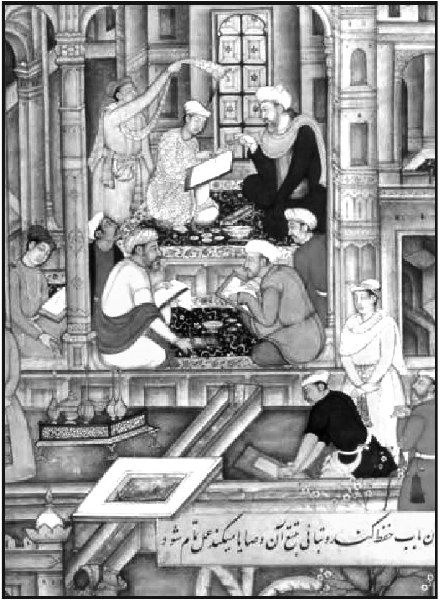
The given painting is from the sixteenth century from Mughal India. Identify the work shown in this painting from the following options:
Which one of the following pairs is correctly matched?
(A) Ram Chaddha – Bengal Gazette
(B) Gangadhar Bhattacharya – Kesari
(C) Jyotiba Phule – Gulamgiri
(D) Rashsundari Devi – Padmarg
(a) "Food offered many examples of long distance cultural exchange during pre-modern times." Explain the statement with any two examples.
(b) "Trade and cultural exchange went hand-in-hand during pre-modern times." Explain the statement with any two examples.
(a) Evaluate the role of print in the French Revolution.
(b) Evaluate the role of Buddhist Missionaries in printing culture.
(a) Describe the process of unification of Germany.
(b) Describe the process of unification of Italy.
Read the given source carefully and answer the questions that follow:
Quit India Movement. The failure of the Cripps Mission and the effects of World War II created widespread discontentment in India. This led Gandhiji to launch a movement calling for complete withdrawal of the British from India. The Congress Working Committee, in its meeting in Wardha on 14 July 1942, passed the historic 'Quit India' resolution demanding the immediate transfer of power to Indians and quit India. On 8th August 1942 in Bombay, the All India Congress Committee endorsed the resolution which called for a non-violent mass struggle on the widest possible scale throughout the country. It was on this occasion that Gandhiji delivered the famous 'Do or Die' speech. The call for 'Quit India' almost brought the state machinery to a standstill in large parts of the country as people voluntarily threw themselves into the thick of the movement. People observed hartals, and demonstrations and processions were accompanied by national songs and slogans. The movement was truly a mass movement which brought into its ambit thousands of ordinary people, namely students, workers and peasants. It also saw the active participation of leaders, namely, Jayprakash Narayan, Aruna Asaf Ali and Ram Manohar Lohia and many women such as Matangini Hazra in Bengal, Kanaklata Barua in Assam and Rama Devi in Orissa. The British responded with much force, yet it took more than a year to suppress the movement.
8.1 How did the failure of the Cripps Mission contribute to the launch of the Quit India Movement? (1)
8.2 Why was Gandhiji's call for 'the Quit India' considered historic? (1)
8.3 Explain the role of women in making the Quit India Movement more inclusive. (2)
(A) Two places 'A' and 'B' have been marked on the given political outline map of India. Identify them with the help of the following information and write their correct names on the lines drawn near them:
A. The place where Gandhiji broke the Salt Law.
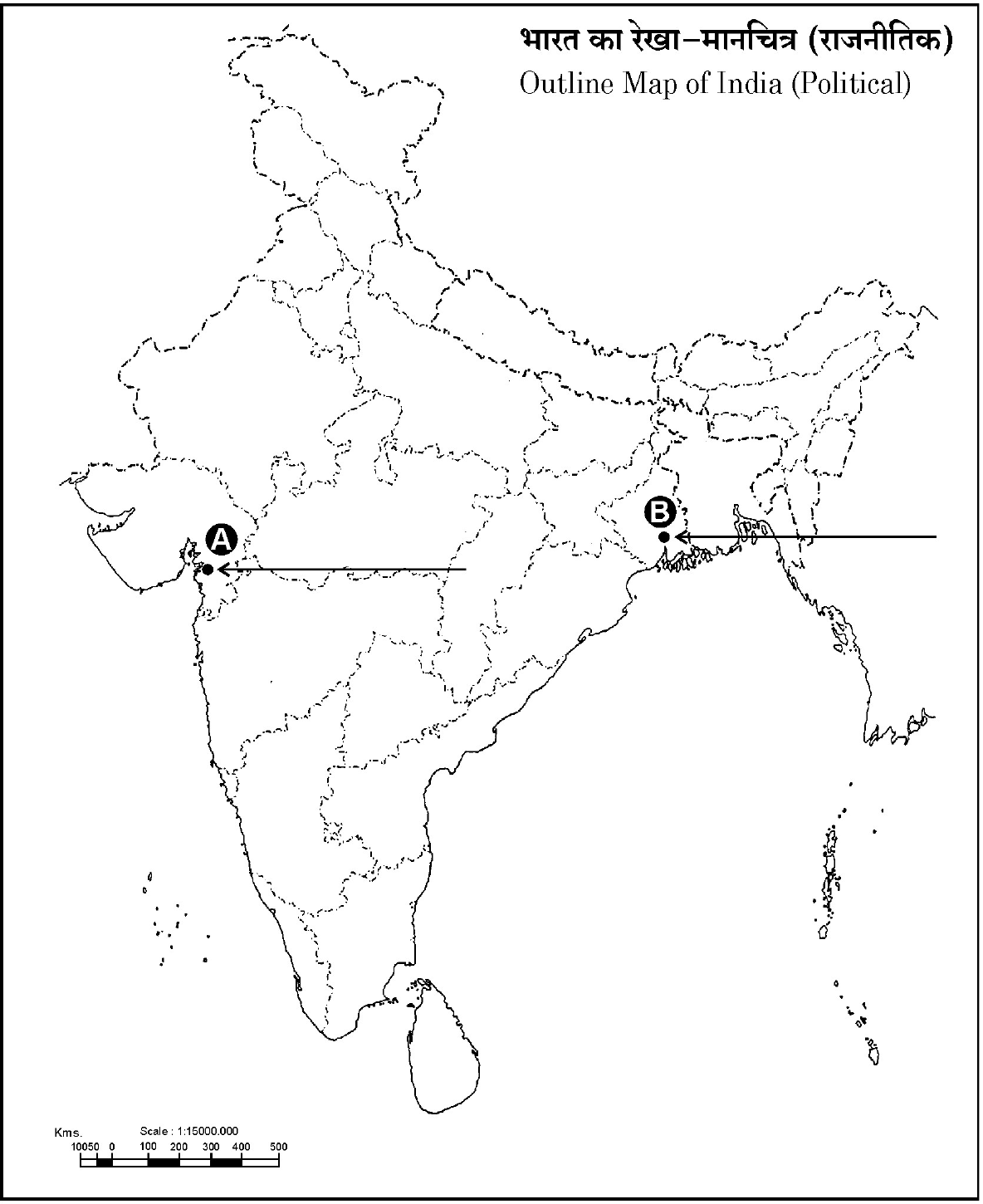
(B) The place where the session of Indian National Congress was held. (Map of Q9.)
Section B · Geography (20 marks)
Read the given infographics carefully and choose the correct option that identifies the soil described: (1) Sandy in texture → (2) Red to brown in colour → (3) Soil lacks humus due to dry climate.
In which of the following regions did the "Beej-Bachao Andolan" of farmers begin?
Match Column-I (National Park) with Column-II (States): a. Corbett, b. Sunderban, c. Sariska, d. Periyar; i. Rajasthan, ii. Uttarakhand, iii. Kerala, iv. West Bengal.
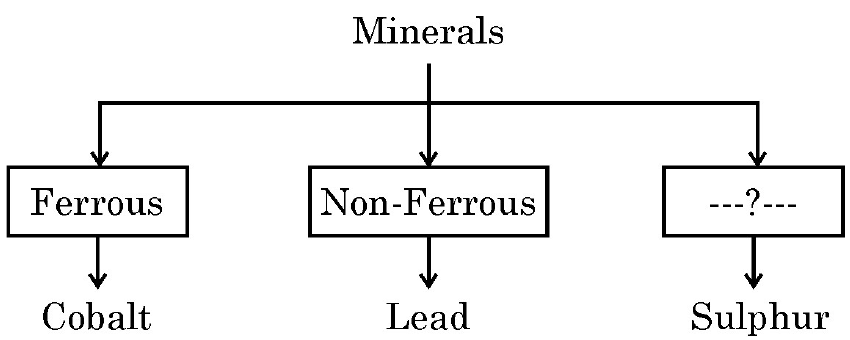
Choose the correct option to fill in the blank:
In which of the following categories of 'land-use' has India registered an increase?
Which one of the following crops grows well in hot and humid climate?
If every farmer in India follows modern farming practices, explain any two positive changes this could bring to villages.
(a) Examine the role of petroleum as an important source of energy and describe its distribution in India. (3 + 2 = 5)
(b) Examine the role of coal as an important energy resource and describe its distribution in India. (3 + 2 = 5)
Read the given source and answer the questions that follow:
Sardar Sarovar Project. Sardar Sarovar Dam has been built over the Narmada river in Gujarat. This is one of the largest water resources projects of India covering four states – Maharashtra, Madhya Pradesh, Gujarat and Rajasthan. The Sardar Sarovar Project would meet the requirement of water in drought prone and desert areas. Sardar Sarovar Project will provide irrigation facilities to 18.45 lakh hectare of land, covering 3112 villages in 15 districts of Gujarat. It will also irrigate 2,46,000 hectare of land in the strategic desert districts of Barmer and Jalore in Rajasthan and 37,500 hectare in the tribal hilly tract of Maharashtra through lift. About 75% of the command area in Gujarat is drought prone while entire command in Rajasthan is drought prone. Assured water supply will soon make this area drought proof.
18.1 Why is Sardar Sarovar Project considered important for Gujarat? (1)
18.2 Why is Sardar Sarovar Project designed to cover four states? (1)
18.3 In what ways does this project promote sustainability? (2)
(i) On the same outline map of India given for Q. No. 9, locate and label any three of the following with suitable symbols:
(i) The major dam constructed on the Chenab river
(ii) Nuclear power plant in Maharashtra
(iii) Software Technology Park in Tamil Nadu
(iv) International Airport in Punjab
Section C · Political Science (20 marks)
Assertion (A): The civil war in Sri Lanka resulted due to failure of political accommodation of ethnicity.
Reason (R): The distrust between the Sinhala and Tamil communities turned into widespread conflict in Sri Lanka.
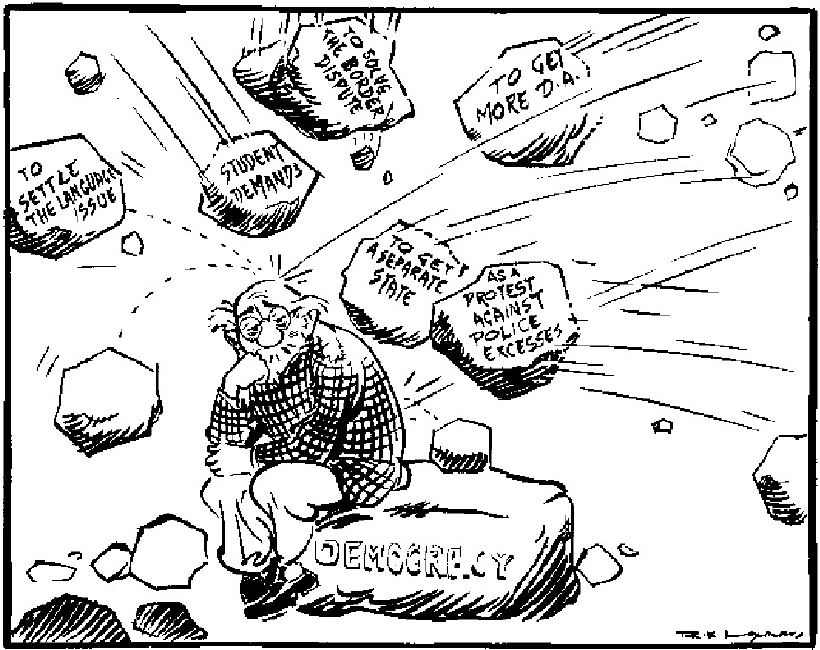
Look at the given picture carefully and choose the most appropriate option: Which of the following is a strength of democracy highlighted in the cartoon?
Find the odd one out from the following:
Read the given statements regarding decentralisation in India and choose the correct option:
i. Rural local government is known as Panchayati Raj.
ii. Each village or group of villages have Gram Panchayat.
iii. Panch and Sarpanch of villages are selected by Election Commission.
iv. Panchayat works under the supervision of Gram Sabha.
Suggest any two ways to promote Women's Entrepreneurship in the economy.
Differentiate between democracy and dictatorship.
How does the Indian Constitution define the distribution of powers between the centre and the states? Explain with examples.
(a) Examine the role of political parties in a democracy.
(b) Examine the need of the political parties in a democratic government.
Read the given source carefully and answer the questions that follow:
Power Sharing. Power is shared among different organs of government, such as the legislature, executive and judiciary. Let us call this horizontal distribution of power because it allows different organs of government placed at the same level to exercise different powers. Such a separation ensures that none of the organs can exercise unlimited power. Each organ checks the others. This results in a balance of power among various institutions. Last year, we studied that in a democracy, even though ministers and government officials exercise power, they are responsible to the Parliament or State Assemblies. Similarly, although judges are appointed by the executive, they can check the functioning of executive or laws made by the legislatures. This arrangement is called a system of checks and balances.
28.1 Explain the term 'Balance of Power'. (1)
28.2 Why is the judiciary considered independent in a democracy? (1)
28.3 How is power shared among different organs of government? (2)
Section D · Economics (20 marks)
Study the given data carefully and answer the question that follows: Monthly income of citizens (in ₹) of Country A: I – 9,500; II – 10,500; III – 9,800; IV – 1,000; V – 10,200. (Country B: 500, 500, 500, 500, 4,800.) Identify the average monthly income of citizens in 'country A'.
Identify the sector of the economy on the basis of ownership with the help of following information: The government owns most of the assets. Delivery of services in the hands of government. Fair price shops is an example of it.
Swapna, a small farmer grows groundnut on her three acres of land. She takes a loan from the moneylender to meet the expenses of cultivation but midway due to flood, crop fails and her debt increased. Again she has to take loan to manage crops. Suggest Swapna, which of the following sources of loan would be suitable for her.
The removal of barriers on foreign trade and investment by the Indian government has been called as:
Which of the following reports compare countries using health, education and per capita income?
Choose the correct option to fill in the blank: Net attendance ratio is expressed as a ______ of total children in the age group of 6–10 years attending school.
"New technology has helped to connect the world." Justify the statement with suitable arguments.
Explain the role of Reserve Bank of India in the Indian economy.
Analyse the issues that necessitate sustainable development for the future.
(a) How are primary sectors different from secondary sectors? Explain with examples.
(b) How are organized sectors different from unorganized sectors? Explain with examples.
Solutions: CBSE 2026 · 32/4/1
Answer: (C) IV, III, II, I
Awadh Kisan Sabha (October 1920) → Lahore Session of the INC (December 1929) → Depressed Classes Association (1930) → Second Round Table Conference (December 1931).
Answer: (D) Book making
The painting shows calligraphers, illustrators and binders at work in a royal workshop (kitabkhana) of the Mughal court, where manuscripts were copied and illustrated by hand.
1. Traders and travellers introduced new crops to the lands they travelled. Noodles travelled west from China and became spaghetti in Italy; pasta may have reached Sicily with Arab traders.
2. Many common foods of Europe and Asia, such as potatoes, soya, groundnuts, maize, tomatoes, chillies and sweet potatoes, came from America after Columbus reached it.
1. Print popularised the ideas of Enlightenment thinkers such as Voltaire and Rousseau, who attacked the sacred authority of the Church and the despotic power of the state and argued for the rule of reason.
2. Print created a new culture of dialogue and debate. All values, norms and institutions were re-evaluated by a public that had become aware of the power of reason.
3. By the 1780s there was an outpouring of literature, cartoons and caricatures mocking the royalty and its morality, showing the monarchy absorbed in pleasure while common people suffered. This helped turn people against the monarchy.
1. In 1848 middle-class Germans tried to unite the regions of the German Confederation into a nation-state governed by an elected parliament (Frankfurt Parliament).
2. This liberal initiative was repressed by the monarchy and the military, supported by the large landowners (Junkers) of Prussia.
3. Prussia then took over the leadership of the movement for national unification.
4. Its chief minister, Otto von Bismarck, was the architect of the process, carried out with the help of the Prussian army and bureaucracy.
5. Three wars over seven years, with Denmark, Austria and France, ended in Prussian victory and completed unification. In January 1871 the Prussian king William I was proclaimed German Emperor at Versailles.
8.1 The failure of the Cripps Mission, together with the hardships of World War II, created widespread discontent in India. Gandhiji responded by launching a movement demanding complete withdrawal of the British.
8.2 The call, given with the 'Do or Die' speech on 8 August 1942, almost brought the state machinery to a standstill as people all over the country voluntarily joined the movement.
8.3 (i) Women leaders such as Aruna Asaf Ali, Matangini Hazra (Bengal), Kanaklata Barua (Assam) and Rama Devi (Orissa) took an active part and led protests.
(ii) Ordinary women joined hartals, demonstrations and processions in large numbers, which made it a true mass movement.
B – Calcutta (Kolkata), West Bengal. The special session of September 1920 at Calcutta accepted Gandhiji's Non-Cooperation programme.
Answer: (B) Tehri
The Beej Bachao Andolan in Tehri (Uttarakhand) showed that diversified crops can be grown without synthetic chemicals.
Answer: (A) Non-metallic
Cobalt (ferrous) and lead (non-ferrous) are metallic minerals; sulphur is a non-metallic mineral.
Answer: (A) Sugarcane
Sugarcane is a tropical and subtropical crop that needs a hot and humid climate (21–27°C) and 75–100 cm of rainfall. Peas, wheat and gram are rabi crops of the cool season.
Role (3):
1. Petroleum is the next major energy source in India after coal; it provides fuel for heat and lighting.
2. It provides lubricants for machinery.
3. It provides raw materials for many industries, such as synthetic textiles, fertilisers and chemicals; refineries act as nodal industries.
Distribution (2):
1. About 63% of India's petroleum comes from Mumbai High, 18% from Gujarat and 16% from Assam. Ankeleshwar is the most important field of Gujarat.
2. Assam is the oldest oil-producing state; Digboi, Naharkatiya and Moran-Hugrijan are its main oil fields.
18.1 It irrigates 18.45 lakh hectares covering 3112 villages in 15 districts of Gujarat, where about 75% of the command area is drought prone.
18.2 To meet the water needs of the drought-prone and desert areas of all four states that share the Narmada basin, and to irrigate land in Gujarat, Rajasthan and Maharashtra.
18.3 (i) It assures drinking water and irrigation to drought-prone areas, making them drought proof and supporting food security.
(ii) It generates hydroelectricity, a renewable and clean source of energy, and helps recharge groundwater.
Tarapur, on the coast of Maharashtra north of Mumbai (near the Gujarat border).
Amritsar (Sri Guru Ram Dass Jee International Airport), in north-western Punjab near the Pakistan border.
Answer: (D)
The rocks hurled at "democracy" are the many demands of people (language, separate state, more DA, students' demands). A democracy has to listen to and accommodate such demands peacefully.
Answer: (B)
Statement iii is wrong: the panch and the sarpanch are directly elected by all the adult residents of the village, not selected by the Election Commission.
| Democracy | Dictatorship |
|---|---|
| People elect their rulers in free and fair elections held regularly. | People have no role in choosing the ruler; elections are not held or are not free and fair. |
| The government is accountable to the citizens, and people enjoy rights and freedoms. | Power lies with one person or a small group that is not accountable; rights and freedoms are not guaranteed. |
1. Parties contest elections; in most democracies elections are fought mainly among candidates put up by parties.
2. They put forward different policies and programmes, and voters choose from them.
3. They play a decisive role in making laws in the legislature.
4. They form and run governments; the parties that lose play the role of opposition, criticising the government for its failures or wrong policies.
5. They shape public opinion, raise issues and launch movements, and give people access to government machinery and welfare schemes.
28.1 No organ of government can exercise unlimited power, because each organ checks the others.
28.2 Although judges are appointed by the executive, they can check the functioning of the executive and the laws made by the legislature.
28.3 (i) Power is shared horizontally among organs placed at the same level: the legislature makes laws, the executive implements them and the judiciary interprets them and settles disputes.
(ii) Ministers are responsible to the legislature, and courts can review executive actions and laws, which creates a system of checks and balances.
Answer: (B) Public Sector
In the public sector the government owns most of the assets and provides the services.
Answer: (D) Liberalisation
Removing barriers or restrictions set by the government is called liberalisation (India, 1991).
Answer: (B) Percentage
Net attendance ratio is the number of children of an age group attending school, expressed as a percentage of all children of that age group.
1. The RBI issues currency notes on behalf of the central government; no other individual or organisation may issue currency.
2. It supervises the functioning of formal sources of loans; it checks that banks maintain a minimum cash balance out of their deposits.
3. It sees that banks lend not only to profit-making businesses and traders but also to small cultivators, small-scale industries and small borrowers; banks report to the RBI how much they lend, to whom and at what interest rate.
| Primary sector | Secondary sector |
|---|---|
| Goods are produced by exploiting natural resources directly. | Natural products are changed into other forms through manufacturing. |
| It produces raw materials. | It uses the produce of the primary sector as raw material. |
| Also called the agriculture and related sector. | Also called the industrial sector. |
| Work is done on farms, in forests, mines and seas. | Work is done in factories and workshops. |
| Examples: farming, dairy, fishing, forestry, mining. | Examples: cotton to cloth, sugarcane to sugar, brick making. |
Get every solution for all 17 papers
- Every board question of every chapter, each fully solved the way the board gives marks
- 17 complete board papers, each followed by its solutions
- Weightage and most-asked topics for every chapter
- Instant PDF download, colour and black & white print copies
Revising the chapter first? Complete Social Science Notes for Class 10 (NCERT 2026-27) →
What you get in the pack
- Questions from 126 CBSE papers, 2016 to 2026: every set code available
- Complete: 2341 different questions and parts from all set codes, 20 chapters and 17 full papers
- Part A: all 20 chapters of History, Geography, Pol Science and Economics, sorted by marks
- Year-wise weightage table and most-asked topics for every chapter
- Part B: 17 full board papers, each followed by its complete answers, for timed practice
- Answers written to the marking-scheme points; map questions with the paper's map and every place named
- Questions on topics outside the 2026-27 board exam flagged; only the current syllabus in Part A
All chapters in this pack
- PYQ History 1 The Rise of Nationalism in Europe
- PYQ History 2 Nationalism in India
- PYQ History 3 The Making of a Global World
- PYQ History 5 Print Culture and the Modern World
- PYQ Geography 1 Resources and Development
- PYQ Geography 2 Forest and Wildlife Resources
- PYQ Geography 3 Water Resources
- PYQ Geography 4 Agriculture
- PYQ Geography 5 Minerals and Energy Resources
- PYQ Geography 6 Manufacturing Industries
- PYQ Geography 7 Lifelines of National Economy (Map)
- PYQ Pol Science 1 Power-sharing
- PYQ Pol Science 2 Federalism
- PYQ Pol Science 3 Gender, Religion and Caste
- PYQ Pol Science 4 Political Parties
- PYQ Pol Science 5 Outcomes of Democracy
- PYQ Economics 1 Development
- PYQ Economics 2 Sectors of the Indian Economy
- PYQ Economics 3 Money and Credit
- PYQ Economics 4 Globalisation and the Indian Economy
- Board Paper 2026 Set 32-4-1 with Solutions
- Board Paper 2026 Set 32-5-1 with Solutions
- Board Paper 2025 Set 32-1-1 with Solutions
- Board Paper 2025 Set 32-2-1 with Solutions
- Board Paper 2024 Set 32-2-1 with Solutions
- Board Paper 2024 Set 32-4-1 with Solutions
- Board Paper 2023 Set 32-2-1 with Solutions
- Board Paper 2023 Set 32-4-1 with Solutions
- Board Paper 2022 Term 2 Set 32-1-1 with Solutions
- Board Paper 2022 Term 2 Set 32-3-1 with Solutions
- Board Paper 2020 Set 32-1-1 with Solutions
- Board Paper 2020 Set 32-4-1 with Solutions
- Board Paper 2019 Set 32-2-1 with Solutions
- Board Paper 2019 Set 32-4-1 with Solutions
- Board Paper 2018 Set 32-1 with Solutions
- Board Paper 2017 Set 32-1 with Solutions
- Board Paper 2016 Set 32-1 with Solutions