
CBSE Class 10 Social Studies Question Paper 2025 (32/2/1) with Solutions
The complete CBSE Class 10 Social Studies board paper of 2025, Q.P. code 32/2/1: all 37 questions exactly as set, with marks. 24 solutions are free below. The Class 10 SST PYQ Book: Solved Board Papers 2016-2026 (CBSE) solves all 17 papers in full and sorts every question chapter-wise.
Subject expert: Vikas Chandrawal, M.A. History · 8 years teaching


Free: NCERT solutions for Class 10 SST →
Question paper
Jump to: Question paperSolutions
2025 · Q.P. Code 32/2/1
Maximum marks: 80
Section A · Multiple choice (1 mark each)
'Potato famine' was related to which of the following countries?
Arrange the following events in chronological order and choose the correct option:
I. Defeat of Napoleon in the battle of Leipzig
II. Beginning of struggle for Greek independence
III. Formation of customs union Zollverein
IV. Signing of Treaty of Vienna
In the mid-16th century, diseases like smallpox reached America through which of the following?
Read the following characteristics of 'Jikji' of Korea carefully and choose the correct option:
I. It is one of the oldest existing printed books in the world.
II. It contains the main beliefs of Christianity.
III. Its second volume is available in the National Library of France.
IV. It was inscribed on the UNESCO Memory of the World Register in 2001.
Choose the correctly matched pair from the following (National Park/Tiger Reserve – State):
Which of the following characteristics of the Indian Wild Life (Protection) Act are correct?
I. To make provisions for habitat for wild animals.
II. To publish list of protected species.
III. To ban hunting to save endangered species.
IV. To include important subjects like forests and wildlife in the Union List.
Match Column I (River) with Column II (Dam): a. Chambal, b. Ganga, c. Chenab, d. Satluj; i. Salal, ii. Bhakra Nangal, iii. Gandhi Sagar, iv. Tehri.
Choose the correct option of the states that have been majorly benefitted by the Sardar Sarovar Dam.
Swapna is a small farmer. Swapna wants to cultivate cotton. What kind of geographical conditions will be suitable for this?
Assertion (A): India has enormous possibilities of production of solar energy.
Reason (R): Most of the land area of India falls under the cold zone.
Match Column I (Thermal Power Plant) with Column II (State): a. Talcher, b. Ramagundam, c. Bhusawal, d. Vijayawada; i. Telangana, ii. Odisha, iii. Andhra Pradesh, iv. Maharashtra.
Which one of the following organisations has its headquarter in Brussels?
Which of the following countries is an example of sharing of power between the national and state governments to account for internal diversity?
Choose the correctly matched pair from the following (Political Party – State):
Study the following table related to 'World Human Development Index': India – 130, Myanmar – 148, Nepal – 149, Pakistan – 150. Which one of the following countries has the lowest rank in 'Human Development Index'?
Choose the correct option to fill in the blank: The total value of all final goods and services produced within a country in a particular year is called ______.
Look at the given picture and answer the question that follows: The work being done in the picture falls under which sector of the economy?
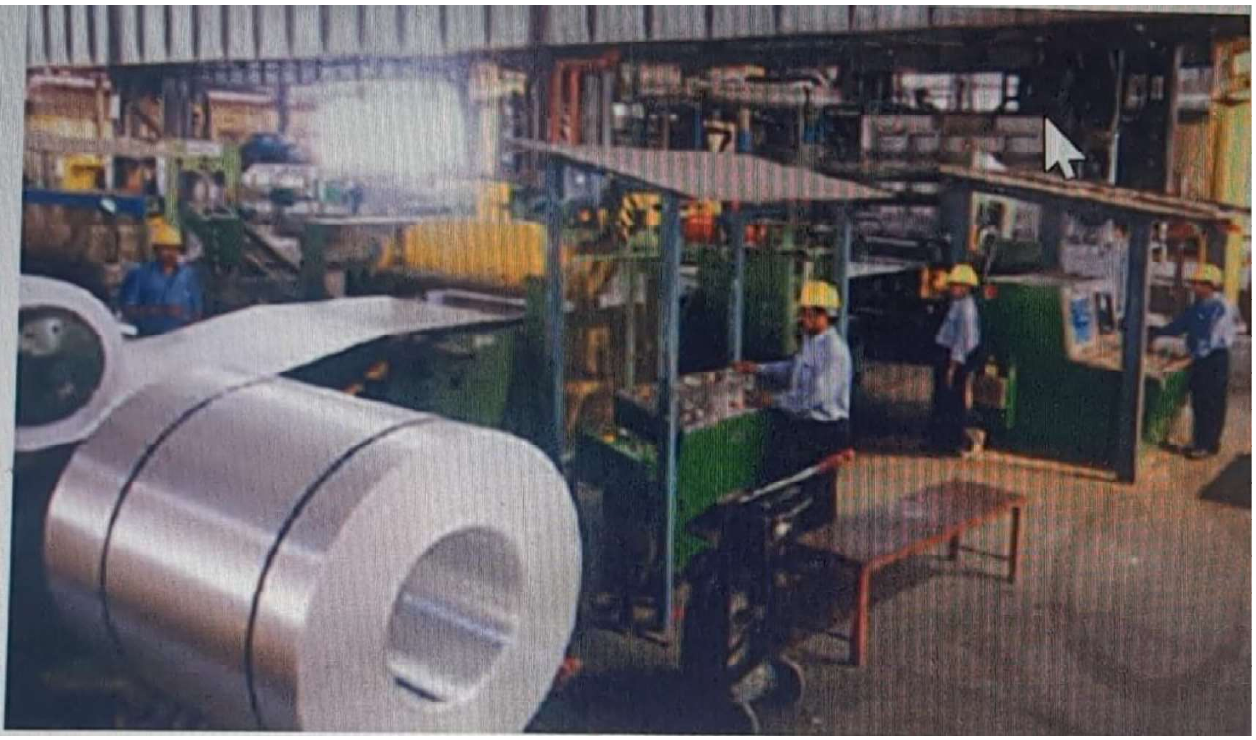
Rakhi has done an economic survey of her area: Farmer working in his fields – 250; Teachers teaching in school – 10; Handloom weaver working in his/her house – 70; Workers working in big factories – 140; Employees working at a hospital in the area – 60. How many people are working in the organised sector?
Arrange the following sources of credit in the most to least order to meet the credit requirement of rural households in India:
I. Government
II. Cooperative Banks and Societies
III. Moneylenders
IV. Relatives and friends
Statement I: Information and communication technology stimulate the process of globalisation.
Statement II: It is used to contact each other, receive information instantly and communicate with remote areas.
Section B · Very short answer (2 marks each)
(a) How did reinterpretation of history become a means of creating a sense of nationalism by the end of the nineteenth century in India? Explain.
(b) How did symbols and icons contribute to create a feeling of nationalism among the people in the national movement of India? Explain.
Why is planning necessary for judicious use of resources? Explain.
Describe any two provisions made in the constitution to establish the model of 'secular governance' in India.
"Globalisation is the process of rapid integration and interconnection between countries." Explain the statement with examples.
Section C · Short answer (3 marks each)
Why did Mahatma Gandhi decide to withdraw the Non-Cooperation Movement? Analyse any three reasons.
Read the story of Rinjha (her family clears, slashes and burns a patch of land near Diphu in Assam, irrigates it through a bamboo canal, and moves to a fresh patch when soil fertility declines). Suggest any three measures to Rinjha so that the fertility of the soil of her fields remains intact for a long time.
"The government measures gradually increased the feeling of alienation among the Sri Lankan Tamils." Explain the statement.
(a) Describe three main functions of political parties.
(b) Describe three major challenges faced by the political parties in India.
Analyse the problem of under employment in agriculture sector in India.
Section D · Long answer (5 marks each)
(a) How did French Revolution spread the spirit of nationalism in Europe? Explain with suitable arguments.
(b) How did the Greek freedom struggle arouse nationalist sentiments in Europe? Explain with suitable arguments.
(a) Explain the role of industries in increasing air pollution and suggest measures to control it. (2 + 3 = 5)
(b) Explain the measures taken by 'National Thermal Power Corporation' to prevent environmental degradation.
(a) How is democracy better than other types of government? Analyse.
(b) Analyse the role of democracy in reducing inequality and poverty.
(a) How is income an important factor in assessing the development of a country? Mention the classification done by the World Bank. (2 + 3 = 5)
(b) How has the overuse of underground water created a serious crisis in many parts of India? Explain with examples in the context of sustainable development. (2 + 3 = 5)
Section E · Case/source-based (4 marks each)
Read the given source and answer the questions that follow:
Print Culture and the French Revolution. Many historians have argued that print culture created the conditions within which French Revolution occurred. First: print popularised the ideas of the Enlightenment thinkers. Collectively, their writings provided a critical commentary on tradition, superstition and despotism. They argued for the rule of reason rather than custom, and demanded that everything be judged through the application of reason and rationality. They attacked the sacred authority of the Church and the despotic power of the state, thus eroding the legitimacy of a social order based on tradition. The writings of Voltaire and Rousseau were read widely; and those who read these books saw the world through new eyes, eyes that were questioning, critical and rational. Second: print created a new culture of dialogue and debate. All values, norms and institutions were re-evaluated and discussed by a public that had become aware of the power of reason, and recognised the need to question existing ideas and beliefs. Within this public culture, new ideas of social revolution came into being.
34.1 What impact did the ideas of Enlightenment thinkers have on society? (1)
34.2 How did print culture affect religion in France? (1)
34.3 How did print culture contribute to the social revolution in France? (2)
Read the given source and answer the questions that follow:
Decentralisation in India. The need for decentralisation was recognised in our Constitution. Since then, there have been several attempts to decentralise power to the level of villages and towns. Panchayats in villages and municipalities in urban areas were set up in all the States. But these were directly under the control of state governments. Elections to these local governments were not held regularly. Local governments did not have any powers or resources of their own. Thus, there was very little decentralisation in effective terms. A major step towards decentralisation was taken in 1992. The Constitution was amended to make the third-tier of democracy more powerful and effective.
35.1 At how many levels has decentralisation of power been done in the Indian Constitution? (1)
35.2 Explain the role of local self-government in solving problems. (1)
35.3 "Local government is the best way to realise one important principle of democracy, namely local self-government." Explain the statement. (2)
Read the given source and answer the questions that follow:
Arun's Story. Arun supervises the work of one farm labourer. Arun has seven acres of land. He is one of the few persons in Sonpur to receive bank loan for cultivation. The interest rate on the loan is 8.5 per cent per annum, and can be repaid anytime in the next three years. Arun plans to repay the loan after harvest by selling a part of the crop. He then intends to store the rest of the potatoes in a cold storage and apply for a fresh loan from the bank against the cold storage receipt. The bank offers this facility to farmers who have taken crop loan from them.
36.1 Under which source does Arun's loan come? (1)
36.2 Mention one important term of credit for taking a loan from the bank. (1)
36.3 How is Arun's loan beneficial? Explain any two reasons. (2)
Section F · Map skills (5 marks)
(a)A Two places A and B have been marked on the given political outline map of India. Identify them with the help of the following information and write their correct names on the lines drawn near them:
A. The place where the session of Indian National Congress was held in December 1927.
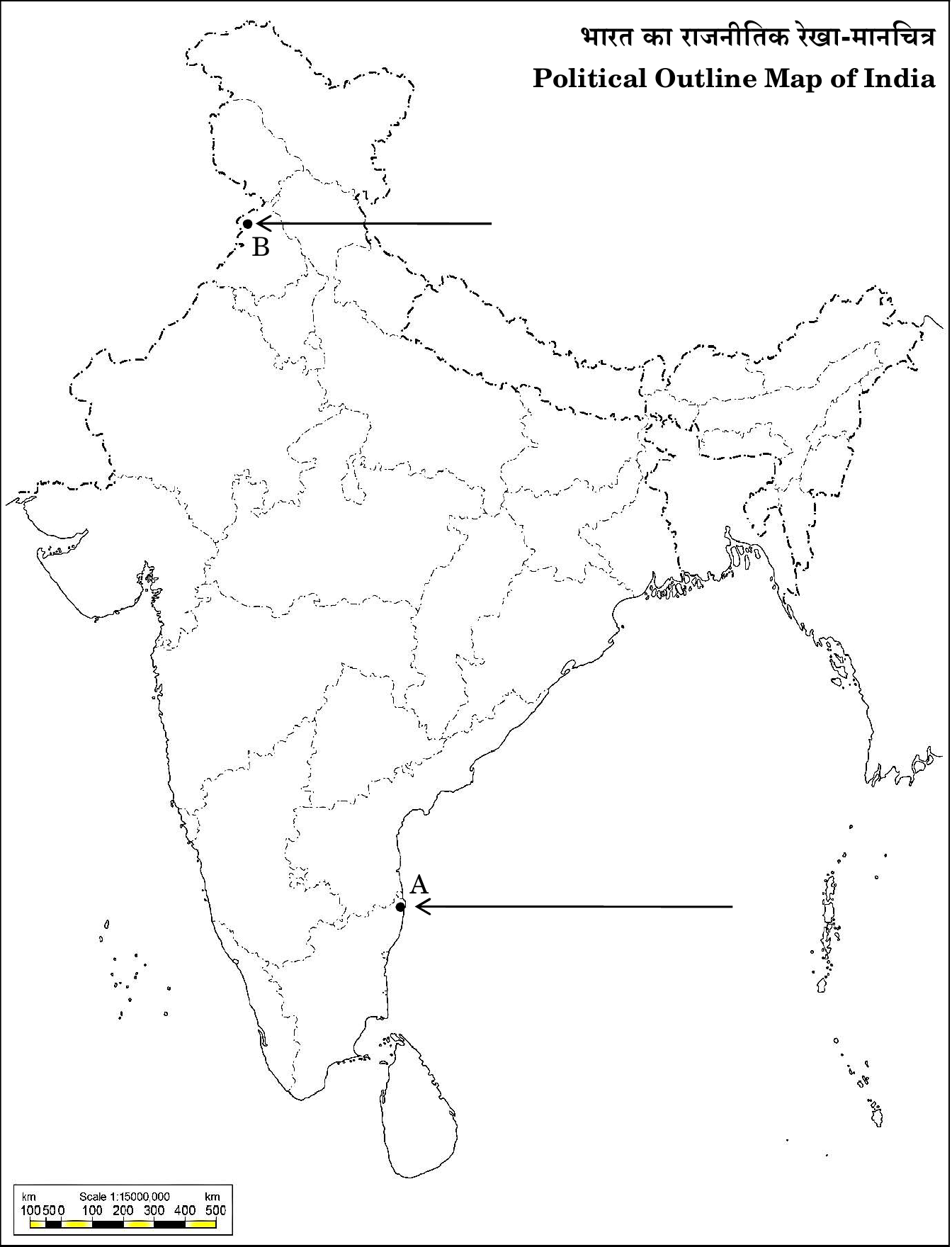
(a)B The place where Jallianwala Bagh incident took place.
(b)(i) On the same political outline map of India, locate and label any three of the following with suitable symbols:
(i) Eastern terminal station of the East-West corridor
(b)(ii) Leading state in Coffee production
(b)(iii) Nuclear power plant located in Uttar Pradesh
(b)(iv) Major seaport located in Odisha
Solutions: CBSE 2025 · 32/2/1
Answer: (B) Ireland
When potato blight destroyed the crop in 1845–49, about one million people died of starvation in Ireland and double that number emigrated.
Answer: (A) Spanish soldiers
The Spanish conquerors carried smallpox to America; the local people had no immunity and whole communities were wiped out.
Answer: (D) Manas Tiger Reserve – Assam
Corbett is in Uttarakhand, Bandhavgarh in Madhya Pradesh, and Periyar in Kerala.
Answer: (C)
Chambal – Gandhi Sagar; Ganga (Bhagirathi) – Tehri; Chenab – Salal; Satluj – Bhakra Nangal.
Answer: (B)
Cotton grows well in the drier parts of the black soil region of the Deccan plateau and needs high temperature, light rainfall, 210 frost-free days and bright sunshine.
Answer: (A)
Talcher – Odisha; Ramagundam – Telangana; Bhusawal – Maharashtra; Vijayawada – Andhra Pradesh.
Answer: (C) Belgium
Belgium gave powers to state governments and created a community government to accommodate its linguistic diversity.
Answer: (D) Pakistan
Rank 150 is the lowest position among these countries.
Answer: (D) Secondary
Workers are producing steel coils in a factory: manufacturing changes raw materials into other forms.
Answer: (B) III, II, IV, I
Moneylenders are the largest source of credit for rural households, followed by cooperatives, then relatives and friends; government is the smallest.
1. The British portrayed Indians as backward and primitive, incapable of self-rule. In response, Indians looked into the past and wrote about ancient India's glorious achievements in art, architecture, science, mathematics, religion, law, philosophy, crafts and trade.
2. These histories showed a later decline under colonial rule and urged readers to take pride in the past and struggle to change the miserable conditions under British rule.
1. India has enormous diversity in resources: some regions are rich in some resources and poor in others. Jharkhand and Chhattisgarh are rich in minerals, Arunachal Pradesh has water but little infrastructure, and Rajasthan has solar and wind energy but lacks water.
2. Balanced resource planning at the national, state, regional and local levels is needed so that resources are used without waste and every region can develop.
1. More and more goods and services, investment and technology are moving between countries; foreign trade has been rising rapidly, integrating markets (for example, Chinese toys sold in Indian markets).
2. MNCs spread production across countries (for example, Ford Motors setting up a plant near Chennai), and greater foreign investment integrates production across the world.
1. Practise crop rotation, including leguminous crops that add nitrogen to the soil.
2. Use manure and compost (organic fertilisers) regularly.
3. Prevent soil erosion on slopes by terrace farming and contour ploughing, and manage pests and plant diseases.
1. Parties select candidates and contest elections, putting forward policies and programmes for voters.
2. They make laws and form and run governments; losing parties act as the opposition.
3. They shape public opinion by raising issues and launching movements, and give people access to government machinery and welfare schemes.
1. More people are employed in agriculture than are needed; even if a few move out, production will not fall.
2. All family members work on the small plot, so everyone appears busy, but each works less than their potential; their labour effort is divided.
3. This hidden unemployment is called disguised unemployment. Creating other work, such as cold storage, honey collection or vegetable processing, can employ the extra workers gainfully.
1. The Greek war of independence mobilised nationalist feelings among the educated elite across Europe.
2. Greece had been part of the Ottoman Empire since the 15th century; a struggle for independence began in 1821.
3. Greek nationalists got support from Greeks in exile and from West Europeans who admired ancient Greek culture.
4. Poets and artists lauded Greece as the cradle of European civilisation and mobilised public opinion for its struggle against a Muslim empire; the English poet Lord Byron raised funds and died fighting in 1824.
5. The Treaty of Constantinople (1832) recognised Greece as an independent nation.
1. NTPC follows a proactive approach to preserve the natural environment and resources like water, oil, gas and fuel where it sets up power plants.
2. It makes optimum use of equipment by adopting the latest techniques and upgrading existing equipment.
3. It minimises waste by maximising ash utilisation.
4. It provides green belts to maintain ecological balance and works on afforestation.
5. It reduces pollution through ash pond management, ash water recycling and liquid waste management, and carries out ecological monitoring and online database management for all its power stations.
1. Democracy is based on political equality; every individual has equal weight in electing representatives.
2. It strengthens the claims of disadvantaged and discriminated groups for equal status and opportunity, and discourages discrimination on the basis of economic status, religion or language.
3. Democratic governments make special provisions such as reservations in education and jobs for weaker sections.
4. They run poverty-eradication and employment programmes, for example MGNREGA.
5. However, economic inequality has not ended: a small number of the ultra-rich enjoy a large share of wealth, and democracy needs to do more to reduce poverty.
1. Groundwater is renewable and replenished by rain, but if we use more than is replenished we overuse it, through excessive irrigation and industrial use.
2. Recent evidence shows groundwater is under serious threat in many parts of India; many districts report a steep fall in the water level.
3. Nearly one-third of the country is overusing its groundwater reserves; if this continues, most of India will face a serious water crisis.
4. Overuse is worst in agriculturally prosperous Punjab and western Uttar Pradesh, the hard-rock plateau areas of central and south India, some coastal areas and fast-growing cities.
5. Sustainable development needs water to be used judiciously so that future generations also have enough.
35.1 Three levels: Union (central) government, state governments, and local governments (rural and urban).
35.2 Many problems are best settled locally, because local people know their problems better and have better ideas on where to spend money and how to manage things efficiently.
35.3 (i) Local government lets people participate directly in decisions that affect their lives, through bodies like the gram sabha.
(ii) It ensures representation of diverse groups (one-third of seats for women, reserved seats for SCs, STs and OBCs) and so deepens democracy.
A – Madras (Chennai), Tamil Nadu. The December 1927 session decided to boycott the Simon Commission.
Silchar, in southern Assam (the corridor runs from Porbandar in Gujarat to Silchar).
Narora, on the Ganga in western Uttar Pradesh (Bulandshahr district).
Get every solution for all 17 papers
- Every board question of every chapter, each fully solved the way the board gives marks
- 17 complete board papers, each followed by its solutions
- Weightage and most-asked topics for every chapter
- Instant PDF download, colour and black & white print copies
Revising the chapter first? Complete Social Science Notes for Class 10 (NCERT 2026-27) →
What you get in the pack
- Questions from 126 CBSE papers, 2016 to 2026: every set code available
- Complete: 2341 different questions and parts from all set codes, 20 chapters and 17 full papers
- Part A: all 20 chapters of History, Geography, Pol Science and Economics, sorted by marks
- Year-wise weightage table and most-asked topics for every chapter
- Part B: 17 full board papers, each followed by its complete answers, for timed practice
- Answers written to the marking-scheme points; map questions with the paper's map and every place named
- Questions on topics outside the 2026-27 board exam flagged; only the current syllabus in Part A
All chapters in this pack
- PYQ History 1 The Rise of Nationalism in Europe
- PYQ History 2 Nationalism in India
- PYQ History 3 The Making of a Global World
- PYQ History 5 Print Culture and the Modern World
- PYQ Geography 1 Resources and Development
- PYQ Geography 2 Forest and Wildlife Resources
- PYQ Geography 3 Water Resources
- PYQ Geography 4 Agriculture
- PYQ Geography 5 Minerals and Energy Resources
- PYQ Geography 6 Manufacturing Industries
- PYQ Geography 7 Lifelines of National Economy (Map)
- PYQ Pol Science 1 Power-sharing
- PYQ Pol Science 2 Federalism
- PYQ Pol Science 3 Gender, Religion and Caste
- PYQ Pol Science 4 Political Parties
- PYQ Pol Science 5 Outcomes of Democracy
- PYQ Economics 1 Development
- PYQ Economics 2 Sectors of the Indian Economy
- PYQ Economics 3 Money and Credit
- PYQ Economics 4 Globalisation and the Indian Economy
- Board Paper 2026 Set 32-4-1 with Solutions
- Board Paper 2026 Set 32-5-1 with Solutions
- Board Paper 2025 Set 32-1-1 with Solutions
- Board Paper 2025 Set 32-2-1 with Solutions
- Board Paper 2024 Set 32-2-1 with Solutions
- Board Paper 2024 Set 32-4-1 with Solutions
- Board Paper 2023 Set 32-2-1 with Solutions
- Board Paper 2023 Set 32-4-1 with Solutions
- Board Paper 2022 Term 2 Set 32-1-1 with Solutions
- Board Paper 2022 Term 2 Set 32-3-1 with Solutions
- Board Paper 2020 Set 32-1-1 with Solutions
- Board Paper 2020 Set 32-4-1 with Solutions
- Board Paper 2019 Set 32-2-1 with Solutions
- Board Paper 2019 Set 32-4-1 with Solutions
- Board Paper 2018 Set 32-1 with Solutions
- Board Paper 2017 Set 32-1 with Solutions
- Board Paper 2016 Set 32-1 with Solutions