
CBSE Class 10 Social Studies Question Paper 2025 (32/1/1) with Solutions
The complete CBSE Class 10 Social Studies board paper of 2025, Q.P. code 32/1/1: all 37 questions exactly as set, with marks. 24 solutions are free below. The Class 10 SST PYQ Book: Solved Board Papers 2016-2026 (CBSE) solves all 17 papers in full and sorts every question chapter-wise.
Subject expert: Vikas Chandrawal, M.A. History · 8 years teaching


Free: NCERT solutions for Class 10 SST →
Question paper
Jump to: Question paperSolutions
2025 · Q.P. Code 32/1/1
Maximum marks: 80
Section A · Multiple choice (1 mark each)
Which one of the following regions became a part of unified Italy in 1866?
Read the following reasons of migration of people from Europe to America till the 19th century and choose the correct option:
I. Poverty and hunger
II. Slaves for sale
III. Wide spread of diseases
IV. Religious conflicts and persecution
The author of 'Book of Marvels' is:
Assume you are doing research on 15th century print culture. Which of the following would be the most significant advantage for your research?
Arrange the following categories of forests in India from the largest to the smallest in terms of area and choose the correct option:
I. Reserved
II. Protected
III. Unclassed
'Sariska Tiger Reserve' is located in which one of the following states?
Match Column I (Dam) with Column II (River): a. Hirakud, b. Gandhi Sagar, c. Nagarjuna Sagar, d. Mettur; i. Chambal, ii. Krishna, iii. Kaveri, iv. Mahanadi.
Choose the correct option regarding major states involved in the Krishna Godavari issue:
Imagine you are travelling from Delhi to Chandigarh to attend a wedding, by road in January. Which of the following crops will you notice prominently in the fields during the journey?
Assertion (A): Minerals are an indispensable part of our lives.
Reason (R): All living things need minerals.
Match Column I (Minerals) with Column II (Major Mines): a. Iron ore, b. Mica, c. Bauxite, d. Coal; i. Gaya, ii. Singrauli, iii. Chandrapur, iv. Maikala.
Belgium solved its problem of majoritarianism by strengthening which of the following types of government?
Choose the correctly matched pair from the following (Country – System):
Which of the following are the main components of a political party? Choose the correct option:
I. Leaders
II. Active members
III. Followers
IV. Pressure groups
Study the following table related to 'World Human Development Index': India – 130, Myanmar – 148, Nepal – 149, Pakistan – 150. Amongst the given countries, which one of the following countries has the highest rank in 'Human Development Index'?
'X' lives in a town. He cultivates flowers along with animal husbandry. The work of 'X' will fall under which sector of the economy?
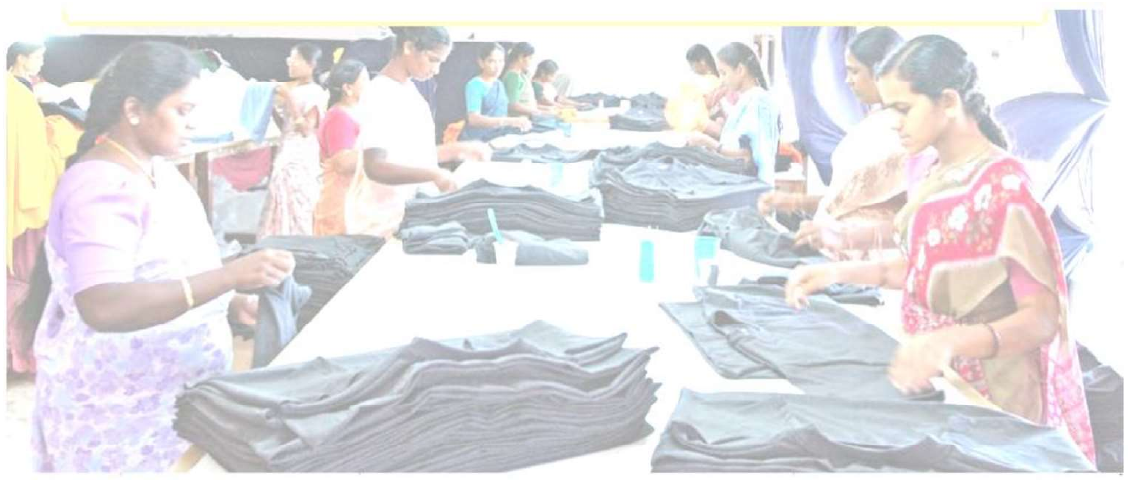
Look at the given picture and answer the question that follow: The work being done in the picture falls under which sector of the economy?
Why does it become difficult for farmers in rural areas to take loans from government banks? Read the following reasons and choose the most appropriate option:
I. Lack of collateral
II. Complicated procedure
III. Higher cost of borrowing
IV. Lack of awareness
Which of the following groups in urban India depend on informal sources to meet their credit needs?
Statement I: Rapid improvement in technology has been one major factor to stimulate the globalisation process.
Statement II: This has made much faster delivery of goods across long distances possible at lower costs.
Section B · Very short answer (2 marks each)
(a) Explain the role of anti-colonial movement in the rise of 'modern nationalism' in India.
(b) Why did Gandhiji say 'Satyagraha is pure soul force'? Explain by giving two arguments.
Explain any two problems of the 'global ecology' arising due to indiscriminate use of resources.
Suggest any two measures to remove gender inequality.
How did the process of liberalisation initiated in India in the 1990s, promote globalisation? Explain.
Section C · Short answer (3 marks each)
"Tribal peasants interpreted the message of Mahatma Gandhi and the idea of 'Swaraj' in yet another way." Explain the statement in the context of Non-Cooperation Movement.
Read the story of Rinjha and answer the question that follows:
Story of Rinjha. Rinjha lived with her family in a small village at the outskirts of Diphu in Assam. She enjoys watching her family members clearing, slashing and burning a patch of land for cultivation. She often helps them in irrigating the fields with water running through a bamboo canal from the nearby spring. She loves the surroundings and wants to stay here as long as she can, but this little girl has no idea about the declining fertility of the soil and her family's search for a fresh patch of land in the next season.
What type of farming is Rinjha's family doing? Describe any two of its characteristics. (1 + 2 = 3)
"That democratic system of government is considered good in which maximum number of citizens are made stakeholders in political power." Explain the statement with suitable arguments.
(a) Explain the importance of political parties in democracy.
(b) Why did India adopt the multiparty system? Explain with suitable arguments.
Explain the difference between public and private sector of Indian economy with example.
Section D · Long answer (5 marks each)
(a) Analyse the significance of the 'Napoleonic Code' in making the administrative system rational and efficient.
(b) How was liberalism allied to national unity in Europe in the early decades of the 19th century? Analyse.
(a) "Manufacturing industries are considered the backbone of the economic development of a country." Justify the statement.
(b) "Agriculture and industries complement each other." Justify the statement.
(a) Explain any five bases for assessing the outcomes of democracy.
(b) Explain any five values of democracy.
(a) "Recent evidence suggests that the overuse of groundwater is becoming a serious threat in many parts of the country." Evaluate the statement in the context of sustainability of development.
(b) "The development goals of different categories of people may differ." Evaluate the statement.
Section E · Case/source-based (4 marks each)
Read the given source and answer the questions that follow:
Print and Censorship. The power of the printed word is most often seen in the way governments seek to regulate and suppress print. The colonial government kept continuous track of all books and newspapers published in India and passed numerous laws to control the press. During the First World War, under the Defence of India Rules, 22 newspapers had to furnish securities. Of these, 18 shut down rather than comply with government orders. The Sedition Committee Report under Rowlatt in 1919 further strengthened controls that led to imposition of penalties on various newspapers. At the outbreak of the Second World War, the Defence of India Act was passed, allowing censoring of reports of war-related topics. All reports about the Quit India movement came under its purview. In August 1942, about 90 newspapers were suppressed.
34.1 Explain the meaning of 'censor'. (1)
34.2 Why did the colonial administration keep an eye on books and newspapers? (1)
34.3 Why did Gandhiji start a nationwide Satyagraha against the Rowlatt Act? Explain any two reasons. (2)
Read the given source and answer the questions that follow:
An Experiment in Brazil. A city called Porto Alegre in Brazil has carried out an extraordinary experiment in combining decentralisation with participative democracy. The city has set up a parallel organisation operating alongside the municipal council, enabling local inhabitants to take real decisions for their city. The nearly 13 lakh people in this city get to participate in making the budget for their own city. The city is divided into many sectors or what we call wards. Each sector has a meeting, like that of the gram sabha, in which anyone living in that area can participate. There are some meetings to discuss issues that affect the entire city. Any citizen of the city can participate in those meetings. The budget of the city is discussed in these meetings. The proposals are put to the municipality that takes a final decision about it.
35.1 Explain the meaning of 'participatory democracy'. (1)
35.2 In the context of separation of powers, the given example defines which type of government? (1)
35.3 Describe the structure of the system in India which is almost similar to the above example of Brazil. (2)
Read the given source and answer the questions that follow:
Loans From Cooperatives. Besides banks, the other major source of cheap credit in rural areas are the cooperative societies (or cooperatives). Members of a cooperative pool their resources for cooperation in certain areas. There are several types of cooperatives possible such as farmers cooperatives, weavers cooperatives, industrial workers cooperatives, etc. Krishak Cooperative functions in a village not very far away from Sonpur. It has 2300 farmers as members. It accepts deposits from its members. With these deposits as collateral, the Cooperative has obtained a large loan from the bank. These funds are used to provide loans to members. Once these loans are repaid, another round of lending can take place. Krishak Cooperative provides loans for the purchase of agricultural implements, loans for cultivation and agricultural trade, fishery loans, loans for construction of houses and for a variety of other expenses.
36.1 Cooperative societies come under which source of credit? (1)
36.2 Mention any two sources of capital of cooperative societies. (1)
36.3 Explain the role of cooperative societies in increasing the income of farmers. (2)
Section F · Map skills (5 marks)
(a)A Two places A and B have been marked on the given political outline map of India. Identify them with the help of the following information and write their correct names on the lines drawn near them:
A. The place where the session of Indian National Congress was held in 1920.
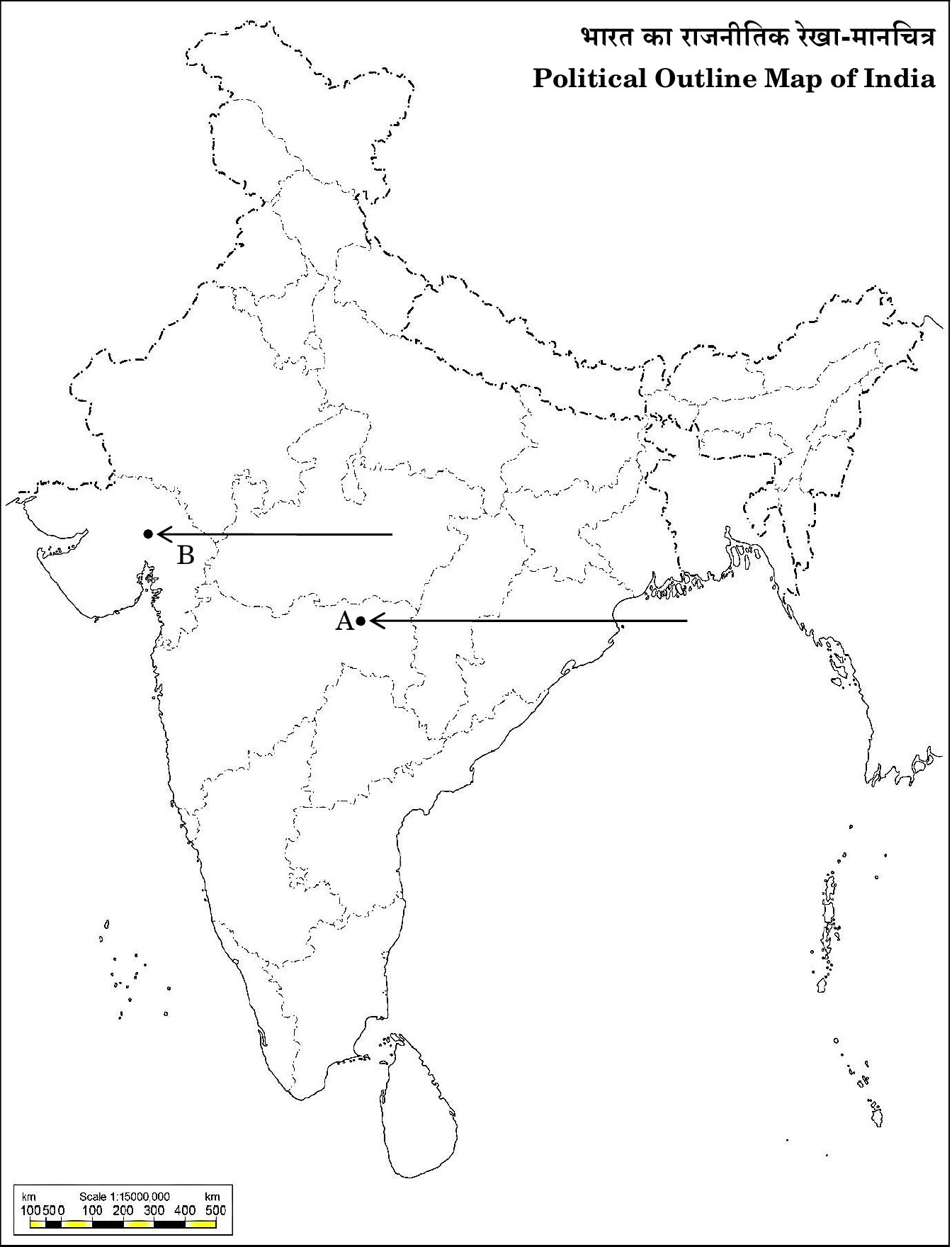
(a)B The place where Gandhiji started Dandi March.
(b)(i) On the same political outline map of India, locate and label any three of the following with suitable symbols:
(i) Leading state in production of Jute
(b)(ii) Atomic Power Plant located in Gujarat
(b)(iii) Iron and Steel Plant located in Jharkhand
(b)(iv) Sri Guru Ram Das Jee International Airport
Solutions: CBSE 2025 · 32/1/1
Answer: (B) Venetia
Venetia was added to Italy in 1866 (after the Austro-Prussian War); the Papal States followed in 1870.
Answer: (A) Marco Polo (the board awarded the mark to all candidates who attempted it)
Marco Polo's 'Book of Marvels' on China was one of the travel books that became popular in Europe after printing spread.
Answer: (B) I, II, III
Reserved forests make up more than half the forest land, protected forests about one-third, and unclassed forests the rest.
Answer: (C)
Hirakud – Mahanadi; Gandhi Sagar – Chambal; Nagarjuna Sagar – Krishna; Mettur – Kaveri.
Answer: (C) Wheat
January falls in the rabi season (sown October–December, harvested April–June), and Haryana and Punjab are major wheat producers.
Answer: (A)
Iron ore – Chandrapur (Maharashtra); Mica – Gaya (Bihar); Bauxite – Maikala hills; Coal – Singrauli.
Answer: (D) Spain – Federal
Spain, Canada and Australia are federations; Bolivia is a unitary state.
Answer: (B) India
A smaller rank number means a better (higher) position; India at 130 is highest among them.
Answer: (D) Tertiary (as per the CBSE marking scheme)
The women are sorting, checking and packing finished garments, a service activity that helps goods reach the market. (Stitching the garments would be secondary.)
Answer: (C)
In urban areas, poor households and those with few assets depend largely on informal sources; rich households mostly use formal credit.
1. People began discovering their unity in the process of their struggle against colonialism; the shared sense of being oppressed tied many different groups together.
2. Mass movements such as Non-Cooperation, Civil Disobedience and Quit India brought peasants, workers, tribals, women and the middle classes into one national struggle, under the Congress led by Gandhiji.
1. Global warming caused by burning fossil fuels and cutting forests.
2. Depletion of the ozone layer, along with environmental pollution and land degradation.
1. Around 1991 the government removed many barriers on foreign trade and investment, so goods could be imported and exported easily.
2. Foreign companies were allowed to set up factories and offices in India, and SEZs were created to attract investment, integrating the Indian economy with the world.
Type: primitive subsistence farming (slash and burn or shifting cultivation, called 'jhumming' in the north-east).
1. It is practised on small patches of land with primitive tools like hoe, dao and digging sticks, using family or community labour.
2. It depends on the monsoon and the natural fertility of the soil; when fertility declines, farmers clear a fresh patch of land.
1. Parties contest elections and put forward different policies and programmes for voters to choose from.
2. They make laws, and form and run governments; the losing parties act as the opposition and criticise wrong policies.
3. They shape public opinion and give people access to government machinery and welfare schemes.
| Public sector | Private sector |
|---|---|
| The government owns most of the assets and provides the services. | Assets and services are owned and run by private individuals or companies. |
| The motive is public welfare, not just profit; charges are often low. | Activities are guided by the motive to earn profits. |
| Funds come from taxes and government revenue. Examples: railways, post office. | Funds are raised by the owners. Examples: Tata Steel (TISCO), Reliance Industries. |
1. For the new middle classes, liberalism meant freedom for the individual and equality of all before the law.
2. Politically it stood for government by consent: an end to autocracy and clerical privileges, a constitution and representative government through parliament.
3. Economically it stood for freedom of markets and the abolition of state-imposed restrictions on the movement of goods and capital.
4. In the German lands, merchants travelling from Hamburg to Nuremberg had to pass 11 customs barriers, and each region had its own currency, weights and measures; such barriers were seen as obstacles to economic growth.
5. In 1834 the Zollverein, a customs union led by Prussia, abolished tariff barriers and reduced currencies from over thirty to two. It created a network of railways and linked economic interests with national unity.
1. Agriculture and industry are not exclusive of each other; they move hand in hand.
2. Agro-based industries (cotton, jute, sugar, vegetable oil) depend on agriculture for their raw materials.
3. Industries in turn supply agriculture with irrigation pumps, fertilisers, insecticides, pesticides, PVC pipes, machines and tools.
4. Competitive manufacturing has helped farmers increase production and made the production process more efficient.
5. Agro-industries have given a major boost to agriculture by raising its productivity and creating demand for farm produce.
1. Equality: all citizens have equal rights and opportunities.
2. Freedom: citizens are free to express themselves.
3. Participation: citizens choose their leaders and take part in the political process.
4. Dignity and respect for every individual, and accommodation of social diversity.
5. Transparency and accountability: citizens have the right and means to examine the process of decision-making, and the government is responsive to them.
1. People have different life situations, so they seek things that are most important to them and fulfil their aspirations.
2. A landless rural labourer wants more days of work and better wages, while a prosperous farmer wants higher support prices for crops.
3. An urban unemployed youth wants a job; a girl wants as much freedom and opportunity as her brother and wants him to share household work.
4. Goals can even conflict: an industrialist wants more dams for electricity, but the people they displace resent this.
5. So what is development for one may not be development for another, or may even be destructive for others.
35.1 A democracy in which citizens directly take part in decision-making, such as making the budget, and not only through elected representatives.
35.2 Local self-government (decentralised, third-tier government).
35.3 (i) Rural local government (Panchayati Raj): gram panchayats in villages, panchayat samitis at block level and zila parishads at district level, all elected by the people.
(ii) The gram sabha, made up of all voters of the village, meets to approve the annual budget and review the panchayat, just like Porto Alegre's ward meetings; towns have municipalities and big cities municipal corporations.
A – Nagpur (Maharashtra, centre of India), where the December 1920 session adopted Non-Cooperation. (Calcutta, the other 1920 session, was also accepted for visually impaired candidates.)
West Bengal (Ganga–Brahmaputra delta region).
Bokaro or Jamshedpur, in eastern Jharkhand.
Get every solution for all 17 papers
- Every board question of every chapter, each fully solved the way the board gives marks
- 17 complete board papers, each followed by its solutions
- Weightage and most-asked topics for every chapter
- Instant PDF download, colour and black & white print copies
Revising the chapter first? Complete Social Science Notes for Class 10 (NCERT 2026-27) →
What you get in the pack
- Questions from 126 CBSE papers, 2016 to 2026: every set code available
- Complete: 2341 different questions and parts from all set codes, 20 chapters and 17 full papers
- Part A: all 20 chapters of History, Geography, Pol Science and Economics, sorted by marks
- Year-wise weightage table and most-asked topics for every chapter
- Part B: 17 full board papers, each followed by its complete answers, for timed practice
- Answers written to the marking-scheme points; map questions with the paper's map and every place named
- Questions on topics outside the 2026-27 board exam flagged; only the current syllabus in Part A
All chapters in this pack
- PYQ History 1 The Rise of Nationalism in Europe
- PYQ History 2 Nationalism in India
- PYQ History 3 The Making of a Global World
- PYQ History 5 Print Culture and the Modern World
- PYQ Geography 1 Resources and Development
- PYQ Geography 2 Forest and Wildlife Resources
- PYQ Geography 3 Water Resources
- PYQ Geography 4 Agriculture
- PYQ Geography 5 Minerals and Energy Resources
- PYQ Geography 6 Manufacturing Industries
- PYQ Geography 7 Lifelines of National Economy (Map)
- PYQ Pol Science 1 Power-sharing
- PYQ Pol Science 2 Federalism
- PYQ Pol Science 3 Gender, Religion and Caste
- PYQ Pol Science 4 Political Parties
- PYQ Pol Science 5 Outcomes of Democracy
- PYQ Economics 1 Development
- PYQ Economics 2 Sectors of the Indian Economy
- PYQ Economics 3 Money and Credit
- PYQ Economics 4 Globalisation and the Indian Economy
- Board Paper 2026 Set 32-4-1 with Solutions
- Board Paper 2026 Set 32-5-1 with Solutions
- Board Paper 2025 Set 32-1-1 with Solutions
- Board Paper 2025 Set 32-2-1 with Solutions
- Board Paper 2024 Set 32-2-1 with Solutions
- Board Paper 2024 Set 32-4-1 with Solutions
- Board Paper 2023 Set 32-2-1 with Solutions
- Board Paper 2023 Set 32-4-1 with Solutions
- Board Paper 2022 Term 2 Set 32-1-1 with Solutions
- Board Paper 2022 Term 2 Set 32-3-1 with Solutions
- Board Paper 2020 Set 32-1-1 with Solutions
- Board Paper 2020 Set 32-4-1 with Solutions
- Board Paper 2019 Set 32-2-1 with Solutions
- Board Paper 2019 Set 32-4-1 with Solutions
- Board Paper 2018 Set 32-1 with Solutions
- Board Paper 2017 Set 32-1 with Solutions
- Board Paper 2016 Set 32-1 with Solutions