
CBSE Class 10 Social Studies Question Paper 2024 (32/4/1) with Solutions
The complete CBSE Class 10 Social Studies board paper of 2024, Q.P. code 32/4/1: all 37 questions exactly as set, with marks. 24 solutions are free below. The Class 10 SST PYQ Book: Solved Board Papers 2016-2026 (CBSE) solves all 17 papers in full and sorts every question chapter-wise.
Subject expert: Vikas Chandrawal, M.A. History · 8 years teaching


Free: NCERT solutions for Class 10 SST →
Question paper
Jump to: Question paperSolutions
2024 · Q.P. Code 32/4/1
Maximum marks: 80
Section A · Multiple choice (1 mark each)
Arrange the following incidents in chronological order:
I. French Revolution
II. Napoleon's invasion of Italy
III. Unification of Italy
IV. Vienna Peace Treaty
Choose the correct option to fill in the blank: ______ from India and Southeast Asia travelled through 'Silk Route' to other parts of the world.
Choose the correct option, related to the founders of the 'Swaraj Party' within the Congress.
Who among the following said – "Printing is the ultimate gift of God and the greatest one."?
Assertion (A): The famous 'Chipko Movement' in the Himalayas successfully resisted deforestation in several areas.
Reason (R): Through this, community afforestation campaign with indigenous species was made enormously successful.
Match Column I (Dams) with Column II (Rivers): i. Sardar Sarovar, ii. Hirakud, iii. Bhakra Nangal, iv. Nagarjuna Sagar; a. Sutlej, b. Krishna, c. Narmada, d. Mahanadi.
Choose the correct option for the following States' share (in percentage) in the production of 'manganese' in India from the highest to the lowest order.
Read the arguments given in favour of power sharing:
I. Reduces the likelihood of bias.
II. Barricades the decision-making process.
III. Accommodates diversities.
IV. Increases the participation of people in power.
'Education' falls under which one of the following lists given in the Indian Constitution?
In which one of the following institutions in India was a system of reservation for women made by amending the Constitution in 1992?
Assertion (A): Modern democracy cannot function without political parties.
Reason (R): Elected representatives will be accountable only to their constituencies, not towards the country.
Which one of the following countries has a two-party system?
In which of the following regions was women representation the highest in their respective National Parliaments (2018)?
Read the following characteristics of democracy: I. Free and fair elections; II. Equality before law; III. Dignity of a person; IV. Majority rule.
Salim obtains credit to meet the working capital needs of production. The credit helps him to meet the ongoing expenses and complete production on time. Identify the positive impact of credit.
Study the following picture. The work done in the picture comes under which one of the following sectors of the economy?
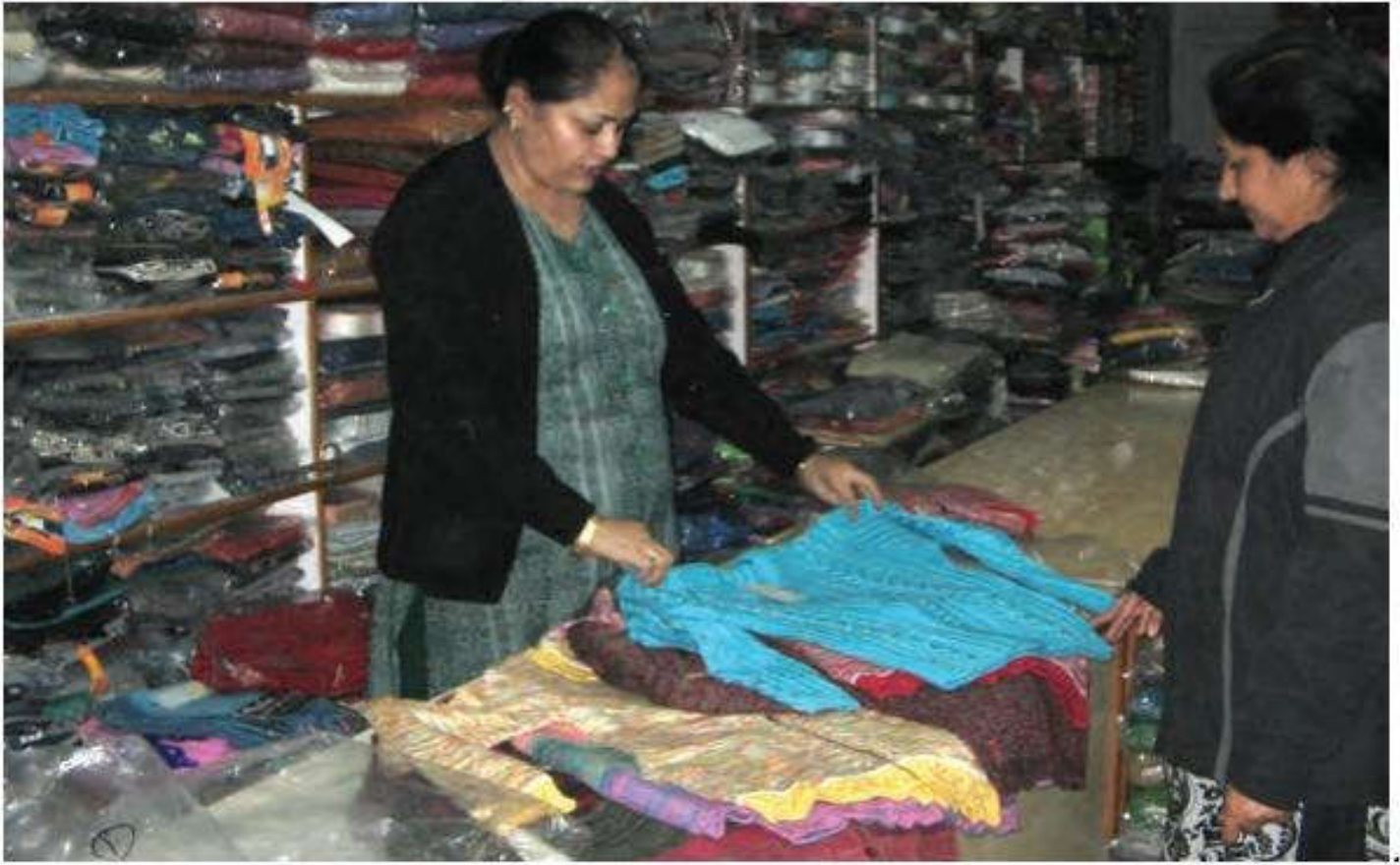
Assertion (A): No individual in India can legally refuse a payment made in rupees.
Reason (R): In India the rupee is authorized by the State Governments.
Which one of the following statements best describes the meaning of 'Globalization'?
On which of the following basis does the UNDP publish the 'Human Development Report'?
Assertion (A): Banks are not ready to lend money to certain borrowers.
Reason (R): Some people do not have collateral.
Section B · Very short answer (2 marks each)
"Until the nineteenth century, poverty and hunger were common in Europe." Analyse the statement.
How is energy a basic requirement for economic development of a country? Explain with examples.
(a) Examine the role of the Constitution in the Federal System of India in two points.
(b) Examine the role of the Supreme Court in the Federal System of India in two points.
How is technology an important factor of globalisation? Explain with examples.
Section C · Short answer (3 marks each)
(a) How did people belonging to different communities, regions or language groups develop a sense of collective belonging in the National Movement? Explain with examples.
(b) "Workers had their own understanding of Mahatma Gandhi and the notion of 'Swaraj'." Explain the statement with examples.
Describe any three features of cultivation of millets in India.
Analyse the role of political parties in shaping public opinion.
"Federal form of government is in direct contrast to the Unitary form of Government." Explain the statement.
Why could different persons have different notions of a country's development? Explain with examples.
Section D · Long answer (5 marks each)
(a) "The French Revolution created a sense of collective identity among the French people." Explain the statement with suitable arguments.
(b) "The Greek war of independence mobilised nationalist feelings among the educated elite across Europe." Explain the statement with suitable arguments.
(a) Describe the role of manufacturing industries in the economic development of a country.
(b) Describe any five steps taken to save fresh water from industrial pollution.
(a) Analyse the importance of democracy in accommodation of social diversity.
(b) Analyse the importance of democracy in reducing poverty and inequality.
(a) "There is a need for protection and support of the workers in the unorganised sector." Examine the statement with examples.
(b) "Activities in private sector are guided by motive to earn profits." Examine the statement with examples.
Section E · Case/source-based (4 marks each)
Read the given source and answer the questions that follow:
After the Revolt of 1857, the attitude to freedom of the press changed. Enraged Englishmen demanded a clamp down on the 'native' press. As vernacular newspapers became assertively nationalist, the colonial government began debating measures of stringent control. In 1878, the Vernacular Press Act was passed, modelled on the Irish Press Laws. It provided the government with extensive rights to censor reports and editorials in the vernacular press. From now on the government kept regular track of the vernacular newspapers published in different provinces. When a report was judged as seditious, the newspaper was warned, and if the warning was ignored, the press was liable to be seized and the printing machinery confiscated.
34.1 On which rule was the 'Vernacular Press Act' based? (1)
34.2 Why did the attitude of the British change towards the freedom of press after the Revolt of 1857? Explain. (1)
34.3 Explain any two impacts of passing the 'Vernacular Press Act'. (2)
Read the given source and answer the questions that follow:
Conservation of Resources. Resources are vital for any developmental activity. But irrational consumption and over-utilisation of resources may lead to socio-economic and environmental problems. To overcome these problems, resource conservation at various levels is important. This had been the main concern of the leaders and thinkers in the past. For example, Gandhiji was very apt in voicing his concern about resource conservation in these words: "There is enough for everybody's need and not for anybody's greed." He placed the greedy and selfish individuals and exploitative nature of modern technology as the root cause for resource depletion at the global level. He was against mass production and wanted to replace it with the production by the masses.
35.1 Define the term 'Resource Planning'. (1)
35.2 Explain the need for conservation of resources. (1)
35.3 Why did Gandhiji say – "There is enough for everybody's need and not for anybody's greed"? Analyse any two reasons. (2)
Read the given source and answer the questions that follow:
Loans from Cooperatives. Besides banks, the other major source of cheap credit in rural areas are the cooperative societies (or cooperatives). Members of a cooperative pool their resources for cooperation in certain areas. There are several types of cooperatives possible such as farmers cooperatives, weavers cooperatives and industrial workers cooperatives, etc. Krishak Cooperative functions in a village not very far away from Sonpur. It has 2300 farmers as members. It accepts deposits from its members. With these deposits as collateral, the Cooperative has obtained a large loan from the bank. These funds are used to provide loans to members. Once these loans are repaid, another round of lending can take place. Krishak Cooperative provides loans for the purchase of agricultural implements, loans for cultivation and agricultural trade, fishery loans, loans for construction of houses and for a variety of other expenses.
36.1 'Cooperative society' is an example of which source of 'credit'? (1)
36.2 Explain the contribution of Cooperative Societies in rural development. (1)
36.3 Mention any two sources of capital for Self-Help Groups. (2)
Section F · Map skills (5 marks)
(a)A Two places 'A' and 'B' have been marked on the given political outline map of India. Identify them:
A. The place where Gandhiji started Satyagraha for indigo peasants.
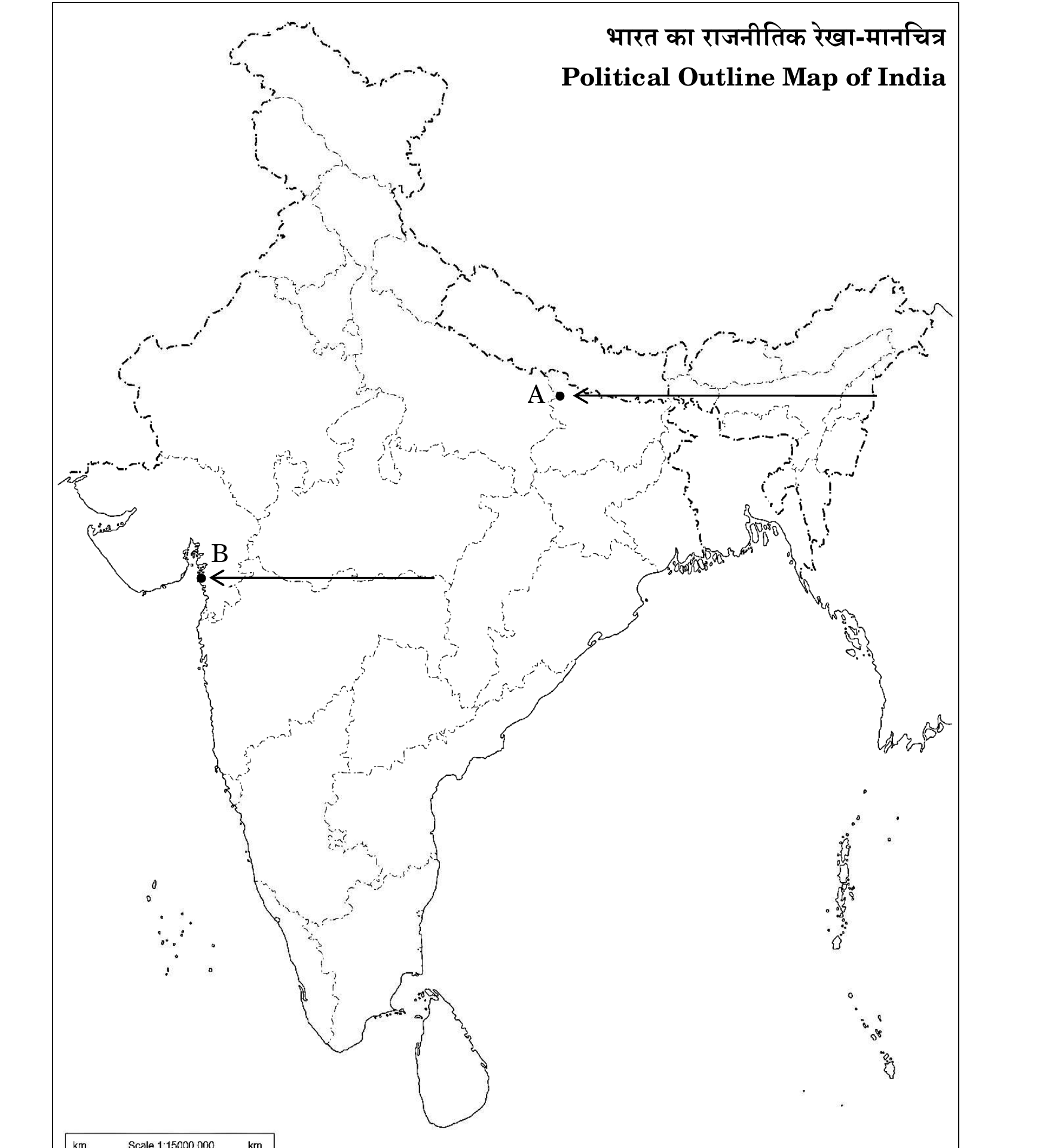
(a)B The place where Gandhiji broke the Salt Law.
(b)(i) On the same political outline map of India, locate and label any three of the following with suitable symbols:
(i) Naharkatiya – Oil field
(b)(ii) Talcher – Major Coal Mines
(b)(iii) Narora – Atomic Power Plant
(b)(iv) Tuticorin – Major Sea Port
Solutions: CBSE 2024 · 32/4/1
Answer: (A) I, II, IV, III
French Revolution (1789) → Napoleon's invasion of Italy (1796–97) → Treaty of Vienna (1815) → unification of Italy (1861).
Answer: (C) C.R. Das and Motilal Nehru
They formed the Swaraj Party in 1922–23 to argue for a return to council politics.
Answer: (B) (as per the CBSE marking scheme)
The Chipko Movement resisted deforestation and also showed that community afforestation with indigenous species can be enormously successful.
Answer: (B) (as per the CBSE marking scheme, from the NCERT pie chart)
Answer: (C) Concurrent List
Answer: (C)
Without parties every representative would be independent and accountable only to his constituency; nobody would be responsible for how the country is run.
Answer: (A) Nordic countries
Answer: (B)
Credit lets him complete production on time, sell it and earn more.
Answer: (C)
The rupee is legal tender authorised by the central government; the RBI issues currency notes on its behalf. So R is false.
Answer: (B)
1. Cities were crowded and deadly diseases were widespread; there was frequent shortage of food grains.
2. Religious conflicts were common and dissenters were persecuted, so thousands fled Europe for America.
1. The jurisdictions of each tier of government are specified in the Constitution (Union, State and Concurrent Lists), and the existence and authority of each tier is constitutionally guaranteed.
2. The fundamental provisions cannot be changed by one level alone; changes need the consent of both levels.
1. Better transport technology (containers, cheaper air transport) makes faster delivery of goods over long distances possible at low cost.
2. Telecommunication, computers and the internet let people communicate instantly; services like data entry, designing and call centres can be provided across countries.
1. For plantation workers in Assam, freedom meant the right to move freely in and out of the confined space in which they were enclosed and to keep a link with their villages.
2. Under the Inland Emigration Act of 1859, they were not allowed to leave the tea gardens without permission, which they rarely got.
3. When they heard of the Non-Cooperation Movement, thousands defied the authorities and headed home, believing that 'Gandhi Raj' was coming and everyone would get land in their own village.
1. Parties raise and highlight issues; with lakhs of members and activists across the country, they spread their views widely.
2. Many pressure groups are extensions of parties among different sections of society.
3. Parties sometimes launch movements for the resolution of problems faced by people, and opinions in society often crystallise on the lines parties take.
1. People have different life situations and seek the things most important to them, so their ideas of development differ.
2. Ideas can even conflict: industrialists may want more dams for electricity.
3. But dams may submerge land and disrupt the lives of displaced people such as tribals, who might prefer small check dams or tanks to irrigate their land.
1. Greece had been part of the Ottoman Empire since the 15th century.
2. The growth of revolutionary nationalism in Europe sparked off a struggle for independence among the Greeks in 1821.
3. Greek nationalists got support from Greeks in exile and from West Europeans who admired ancient Greek culture.
4. Poets and artists lauded Greece as the cradle of European civilisation and mobilised public opinion to support its struggle against a Muslim empire; the English poet Lord Byron organised funds and died fighting in 1824.
5. The Treaty of Constantinople (1832) recognised Greece as an independent nation.
1. Minimise the use of water for processing by reusing and recycling it in two or more successive stages.
2. Harvest rainwater to meet water requirements.
3. Treat hot water and effluents before releasing them into rivers and ponds.
4. Treat industrial effluents in three phases: primary treatment by mechanical means (screening, grinding, flocculation, sedimentation), secondary treatment by biological processes, and tertiary treatment by biological, chemical and physical processes, including recycling of wastewater.
5. Regulate overdrawing of groundwater by industries in areas where the water table is falling.
1. Democracies are based on political equality: universal adult franchise gives every individual equal weight in electing representatives.
2. Democracy enhances the dignity of individuals by treating them as citizens, not subjects, and strengthens the claims of disadvantaged groups for equal status and opportunity.
3. It improves decision-making through debate and allows room to correct mistakes in policies.
4. Governments run schemes to reduce disparity, such as employment guarantee and food security programmes.
5. Reservations in education and jobs have helped uplift marginalised sections. (Yet economic inequality persists, so democracy must do more.)
1. In the private sector, ownership of assets and delivery of services are in the hands of private individuals or companies (for example Tata Steel, Reliance Industries).
2. They charge money for their goods and services, and their decisions are based on market analysis and profit.
3. Even for basic facilities like health and education, private hospitals and schools charge heavy fees.
4. They seek competitive advantage and cut costs to raise profits.
5. Many things society needs, such as roads, bridges, irrigation, cheap electricity and healthcare for the poor, will not be provided by the private sector at a reasonable cost, so the government must provide them.
35.1 Resource planning is the strategy for judicious use of resources: identifying and making an inventory of resources across regions, building a plan with suitable technology and skills, and matching it with national development plans.
35.2 Irrational consumption and over-use of resources lead to socio-economic and environmental problems, and resources must be saved for future generations.
35.3 (i) He saw greedy, selfish individuals and the exploitative nature of modern technology as the root cause of resource depletion.
(ii) He opposed mass production, which wastes resources, and wanted 'production by the masses' instead.
A – Champaran, north-western Bihar.
Naharkatiya, in north-eastern Assam (near Digboi).
Narora, on the Ganga in western Uttar Pradesh.
Get every solution for all 17 papers
- Every board question of every chapter, each fully solved the way the board gives marks
- 17 complete board papers, each followed by its solutions
- Weightage and most-asked topics for every chapter
- Instant PDF download, colour and black & white print copies
Revising the chapter first? Complete Social Science Notes for Class 10 (NCERT 2026-27) →
What you get in the pack
- Questions from 126 CBSE papers, 2016 to 2026: every set code available
- Complete: 2341 different questions and parts from all set codes, 20 chapters and 17 full papers
- Part A: all 20 chapters of History, Geography, Pol Science and Economics, sorted by marks
- Year-wise weightage table and most-asked topics for every chapter
- Part B: 17 full board papers, each followed by its complete answers, for timed practice
- Answers written to the marking-scheme points; map questions with the paper's map and every place named
- Questions on topics outside the 2026-27 board exam flagged; only the current syllabus in Part A
All chapters in this pack
- PYQ History 1 The Rise of Nationalism in Europe
- PYQ History 2 Nationalism in India
- PYQ History 3 The Making of a Global World
- PYQ History 5 Print Culture and the Modern World
- PYQ Geography 1 Resources and Development
- PYQ Geography 2 Forest and Wildlife Resources
- PYQ Geography 3 Water Resources
- PYQ Geography 4 Agriculture
- PYQ Geography 5 Minerals and Energy Resources
- PYQ Geography 6 Manufacturing Industries
- PYQ Geography 7 Lifelines of National Economy (Map)
- PYQ Pol Science 1 Power-sharing
- PYQ Pol Science 2 Federalism
- PYQ Pol Science 3 Gender, Religion and Caste
- PYQ Pol Science 4 Political Parties
- PYQ Pol Science 5 Outcomes of Democracy
- PYQ Economics 1 Development
- PYQ Economics 2 Sectors of the Indian Economy
- PYQ Economics 3 Money and Credit
- PYQ Economics 4 Globalisation and the Indian Economy
- Board Paper 2026 Set 32-4-1 with Solutions
- Board Paper 2026 Set 32-5-1 with Solutions
- Board Paper 2025 Set 32-1-1 with Solutions
- Board Paper 2025 Set 32-2-1 with Solutions
- Board Paper 2024 Set 32-2-1 with Solutions
- Board Paper 2024 Set 32-4-1 with Solutions
- Board Paper 2023 Set 32-2-1 with Solutions
- Board Paper 2023 Set 32-4-1 with Solutions
- Board Paper 2022 Term 2 Set 32-1-1 with Solutions
- Board Paper 2022 Term 2 Set 32-3-1 with Solutions
- Board Paper 2020 Set 32-1-1 with Solutions
- Board Paper 2020 Set 32-4-1 with Solutions
- Board Paper 2019 Set 32-2-1 with Solutions
- Board Paper 2019 Set 32-4-1 with Solutions
- Board Paper 2018 Set 32-1 with Solutions
- Board Paper 2017 Set 32-1 with Solutions
- Board Paper 2016 Set 32-1 with Solutions