
CBSE Class 10 Social Studies Question Paper 2024 (32/2/1) with Solutions
The complete CBSE Class 10 Social Studies board paper of 2024, Q.P. code 32/2/1: all 37 questions exactly as set, with marks. 24 solutions are free below. The Class 10 SST PYQ Book: Solved Board Papers 2016-2026 (CBSE) solves all 17 papers in full and sorts every question chapter-wise.
Subject expert: Vikas Chandrawal, M.A. History · 8 years teaching


Free: NCERT solutions for Class 10 SST →
Question paper
Jump to: Question paperSolutions
2024 · Q.P. Code 32/2/1
Maximum marks: 80
Section A · Multiple choice (1 mark each)
The German philosopher 'Johann Gottfried' belonged to which one of the following schools of thought?
Assertion (A): 'The Act of Union 1707' between England and Scotland resulted in the formation of 'United Kingdom of Great Britain'.
Reason (R): England wanted to impose its influence on Scotland.
Arrange the following events in chronological order:
I. Treaty of Constantinople
II. Habsburgs granted autonomy to Hungary
III. Balkan Conflict
IV. Napoleonic Civil Code
Which one of the following pairs is correctly matched? (Author – Book)
(A) Jyotiba Phule – Amar Jiban
(B) Sudarshan Chakra – Sachhi Kavitayen
(C) Rash Sundari Debi – Gulamgiri
(D) Kashi Baba – Chhote aur Bade ka Sawal
Choose the correct option to fill the blank: Non Metallic Mineral : Mica :: Energy Mineral : ______
Read the following characteristics of a soil and identify it: It is widely spread and important soil. Northern plains are made of it. It consists of sand, silt and clay.
Match Column-I (Crop) with Column-II (Type): I. Wheat, II. Ragi, III. Tea, IV. Maize; a. Millet crop, b. Beverage crop, c. Food crop, d. Food & fodder crop.
Read the following statements and choose the correct term mentioned in the Indian Constitution: There is no official religion for the Indian State. There is freedom to profess, practise and propagate any religion in India.
Which one of the following pairs is correctly matched? (Subject List – Subject)
(A) Union List Subjects – Communication
(B) State List Subjects – Education
(C) Concurrent List Subjects – Adoption
(D) Residuary Subjects – Marriages
Read the following statements about power sharing arrangement in Belgium:
I. Brussels has a separate govt. with equal representation.
II. Dutch & French speaking ministers are equal in Central Govt.
III. Community Govt. is elected by People belonging to one language.
IV. Series of majoritarian measures adopted in Belgium.
Which one of the following countries has 'one-party system'?
Which one of the following is a fundamental principle of democracy?
Which one of the following languages is included in Eighth Schedule in Indian Constitution?
Choose the correct option to fill the blank: Literacy Rate measures the proportion of literate population in the ______ years and above age group.
Assume there are four families in a locality. If the incomes of these four families in a week are ₹ 2,000, ₹ 5,000, ₹ 3,000 and ₹ 6,000, then the weekly average income of the locality will be –
Which one of the following pairs is correctly matched? (Sector – Example)
(A) Primary Sector – Tailor
(B) Secondary Sector – Fisherman
(C) Tertiary Sector – Astronaut
(D) Primary Sector – Courier
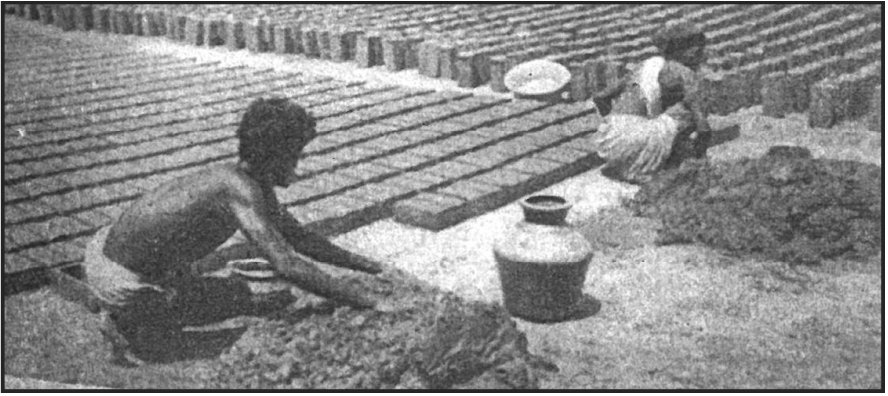
Look at the given image. The work done in the image comes under which one of the following sectors?
Which of the following is the primary purpose of loan activities offered by banks?
Match: I. Technological advancement, II. Liberalisation of trade, III. Cultural exchange, IV. Multinational corporations; a. Interaction of ideas, values and traditions, b. Companies operating in many countries, c. Innovation in manufacturing, communication and information, d. The removal of restriction on trade.
Choose the correct option regarding 'Body Mass Index' (BMI) from the following.
Section B · Very short answer (2 marks each)
"Conservative regimes set up in Europe in 1815 were autocratic." Support the statement by giving any two arguments.
How is horizontal power sharing different from vertical? Explain.
(a) Differentiate between Primitive Subsistence and Commercial Farming.
(b) Differentiate between Rabi and Kharif cropping seasons.
How can a nation achieve a balance between economic growth and environment sustainability? Explain by giving any two arguments.
Section C · Short answer (3 marks each)
(a) How was the 'Silk Route' an example of vibrant pre-modern trade? Explain.
(b) How did food promote long-distance cultural contacts in the pre-modern world? Explain.
"India's prosperity lies in expanding and diversifying its manufacturing industries." Justify the statement.
Explain any three responsibilities carried out by the political parties in a democracy.
Examine the significance of credit in economic development of the country.
"Tertiary sector has a pivotal role in the economy of the country." Support your answer with day-to-day examples.
Section D · Long answer (5 marks each)
(a) "The Gandhian idea of Satyagraha, emphasized the power of truth and struggle against injustice." Explain the statement with examples.
(b) How did people belonging to different communities, regions and language groups develop a sense of collective belonging in the late-nineteenth century India? Explain with examples.
(a) "Promotion of energy conservation is important plank of sustainable energy." Explain the statement with examples.
(b) "Energy is required for all kinds of activities." Explain this statement with examples.
(a) Democracy is a better form of govt. than dictatorship. Analyse.
(b) Democracy accommodates social diversities. Analyse.
(a) "Rapid improvement in technology has been one major factor that has stimulated the globalisation process." Explain the statement with examples.
(b) "Foreign trade and foreign investment policies are the aspects of liberalisation and globalisation." Explain the statement with examples.
Section E · Case-based (4 marks each)
Read the following source and answer the questions that follow:
Print and Censorship. The power of the printed word is most often seen in the way governments seek to regulate and suppress print. The colonial government kept continuous track of all books and newspapers published in India and passed numerous laws to control the press. During the First World War, under the Defense of India Rules, 22 newspapers had to furnish securities. Of these, 18 shut down rather than comply with government orders. The Sedition Committee Report under Rowlatt in 1919 further strengthened controls that led to imposition of penalties on various newspapers. At the outbreak of the Second World War, the Defense of India Act was passed, allowing censoring of reports of war-related topics. All reports about the Quit India Movement came under its purview. In August 1942, about 90 newspapers were suppressed.
34.1 What method did the colonial government employ to keep track of Indian newspapers? (1)
34.2 How did the colonial government's laws affect the press? (1)
34.3 Analyse the impact of 'Sedition Committee' on Newspapers. (2)
Read the following source and answer the questions that follow:
Project Tiger. Tiger is one of the key wildlife species in the faunal web. In 1973, the authorities realized that the tiger population had dwindled to 1,827 from an estimated 55,000 at the turn of the 20th century. The major threats to tiger population are numerous, such as poaching for trade, shrinking habitat, depletion of prey base species, growing human population, etc. The trade of tiger skins and the use of their bones in traditional medicines, especially in the Asian countries left the tiger population on the verge of extinction. Since India and Nepal provide habitat to about two-thirds of the surviving tiger population in the world, these two nations become prime targets for poaching and illegal trading. "Project Tiger", one of the well publicised wildlife campaigns in the world, was launched in 1973. Tiger conservation has been viewed not only as an effort to save an endangered species but with equal importance as a means of preserving biotypes of sizeable magnitude. Corbett National Park in Uttarakhand, Sunderbans National Park in West Bengal, Bandhavgarh National Park in Madhya Pradesh, Sariska Wildlife Sanctuary in Rajasthan, Manas Tiger Reserve in Assam and Periyar Tiger Reserve in Kerala are some examples of the tiger reserves in India.
35.1 Why was 'Project Tiger' considered a significant step for Tiger Conservation? (1)
35.2 What role did India play in the global tiger population? (1)
35.3 Mention any two major threats to the wildlife species. (2)
Read the following extract and answer the questions that follow:
Linguistic diversity of India. How many languages do we have in India? The answer depends on how one counts it. The latest information that we have is from the Census of India held in 2011. This census recorded more than 1300 distinct languages which people mentioned as their mother tongues. These languages were grouped together under some major languages. For example, languages like Bhojpuri, Magadhi, Bundelkhandi, Chhattisgarhi, Rajasthani and many others were grouped together under 'Hindi'. Even after this grouping, the Census found 121 major languages. Of these, 22 languages are now included in the Eighth Schedule of the Indian Constitution and are therefore called 'Scheduled Languages'. Others are called 'Non-Scheduled Languages'. In terms of languages, India is perhaps the most diverse country in the world.
36.1 How many languages were recorded as mother tongues in the 2011 Census of India? (1)
36.2 How were the languages grouped together in the Census report? (1)
36.3 How does the inclusion of languages in the Eighth Schedule of the Indian Constitution contribute to linguistic diversity? Explain. (2)
Section F · Map skills (5 marks)
(a)(i) Two places A and B have been marked on the given political outline map of India. Identify them with the help of the following information and write their correct names on the lines drawn near them:
(i) The place where Gandhiji broke Salt Law.
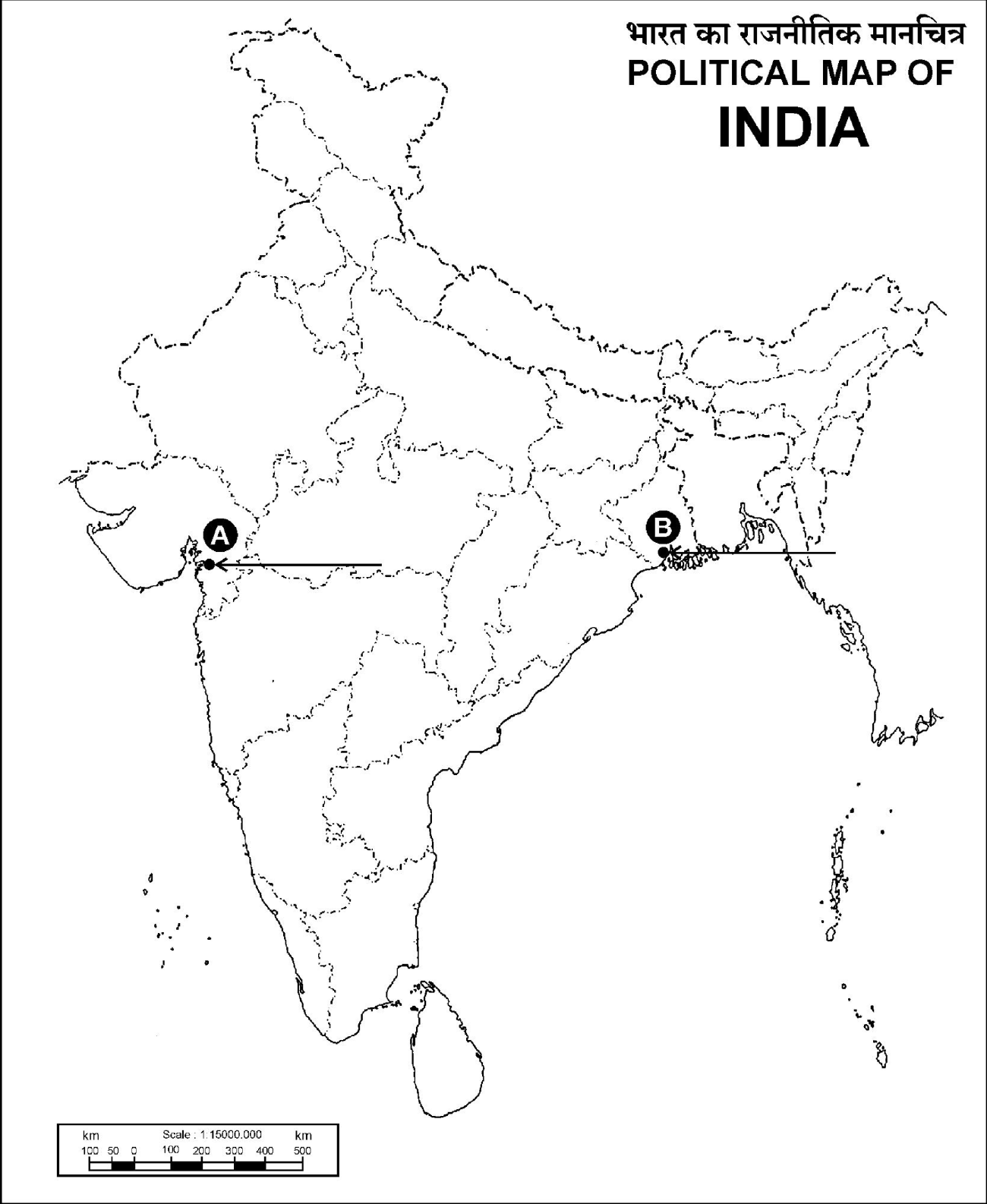
(a)(ii) The place where the Indian National Congress Session was held in 1920.
(b)(i) On the same political outline map of India, locate and label any three of the following with suitable symbols:
(i) Salal – Dam
(b)(ii) Kalpakkam – Nuclear Power Plant
(b)(iii) Bengaluru – Software Technology Park
(b)(iv) Mormugao – Major Sea Port
Solutions: CBSE 2024 · 32/2/1
Answer: (C) Romanticist
Johann Gottfried Herder held that true German culture was to be discovered among the common people (das volk), through folk songs, folk poetry and folk dances.
Answer: (C) IV, I, II & III
Napoleonic Code (1804) → Treaty of Constantinople (1832) → autonomy to Hungary (1867) → Balkan conflict (from 1871, leading to the First World War).
Answer: (A) Natural Gas
Coal, petroleum and natural gas are energy minerals; bauxite, manganese and platinum are metallic.
Answer: (C) I-c, II-a, III-b, IV-d
Wheat – food crop; ragi – millet; tea – beverage crop; maize – used both as food and fodder.
Answer: (A) or (C) (the board accepted both)
Communications is a Union List subject and adoption a Concurrent List subject. Education and marriage are also Concurrent List subjects.
Answer: (D) China
In China only the Communist Party is allowed to rule.
Answer: (D) Odia
Odia is one of the 22 scheduled languages; the others listed are grouped under Hindi.
Answer: (A) ₹ 4,000
Average $= \frac{2000 + 5000 + 3000 + 6000}{4} = \frac{16000}{4} = 4000$.
Answer: (C) Unorganized sector
Workers in brick kilns are casually employed, with low pay, no job security and no benefits.
Answer: (B) I-c, II-d, III-a, IV-b
1. They did not tolerate criticism and dissent and sought to curb activities that questioned the legitimacy of autocratic governments.
2. Most of them imposed censorship laws to control what was said in newspapers, books, plays and songs.
| Primitive subsistence farming | Commercial farming |
|---|---|
| Practised on small patches with primitive tools (hoe, dao, digging sticks) and family labour; depends on the monsoon and natural soil fertility. | Uses high doses of modern inputs: HYV seeds, chemical fertilisers, insecticides and pesticides. |
| Crops are grown mainly for the family's own use. | Crops are grown for sale in the market (for example rice in Punjab, plantations of tea and rubber). |
1. Use resources judiciously, so that non-renewable resources such as groundwater and minerals are not exhausted, and shift to renewable energy like solar and wind.
2. Control pollution and protect forests through strict laws and clean technology, so that development meets present needs without compromising those of future generations.
1. Traders and travellers introduced new crops wherever they went; even ready foods in distant places may share common origins.
2. Noodles are believed to have travelled west from China to become spaghetti; Arab traders may have taken pasta to Sicily.
3. Many common foods of Europe and Asia, such as potatoes, soya, groundnuts, maize, tomatoes, chillies and sweet potatoes, came from America after Columbus.
1. They contest elections and put forward policies and programmes for voters to choose from.
2. They make laws in the legislature and form and run governments; the parties that lose act as the opposition.
3. They shape public opinion, raise issues and launch movements, and give people access to government machinery and welfare schemes.
1. It provides basic services every country needs, such as hospitals, schools, post offices, police, courts, banks and insurance.
2. It supports the other sectors: transport carries goods, traders sell them, banks lend money and warehouses store produce.
3. With rising incomes people demand more services like restaurants, tourism, shopping and private schools, and IT services like ATMs, call centres and software; the tertiary sector has become the largest producing sector in India.
1. United struggles: the experience of fighting colonialism together tied different groups together.
2. History and fiction, folklore and songs: Rabindranath Tagore and Natesa Sastri collected folk tales and songs to revive the nation's identity.
3. Images: Bharat Mata, created by Bankim Chandra Chattopadhyay (Vande Mataram, in Anandamath) and painted by Abanindranath Tagore, became an image people identified with.
4. Icons and symbols: the Swadeshi tricolour flag and Gandhiji's Swaraj flag with the spinning wheel; holding the flag during marches became a symbol of defiance.
5. Reinterpretation of history: nationalists wrote about India's glorious ancient achievements and urged people to take pride in the past and fight British rule.
1. Energy is needed to cook food, and to provide light and heat in homes.
2. It is needed to propel vehicles and transport goods.
3. It drives machinery in industries and factories.
4. Agriculture needs energy for tubewells, tractors and threshers.
5. Commercial establishments, offices, hospitals and communications all run on energy. That is why energy is a basic requirement for economic development.
1. No society can fully and permanently resolve conflicts among groups, but democracies develop procedures to accommodate them through negotiation.
2. Democracy ensures that the majority works with the minority, so that governments represent the general view.
3. Majority does not always mean the same religion or language group; rule by majority must not become rule by the majority community.
4. Every citizen must have a chance of being in the majority at some point; if anyone is barred from power because of birth, democracy ceases to be accommodative.
5. Belgium's power-sharing arrangements are an example of accommodating social differences peacefully.
1. After independence India put barriers on foreign trade and investment to protect domestic producers.
2. Around 1991 the government decided Indian producers should compete globally and removed many barriers; this is liberalisation.
3. Goods can now be imported and exported easily, and foreign companies can set up factories and offices in India.
4. Special Economic Zones with world-class facilities were set up to attract foreign investment, and labour laws were made flexible.
5. As a result MNCs such as Ford Motors invested in India, and Indian companies like Tata Motors and Infosys became multinationals themselves, integrating India with the world economy.
35.1 Launched in 1973 when tigers had fallen to 1,827, it not only saved an endangered species but also preserved large biotypes (ecosystems) through tiger reserves.
35.2 India and Nepal together provide habitat to about two-thirds of the world's surviving tigers.
35.3 (i) Poaching for trade in skins and bones (used in traditional medicines).
(ii) Shrinking habitat and depletion of prey species because of the growing human population.
A – Dandi, on the Gujarat coast south of Surat.
Salal Dam, on the Chenab in Jammu and Kashmir.
Bengaluru, south-eastern Karnataka.
Get every solution for all 17 papers
- Every board question of every chapter, each fully solved the way the board gives marks
- 17 complete board papers, each followed by its solutions
- Weightage and most-asked topics for every chapter
- Instant PDF download, colour and black & white print copies
Revising the chapter first? Complete Social Science Notes for Class 10 (NCERT 2026-27) →
What you get in the pack
- Questions from 126 CBSE papers, 2016 to 2026: every set code available
- Complete: 2341 different questions and parts from all set codes, 20 chapters and 17 full papers
- Part A: all 20 chapters of History, Geography, Pol Science and Economics, sorted by marks
- Year-wise weightage table and most-asked topics for every chapter
- Part B: 17 full board papers, each followed by its complete answers, for timed practice
- Answers written to the marking-scheme points; map questions with the paper's map and every place named
- Questions on topics outside the 2026-27 board exam flagged; only the current syllabus in Part A
All chapters in this pack
- PYQ History 1 The Rise of Nationalism in Europe
- PYQ History 2 Nationalism in India
- PYQ History 3 The Making of a Global World
- PYQ History 5 Print Culture and the Modern World
- PYQ Geography 1 Resources and Development
- PYQ Geography 2 Forest and Wildlife Resources
- PYQ Geography 3 Water Resources
- PYQ Geography 4 Agriculture
- PYQ Geography 5 Minerals and Energy Resources
- PYQ Geography 6 Manufacturing Industries
- PYQ Geography 7 Lifelines of National Economy (Map)
- PYQ Pol Science 1 Power-sharing
- PYQ Pol Science 2 Federalism
- PYQ Pol Science 3 Gender, Religion and Caste
- PYQ Pol Science 4 Political Parties
- PYQ Pol Science 5 Outcomes of Democracy
- PYQ Economics 1 Development
- PYQ Economics 2 Sectors of the Indian Economy
- PYQ Economics 3 Money and Credit
- PYQ Economics 4 Globalisation and the Indian Economy
- Board Paper 2026 Set 32-4-1 with Solutions
- Board Paper 2026 Set 32-5-1 with Solutions
- Board Paper 2025 Set 32-1-1 with Solutions
- Board Paper 2025 Set 32-2-1 with Solutions
- Board Paper 2024 Set 32-2-1 with Solutions
- Board Paper 2024 Set 32-4-1 with Solutions
- Board Paper 2023 Set 32-2-1 with Solutions
- Board Paper 2023 Set 32-4-1 with Solutions
- Board Paper 2022 Term 2 Set 32-1-1 with Solutions
- Board Paper 2022 Term 2 Set 32-3-1 with Solutions
- Board Paper 2020 Set 32-1-1 with Solutions
- Board Paper 2020 Set 32-4-1 with Solutions
- Board Paper 2019 Set 32-2-1 with Solutions
- Board Paper 2019 Set 32-4-1 with Solutions
- Board Paper 2018 Set 32-1 with Solutions
- Board Paper 2017 Set 32-1 with Solutions
- Board Paper 2016 Set 32-1 with Solutions