
CBSE Class 10 Social Studies Question Paper 2023 (32/4/1) with Solutions
The complete CBSE Class 10 Social Studies board paper of 2023, Q.P. code 32/4/1: all 37 questions exactly as set, with marks. 24 solutions are free below. The Class 10 SST PYQ Book: Solved Board Papers 2016-2026 (CBSE) solves all 17 papers in full and sorts every question chapter-wise.
Subject expert: Vikas Chandrawal, M.A. History · 8 years teaching


Free: NCERT solutions for Class 10 SST →
Question paper
Jump to: Question paperSolutions
2023 · Q.P. Code 32/4/1
Maximum marks: 80
Section A · Multiple choice (1 mark each)
Arrange the following in chronological order:
(I) Napoleonic wars
(II) The Treaty of Vienna
(III) Greek Struggle for Independence
(IV) Slav Nationalism in Ottoman Empire
Which one of the following aspects was common among the writings of Kailashbashini Debi, Tarabai Shinde and Pandita Ramabai?
There were three important developments that greatly shrank the pre-modern world. Identify the incorrect one from the following options:
Who among the following improved the steam engine?
Which one of the following is an example of the Ferrous Metal?
Match Column 1 (Resources) with Column 2 (Example): (I) Biological, (II) Renewable, (III) Non-renewable; 1. Coal, 2. Wildlife, 3. Solar Energy.
Which of the following is correctly matched?
(a) Alluvial Soil – Consist of sand and silt
(b) Black Soil – Salt content is high
(c) Arid Soil – Diffusion of iron in crystalline
(d) Laterite Soil – Made up of Lava flows
Which of the following countries has better rank in Human Development Index?
Which one of the following sectors contribute highest in the GDP of India?
Why did the Indian government liberalize trade regulations in 1991?
Read the following statements about Human Development:
(I) It is the composite Index prepared by United Nations Development Programme (UNDP).
(II) Parameters to measure it are Longevity, Literacy and Per Capita Income.
(III) Countries are ranked according to Developed and Low Developing countries.
(IV) World Bank also prepares report of Human Development on the basis of Quality of Life.
Read the following data: Haryana – IMR 30, literacy 82%, net attendance ratio 61 (per 100); Kerala – 7, 94%, 83; Bihar – 32, 62%, 43. How much is the Net Absence Ratio of Haryana?
Which one of the following is a developmental goal of the factory workers?
Which one of the following pairs is correctly matched?
(a) Primary Sector – Flower Cultivator
(b) Secondary Sector – Milk Vendor
(c) Tertiary Sector – Fisherman
(d) Manufacturing Sector – Gardener
Consider the following statements on Power Sharing:
(I) Majoritarianism is the real spirit of democracy.
(II) It creates balance and harmony in different groups.
(III) It reduces the possibility of conflict among social groups.
(IV) Power sharing is the essence of democracy.
Assertion (A): Sri Lanka adopted 'Tamil' as the official language of the State.
Reason (R): The Govt. of Sri Lanka adopted a series of majoritarian measures.
Match Column A (Subjects) with Column B (List): (I) Banks, (II) Agriculture, (III) Education, (IV) Computer; 1. Concurrent List, 2. Union List, 3. State List, 4. Residuary Subjects.
Identify the administrative level of Indian Government with the help of the information given in the box: 1. Power shared between Central to Local Government. 2. The State Governments are required to share some powers and revenue with them. 3. It is called a three tier government.
Which one of the following countries has two party system?
Which type of government is likely to be more acceptable to the people in the world?
Section B · Very short answer (2 marks each)
(A) Explain any two methods that were used by the Europeans for the recruitment of the indentured labours.
not in 2026-27 syllabus(B) How did the 'small pox' prove as the most powerful weapon of the Spanish conquerors in the mid-sixteenth century? Explain.
"Agriculture and industry move hand in hand." Support the statement with examples.
"Different persons can have different developmental goals." Support the statement with an example.
"Women face discrimination in various ways in our society." Explain any two ways.
Section C · Short answer (3 marks each)
"Ideas of national unity in the early nineteenth century Europe were closely allied to the ideology of liberalism." Examine the statement.
Explain any three institutional reforms taken for the development of Indian agriculture.
How is information technology connected with globalization? Explain.
Analyze the need of Political Parties in the Democracy.
(A) Why is 'Tertiary Sector' becoming important in India? Explain.
(B) Why is there a need to protect workers in the Unorganized Sector? Explain.
Section D · Long answer (5 marks each)
(A) Examine the progress of the Civil Disobedience Movement in the countryside.
(B) Analyze the ways through which people of different communities developed a sense of collective belonging in India.
(A) How is pipeline transport network important in the transport system of India? Explain with an example.
not in 2026-27 syllabus(B) How have physical and economic factors influenced the distribution pattern of the Indian Railway Network? Explain with examples.
not in 2026-27 syllabus(A) "Democracy stands much superior to any other forms of governments in promoting dignity and freedom of the individual." Support the statement with arguments.
(B) "Democracy produces an accountable, responsive and legitimate government." Support the statement with arguments.
(A) Justify the role of 'Self Help Groups' in the rural economy.
(B) "Cheap and affordable credit is crucial for the country's development." Justify the statement.
Section E · Case/source-based (4 marks each)
Read the given source and answer the questions that follow:
Why Newspapers? 'Krishnaji Trimbuck Ranade inhabitant of Poona intends to publish a Newspaper in the Marathi Language with a view of affording useful information on every topic of local interest. It will be open for free discussion on subjects of general utility, scientific investigation and the speculations connected with the antiquities, statistics, curiosities, history and geography of the country and of the Deccan especially... the patronage and support of all interested in the diffusion of knowledge and Welfare of the People is earnestly solicited.' (Bombay Telegraph and Courier, 6 January, 1849)
'The task of the native newspapers and political associations is identical to the role of the Opposition in the House of Commons in Parliament in England. That is of critically examining government policy to suggest improvements, by removing those parts that will not be to the benefit of the people, and also by ensuring speedy implementation. These associations ought to carefully study the particular issues, gather diverse relevant information on the nation as well as on what are the possible and desirable improvements, and this will surely earn it considerable influence.' (Native Opinion, 3 April, 1870)
(I) Explain the main reason of publishing newspaper by Krishnaji? (1)
(II) How was the task of native newspaper and political association seen identical to the role of opposition? (1)
(III) Analyze the reasons of popularity of newspapers during 19th century. (2)
Read the given source and answer the questions that follow:
Rainwater Harvesting. Many thought that given the disadvantages and rising resistance against the multi purpose projects, water harvesting system was a viable alternative, both socio-economically and environmentally. In ancient India, along with the sophisticated hydraulic structures, there existed an extraordinary tradition of water harvesting system. People had in-depth knowledge of rainfall regimes and soil types and developed wide ranging techniques to harvest rainwater, groundwater, river water and flood water in keeping with the local ecological conditions and their water needs. In hill and mountainous regions, people built diversion channels like the 'guls' or 'kuls' of the Western Himalayas for agriculture. 'Rooftop rainwater harvesting' was commonly practised to store drinking water, particularly in Rajasthan. In the flood plains of Bengal, people developed inundation channels to irrigate their fields. In arid and semi-arid regions, agricultural fields were converted into rain fed storage structures that allowed the water to stand and moisten the soil like the 'khadins' in Jaisalmer and 'Johads' in other parts of Rajasthan.
(I) Why is water harvesting system a viable alternative? (1)
(II) Describe the process of 'rooftop rainwater harvesting'. (1)
(III) Mention any two methods adopted by ancient India for water conservation. (2)
Read the given source and answer the questions that follow:
Language Diversity of India. How many languages do we have in India? The answer depends on how one counts it. The latest information that we have is from the Census of India held in 2011. This census recorded more than 1300 distinct languages which people mentioned as their mother tongues. These languages were grouped together under some major languages. For example languages like Bhojpuri, Magadhi, Bundelkhandi, Chhattisgarhi, Rajasthani and many others were grouped together under 'Hindi'. Even after this grouping, the Census found 121 major languages. Of these 22 languages are now included in the Eighth Schedule of the Indian Constitution and are therefore called 'Scheduled Languages'. In terms of languages, India is perhaps the most diverse country in the world.
(I) Explain the importance of language diversity in India. (1)
(II) Differentiate between Scheduled and Non-Scheduled Languages. (1)
(III) 'The fusion of languages has united the country into one cultural entity.' Explain the statement with an example. (2)
Section F · Map skills (5 marks)
(i)(a) Two places A and B have been marked on the given political outline map of India. Identify them:
(a) The place where Mahatma Gandhi started Satyagraha for Indigo peasants.
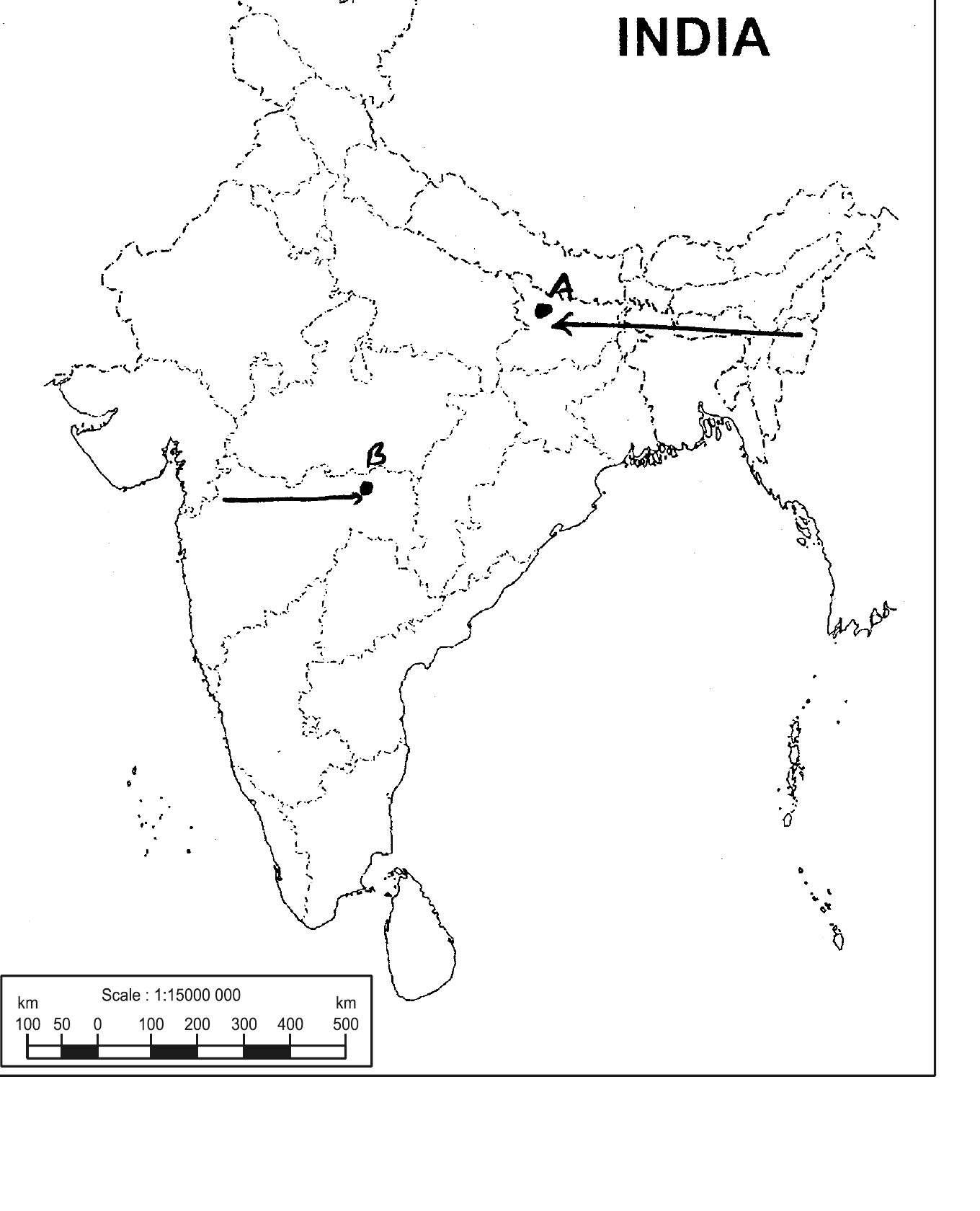
(i)(b) The place where the session of Indian National Congress held in December, 1920.
(ii)(a) On the same outline map of India locate and label any three of the following with suitable symbols:
(a) Tehri Dam
(ii)(b) Naraura Atomic Power Station
(ii)(c) Pune Software Technology Park
(ii)(d) Haldia Sea Port
Solutions: CBSE 2023 · 32/4/1
Answer: (b) I, II, III and IV
Napoleonic wars (to 1815) → Treaty of Vienna (1815) → Greek struggle (from 1821) → Slav nationalism in the Balkans (late 19th century).
Answer: (d) The flow of technology
Economists identify three types of movement within the world economy in the 19th century: flows of trade (goods), labour (people) and capital.
Answer: (d) Nickel
Ferrous minerals include iron ore, manganese, nickel and cobalt; copper, tin and bauxite are non-ferrous.
Answer: (a)
Alluvial soil consists of various proportions of sand, silt and clay. High salt content is a feature of arid soil, diffusion of iron of red soil, and lava flows form black soil.
Answer: (c) Tertiary
Answer: (a) I and II
The World Bank prepares the World Development Report on the basis of income, not the Human Development Report.
Answer: (a) Better wages
Answer: (b) II, III and IV
Power sharing, not majoritarianism, is the spirit of democracy.
Answer: (c) I-2, II-3, III-1, IV-4
Answer: (c) America (USA)
1. Recruitment was done by agents engaged by employers and paid a small commission; agents tempted migrants with false information about destinations, travel, the nature of work and living conditions.
2. Often migrants were not even told that they were to embark on a long sea voyage, and sometimes agents forcibly abducted less willing migrants.
1. Agro-industries depend on agriculture for raw materials, such as cotton for textiles, sugarcane for sugar and jute for jute mills.
2. Industries in turn supply agriculture with irrigation pumps, fertilisers, insecticides, pesticides, PVC pipes, machines and tools, raising farm productivity and making production efficient.
1. Many parents prefer to spend their resources on their sons' education rather than their daughters', so the literacy rate among women is lower.
2. Women are paid less than men for the same work and have fewer highly paid jobs; many also face domestic violence and are unsafe in public places.
1. Land reforms after independence: abolition of zamindari, consolidation of holdings and collectivisation, along with the Green Revolution and White Revolution (Operation Flood).
2. Crop insurance against drought, flood, cyclone, fire and disease, and the establishment of Grameen banks, cooperative societies and banks to give farmers loans at low interest.
3. Kisan Credit Card (KCC), Personal Accident Insurance Scheme (PAIS), weather bulletins and farm programmes on radio and TV, and minimum support prices to protect farmers from middlemen.
1. Large societies need representative democracy, and parties gather different views on various issues and present them to the government.
2. Parties bring representatives together so that a responsible government can be formed.
3. They provide a mechanism to support or restrain the government, make policies, justify or oppose them; without parties, every candidate would be independent and no one could promise major policy changes.
1. Workers are low-paid and often exploited, and their jobs are not regular or secure.
2. They get no paid leave, holidays, provident fund, gratuity or medical benefits, and rules are not followed.
3. Many are from scheduled castes, tribes and backward communities who also face social discrimination; protecting them is needed for economic and social development.
1. The identity of India came to be visually associated with Bharat Mata: Bankim Chandra Chattopadhyay wrote Vande Mataram (1870s, later in Anandamath), and Abanindranath Tagore painted Bharat Mata as a calm, divine ascetic figure.
2. Nationalists revived Indian folklore: Rabindranath Tagore and Natesa Sastri collected folk tales, songs and legends to discover national identity and restore pride in the past.
3. During the Swadeshi movement a tricolour flag (red, green, yellow) was designed with eight lotuses for the provinces and a crescent moon for Hindus and Muslims.
4. By 1921 Gandhiji had designed the Swaraj flag with a spinning wheel; carrying the flag during marches became a symbol of defiance.
5. Nationalists reinterpreted history, writing about India's glorious ancient achievements and urging people to struggle against British rule.
1. The level land, high population density and rich agricultural resources of the northern plains favoured a dense railway network.
2. In the hilly terrain of the peninsular region, railways were laid through low hills, gaps or tunnels; the Sahyadri could be crossed only through gaps or passes.
3. The Himalayan mountains are unfavourable because of high relief, sparse population and lack of economic opportunities.
4. It was difficult to lay railway lines on the sandy plains of western Rajasthan, the swamps of Gujarat and the forested tracts of Madhya Pradesh, Chhattisgarh, Odisha and Jharkhand.
5. The Konkan Railway along the west coast has facilitated the movement of passengers and goods in this important economic region, though it faces problems like landslides.
1. Accountable: democracy develops mechanisms for citizens to hold the government accountable and to take part in decision-making.
2. Regular, free and fair elections, open public debate on major policies and laws, and citizens' right to information make the government transparent.
3. Responsive: a democratic government is expected to attend to the needs and expectations of people; it is based on deliberation and negotiation.
4. Legitimate: it is the people's own government, chosen by them; this is why there is overwhelming support for democracy all over the world.
5. It may be slow and less efficient, but it is the most legitimate form of government because people feel it belongs to them.
1. Cheap and affordable credit leads to higher incomes, because more of the earnings stay with the borrower.
2. Many people could then borrow for a variety of needs: growing crops, doing business, setting up small-scale industries or trading in goods.
3. Expensive informal credit pushes borrowers into debt traps and discourages enterprise.
4. Banks and cooperatives should increase lending, especially in rural areas, so that dependence on informal sources falls.
5. Formal credit must be distributed more equally so that the poor, not only the rich, benefit from cheaper loans.
(I) It is inexpensive, affordable by common people and environmentally friendly, unlike big multi-purpose projects.
(II) Rainwater from the roof is collected through PVC pipes, filtered through sand and bricks, and led by an underground pipe to a sump for use; excess water goes to a well, which recharges the groundwater.
(III) (i) Diversion channels like the guls or kuls of the Western Himalayas for agriculture.
(ii) Inundation channels in the flood plains of Bengal, and khadins and johads in Rajasthan that stored rainwater in fields.
A – Champaran, north-western Bihar.
Tehri Dam, on the Bhagirathi river in Uttarakhand.
Pune, western Maharashtra, south-east of Mumbai.
Get every solution for all 17 papers
- Every board question of every chapter, each fully solved the way the board gives marks
- 17 complete board papers, each followed by its solutions
- Weightage and most-asked topics for every chapter
- Instant PDF download, colour and black & white print copies
Revising the chapter first? Complete Social Science Notes for Class 10 (NCERT 2026-27) →
What you get in the pack
- Questions from 126 CBSE papers, 2016 to 2026: every set code available
- Complete: 2341 different questions and parts from all set codes, 20 chapters and 17 full papers
- Part A: all 20 chapters of History, Geography, Pol Science and Economics, sorted by marks
- Year-wise weightage table and most-asked topics for every chapter
- Part B: 17 full board papers, each followed by its complete answers, for timed practice
- Answers written to the marking-scheme points; map questions with the paper's map and every place named
- Questions on topics outside the 2026-27 board exam flagged; only the current syllabus in Part A
All chapters in this pack
- PYQ History 1 The Rise of Nationalism in Europe
- PYQ History 2 Nationalism in India
- PYQ History 3 The Making of a Global World
- PYQ History 5 Print Culture and the Modern World
- PYQ Geography 1 Resources and Development
- PYQ Geography 2 Forest and Wildlife Resources
- PYQ Geography 3 Water Resources
- PYQ Geography 4 Agriculture
- PYQ Geography 5 Minerals and Energy Resources
- PYQ Geography 6 Manufacturing Industries
- PYQ Geography 7 Lifelines of National Economy (Map)
- PYQ Pol Science 1 Power-sharing
- PYQ Pol Science 2 Federalism
- PYQ Pol Science 3 Gender, Religion and Caste
- PYQ Pol Science 4 Political Parties
- PYQ Pol Science 5 Outcomes of Democracy
- PYQ Economics 1 Development
- PYQ Economics 2 Sectors of the Indian Economy
- PYQ Economics 3 Money and Credit
- PYQ Economics 4 Globalisation and the Indian Economy
- Board Paper 2026 Set 32-4-1 with Solutions
- Board Paper 2026 Set 32-5-1 with Solutions
- Board Paper 2025 Set 32-1-1 with Solutions
- Board Paper 2025 Set 32-2-1 with Solutions
- Board Paper 2024 Set 32-2-1 with Solutions
- Board Paper 2024 Set 32-4-1 with Solutions
- Board Paper 2023 Set 32-2-1 with Solutions
- Board Paper 2023 Set 32-4-1 with Solutions
- Board Paper 2022 Term 2 Set 32-1-1 with Solutions
- Board Paper 2022 Term 2 Set 32-3-1 with Solutions
- Board Paper 2020 Set 32-1-1 with Solutions
- Board Paper 2020 Set 32-4-1 with Solutions
- Board Paper 2019 Set 32-2-1 with Solutions
- Board Paper 2019 Set 32-4-1 with Solutions
- Board Paper 2018 Set 32-1 with Solutions
- Board Paper 2017 Set 32-1 with Solutions
- Board Paper 2016 Set 32-1 with Solutions