
CBSE Class 10 Social Studies Question Paper 2023 (32/2/1) with Solutions
The complete CBSE Class 10 Social Studies board paper of 2023, Q.P. code 32/2/1: all 37 questions exactly as set, with marks. 24 solutions are free below. The Class 10 SST PYQ Book: Solved Board Papers 2016-2026 (CBSE) solves all 17 papers in full and sorts every question chapter-wise.
Subject expert: Vikas Chandrawal, M.A. History · 8 years teaching


Free: NCERT solutions for Class 10 SST →
Question paper
Jump to: Question paperSolutions
2023 · Q.P. Code 32/2/1
Maximum marks: 80
Section A · Multiple choice (1 mark each)
Which one of the following ideologies were the European Governments driven by after the defeat of Napoleon in 1815?
Choose the correct option from the following regarding Central Powers in the First World War:
In which one of the following countries was 'mass production' an important feature in the 1920s?
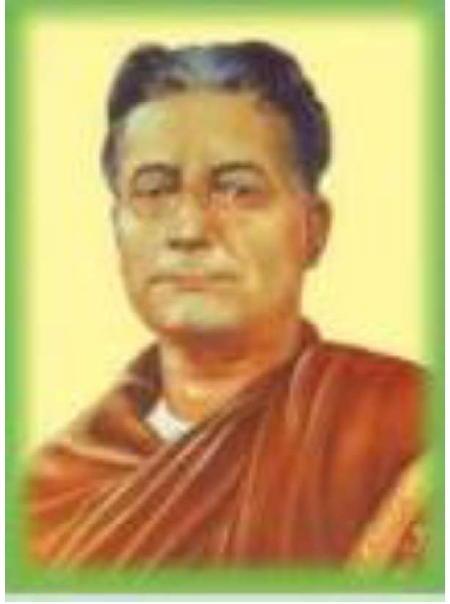
Look at the picture given below. Identify the name of the senior litterateur shown in the image and choose the correct option.
Which one of the following soils develops in an area with high temperature and heavy rainfall?
Assertion (A): Agriculture and industry move hand in hand.
Reason (R): Industrial development is a precondition for eradication of unemployment and poverty from the country.
Match Column I (Port) with Column II (Type): i. Kandla, ii. Mumbai, iii. Visakhapatnam, iv. Kolkata; 1. Riverine port, 2. Deepest landlocked port, 3. Biggest port, 4. Port developed after independence.
Assertion (A): Belgium amended their constitution four times.
Reason (R): Amendments were to enable everyone to live together in the same country.
Which one of the following is an example of 'coming together federation'?
Match Column I with Column II: i. Union List, ii. State List, iii. Concurrent List, iv. Residuary Subjects; 1. Agriculture, 2. Computer Software, 3. Banking, 4. Education.
In which one of the following regions is the participation of women in public life the highest?
Which of the following States is ruled by a regional party?
Which one of the following countries adopted multi-party system?
Choose the correct option to fill in the blank: For comparing countries, their ______ is considered to be one of the most important attributes by the World Bank.
Study the given table (data for India and its neighbours, 2019 – HDI rank: Sri Lanka 73, India 130, Myanmar 148, Pakistan 154, Nepal 143, Bangladesh 134). Which of the following countries has the highest level of 'Human Development Index (HDI)'?
Natural products being changed into other forms is known as:
Which one of the following is a feature of the unorganized sector?
Which one of the following is the modern form of currency?
Which one of the following categories of urban households take the highest percentage of loan from the formal sector?
Which one of the following is a challenge of Globalisation?
Section B · Very short answer (2 marks each)
(a) Analyse the role of Chief Minister Cavour who led the movement to unite the regions of Italy.
(b) Examine the ideas of liberal nationalism in Europe during the nineteenth century.
Suggest any two ways to conserve wildlife in India.
Why did the feeling of alienation increase among the Sri Lankan Tamils in 1956? Explain.
"Credit pushes the borrower into a situation from which recovery is painful." Examine the statement.
Section C · Short answer (3 marks each)
(a) How did print come into existence in Europe? Explain.
(b) How did access to books create a new culture of reading? Explain.
"Energy is required for all activities." Explain the statement with examples.
Suggest three steps to enhance the literacy rate among women in India.
Differentiate between primary and secondary sectors with examples.
Examine the rising importance of the tertiary sector in India.
Section D · Long answer (5 marks each)
(a) Analyse the role of the business classes in Civil Disobedience Movement.
(b) Analyse the role of women in Civil Disobedience Movement.
(a) Explain the features of primitive subsistence and commercial farming in India. (2 + 3 = 5)
(b) Explain the features of intensive subsistence and plantation farming in India. (2 + 3 = 5)
(a) Analyse the conditions under which democracies accommodate social diversities.
(b) Analyse the conditions under which democracies promote dignity and freedom of citizens.
(a) How do Multinational Corporations (MNCs) interlink production across countries? Explain with examples.
not in 2026-27 syllabus(b) Explain any five steps taken by the Central and State Governments to attract foreign investments.
not in 2026-27 syllabusSection E · Case-based (4 marks each)
Read the given source and answer the questions that follow:
Yet, till the First World War, industrial growth was slow. The war created a dramatically new situation. With British mills busy with war production to meet the needs of the army, Manchester imports into India declined. Suddenly, Indian mills had a vast home market to supply. As the war prolonged, Indian factories were called upon to supply war needs: jute bags, cloth for army uniforms, tents and leather boots, horse and mule saddles and a host of other items. New factories were set up and old ones ran multiple shifts. Many new workers were employed and everyone was made to work longer hours. Over the war years industrial production boomed. After the war, Manchester could never recapture its old position in the Indian market. Unable to modernise and compete with the US, Germany and Japan, the economy of Britain crumbled after the war. Cotton production collapsed and exports of cotton cloth from Britain fell dramatically. Within the colonies, local industrialists gradually consolidated their position, substituting foreign manufacturers and capturing the home market.
34.1 Why did Manchester imports decline in India? (1)
34.2 Why could Manchester never recapture its old position in the Indian market after the First World War? (1)
34.3 Analyse any two benefits of the First World War to India. (2)
Read the given source and answer the questions that follow:
Most of the objections to the projects arose due to their failure to achieve the purposes for which they were built. Ironically, the dams that were constructed to control the floods have triggered floods due to sedimentation in the reservoir. Moreover, the big dams have mostly been unsuccessful in controlling floods at the time of excessive rainfall. You may have seen or read how the release of water from the dams during heavy rains aggravated the flood situation in Maharashtra and Gujarat in 2006. The floods have not only devastated life and property but also caused extensive soil erosion. Sedimentation also meant that the flood plains were deprived of silt, a natural fertiliser, further adding on to the problem of land degradation. It was also observed that the multi-purpose projects induced earthquakes, caused water-borne diseases and pests and pollution resulting from excessive use of water.
35.1 Name the movement against the river project in Gujarat. (1)
35.2 How have the big dams mostly been unsuccessful in controlling floods at the time of excessive rainfall? (1)
35.3 Analyse any two merits of multi-purpose river projects. (2)
Read the given source and answer the questions that follow:
The rise of political parties is directly linked to the emergence of representative democracies. As we have seen, large societies need representative democracy. As societies became large and complex, they also needed some agency to gather different views on various issues and to present these to the government. They needed some ways, to bring various representatives together so that a responsible government could be formed. They needed a mechanism to support or restrain the government, make policies, justify or oppose them. Political parties fulfil these needs that every representative government has. We can say that parties are a necessary condition for a democracy.
36.1 Explain the meaning of a 'political party'. (1)
36.2 "The rise of political parties is directly linked to the emergence of representative democracies." Support this statement. (1)
36.3 Why are political parties a necessary condition for a democracy? Explain. (2)
Section F · Map skills (5 marks)
(a)(i) Two places A and B have been marked on the given political outline map of India. Identify them:
(i) The place where the session of the Indian National Congress was held in December, 1920.
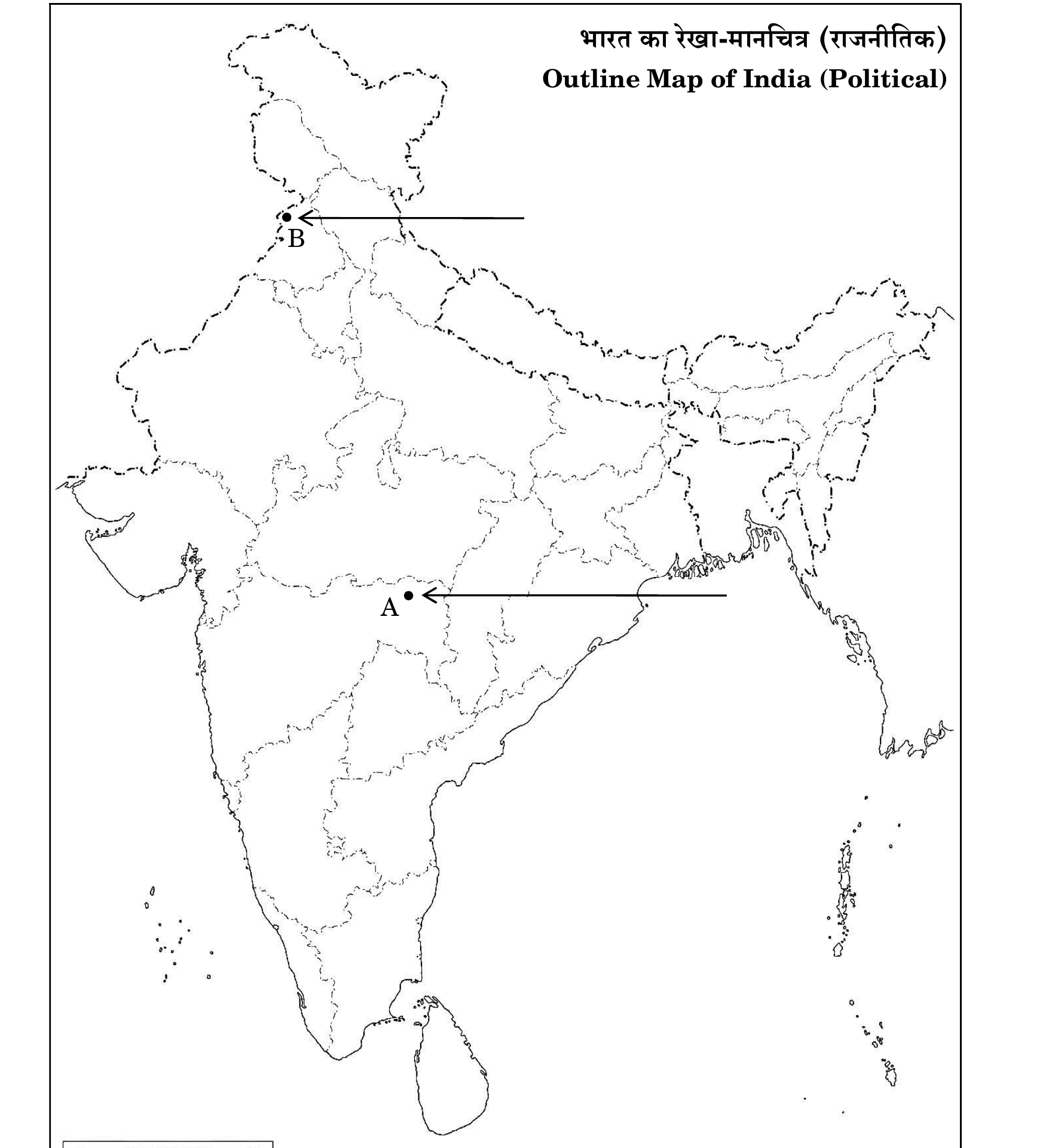
(a)(ii) The place where Jallianwala Bagh incident occurred.
(b)(i) On the same political outline map of India, locate and label any three of the following with suitable symbols:
(i) Noida Software Technology Park
(b)(ii) Bailadila Iron-ore mines
(b)(iii) Tarapur Nuclear Power Plant
(b)(iv) Haldia Sea port
Solutions: CBSE 2023 · 32/2/1
Answer: (b) Conservatism
After 1815, European governments wanted to preserve traditional institutions such as the monarchy, the Church, social hierarchies, property and the family.
Answer: (a) United States of America
Henry Ford's assembly line made the T-model car; mass production lowered costs and prices in the US economy of the 1920s.
Answer: (d) Laterite
Laterite soil develops under high temperature and heavy rainfall, which leach the soil intensively.
Answer: (a)
Kandla – first port developed after independence; Mumbai – biggest port; Visakhapatnam – deepest landlocked and well-protected port; Kolkata – inland riverine port.
Answer: (b) USA
In a coming-together federation, independent states come together on their own to form a bigger unit (USA, Switzerland, Australia). India, Spain and Belgium are holding-together federations.
Answer: (a) Nordic countries
In Sweden, Norway and Finland, the participation of women in public life is very high.
Answer: (b) India
USA and the UK have two-party systems and China a one-party system.
Answer: (c) Sri Lanka
Sri Lanka's rank (73) is the best, with the highest income per capita (12,707), life expectancy (77) and mean years of schooling (10.6).
Answer: (d)
The others are features of the organised sector.
Answer: (d) Rich households
About 90% of the loans of rich urban households come from formal sources, while poor households depend mostly on informal sources.
1. Cavour, the chief minister of Sardinia-Piedmont, was neither a revolutionary nor a democrat; like many educated Italian elites he spoke French better than Italian.
2. Through a tactful diplomatic alliance with France that he engineered, Sardinia-Piedmont defeated the Austrian forces in 1859, a decisive step towards unification.
1. Strictly enforce the Wildlife (Protection) Act 1972: ban hunting and poaching, restrict trade in wildlife and protect habitats through national parks, sanctuaries and projects like Project Tiger.
2. Involve local communities in conservation (for example Bishnois, joint forest management) and spread awareness through nature clubs, along with afforestation and control of forest fires.
1. Repayment of a loan depends on income, for example from farming; if the crop fails, repayment becomes impossible.
2. The borrower may then have to sell part of the land or assets to repay, and ends up much worse off than before; this is called a debt trap.
1. Earlier, books were expensive and few; common people lived in an oral culture, hearing sacred texts, ballads and folk tales recited.
2. Printing reduced the cost of books and multiple copies could be produced easily; books flooded the market, reaching an ever-growing readership.
3. A new reading public emerged; since many were not literate, printers published popular ballads and folk tales illustrated with pictures, which were sung and recited at gatherings, merging oral and reading cultures.
1. Enforce compulsory education for girls and run literacy campaigns at the grass-root level, along with counselling for parents to send girls to school.
2. Give incentives such as scholarships for poor and meritorious girls, free mid-day meals, uniforms and books, and convenient school timings.
3. Break traditional prejudices against girls' education through awareness programmes, and build schools and safe transport close to villages.
1. Basic services like hospitals, schools, post and telegraph, police, courts, transport, banks and insurance are provided by the government and needed by everyone.
2. Development of agriculture and industry increases the need for services like transport, trade and storage; as incomes rise, people demand more services like restaurants, tourism and private schools.
3. New services based on information and communication technology have grown rapidly; the tertiary sector is now the largest producing sector in India.
1. An important feature of the movement was the large-scale participation of women.
2. During Gandhiji's Salt March, thousands of women came out of their homes to listen to him.
3. They participated in protest marches, manufactured salt, and picketed foreign cloth and liquor shops.
4. Many went to jail; in urban areas they came from high-caste families, and in rural areas from rich peasant households.
5. Moved by Gandhiji's call, they began to see service to the nation as a sacred duty. But Gandhiji believed women's duty was to look after home and hearth, and the Congress was reluctant to give women positions of authority within the organisation.
Intensive subsistence farming (2):
1. Practised in areas of high population pressure on land; it is labour-intensive.
2. High doses of biochemical inputs and irrigation are used to obtain higher production from small holdings.
Plantation farming (3):
1. A type of commercial farming in which a single crop is grown on a large area.
2. It has an interface of agriculture and industry, and uses capital-intensive inputs with the help of migrant labourers.
3. All the produce is used as raw material in industries; important plantation crops are tea, coffee, rubber, sugarcane and banana, and a well-developed transport network is essential.
1. Every individual wants respect from fellow beings; the passion for respect and freedom is the basis of democracy.
2. Democracies throughout the world have recognised the dignity and freedom of citizens in principle, though they are achieved in different degrees.
3. Equal treatment of women is a necessary ingredient of a democratic society; women's long struggles have earned them more respect and equal treatment.
4. Democracy has strengthened the claims of disadvantaged and discriminated castes for equal status and opportunity.
5. People have developed awareness and the ability to look critically at power holders; complaints about democracy themselves show that citizens expect more from it.
1. Barriers on foreign trade and foreign investment have been removed to a large extent (liberalisation).
2. Industrial zones called Special Economic Zones (SEZs) are being set up.
3. SEZs have world-class facilities: electricity, water, roads, transport, storage, recreation and education.
4. Companies setting up units in SEZs do not have to pay taxes for an initial period of five years.
5. The government has allowed flexibility in labour laws, so companies can employ workers flexibly for short periods when there is intense pressure of work.
35.1 The Narmada Bachao Andolan (against the Sardar Sarovar Dam).
35.2 During heavy rains water has to be released from the dams, which aggravates floods (as in Maharashtra and Gujarat in 2006); sedimentation in reservoirs also reduces their capacity.
35.3 (i) They generate hydroelectricity and supply water for irrigation, domestic and industrial use.
(ii) They help in flood control, inland navigation, fish breeding and recreation.
A – Nagpur, Maharashtra.
Noida, western Uttar Pradesh near Delhi.
Tarapur, on the Maharashtra coast north of Mumbai.
Get every solution for all 17 papers
- Every board question of every chapter, each fully solved the way the board gives marks
- 17 complete board papers, each followed by its solutions
- Weightage and most-asked topics for every chapter
- Instant PDF download, colour and black & white print copies
Revising the chapter first? Complete Social Science Notes for Class 10 (NCERT 2026-27) →
What you get in the pack
- Questions from 126 CBSE papers, 2016 to 2026: every set code available
- Complete: 2341 different questions and parts from all set codes, 20 chapters and 17 full papers
- Part A: all 20 chapters of History, Geography, Pol Science and Economics, sorted by marks
- Year-wise weightage table and most-asked topics for every chapter
- Part B: 17 full board papers, each followed by its complete answers, for timed practice
- Answers written to the marking-scheme points; map questions with the paper's map and every place named
- Questions on topics outside the 2026-27 board exam flagged; only the current syllabus in Part A
All chapters in this pack
- PYQ History 1 The Rise of Nationalism in Europe
- PYQ History 2 Nationalism in India
- PYQ History 3 The Making of a Global World
- PYQ History 5 Print Culture and the Modern World
- PYQ Geography 1 Resources and Development
- PYQ Geography 2 Forest and Wildlife Resources
- PYQ Geography 3 Water Resources
- PYQ Geography 4 Agriculture
- PYQ Geography 5 Minerals and Energy Resources
- PYQ Geography 6 Manufacturing Industries
- PYQ Geography 7 Lifelines of National Economy (Map)
- PYQ Pol Science 1 Power-sharing
- PYQ Pol Science 2 Federalism
- PYQ Pol Science 3 Gender, Religion and Caste
- PYQ Pol Science 4 Political Parties
- PYQ Pol Science 5 Outcomes of Democracy
- PYQ Economics 1 Development
- PYQ Economics 2 Sectors of the Indian Economy
- PYQ Economics 3 Money and Credit
- PYQ Economics 4 Globalisation and the Indian Economy
- Board Paper 2026 Set 32-4-1 with Solutions
- Board Paper 2026 Set 32-5-1 with Solutions
- Board Paper 2025 Set 32-1-1 with Solutions
- Board Paper 2025 Set 32-2-1 with Solutions
- Board Paper 2024 Set 32-2-1 with Solutions
- Board Paper 2024 Set 32-4-1 with Solutions
- Board Paper 2023 Set 32-2-1 with Solutions
- Board Paper 2023 Set 32-4-1 with Solutions
- Board Paper 2022 Term 2 Set 32-1-1 with Solutions
- Board Paper 2022 Term 2 Set 32-3-1 with Solutions
- Board Paper 2020 Set 32-1-1 with Solutions
- Board Paper 2020 Set 32-4-1 with Solutions
- Board Paper 2019 Set 32-2-1 with Solutions
- Board Paper 2019 Set 32-4-1 with Solutions
- Board Paper 2018 Set 32-1 with Solutions
- Board Paper 2017 Set 32-1 with Solutions
- Board Paper 2016 Set 32-1 with Solutions