
CBSE Class 10 Social Studies Question Paper 2022 (32/1/1, Term 2) with Solutions
The complete CBSE Class 10 Social Studies board paper of 2022, Q.P. code 32/1/1 · Term 2: all 13 questions exactly as set, with marks. 9 solutions are free below. The Class 10 SST PYQ Book: Solved Board Papers 2016-2026 (CBSE) solves all 17 papers in full and sorts every question chapter-wise.
Subject expert: Vikas Chandrawal, M.A. History · 8 years teaching


Free: NCERT solutions for Class 10 SST →
Question paper
Jump to: Question paperSolutions
2022 · Q.P. Code 32/1/1 · Term 2
Maximum marks: 40
In 2022 CBSE held the board exam in two terms. Term 1 (Nov–Dec 2021) was an MCQ paper; this is the Term 2 written paper (40 marks, 2 hours), which covered the second half of the syllabus.
Section A · Very short answer (2 marks each)
Why did Indian merchants and industrialists support the Civil Disobedience Movement? Explain.
Examine the significance of pipeline as a means of transportation in the country.
not in 2026-27 syllabusWhy has India adopted a multi-party system? Explain.
How is 'Demand Deposit' an essential feature of money?
Study the given flowchart (Fibre production → Spinning → Weaving/Knitting → Dyeing and Finishing → Garment manufacture; products: raw fibre, yarn, fabric, garments) and answer the questions that follow:
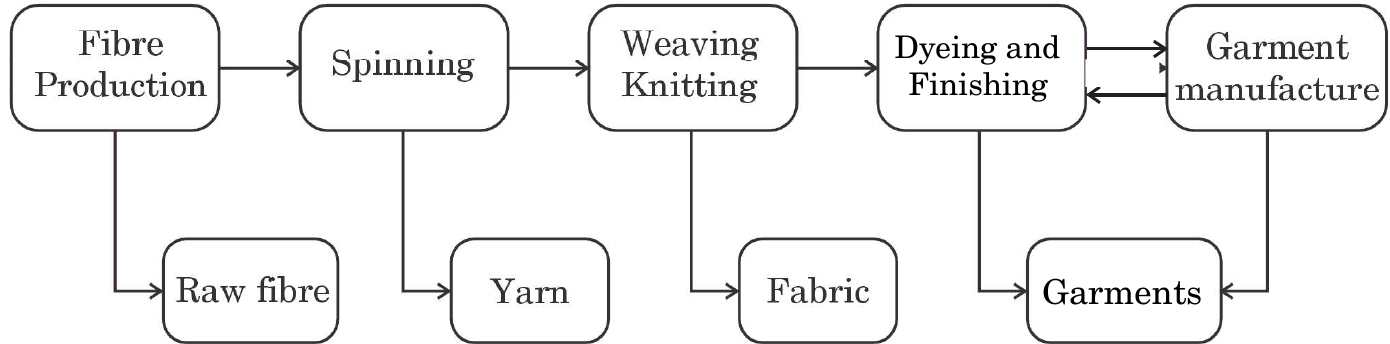
(5.1) Which is the basic material required for garment manufacturing? (1)
(5.2) Give one example of value addition in the textile industry. (1)
Section B · Short answer (3 marks each)
(a) Differentiate between formal and informal sources of Credit.
(b) How does a bank work as a key component of the financial system? Explain.
"It was essential to preserve folk tradition in order to discover one's national identity and restore a sense of pride in one's past." Support the statement in reference to India.
Explain the role of Election Commission in the 'registration and recognition' of political parties in India.
Section C · Long answer (5 marks each)
(a) "Democracy is a better form of government than any other alternative." Analyse the statement.
(b) Analyse the reasons for the overwhelming support for the idea of democracy all over the world.
(a) Examine the factors which facilitate globalization in India.
(b) Assess, how globalization has touched the lives of larger society.
not in 2026-27 syllabusSection D · Case-based (4 marks each)
Read the case given below carefully and answer the questions that follow:
The Independence Day Pledge, 26 January, 1930. 'We believe that it is the inalienable right of the Indian people, as of any other people, to have freedom and to enjoy the fruits of their toil and have the necessities of life, so that they may have full opportunities of growth. We believe also that if any government deprives a people of these rights and oppresses them, the people have a further right to alter it or to abolish it. The British Government in India has not only deprived the Indian people of their freedom but has based itself on the exploitation of the masses, and has ruined India economically, politically, culturally, and spiritually. We believe, therefore, that India must sever the British connection and attain Purna Swaraj or Complete Independence.'
(11.1) Why was freedom considered an inalienable right of the Indian people? (1)
(11.2) Why was Purna Swaraj considered essential by the people of India? (1)
(11.3) Explain the significance of the Lahore Session of Congress (1929–30). (2)
Read the case given below carefully and answer the questions that follow:
Lifelines of National Economy. For a long time, trade and transport were restricted to a limited space. With the development in science and technology, the area of influence of trade and transport expanded far and wide. Today, the world has been converted into a large village with the help of efficient and fast moving transport. Transport has been able to achieve this with the help of equally developed communication system. Therefore, transport, communication and trade are complementary to each other. Today, India is well-linked with the rest of the world despite its vast size, diversity and linguistic and socio-cultural plurality. Railways, airways, waterways, newspapers, radio, television, cinema and internet, etc. have been contributing to its socio-economic progress in many ways. The trades from local to international levels have added to the vitality of its economy. It has enriched our life and added substantially to growing amenities and facilities for the comforts of life.
(12.1) How is science an important factor in the development of transport? (1)
(12.2) How has transport integrated socio-cultural plurality? Explain. (1)
(12.3) Analyse the significance of communication for a nation. (2)
Section E · Map (3 marks)
(i) On the given political outline map of India, identify the place marked as A with the help of the following information: A. The place where Non-Cooperation Movement was called off due to violence.
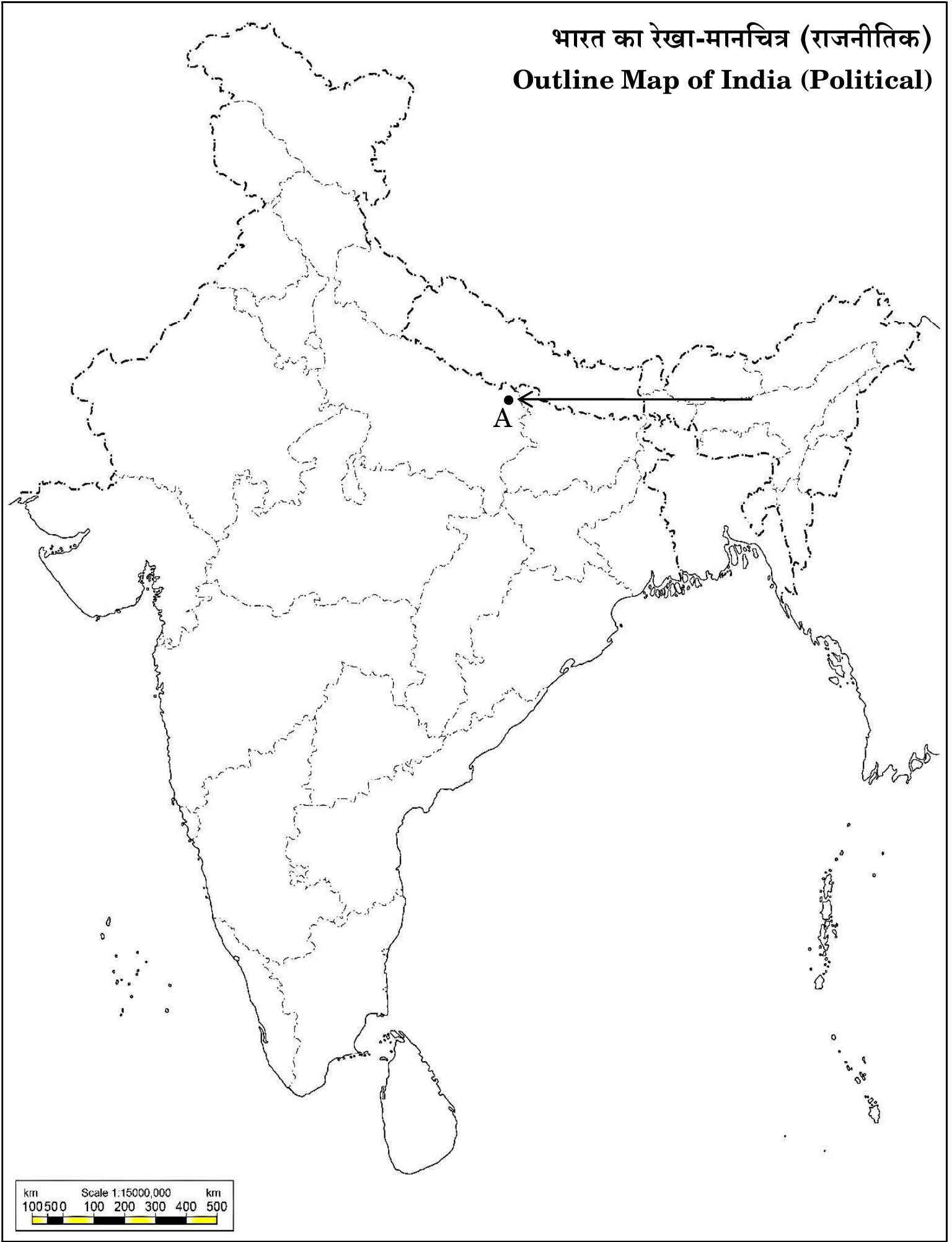
(ii)(a) On the same given map of India, locate and label: (a) (I) Narora Nuclear Power Plant OR (II) Bengaluru Software Technology Park
(ii)(b) Indira Gandhi International Airport
Solutions: CBSE 2022 · 32/1/1 · Term 2
1. They had made huge profits during the First World War and wanted to expand their business; they reacted against colonial policies that restricted business activities.
2. They wanted protection against imports of foreign goods and a rupee–sterling exchange ratio that would discourage imports. Through organisations like FICCI (1927) they attacked colonial control of the economy and gave financial help to the movement.
1. India has great social and geographical diversity, which cannot be easily absorbed by two or even three parties.
2. A multi-party system allows a variety of interests and opinions to get political representation; no country chooses its party system, it evolves from the society's nature and history.
5.1 Raw fibre (cotton, jute, silk, wool or synthetic fibre), which is turned into yarn and fabric.
5.2 Dyeing and finishing of fabric (also spinning yarn, weaving fabric, stitching garments); each stage adds value to the raw fibre.
1. People deposit their extra cash in banks, which keep it safe and pay interest on it.
2. Banks keep only a small part (about 15%) of deposits as cash for withdrawals, and lend the major portion to people who need loans.
3. They charge a higher interest rate on loans than they pay on deposits; the difference is their main income. So banks mediate between depositors and borrowers.
1. Every party in the country has to register with the Election Commission; the Commission treats all parties as equal.
2. It offers special facilities to large and established parties: they are given a unique symbol, which only their official candidates can use. Such parties are called 'recognised political parties'.
3. It lays down detailed criteria: a party that gets a certain proportion of votes or seats in a state election is recognised as a state party, and one that does so in four states becomes a national party.
1. Democracy produces a government that is accountable to citizens and responsive to their needs.
2. It is a legitimate government: people feel it is their own, since they choose it.
3. It promotes equality and the dignity and freedom of the individual.
4. It allows conflicts to be resolved peacefully and mistakes to be corrected through elections and public debate.
5. Its ability to generate its own support is itself an outcome: people want to be ruled by representatives they elect, and even ordinary citizens in South Asia express strong support for democracy.
1. Consumers, especially the well-off in urban areas, have greater choice of goods, better quality and lower prices, and a higher standard of living.
2. New jobs have been created in industries and services (electronics, automobiles, IT services), and MNCs have increased their investments in India.
3. Top Indian companies such as Tata Motors and Infosys have benefited from competition and become multinationals themselves.
4. However, many small producers (batteries, plastic toys, dairy products, vegetable oil) were hit hard by competition, and several units shut down, leaving workers jobless.
5. Workers' jobs have become less secure, with flexible labour laws and temporary employment; so the benefits of globalisation have not been shared equally.
12.1 Developments in science and technology expanded the reach of trade and transport far and wide, making transport efficient and fast moving.
12.2 Railways, roads and airways bring people of different regions, languages and cultures into contact, so India is well-linked despite its vast size and diversity.
12.3 (i) Newspapers, radio, television, cinema and the internet spread information and entertainment and connect people across the country and the world.
(ii) Communication supports trade and transport and contributes to socio-economic progress, adding to the comforts of life.
Narora, on the Ganga in western Uttar Pradesh; or Bengaluru, south-eastern Karnataka.
Get every solution for all 17 papers
- Every board question of every chapter, each fully solved the way the board gives marks
- 17 complete board papers, each followed by its solutions
- Weightage and most-asked topics for every chapter
- Instant PDF download, colour and black & white print copies
Revising the chapter first? Complete Social Science Notes for Class 10 (NCERT 2026-27) →
What you get in the pack
- Questions from 126 CBSE papers, 2016 to 2026: every set code available
- Complete: 2341 different questions and parts from all set codes, 20 chapters and 17 full papers
- Part A: all 20 chapters of History, Geography, Pol Science and Economics, sorted by marks
- Year-wise weightage table and most-asked topics for every chapter
- Part B: 17 full board papers, each followed by its complete answers, for timed practice
- Answers written to the marking-scheme points; map questions with the paper's map and every place named
- Questions on topics outside the 2026-27 board exam flagged; only the current syllabus in Part A
All chapters in this pack
- PYQ History 1 The Rise of Nationalism in Europe
- PYQ History 2 Nationalism in India
- PYQ History 3 The Making of a Global World
- PYQ History 5 Print Culture and the Modern World
- PYQ Geography 1 Resources and Development
- PYQ Geography 2 Forest and Wildlife Resources
- PYQ Geography 3 Water Resources
- PYQ Geography 4 Agriculture
- PYQ Geography 5 Minerals and Energy Resources
- PYQ Geography 6 Manufacturing Industries
- PYQ Geography 7 Lifelines of National Economy (Map)
- PYQ Pol Science 1 Power-sharing
- PYQ Pol Science 2 Federalism
- PYQ Pol Science 3 Gender, Religion and Caste
- PYQ Pol Science 4 Political Parties
- PYQ Pol Science 5 Outcomes of Democracy
- PYQ Economics 1 Development
- PYQ Economics 2 Sectors of the Indian Economy
- PYQ Economics 3 Money and Credit
- PYQ Economics 4 Globalisation and the Indian Economy
- Board Paper 2026 Set 32-4-1 with Solutions
- Board Paper 2026 Set 32-5-1 with Solutions
- Board Paper 2025 Set 32-1-1 with Solutions
- Board Paper 2025 Set 32-2-1 with Solutions
- Board Paper 2024 Set 32-2-1 with Solutions
- Board Paper 2024 Set 32-4-1 with Solutions
- Board Paper 2023 Set 32-2-1 with Solutions
- Board Paper 2023 Set 32-4-1 with Solutions
- Board Paper 2022 Term 2 Set 32-1-1 with Solutions
- Board Paper 2022 Term 2 Set 32-3-1 with Solutions
- Board Paper 2020 Set 32-1-1 with Solutions
- Board Paper 2020 Set 32-4-1 with Solutions
- Board Paper 2019 Set 32-2-1 with Solutions
- Board Paper 2019 Set 32-4-1 with Solutions
- Board Paper 2018 Set 32-1 with Solutions
- Board Paper 2017 Set 32-1 with Solutions
- Board Paper 2016 Set 32-1 with Solutions