
CBSE Class 10 Social Studies Question Paper 2020 (32/1/1) with Solutions
The complete CBSE Class 10 Social Studies board paper of 2020, Q.P. code 32/1/1: all 35 questions exactly as set, with marks. 25 solutions are free below. The Class 10 SST PYQ Book: Solved Board Papers 2016-2026 (CBSE) solves all 17 papers in full and sorts every question chapter-wise.
Subject expert: Vikas Chandrawal, M.A. History · 8 years teaching


Free: NCERT solutions for Class 10 SST →
Question paper
Jump to: Question paperSolutions
2020 · Q.P. Code 32/1/1
Maximum marks: 80
Section A · 1 mark each
Which of the following revolutions is called as the first expression of 'Nationalism'?
Why was the Inland Emigration Act of 1859 troublesome for plantation workers?
(a) Why was the Vernacular Press Act passed in 1878?
(b) Why was 'Gulamgiri' book written by Jyotiba Phule in 1871?
(a) Define the term 'Veto'.
not in 2026-27 syllabus(b) Define the term 'Carding'.
not in 2026-27 syllabus(a) Fill in the blank: Buddhist missionaries from China introduced hand-printing technology into ______ around A.D. 768–770.
(b) By 1448, Gutenberg perfected the system of printing. The first book he printed was the ______.
Why was reading of manuscript not easy in India?
Who were called 'Chapmen'?
Fill in the blanks: Types of Resources – A-? : Biotic and Abiotic; B-? : Renewable and non-renewable.
(a) Which is the oldest artificial sea port of India?
not in 2026-27 syllabus(b) Which is the deepest, landlocked and well protected sea port of India?
not in 2026-27 syllabusIn which of the following States is Kalpakkam Nuclear Power Plant located?
Choose the correct option from columns A and B: (a) Chandrapur thermal power plant, (b) Mayurbhanj iron ore mines, (c) Kalol oil fields, (d) Bauxite mines; (i) Odisha, (ii) Amarkantak, (iii) Gujarat, (iv) Jharkhand.
Fill in the blank: ______ industry is used for manufacturing aircraft, utensils and wires.
Which one of the following is a major caste group of Sri Lanka:
State any one step taken in Belgium to rule out the problem of regional differences and cultural diversities.
Modern democracies maintain check and balance system. Identify the correct option based on the horizontal power sharing arrangement.
(a) Suggest any one way to protect women from domestic oppression.
(b) Suggest any one way to create communal harmony among various communities of India.
Choose the incorrect option from column A (Category of person) and column B (Developmental goals): (a) Landless rural labourers – More days of work and better wages; (b) Prosperous farmers from Punjab – Availability of other sources of irrigation; (c) Farmers who depend only on rain for growing crops – Assured a higher support prices for their crops; (d) A rural woman from a land owning family – Regular job and high wages to increase her income.
In comparison to Kerala (IMR 10), which state has the highest infant mortality rate? (Haryana 33, Bihar 38.)
Suggest any one way to create employment in semi-rural areas.
(a) How is GDP calculated?
(b) How is Public sector different from Private sector?
Section B · 3 marks each
Read the source given below and answer the questions that follow:
The Movement in the Towns. The movement started with middle-class participation in the cities. Thousands of students left government-controlled schools and colleges, headmasters and teachers resigned, and lawyers gave up their legal practices. The council elections were boycotted in most provinces except Madras, where the Justice Party, the party of the non-Brahmans, felt that entering the council was one way of gaining some power – something that usually only Brahmans had access to. The effects of non-cooperation on the economic front were more dramatic. Foreign goods were boycotted, liquor shops picketed, and foreign cloth burnt in huge bonfires. The import of foreign cloth halved between 1921 and 1922, its value dropping from Rs. 102 crore to Rs. 57 crore. In many places merchants and traders refused to trade in foreign goods or finance foreign trade. As the boycott movement spread, and people began discarding imported clothes and wearing only Indian ones, production of Indian textile mills and handlooms went up.
21.1 Explain the role of 'Justice Party' in boycotting of council elections. (1)
21.2 How was the effects of 'non-cooperation on the economic front' dramatic? (1)
21.3 Explain the effect of 'Boycott' movement on 'foreign textile trade.' (1)
(a) Explain any three effects of population growth in England in the late eighteenth century.
not in 2026-27 syllabus(b) Why did the export of Indian textile decline at the beginning of the nineteenth century? Explain any three reasons.
not in 2026-27 syllabus(a) Describe the importance of judicious use of resources.
(b) Describe the different steps of 'resource planning'.
"Efficient means of transport are pre-requisites for fast development of the country." Support the statement with examples.
not in 2026-27 syllabus(a) Describe any three features of 'federal government'.
(b) Describe any three features of 'unitary government'.
(a) Mention any three features of 'secularism' described in the Indian Constitution.
(b) Mention the problem of 'Casteism' in Indian politics.
Suggest any three ways to maintain Body Mass Index (BMI).
(a) "Tertiary sector activities help in the development of the primary and secondary sectors." Evaluate the statement.
(b) "'Primary sector' was the most important sector of economic activity at initial stages of development." Evaluate the statement.
Section C · 5 marks each
(a) How did ideas of national unity in early nineteenth century Europe allied to the ideology of liberalism? Explain.
(b) How did Greek war of independence mobilise nationalist feelings among the educated elite across Europe? Explain.
Why is agriculture called the backbone of Indian economy? Explain.
Describe any five functions of political party.
'Democratic system is better than any other form of governments.' Support the statement with examples.
(a) "Bank plays an important role in the economic development of the country." Support the statement with examples.
(b) "Credit sometimes pushes the borrower into a situation from which recovery is very painful." Support the statement with examples.
Read the sources given below and answer the questions that follow:
Source A – Production across countries. Until the middle of the twentieth century, production was largely organised within countries. What crossed the boundaries of these countries were raw material, food stuff and finished products. Colonies such as India exported raw materials and food stuff and imported finished goods. Trade was the main channel connecting distant countries. This was before large companies called multinational corporations (MNCs) emerged on the scene.
Source B – Foreign trade and integration of markets. Foreign trade creates an opportunity for the producers to reach beyond the domestic markets, i.e., markets of their own countries. Producers can sell their produce not only in markets located within the country but can also compete in markets located in other countries of the world. Similarly, for the buyers, import of goods produced in another country is one way of expanding the choice of goods beyond what is domestically produced.
Source C – Impact of globalisation in India. Globalisation and greater competition among producers – both local and foreign producers – has been of advantage to consumers, particularly the well-off sections in the urban areas. There is greater choice before these consumers who now enjoy improved quality and lower prices for several products. As a result, these people today, enjoy much higher standards of living than was possible earlier.
34.1 How are MNCs a major force in connecting the countries of the world? (1)
34.2 How does foreign trade become a main channel in connecting countries? (2)
34.3 How is globalisation beneficial for consumers? (2)
Section D · Map (6 marks)
(a)(A) Two features 'A' and 'B' are marked on the given political outline map of India. Identify them:
(A) The place where the Indian National Congress Session was held.
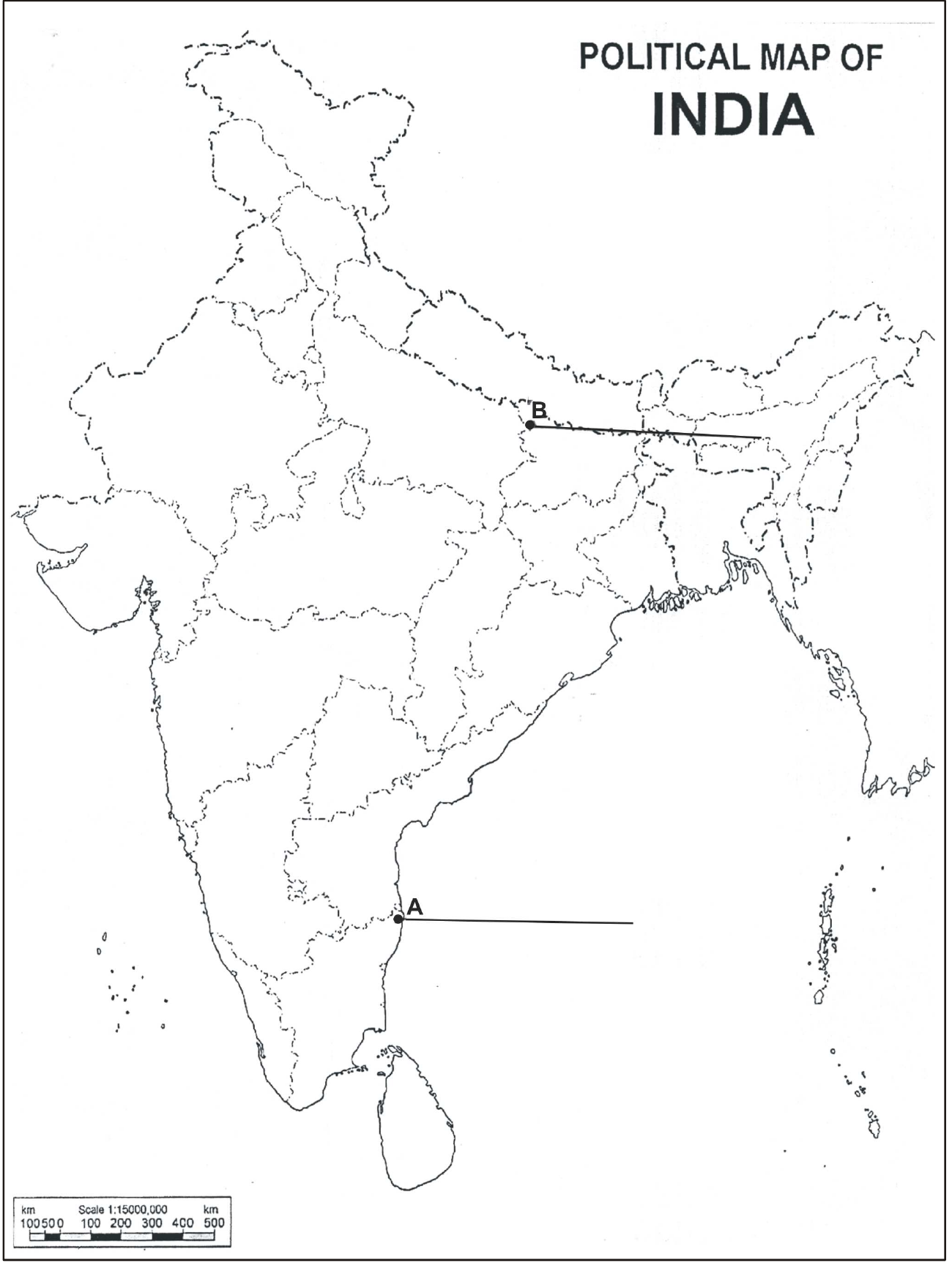
(a)(B) The place where the movement of Indigo planters was started.
(b) Locate and label any four of the following with appropriate symbols on the same map: (i) Sardar Sarovar – Dam; (ii) Bhilai – Iron and Steel Plant; (iii) Pune – Software Technology Park; (iv) Kochi – Major Sea Port; (v) Indore – Cotton Textile Industry; (vi) Naraura – Nuclear Power Plant.
Solutions: CBSE 2020 · 32/1/1
Answer: A. French Revolution (1789)
Because vernacular newspapers had become assertively nationalist after 1857; the Act gave the government extensive rights to censor reports and editorials in the vernacular press.
Veto is the right to reject or block a decision. For example, in the IMF and World Bank the USA has an effective right of veto over key decisions.
Japan
Answer: D. Manuscripts were fragile.
They were also expensive, had to be handled carefully, and were written in different scripts, so they could not be read easily.
A – On the basis of origin; B – On the basis of exhaustibility.
Visakhapatnam port.
Correct pairs: (b) Mayurbhanj – Odisha, (c) Kalol – Gujarat, (d) Bauxite mines – Amarkantak. (Chandrapur thermal power plant is in Maharashtra, so (a) has no correct match.)
Answer: C. Sinhala and Tamil
The major social groups are the Sinhala-speakers (74%) and Tamil-speakers (18%).
Answer: B
Uphold the secular Constitution: treat all religions equally, prevent the use of religion in politics, and promote mutual respect through education.
Bihar (38 per 1,000 live births).
GDP is the sum of the value of all final goods and services produced within the country in a year; only final goods are counted, to avoid double counting.
21.1 The Justice Party, the party of non-Brahmans in Madras, did not boycott the elections; it felt entering the council was a way to gain power that usually only Brahmans had.
21.2 Foreign goods were boycotted, liquor shops picketed and foreign cloth burnt in huge bonfires; merchants refused to trade in foreign goods.
21.3 The import of foreign cloth halved between 1921 and 1922 (from ₹ 102 crore to ₹ 57 crore), and production of Indian textile mills and handlooms went up.
1. British cotton manufacturers began to expand and pressured the government to impose import duties on Indian textiles, so Manchester goods could sell in Britain without competition.
2. They persuaded the East India Company to sell British manufactures in India; cheap machine-made Manchester goods flooded Indian markets.
3. Indian weavers lost their export markets and also faced a shortage of good quality raw cotton, as cotton was exported to Britain at high prices.
1. Identification and inventory of resources across the regions of the country, through surveying, mapping and qualitative and quantitative estimation.
2. Evolving a planning structure with appropriate technology, skill and institutional set-up for implementing resource development plans.
3. Matching the resource development plans with overall national development plans.
1. There are two or more levels (tiers) of government, governing the same citizens, each with its own jurisdiction.
2. The jurisdictions of each tier are specified in the Constitution, and fundamental provisions cannot be changed by one level alone.
3. Courts interpret the Constitution and settle disputes between levels; sources of revenue are specified to ensure financial autonomy.
1. There is no official religion for the Indian state; the Constitution does not give special status to any religion.
2. All individuals and communities have the freedom to profess, practise and propagate any religion, or not to follow any.
3. The Constitution prohibits discrimination on grounds of religion, and allows the state to intervene in religious matters to ensure equality (for example, banning untouchability).
1. Eat a balanced diet with adequate proteins, vitamins and minerals, and avoid junk food.
2. Exercise and play sports regularly.
3. Get regular health check-ups and adequate sleep. (BMI = weight in kg ÷ height in m²; a normal BMI is 18.5–25.)
1. In the initial stages of development, most of the natural products came from agriculture, dairy, fishing and forestry.
2. Most people were employed in the primary sector, since few other jobs existed.
3. As methods of farming changed and agriculture prospered, it produced surplus food; this let people take up other activities, and the secondary sector gradually became important.
1. Greece had been part of the Ottoman Empire since the 15th century.
2. The growth of revolutionary nationalism in Europe sparked off a struggle for independence among the Greeks in 1821.
3. Greek nationalists got support from Greeks in exile and from many West Europeans who admired ancient Greek culture.
4. Poets and artists lauded Greece as the cradle of European civilisation and mobilised public opinion to support its struggle against a Muslim empire; the English poet Lord Byron organised funds and died fighting in 1824.
5. The Treaty of Constantinople (1832) recognised Greece as an independent nation.
1. Parties contest elections by putting up candidates.
2. They put forward different policies and programmes for voters to choose from.
3. They play a decisive role in making laws for the country.
4. They form and run governments; parties that lose play the role of opposition, criticising the government's failures and wrong policies.
5. They shape public opinion, raise issues and launch movements, and provide people access to government machinery and welfare schemes.
1. Banks accept deposits from the public, keep money safe and pay interest, encouraging savings.
2. They keep only about 15% of deposits as cash and lend the rest to people who need loans, mediating between savers and borrowers.
3. They give loans for agriculture, small industries, trade, housing and education, which increases production, employment and incomes.
4. Bank loans are cheaper than informal credit and are supervised by the RBI, so borrowers are protected from debt traps.
5. Payments by cheque and digital transfers make trade easier; by extending credit to rural areas and the poor, banks support development across the country.
34.1 MNCs own or control production in more than one country, spreading production and trade across countries, which links distant economies.
34.2 (i) It lets producers sell beyond their domestic markets and compete in markets of other countries.
(ii) Buyers get a wider choice of goods than those produced at home; so goods from one market reach another and markets in different countries become integrated.
34.3 (i) Greater competition among local and foreign producers gives consumers more choice, better quality and lower prices.
(ii) Well-off consumers, especially in cities, now enjoy much higher standards of living.
B – Champaran, Bihar.
Get every solution for all 17 papers
- Every board question of every chapter, each fully solved the way the board gives marks
- 17 complete board papers, each followed by its solutions
- Weightage and most-asked topics for every chapter
- Instant PDF download, colour and black & white print copies
Revising the chapter first? Complete Social Science Notes for Class 10 (NCERT 2026-27) →
What you get in the pack
- Questions from 126 CBSE papers, 2016 to 2026: every set code available
- Complete: 2341 different questions and parts from all set codes, 20 chapters and 17 full papers
- Part A: all 20 chapters of History, Geography, Pol Science and Economics, sorted by marks
- Year-wise weightage table and most-asked topics for every chapter
- Part B: 17 full board papers, each followed by its complete answers, for timed practice
- Answers written to the marking-scheme points; map questions with the paper's map and every place named
- Questions on topics outside the 2026-27 board exam flagged; only the current syllabus in Part A
All chapters in this pack
- PYQ History 1 The Rise of Nationalism in Europe
- PYQ History 2 Nationalism in India
- PYQ History 3 The Making of a Global World
- PYQ History 5 Print Culture and the Modern World
- PYQ Geography 1 Resources and Development
- PYQ Geography 2 Forest and Wildlife Resources
- PYQ Geography 3 Water Resources
- PYQ Geography 4 Agriculture
- PYQ Geography 5 Minerals and Energy Resources
- PYQ Geography 6 Manufacturing Industries
- PYQ Geography 7 Lifelines of National Economy (Map)
- PYQ Pol Science 1 Power-sharing
- PYQ Pol Science 2 Federalism
- PYQ Pol Science 3 Gender, Religion and Caste
- PYQ Pol Science 4 Political Parties
- PYQ Pol Science 5 Outcomes of Democracy
- PYQ Economics 1 Development
- PYQ Economics 2 Sectors of the Indian Economy
- PYQ Economics 3 Money and Credit
- PYQ Economics 4 Globalisation and the Indian Economy
- Board Paper 2026 Set 32-4-1 with Solutions
- Board Paper 2026 Set 32-5-1 with Solutions
- Board Paper 2025 Set 32-1-1 with Solutions
- Board Paper 2025 Set 32-2-1 with Solutions
- Board Paper 2024 Set 32-2-1 with Solutions
- Board Paper 2024 Set 32-4-1 with Solutions
- Board Paper 2023 Set 32-2-1 with Solutions
- Board Paper 2023 Set 32-4-1 with Solutions
- Board Paper 2022 Term 2 Set 32-1-1 with Solutions
- Board Paper 2022 Term 2 Set 32-3-1 with Solutions
- Board Paper 2020 Set 32-1-1 with Solutions
- Board Paper 2020 Set 32-4-1 with Solutions
- Board Paper 2019 Set 32-2-1 with Solutions
- Board Paper 2019 Set 32-4-1 with Solutions
- Board Paper 2018 Set 32-1 with Solutions
- Board Paper 2017 Set 32-1 with Solutions
- Board Paper 2016 Set 32-1 with Solutions