
CBSE Class 10 Social Studies Question Paper 2019 (32/4/1) with Solutions
The complete CBSE Class 10 Social Studies board paper of 2019, Q.P. code 32/4/1: all 26 questions exactly as set, with marks. 21 solutions are free below. The Class 10 SST PYQ Book: Solved Board Papers 2016-2026 (CBSE) solves all 17 papers in full and sorts every question chapter-wise.
Subject expert: Vikas Chandrawal, M.A. History · 8 years teaching


Free: NCERT solutions for Class 10 SST →
Question paper
Jump to: Question paperSolutions
2019 · Q.P. Code 32/4/1
Maximum marks: 80
Section A · 1 mark each
(a) Why did Frédéric Sorrieu present utopian vision in his prints in 1848? Explain one reason.
(b) Why was the Tonkin Free School started in Vietnam? Explain one reason.
not in 2026-27 syllabus(a) Why had some parents kept novels away from their children's reach during 19th century in India?
not in 2026-27 syllabus(b) Why had Englishmen demanded a clamp down on the 'Vernacular Press' in the 19th century?
(a) Which type of soil is most suitable for growing the crop of cashew nut?
(b) Which type of soil in India is most widespread and important?
Name the country where ethnic struggle led to violence and revolt after 1956.
(a) Explain the meaning of 'Currency'.
(b) Explain the reason for necessity of supervision by the Reserve Bank of India of formal sources of loans.
Analyse the contribution of communication technology in globalisation.
Suppose you have to buy electrical equipments, which logo or mark of quality will you see on the equipments?
not in 2026-27 syllabusSection B · 3 marks each
(a) Describe the role of Romanticism in developing nationalist feelings among Europeans during nineteenth century.
(b) Describe Hoa Hao movement as a mainstream nationalism of Vietnam.
not in 2026-27 syllabus(a) "Issues of caste discrimination began to be written about in many printed tracts and essays in India in the late nineteenth century." Support the statement with two suitable examples.
(b) "Premchand's characters in different novels create a community based on democratic values." Support the statement with two suitable examples.
not in 2026-27 syllabus(a) "Multi-purpose projects and large dams have been the cause of many new social movements." Highlight the concerns related to such movements.
(b) "Traditional harvesting system is a useful system to conserve and store water." Highlight the importance of this system with two examples.
Highlight any three differences between Kharif cropping season and Rabi cropping season.
(a) Evaluate the strengths and limitations of local self-government in a democracy.
(b) Evaluate the power sharing system in India.
"Democracy is the best way to accommodate social division." Justify the statement.
"Complaints are treated as testimony to the success of democracy." Support the statement with examples.
"Average income is useful for comparison but it may hide disparities." Support the statement with suitable arguments.
Explain any three reasons for the banks and cooperative societies to increase their lending facilities in rural areas.
(a) Assess any three advantages of globalisation.
not in 2026-27 syllabus(b) Assess any three advantages of multinational corporations.
not in 2026-27 syllabus(a) Describe the importance of the 'Right to Information (RTI)' for consumers.
not in 2026-27 syllabus(b) Describe the importance of the 'Right to Seek Redressal' for consumers.
not in 2026-27 syllabusSection C · 5 marks each
(a) Describe the condition of indentured labour that migrated from India during the nineteenth century.
not in 2026-27 syllabus(b) Describe the role of early entrepreneurs of India in the development of industries.
not in 2026-27 syllabus(c) Describe the 'land reclamation' process in Bombay during the late nineteenth and the early twentieth centuries.
not in 2026-27 syllabus(a) Why did Mahatma Gandhi start the 'Civil Disobedience Movement'? How did this movement unite the country? Explain.
(b) Why did Mahatma Gandhi launch the 'Non-Cooperation Movement'? How did this movement unite the country? Explain.
Explain the reasons for concentration of iron and steel industries in and around Chotanagpur region.
Explain the importance of means of transport as a prerequisite for the development of a country.
not in 2026-27 syllabusDescribe the different ways through which women face discrimination and oppression in India.
(a) Explain the role of Political Parties in a democracy.
(b) Explain the necessity of Political Parties in a democracy.
Highlight the contribution of public sector in the economic development of a country.
Section D · Map (5 marks)
(A)(a) Two features 'a' and 'b' are marked on the given political outline map of India. Identify them:
(a) The place where the Indian National Congress Session was held.
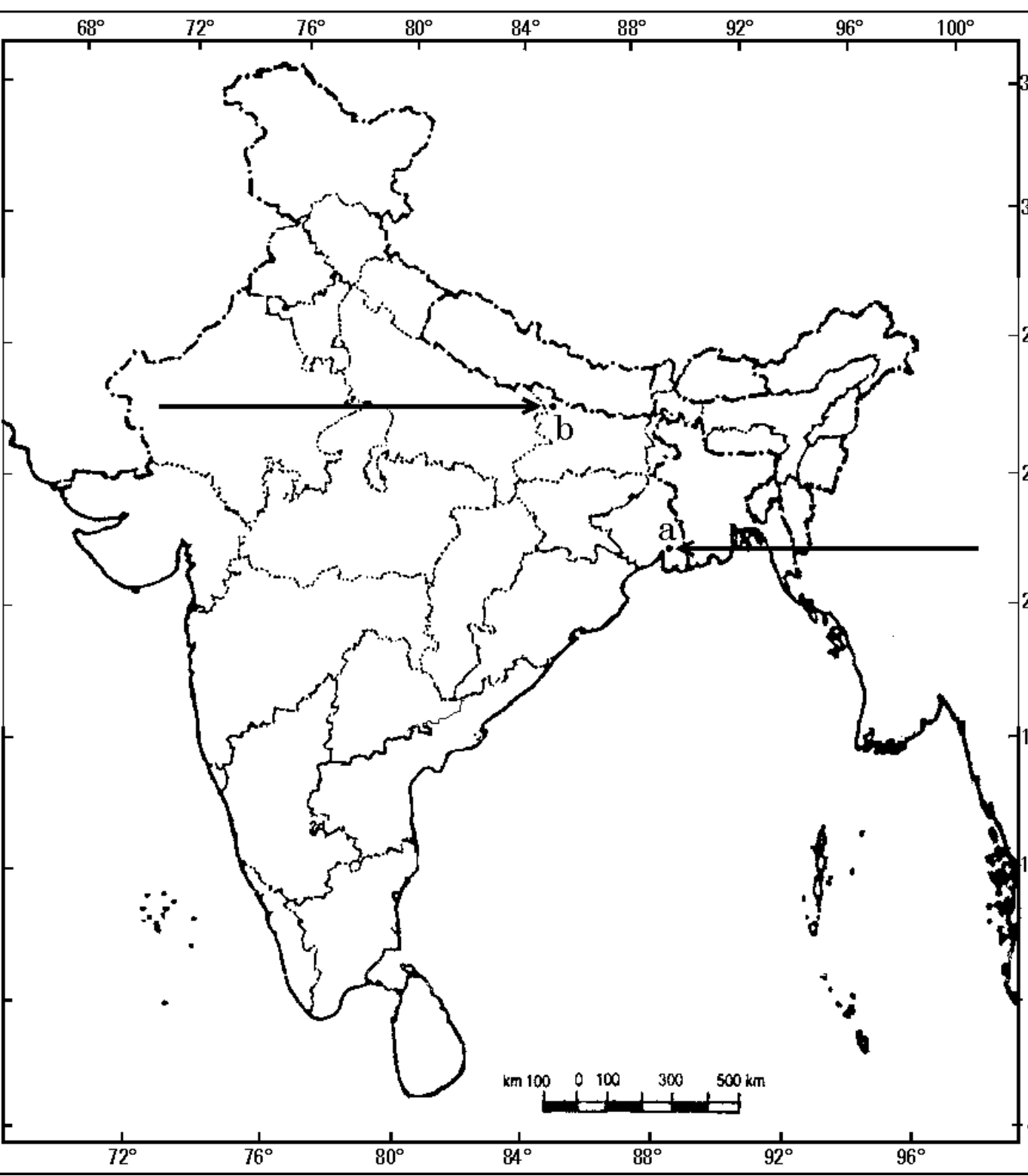
(A)(b) The place from where Gandhiji organised Satyagraha in favour of Indigo planters.
(B) Locate and label any three of the following: (i) Tarapur – Nuclear Power Plant; (ii) Tungabhadra – Dam; (iii) Mohali – Software Technology Park; (iv) Kandla – Major Sea Port; (v) Durgapur – Iron and Steel Plant.
Solutions: CBSE 2019 · 32/4/1
He visualised a world made up of 'democratic and social republics': his prints show the peoples of Europe and America, as distinct nations identified by their flags and costumes, marching together towards the Statue of Liberty, expressing his dream of a world of free nation-states.
They feared that novels would corrupt the young minds: novels were seen as a distraction from serious study and as encouraging immoral thoughts and behaviour.
Red laterite soil, especially in Tamil Nadu, Andhra Pradesh and Kerala.
Sri Lanka (between the Sinhala majority and the Sri Lankan Tamils).
The RBI checks that banks maintain the minimum cash balance and that they lend not only to profit-making businesses and traders but also to small cultivators, small-scale industries and small borrowers, at fair interest rates.
The ISI mark (certified by the Bureau of Indian Standards).
1. The Hoa Hao movement began in 1939 and gained great popularity in the fertile Mekong delta area; it drew on religious traditions popular in anti-French uprisings of the 19th century.
2. Its founder Huynh Phu So performed miracles and helped the poor; his criticism of useless expenditure, opposition to the sale of child brides, gambling and the use of alcohol and opium had wide appeal.
3. The French tried to suppress it: they declared Huynh Phu So mad, called him the Mad Bonze and put him in a mental asylum, but even the doctor who examined him became his follower; he was exiled to Laos and his followers sent to concentration camps.
1. Premchand's novels are filled with powerful characters drawn from all levels of society: aristocrats and landlords, middle-level peasants and landless labourers, middle-class professionals and people from the margins.
2. In Rangbhoomi (The Arena of Life), the hero Surdas, a visually impaired beggar from a so-called 'untouchable' caste, fights to save his land from a tobacco factory, inspired by Gandhian ideas of non-violence and collective struggle.
3. In Godan (The Gift of a Cow, 1936), Hori and his wife Dhania, a peasant couple, live with dignity despite exploitation by landlords and moneylenders. Women and the lower castes are shown as part of a community bound by democratic values.
1. It is an eco-friendly and economically viable way of conserving water, suited to local ecological conditions and needs.
2. In the semi-arid and arid regions of Rajasthan (Bikaner, Phalodi, Barmer), almost every house had underground tanks or tankas for storing drinking water, connected to the sloping roofs by pipes. The water was safe till the next rains, and the tankas also kept the rooms cool in summer.
3. In hill and mountain regions, people built diversion channels like the 'guls' or 'kuls' of the Western Himalayas for agriculture; in the flood plains of Bengal, inundation channels irrigated fields; in Meghalaya, a 200-year-old system of tapping stream and spring water by bamboo pipes is still in use.
Strengths
1. Constitutional status since 1992: elections to local bodies are held regularly; one-third seats are reserved for women and seats are reserved for SCs, STs and OBCs, giving them representation.
2. It deepens democracy: local problems are solved locally, and people participate directly in decision-making (gram sabha).
Limitations
3. Gram sabhas are not held regularly, most state governments have not transferred significant powers and adequate resources to local governments, so we are still far from the ideal of self-government.
1. Democracies develop procedures to conduct their competition peacefully, which reduces the possibility of social tensions becoming explosive or violent.
2. Democracy usually develops harmonious social life: no society can fully and permanently resolve conflicts among groups, but democracy learns to respect differences and to negotiate them. Belgium is a good example of successful accommodation of differences among ethnic groups.
3. Democracy requires that the majority always works with the minority, and that rule by majority does not become rule by a religious, racial or linguistic majority community; every citizen must have a chance to be in the majority at some time. Non-democratic regimes tend to ignore or suppress internal social differences (for example Sri Lanka's majoritarian policies caused civil war).
1. Average (per capita) income = total income of the country ÷ total population; it is used to compare countries, e.g. by the World Bank.
2. It hides distribution: two countries with the same average income can have very different distributions. Example: Country A, 5 citizens each earning ₹10,000 (average ₹10,000); Country B, four earning ₹500 and one earning ₹48,000 (average also ₹10,000). People in Country A are far better off.
3. So average income does not tell us how income is distributed or whether basic needs of the poor are met; other indicators such as IMR, literacy and HDI are also needed.
1. Consumers, especially the well-off in urban areas, have greater choice of goods, of better quality and at lower prices, and enjoy higher standards of living.
2. MNCs have increased investment in India, creating new jobs in industries such as cell phones, automobiles, electronics and fast food, and in services such as IT.
3. Top Indian companies (Tata Motors, Infosys, Ranbaxy, Asian Paints) have benefited from competition, invested in newer technology and become multinationals themselves.
1. Consumers have the right to be informed about the particulars of goods and services they buy: ingredients, price, batch number, date of manufacture, expiry date and the address of the manufacturer.
2. With this information they can choose wisely, and they can complain and ask for compensation or replacement if the product proves defective.
3. The RTI Act (2005) extends this to government departments: citizens can find out everything about their functioning, which brings transparency.
1. In the 19th century hundreds of thousands of Indian and Chinese labourers went to work on plantations, in mines and on road and railway projects; most Indian indentured workers came from eastern Uttar Pradesh, Bihar, central India and the dry districts of Tamil Nadu.
2. They were hired under contracts which promised return travel to India after five years of work on their employer's plantation.
3. Recruitment was done by agents who often gave false information about final destinations, modes of travel, the nature of work, and living and working conditions; sometimes migrants were even forcibly abducted.
4. On arrival, living and working conditions were harsh, and workers had few legal rights; it was called a 'new system of slavery'.
5. Workers found their own ways of surviving, blending different cultural forms (Hosay in Trinidad, chutney music, Rastafarianism). Nationalist leaders opposed the system, and it was abolished in 1921.
1. Bombay was originally seven islands; as the population grew, the islands were joined into one area over time through a series of reclamation projects.
2. The earliest project began in 1784, when Governor William Hornby approved the building of the great sea wall which prevented the flooding of the low-lying areas.
3. The need for additional commercial space led to plans for reclamation; in 1864 the Back Bay Reclamation Company won the right to reclaim the western foreshore from the tip of Malabar Hill to the end of Colaba.
4. Reclamation often meant levelling the surrounding hills; the Bombay Port Trust built a dry dock between 1914 and 1918 and used the excavated earth to create the 22-acre Ballard Estate.
5. Later, the famous Marine Drive was developed on reclaimed land.
Why it was launched
1. The Rowlatt Act (1919) and the Jallianwala Bagh massacre showed the oppressive nature of British rule; Gandhiji believed in Hind Swaraj that British rule survived only because of Indian cooperation.
2. He wanted to bring Hindus and Muslims together by joining the Khilafat issue; the Calcutta session (September 1920) approved non-cooperation, to win swaraj.
How it united the country
3. In towns, the middle class joined: students left government schools, teachers resigned, lawyers gave up practice, foreign cloth was boycotted and burnt, and the import of foreign cloth halved.
4. In the countryside, peasants in Awadh (Baba Ramchandra) struggled against talukdars and landlords; tribal peasants in the Gudem Hills (Alluri Sitaram Raju) launched a guerrilla movement.
5. Plantation workers in Assam left the plantations to go home. Each group interpreted swaraj in its own way, but all were united under the idea of swaraj and the leadership of Gandhiji.
1. Movement of goods and services from their supply locations to demand locations needs transport; the producers and consumers are linked by it.
2. Transport brings raw materials to factories and carries finished goods to markets, so it is essential for industry, agriculture and trade.
3. Efficient and fast-moving transport has turned the world into a large village; it expands trade from local to national and international levels.
4. It creates employment and develops tourism, and helps in times of natural calamities, defence and administration.
5. It links remote and backward regions with developed areas and binds people of different regions, languages and cultures together, promoting national integration. Hence a dense and efficient network of transport is a prerequisite for local, national and global development.
1. Parties contest elections: in most democracies elections are fought mainly among candidates put up by parties.
2. Parties put forward different policies and programmes, and voters choose from them; the government is expected to base its policies on the line taken by the ruling party.
3. Parties play a decisive role in making laws: laws are debated and passed in the legislature, and members follow the direction of their party leadership.
4. Parties form and run governments; parties that lose elections play the role of opposition, criticising the government and mobilising opposition to it.
5. Parties shape public opinion, raise and highlight issues, and provide people access to government machinery and welfare schemes.
1. It provides infrastructure needed for development, roads, bridges, railways, harbours, electricity generation, irrigation through dams, which the private sector cannot provide at reasonable cost because they need huge spending.
2. It supplies essential goods and services at low prices: for example electricity to small-scale industries, and foodgrains bought from farmers at a fair price and sold to the poor at subsidised rates through ration shops.
3. It provides health and education facilities (government schools and hospitals) for all, especially the poor.
4. It creates employment opportunities and promotes balanced regional development by setting up industries in backward areas.
5. It aims at public welfare rather than profit, and helps reduce economic inequalities; so it supports the private sector and the economy as a whole.
b – Champaran, north-western Bihar (1917).
Get every solution for all 17 papers
- Every board question of every chapter, each fully solved the way the board gives marks
- 17 complete board papers, each followed by its solutions
- Weightage and most-asked topics for every chapter
- Instant PDF download, colour and black & white print copies
Revising the chapter first? Complete Social Science Notes for Class 10 (NCERT 2026-27) →
What you get in the pack
- Questions from 126 CBSE papers, 2016 to 2026: every set code available
- Complete: 2341 different questions and parts from all set codes, 20 chapters and 17 full papers
- Part A: all 20 chapters of History, Geography, Pol Science and Economics, sorted by marks
- Year-wise weightage table and most-asked topics for every chapter
- Part B: 17 full board papers, each followed by its complete answers, for timed practice
- Answers written to the marking-scheme points; map questions with the paper's map and every place named
- Questions on topics outside the 2026-27 board exam flagged; only the current syllabus in Part A
All chapters in this pack
- PYQ History 1 The Rise of Nationalism in Europe
- PYQ History 2 Nationalism in India
- PYQ History 3 The Making of a Global World
- PYQ History 5 Print Culture and the Modern World
- PYQ Geography 1 Resources and Development
- PYQ Geography 2 Forest and Wildlife Resources
- PYQ Geography 3 Water Resources
- PYQ Geography 4 Agriculture
- PYQ Geography 5 Minerals and Energy Resources
- PYQ Geography 6 Manufacturing Industries
- PYQ Geography 7 Lifelines of National Economy (Map)
- PYQ Pol Science 1 Power-sharing
- PYQ Pol Science 2 Federalism
- PYQ Pol Science 3 Gender, Religion and Caste
- PYQ Pol Science 4 Political Parties
- PYQ Pol Science 5 Outcomes of Democracy
- PYQ Economics 1 Development
- PYQ Economics 2 Sectors of the Indian Economy
- PYQ Economics 3 Money and Credit
- PYQ Economics 4 Globalisation and the Indian Economy
- Board Paper 2026 Set 32-4-1 with Solutions
- Board Paper 2026 Set 32-5-1 with Solutions
- Board Paper 2025 Set 32-1-1 with Solutions
- Board Paper 2025 Set 32-2-1 with Solutions
- Board Paper 2024 Set 32-2-1 with Solutions
- Board Paper 2024 Set 32-4-1 with Solutions
- Board Paper 2023 Set 32-2-1 with Solutions
- Board Paper 2023 Set 32-4-1 with Solutions
- Board Paper 2022 Term 2 Set 32-1-1 with Solutions
- Board Paper 2022 Term 2 Set 32-3-1 with Solutions
- Board Paper 2020 Set 32-1-1 with Solutions
- Board Paper 2020 Set 32-4-1 with Solutions
- Board Paper 2019 Set 32-2-1 with Solutions
- Board Paper 2019 Set 32-4-1 with Solutions
- Board Paper 2018 Set 32-1 with Solutions
- Board Paper 2017 Set 32-1 with Solutions
- Board Paper 2016 Set 32-1 with Solutions