
CBSE Class 10 Social Studies Question Paper 2019 (32/2/1) with Solutions
The complete CBSE Class 10 Social Studies board paper of 2019, Q.P. code 32/2/1: all 26 questions exactly as set, with marks. 21 solutions are free below. The Class 10 SST PYQ Book: Solved Board Papers 2016-2026 (CBSE) solves all 17 papers in full and sorts every question chapter-wise.
Subject expert: Vikas Chandrawal, M.A. History · 8 years teaching


Free: NCERT solutions for Class 10 SST →
Question paper
Jump to: Question paperSolutions
2019 · Q.P. Code 32/2/1
Maximum marks: 80
Section A · 1 mark each
(a) Explain the aim to form 'Zollverein', a Customs Union, in 1834 in Germany.
(b) Explain the main reason responsible for the eruption of a major protest in Saigon Native Girls School in Vietnam in 1926.
not in 2026-27 syllabus(a) Why was printing of textbooks sponsored by the Imperial State in China?
(b) Why did Chandu Menon give up the idea of translation of 'English Novels' in Malayalam?
not in 2026-27 syllabus(a) How has Shillong solved the problem of acute shortage of water?
(b) How has Tamil Nadu solved the problem of acute shortage of water?
How did the feeling of alienation develop among the Sri Lankan Tamils?
(a) What may be a developmental goal of farmers who depend only on rain for growing crops?
(b) What may be a developmental goal of urban unemployed youth?
Give one example each of modern currency and older currency.
If you want to purchase an electrical valuable good, what logo would you like to see to confirm its quality?
not in 2026-27 syllabusSection B · 3 marks each
(a) Describe the great economic hardship that prevailed in Europe during the 1930s. (The board accepted answers on the 1830s or the 1930s.)
(b) Describe the serious problem faced by the modern part of Hanoi in 1903.
not in 2026-27 syllabus(a) How had the printing press created a new culture of reading in Europe? Explain with examples.
(b) How had Charles Dickens depicted the terrible effects of industrialisation on peoples lives and characters? Explain with examples.
not in 2026-27 syllabus(a) Describe any three main features of 'Alluvial soil' found in India.
(b) Describe any three main features of 'Black soil' found in India.
"The dams that were constructed to control floods have triggered floods." Analyse the statement.
(a) Name any two subjects that are included in Concurrent List. How are laws made on these subjects? Explain. (1 + 2 = 3)
(b) How is sharing of power between the Union and the State Governments basic to the structure of the Constitution of India? Explain.
"Every social difference does not lead to social division." Justify the statement.
not in 2026-27 syllabusHow can caste take several forms in politics? Explain with examples.
"Crude oil reserves are limited all over the world. If people continue to extract it at the present rate, the reserves would last only 35–40 years more." Explain any three ways to solve this problem.
(a) Why is it necessary to increase a large number of banks mainly in rural areas? Explain.
(b) Why are service conditions of formal sector loans better than informal sector? Explain.
(a) How can the Government of India play a major role to make globalisation more fair? Explain with examples.
not in 2026-27 syllabus(b) How has globalisation affected the life of Indians? Explain with examples.
not in 2026-27 syllabusHow are consumers enjoying the 'right to be informed' in their daily life? Explain with examples.
not in 2026-27 syllabusSection C · 5 marks each
(a) How had the 'First World War' created economic problems in India? Explain with examples.
(b) How had a variety of cultural processes developed a sense of collective belongingness in India during the 19th century? Explain with examples.
(a) Describe the role of 'technology' in transformation of the world in the nineteenth century.
not in 2026-27 syllabus(b) Describe the life of workers during the nineteenth century in England.
not in 2026-27 syllabus(c) Describe various steps taken to clean up London in the nineteenth century.
not in 2026-27 syllabusName the two major beverage crops grown in India. Describe their growing areas. (1 + 2 + 2 = 5)
How can the industrial pollution of fresh water be reduced? Explain various ways.
(a) "Democracies do not appear to be very successful in reducing economic inequalities." Justify the statement.
(b) "Democracy is a better form of government than any other form of government." Justify the statement.
What is a political party? Explain any four characteristics of a political party.
Compare the economic activities of the private sector with that of the public sector.
Section D · Map (5 marks)
(A)(a) Two features 'a' and 'b' are marked on the given political outline map of India. Identify them:
(a) The place where the Indian National Congress Session was held.
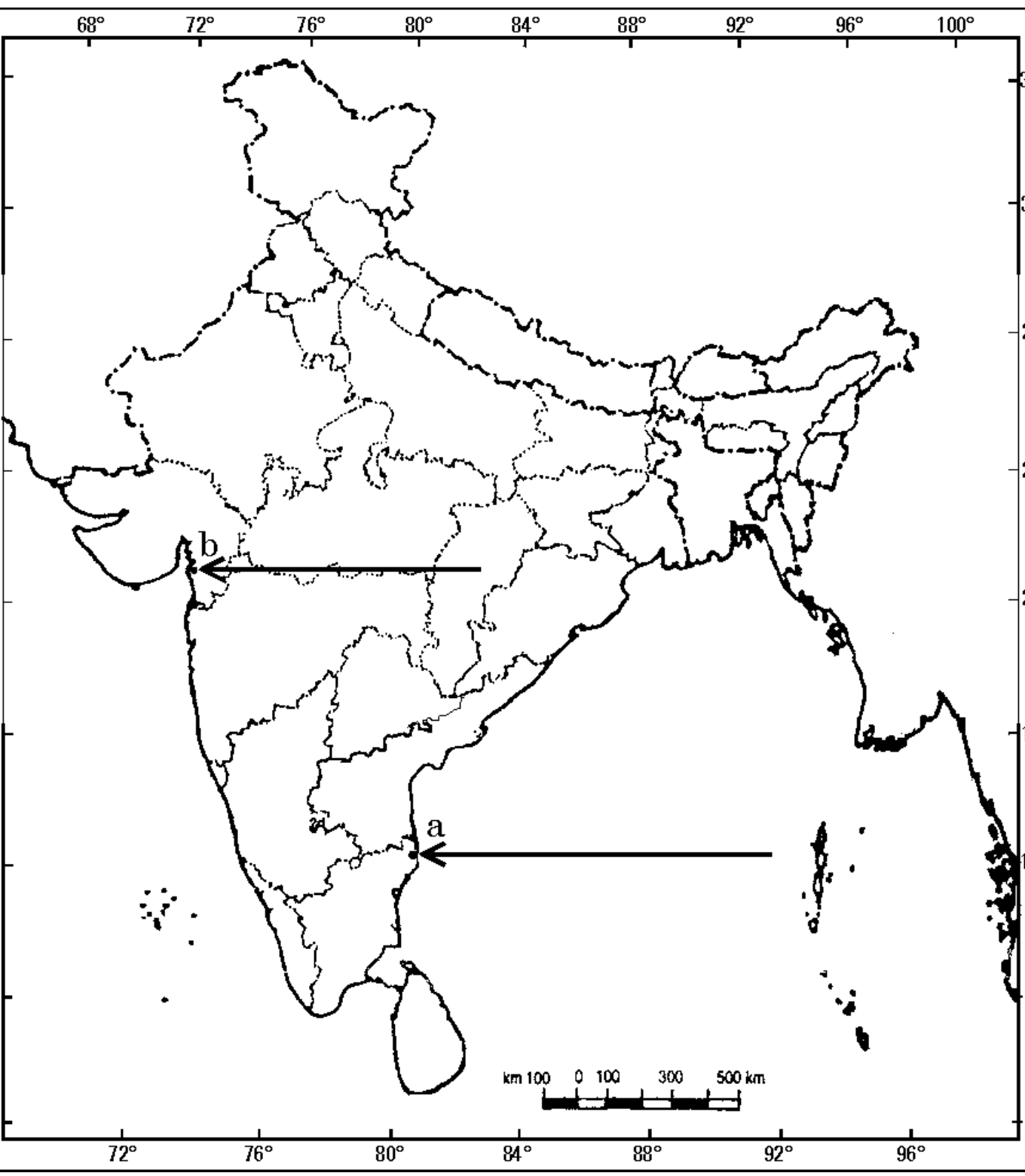
(A)(b) The place where Gandhiji violated the salt law.
(B) Locate and label any three of the following: (i) Bokaro – Iron and Steel Plant; (ii) Gandhinagar – Software Technology Park; (iii) Tarapur – Nuclear Power Plant; (iv) Salal – Dam; (v) Tuticorin – Sea Port.
Solutions: CBSE 2019 · 32/2/1
To abolish tariff barriers among the German states and reduce the number of currencies (from over thirty to two), so that goods and capital could move freely.
China had a huge bureaucratic system that recruited personnel through civil service examinations; vast numbers of textbooks were needed for these examinations.
Through rooftop rainwater harvesting: nearly every household in Shillong has a rooftop structure that meets its water requirement.
Through majoritarian measures: in 1956 Sinhala was made the only official language, Sinhala applicants were preferred for university places and government jobs, and the state was to protect and foster Buddhism.
A regular, well-paid job (or skills and loans to start their own business).
The ISI mark.
1. In 1903 the modern, French part of Hanoi was struck by bubonic plague.
2. The big modern sewers were ideal breeding grounds for rats, which travelled into the well-kept French homes.
3. The French started a rat hunt, paying Vietnamese workers for each rat tail; the workers cut off tails and released the rats, and the measures to control plague created social conflict.
1. In Hard Times (1854) he described Coketown, a fictitious industrial town: a grim place full of machinery, smoking chimneys and polluted rivers.
2. Workers were called 'hands', as if they were only operators of machines.
3. He criticised not just the greed for profit but also the ideas that reduced human beings into simple instruments of production; Oliver Twist showed the misery of urban poor.
1. It is black in colour and also called regur soil; it is formed from lava flows (parent rock) and found over the Deccan trap: Maharashtra, Saurashtra, Malwa, Madhya Pradesh and Chhattisgarh.
2. It is made of extremely fine clayey material and has high capacity to hold moisture; it develops deep cracks in summer, which help aeration.
3. It is rich in calcium carbonate, magnesium, potash and lime but poor in phosphoric content; it is ideal for cotton.
Subjects: education, forest, trade unions, marriage, adoption and succession (any two).
Both the Union and the State governments can make laws on these subjects. If their laws conflict with each other, the law made by the Union government prevails.
1. Social differences divide similar people from one another but also unite very different people (for example, people of different religions may share the same class).
2. When social differences cross-cut one another, it is difficult to pit one group against another, which reduces the chance of division (for example Netherlands).
3. When differences overlap (as in Northern Ireland), they create deep divisions; how they are expressed and accommodated by politics decides whether they lead to division.
1. Use non-conventional, renewable sources of energy such as solar, wind, tidal, geothermal and biogas.
2. Use public transport instead of individual vehicles, and switch off engines and electricity when not in use.
3. Use energy-efficient vehicles and machines, and develop alternatives such as CNG, biofuels and electric vehicles.
1. Formal lenders (banks and cooperatives) are supervised by the RBI, which ensures they lend at reasonable rates.
2. They charge lower interest, so less of the borrower's income goes to repaying the loan.
3. Informal lenders are not supervised, charge high interest and may use unfair means to recover loans, pushing borrowers into debt traps.
1. Consumers, especially the well-off in cities, have more choice, better quality and lower prices.
2. MNCs have increased investment, and new jobs have been created in industries and services like IT.
3. But many small producers have been hit by competition and lost business, and workers' jobs have become less secure.
1. The war led to a huge increase in defence expenditure, financed by war loans and increased taxes.
2. Customs duties were raised and income tax was introduced.
3. Prices increased sharply, doubling between 1913 and 1918, causing extreme hardship to common people.
4. Villages were forced to supply soldiers, and forced recruitment in rural areas caused widespread anger.
5. Crops failed in many parts of India in 1918–19 and 1920–21, causing acute food shortages, and an influenza epidemic killed 12–13 million people.
1. The railways, steamships and the telegraph were important inventions that transformed the 19th-century world.
2. Railways linked agricultural regions to ports; steamships carried goods faster and in larger volumes.
3. The telegraph made communication across countries quick.
4. Refrigerated ships made it possible to transport perishable meat from America, Australia and New Zealand to Europe.
5. This reduced shipping costs and lowered meat prices in Europe, so the poor could eat a more varied diet; technology expanded trade and integrated the world economy.
1. Attempts were made to decongest localities, green open spaces and reduce pollution.
2. Large blocks of apartments were built, and rent control was introduced in Britain during the First World War.
3. The idea of the 'Green Belt' around London was developed and the Garden City of New Earswick was built.
4. Municipal housing (council homes) was built for workers.
5. The London underground railway was built to ease congestion and move people quickly across the city.
1. Minimise the use of water for processing by reusing and recycling it in two or more successive stages.
2. Harvest rainwater to meet water requirements.
3. Treat hot water and effluents before releasing them into rivers and ponds.
4. Treat industrial effluents in three phases: primary (mechanical: screening, grinding, flocculation, sedimentation), secondary (biological) and tertiary (biological, chemical and physical, including recycling of wastewater).
5. Regulate overdrawing of groundwater by industries where the water table is falling.
1. It promotes equality among citizens.
2. It enhances the dignity of the individual.
3. It improves the quality of decision-making through discussion.
4. It provides a method to resolve conflicts peacefully and accommodates social diversity.
5. It allows room to correct mistakes, and produces an accountable, responsive and legitimate government.
| Public sector | Private sector |
|---|---|
| The government owns most of the assets and provides the services. | Ownership of assets and delivery of services are in the hands of private individuals or companies. |
| The purpose is not just to earn profit but public welfare. | Activities are guided by the motive to earn profit. |
| Raises money through taxes and other means to meet expenses. | Raises its own funds from owners and loans. |
| Provides things society needs at reasonable cost: roads, bridges, railways, irrigation, cheap electricity, schools and hospitals. | Provides goods and services at market prices; may not provide essential services cheaply. |
| Examples: Indian Railways, post office. | Examples: Tata Steel, Reliance Industries. |
b – Dandi, Gujarat.
Get every solution for all 17 papers
- Every board question of every chapter, each fully solved the way the board gives marks
- 17 complete board papers, each followed by its solutions
- Weightage and most-asked topics for every chapter
- Instant PDF download, colour and black & white print copies
Revising the chapter first? Complete Social Science Notes for Class 10 (NCERT 2026-27) →
What you get in the pack
- Questions from 126 CBSE papers, 2016 to 2026: every set code available
- Complete: 2341 different questions and parts from all set codes, 20 chapters and 17 full papers
- Part A: all 20 chapters of History, Geography, Pol Science and Economics, sorted by marks
- Year-wise weightage table and most-asked topics for every chapter
- Part B: 17 full board papers, each followed by its complete answers, for timed practice
- Answers written to the marking-scheme points; map questions with the paper's map and every place named
- Questions on topics outside the 2026-27 board exam flagged; only the current syllabus in Part A
All chapters in this pack
- PYQ History 1 The Rise of Nationalism in Europe
- PYQ History 2 Nationalism in India
- PYQ History 3 The Making of a Global World
- PYQ History 5 Print Culture and the Modern World
- PYQ Geography 1 Resources and Development
- PYQ Geography 2 Forest and Wildlife Resources
- PYQ Geography 3 Water Resources
- PYQ Geography 4 Agriculture
- PYQ Geography 5 Minerals and Energy Resources
- PYQ Geography 6 Manufacturing Industries
- PYQ Geography 7 Lifelines of National Economy (Map)
- PYQ Pol Science 1 Power-sharing
- PYQ Pol Science 2 Federalism
- PYQ Pol Science 3 Gender, Religion and Caste
- PYQ Pol Science 4 Political Parties
- PYQ Pol Science 5 Outcomes of Democracy
- PYQ Economics 1 Development
- PYQ Economics 2 Sectors of the Indian Economy
- PYQ Economics 3 Money and Credit
- PYQ Economics 4 Globalisation and the Indian Economy
- Board Paper 2026 Set 32-4-1 with Solutions
- Board Paper 2026 Set 32-5-1 with Solutions
- Board Paper 2025 Set 32-1-1 with Solutions
- Board Paper 2025 Set 32-2-1 with Solutions
- Board Paper 2024 Set 32-2-1 with Solutions
- Board Paper 2024 Set 32-4-1 with Solutions
- Board Paper 2023 Set 32-2-1 with Solutions
- Board Paper 2023 Set 32-4-1 with Solutions
- Board Paper 2022 Term 2 Set 32-1-1 with Solutions
- Board Paper 2022 Term 2 Set 32-3-1 with Solutions
- Board Paper 2020 Set 32-1-1 with Solutions
- Board Paper 2020 Set 32-4-1 with Solutions
- Board Paper 2019 Set 32-2-1 with Solutions
- Board Paper 2019 Set 32-4-1 with Solutions
- Board Paper 2018 Set 32-1 with Solutions
- Board Paper 2017 Set 32-1 with Solutions
- Board Paper 2016 Set 32-1 with Solutions