
CBSE Class 10 Social Studies Question Paper 2018 (32/1 · Set 1) with Solutions
The complete CBSE Class 10 Social Studies board paper of 2018, Q.P. code 32/1 · Set 1: all 26 questions exactly as set, with marks. 20 solutions are free below. The Class 10 SST PYQ Book: Solved Board Papers 2016-2026 (CBSE) solves all 17 papers in full and sorts every question chapter-wise.
Subject expert: Vikas Chandrawal, M.A. History · 8 years teaching


Free: NCERT solutions for Class 10 SST →
Question paper
Jump to: Question paperSolutions
2018 · Q.P. Code 32/1 · Set 1
Maximum marks: 80
Section A · 1 mark each
(a) Why were big European powers met in Berlin in 1885?
(b) Why were merchants from towns in Europe began to move countryside in seventeenth and eighteenth centuries?
not in 2026-27 syllabus(c) Why did Charles Booth, a Liverpool ship owner conduct the first social survey of low skilled workers in the East End of London in 1887?
not in 2026-27 syllabus(a) Why did the Roman Catholic Church impose control over publishers and booksellers?
(b) Why do novels use vernacular?
not in 2026-27 syllabusClassify resources on the basis of origin.
'A challenge is not just any problem but an opportunity for progress.' Analyse the statement.
not in 2026-27 syllabusState any two goals of development other than income.
When we produce goods by exploiting natural resources, in which category of economic sector such activities come?
Give any two examples of informal sector of credit.
Section B · 3 marks each
(a) Describe the impact of 'Rinderpest' on people's livelihoods and local economy in Africa in the 1890s.
(b) Describe any three major problems faced by Indian cotton weavers in nineteenth century.
not in 2026-27 syllabus(c) Describe any three steps taken to clean up London during nineteenth century.
not in 2026-27 syllabus(a) "The 'Print Revolution' had transformed the lives of people changing their relationship to information and knowledge." Analyse the statement.
(b) Distinguish between the themes of 'Pride and Prejudice' and 'Jane Eyre' novels written by Jane Austen and Charlotte Bronte respectively.
not in 2026-27 syllabusHow has the ever increasing number of industries in India made worse position by exerting pressure on existing fresh water resources? Explain.
"Dense and efficient network of transport is a pre-requisite for local and national development." Analyse the statement.
not in 2026-27 syllabusDescribe any three provisions of amendment made in 'Indian Constitution' in 1992 for making 'Three-Tier' government more effective and powerful.
Explain the three factors that are crucial in deciding the outcome of politics of social divisions.
not in 2026-27 syllabus"Secularism is not an ideology of some political parties or persons, but it is one of the foundations of our country." Examine the statement.
How is the issue of sustainability important for development? Explain with examples.
Distinguish the service conditions of organized sector with that of unorganized sector.
Why is cheap and affordable credit important for the country's development? Explain any three reasons.
How can consumer awareness be spread among consumers to avoid exploitation in the market place? Explain any three ways.
not in 2026-27 syllabusSection C · 5 marks each
(a) Describe the explosive conditions prevailed in Balkans after 1871 in Europe.
(b) Describe the role of different religious groups in the development of anti-colonial feelings in Vietnam.
not in 2026-27 syllabus(a) How did Non-Cooperation movement start with participation of middle class people in the cities? Explain its impact on the economic front.
(b) Why was Congress reluctant to allow women to hold any position of authority within the organisation? How did women participate in Civil Disobedience Movement? Explain.
(a) "The Government of India has introduced various institutional and technological reforms to improve agriculture in the 1980s and 1990s." Support this statement with examples.
(b) Compare 'intensive subsistence farming' with that of 'commercial farming' practiced in India.
Why is the economic strength of a country measured by the development of manufacturing industries? Explain with examples.
Describe any five major functions of political parties performed in a democracy.
(a) "Democracy stands much superior to any other form of government in promoting dignity and freedom of the individual." Justify this statement.
(b) "Democracies lead to peaceful and harmonious life among citizens." Justify this statement.
(a) How has foreign trade been integrating markets of different countries? Explain with examples.
not in 2026-27 syllabus(b) How do we feel the impact of globalization on our daily life? Explain with examples.
not in 2026-27 syllabusSection D · Map (5 marks)
(A)(a) Two features a and b are marked on the given political outline map of India. Identify them:
(a) The place where the Indian National Congress Session was held.
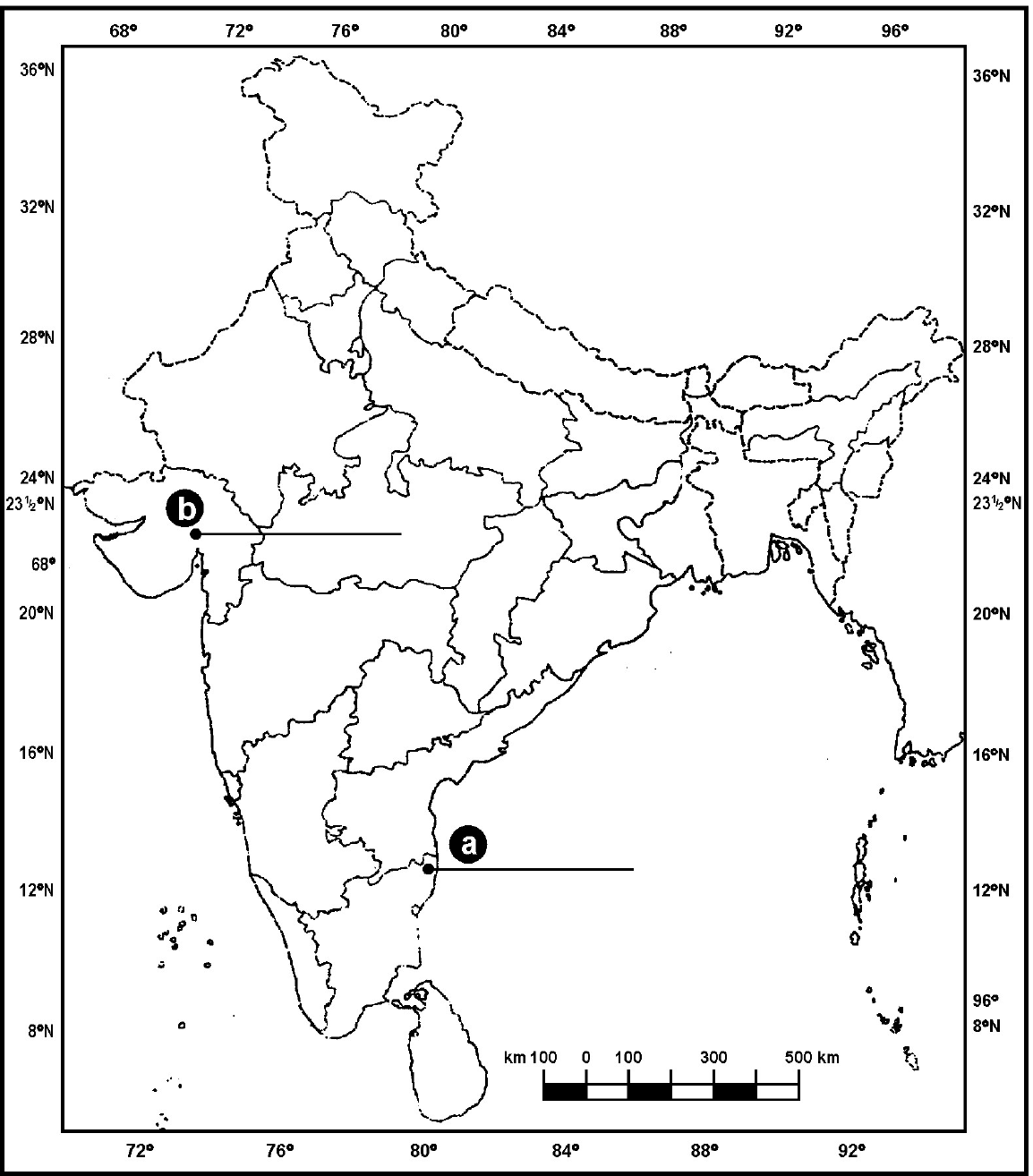
(A)(b) The place where Gandhiji organised 'Satyagraha' in favour of cotton mill workers.
(B) Locate and label the following: (i) Raja Sansi – International Airport; (ii) Bhadravati – Iron and Steel Plant; (iii) Software Technology Park of West Bengal.
Solutions: CBSE 2018 · 32/1 · Set 1
To complete the carving up of Africa among themselves: the European powers met in Berlin to divide Africa, drawing borders with straight lines that ignored local realities.
He wanted to study the condition of low-skilled workers: he found that about 1 million Londoners were very poor and were expected to live only up to an average age of 29, and he concluded that London needed the rebuilding of at least 400,000 rooms to house its poor.
Because the vernacular is the language spoken by common people; by using it, novels could reach a wide readership and produce a sense of a shared world among diverse people in a nation.
A challenge is a difficulty that carries within it an opportunity for progress: once we overcome a challenge, we go up to a higher level than before.
The primary sector (also called the agriculture and related sector), e.g. farming, dairy, fishing, forestry and mining.
1. Rinderpest, a fast-spreading cattle plague, arrived in Africa in the late 1880s with infected cattle imported from British Asia to feed Italian soldiers invading Eritrea; it moved like forest fire and killed about 90% of the cattle.
2. The loss of cattle destroyed African livelihoods, since the people depended on land and livestock.
3. Planters, mine owners and colonial governments monopolised the scarce cattle resources that remained, forcing Africans into the labour market; control over cattle helped Europeans conquer and subdue Africa.
1. Attempts were made to decongest localities, green open spaces, reduce pollution and landscape the city; large blocks of apartments were built.
2. Rent control was introduced in Britain during the First World War to ease the impact of a severe housing shortage.
3. The idea of a 'Green Belt' around London was developed, and garden cities like Letchworth and Welwyn were built (by Ebenezer Howard, Raymond Unwin and Barry Parker); between the wars, the government built over a million single-family houses for the working class.
1. Jane Austen's Pride and Prejudice gives a glimpse of the world of women in genteel rural society of early 19th-century Britain; it opens with 'It is a truth universally acknowledged that a single man in possession of a good fortune must be in want of a wife'.
2. It shows a society that encouraged women to look for 'good' marriages and find wealthy or propertied husbands.
3. Charlotte Brontë's Jane Eyre (1847) shows the young Jane as independent and assertive; while girls of her time were expected to be quiet and well-behaved, Jane at the age of ten protests against the hypocrisy of her elders with startling bluntness.
1. The movement of goods and services from supply locations to demand locations requires transport; producers and consumers are linked by traders through transport.
2. Transport helps in the production and distribution of goods: it carries raw materials to factories and finished products to markets, so industry, agriculture and trade grow.
3. Efficient and fast-moving transport has turned the world into a large village; it supports national and international trade, creates employment and binds people of different regions together.
1. How people perceive their identities: if people see their identity in singular and exclusive terms, it becomes difficult to accommodate; when people see their identities as multiple and complementary with the national identity, accommodation is easier.
2. How political leaders raise the demands of any community: it is easier to accommodate demands within the constitutional framework and not at the cost of another community.
3. How the government reacts to demands of different groups: if rulers share power and accommodate reasonable demands, social divisions become less threatening; if they suppress demands in the name of national unity, the result is often the opposite (e.g. Sri Lanka vs Belgium).
1. Development must not compromise the needs of future generations; resources such as groundwater and minerals are limited and are being overused.
2. Example: groundwater is being overused in many parts of India (about one-third of the country), including Punjab, western UP and parts of the south; if present trends continue, a large part of the country would be running out of groundwater in 25 years.
3. Non-renewable resources like crude oil will get exhausted (known reserves would last about 35–40 years), and environmental degradation affects everyone, so development needs to be sustainable; this is a concern of all nations, not just one.
1. Cheap credit allows people to borrow for productive purposes: farmers can buy seeds and fertilisers, and people can set up small-scale industries or trade, which raises production and incomes.
2. High interest rates mean a large part of earnings goes to repay the loan, and can push borrowers into a debt trap; cheap credit avoids this and leaves more income for the borrower.
3. Affordable credit gives more people access to loans, reduces dependence on informal lenders, and helps spread the benefits of development widely; so banks and cooperatives must lend more to the poor.
1. The Balkans was a region of geographical and ethnic variation comprising modern-day Romania, Bulgaria, Albania, Greece, Macedonia, Croatia, Bosnia-Herzegovina, Slovenia, Serbia and Montenegro, whose inhabitants were broadly known as the Slavs.
2. A large part of the Balkans was under the control of the Ottoman Empire; the spread of the ideas of romantic nationalism together with the disintegration of the Ottoman Empire made the region very explosive.
3. One by one, its European subject nationalities broke away and declared independence; the Balkan peoples based their claims on nationality and used history to prove that they had once been independent.
4. The Balkan states were fiercely jealous of each other and each hoped to gain more territory at the expense of the others, which led to a series of wars in the region.
5. The big European powers (Russia, Germany, England, Austria-Hungary) competed over trade, colonies and naval and military might, and each tried to counter the others' hold over the Balkans; this led to a series of wars and finally the First World War.
Participation of the middle class
1. Thousands of students left government-controlled schools and colleges, headmasters and teachers resigned, and lawyers gave up their legal practices.
2. Council elections were boycotted in most provinces except Madras, where the Justice Party, the party of the non-Brahmans, contested.
Impact on the economic front
3. Foreign goods were boycotted, liquor shops picketed, and foreign cloth burnt in huge bonfires.
4. The import of foreign cloth halved between 1921 and 1922, its value dropping from ₹102 crore to ₹57 crore.
5. Many merchants and traders refused to trade in foreign goods or finance foreign trade; people began wearing Indian clothes, and the production of Indian textile mills and handlooms went up.
1. A comprehensive land development programme was initiated, which included both institutional and technical reforms.
2. Provision for crop insurance against drought, flood, cyclone, fire and disease was made.
3. Grameen banks, cooperative societies and banks were established to provide loan facilities to farmers at lower rates of interest.
4. Kissan Credit Card (KCC) and Personal Accident Insurance Scheme (PAIS) were introduced for the benefit of farmers.
5. Special weather bulletins and agricultural programmes on radio and television were introduced, and the government announced minimum support prices and remunerative and procurement prices for important crops to check exploitation by middlemen.
1. Manufacturing industries help in modernising agriculture, which forms the backbone of our economy.
2. They reduce the heavy dependence of people on agricultural income by providing jobs in secondary and tertiary sectors.
3. Industrial development is a precondition for the eradication of unemployment and poverty; this was the philosophy behind public sector industries and joint sector ventures in India, and also behind setting up industries in tribal and backward areas to reduce regional disparities.
4. Export of manufactured goods expands trade and commerce and brings in much-needed foreign exchange.
5. Countries that transform their raw materials into a wide variety of finished goods of higher value are prosperous; India's prosperity lies in increasing and diversifying its manufacturing industries as quickly as possible.
1. Every individual wants to receive respect from fellow beings; democracy recognises the dignity of every person and gives each citizen equal political rights.
2. Dignity of women: most societies have been male-dominated; long struggles by women have created some sensitivity, and in a democracy the principle of equality of women is accepted as legally and morally right, so women can wage struggles against discrimination.
3. Dignity of the disadvantaged castes: democracy in India has strengthened the claims of disadvantaged and discriminated castes for equal status and equal opportunity.
4. Instances of caste-based inequality and atrocities still exist, but these lack the moral and legal foundations; in a democracy such injustice can be openly challenged.
5. Democracy guarantees fundamental rights and freedoms (speech, expression, religion), and the fact that people complain is itself a testimony to the success of democracy.
1. Foreign trade creates an opportunity for producers to reach beyond the markets of their own countries; producers can sell their produce not only in domestic markets but also compete in markets in other countries.
2. Buyers get a choice of goods beyond what is produced domestically; for example Chinese toys in Indian markets gave Indian buyers a greater choice at lower prices.
3. With the opening of trade, goods travel from one market to another, and the prices of similar goods in the two markets tend to become equal.
4. Producers in the two countries now closely compete against each other despite the distance; Indian toy makers faced competition from Chinese toys.
5. Thus foreign trade has historically been the main channel connecting countries, and results in the integration of markets in different countries.
a – Madras (Chennai), Tamil Nadu (session of December 1927).
(i) Raja Sansi: Amritsar, Punjab.
(ii) Bhadravati: Shivamogga district, Karnataka.
(iii) Kolkata, West Bengal.
Get every solution for all 17 papers
- Every board question of every chapter, each fully solved the way the board gives marks
- 17 complete board papers, each followed by its solutions
- Weightage and most-asked topics for every chapter
- Instant PDF download, colour and black & white print copies
Revising the chapter first? Complete Social Science Notes for Class 10 (NCERT 2026-27) →
What you get in the pack
- Questions from 126 CBSE papers, 2016 to 2026: every set code available
- Complete: 2341 different questions and parts from all set codes, 20 chapters and 17 full papers
- Part A: all 20 chapters of History, Geography, Pol Science and Economics, sorted by marks
- Year-wise weightage table and most-asked topics for every chapter
- Part B: 17 full board papers, each followed by its complete answers, for timed practice
- Answers written to the marking-scheme points; map questions with the paper's map and every place named
- Questions on topics outside the 2026-27 board exam flagged; only the current syllabus in Part A
All chapters in this pack
- PYQ History 1 The Rise of Nationalism in Europe
- PYQ History 2 Nationalism in India
- PYQ History 3 The Making of a Global World
- PYQ History 5 Print Culture and the Modern World
- PYQ Geography 1 Resources and Development
- PYQ Geography 2 Forest and Wildlife Resources
- PYQ Geography 3 Water Resources
- PYQ Geography 4 Agriculture
- PYQ Geography 5 Minerals and Energy Resources
- PYQ Geography 6 Manufacturing Industries
- PYQ Geography 7 Lifelines of National Economy (Map)
- PYQ Pol Science 1 Power-sharing
- PYQ Pol Science 2 Federalism
- PYQ Pol Science 3 Gender, Religion and Caste
- PYQ Pol Science 4 Political Parties
- PYQ Pol Science 5 Outcomes of Democracy
- PYQ Economics 1 Development
- PYQ Economics 2 Sectors of the Indian Economy
- PYQ Economics 3 Money and Credit
- PYQ Economics 4 Globalisation and the Indian Economy
- Board Paper 2026 Set 32-4-1 with Solutions
- Board Paper 2026 Set 32-5-1 with Solutions
- Board Paper 2025 Set 32-1-1 with Solutions
- Board Paper 2025 Set 32-2-1 with Solutions
- Board Paper 2024 Set 32-2-1 with Solutions
- Board Paper 2024 Set 32-4-1 with Solutions
- Board Paper 2023 Set 32-2-1 with Solutions
- Board Paper 2023 Set 32-4-1 with Solutions
- Board Paper 2022 Term 2 Set 32-1-1 with Solutions
- Board Paper 2022 Term 2 Set 32-3-1 with Solutions
- Board Paper 2020 Set 32-1-1 with Solutions
- Board Paper 2020 Set 32-4-1 with Solutions
- Board Paper 2019 Set 32-2-1 with Solutions
- Board Paper 2019 Set 32-4-1 with Solutions
- Board Paper 2018 Set 32-1 with Solutions
- Board Paper 2017 Set 32-1 with Solutions
- Board Paper 2016 Set 32-1 with Solutions