
CBSE Class 10 Social Studies Question Paper 2016 (32/1 · Set 1) with Solutions
The complete CBSE Class 10 Social Studies board paper of 2016, Q.P. code 32/1 · Set 1: all 30 questions exactly as set, with marks. 18 solutions are free below. The Class 10 SST PYQ Book: Solved Board Papers 2016-2026 (CBSE) solves all 17 papers in full and sorts every question chapter-wise.
Subject expert: Vikas Chandrawal, M.A. History · 8 years teaching


Free: NCERT solutions for Class 10 SST →
Question paper
Jump to: Question paperSolutions
2016 · Q.P. Code 32/1 · Set 1
Maximum marks: 90
Section A · 1 mark each
(a) Who remarked "when France sneezes the rest of Europe catches cold".
(b) Who were called colons in Vietnam?
not in 2026-27 syllabusWhy should the use of cattle cake as fuel be discouraged?
Distinguish between pressure groups and political parties by stating any one point of distinction.
not in 2026-27 syllabusWhy did India adopt multi-party system?
Name any two sectional interest groups.
not in 2026-27 syllabusWhy do MNCs set up their offices and factories in those regions where they get cheap labour and other resources?
not in 2026-27 syllabusIf any damage is done to a consumer by a trader, under which consumer right one can move to consumer court to get compensation.
not in 2026-27 syllabusWhy is the supervision of the functioning of formal sources of loans necessary?
Section B · 3 marks each
(a) "The decade of 1830 had brought great economic hardship in Europe." Support the statement with arguments.
(b) "The Ho Chi Minh Trail became advantageous to Vietnamese in the war against U.S." Support the statement with arguments.
not in 2026-27 syllabusWhat type of flag was designed during the 'Swadeshi Movement' in Bengal? Explain its main features.
"The plantation workers in Assam had their own understanding of Mahatma Gandhi and the notion of Swaraj." Support the statement with arguments.
Classify industries on the basis of source of raw material. How are they different from each other?
'Consumption of energy in all forms has been rising all over the country. There is an urgent need to develop a sustainable path of energy development and energy saving.' Suggest and explain any three measures to solve this burning problem.
Suggest any three steps to minimise the environmental degradation caused by the industrial development in India.
What is meant by regional political party? State the conditions required to be recognised as a 'regional political party'.
What are public interest pressure groups? Describe their functioning.
not in 2026-27 syllabusWhich three challenges do you feel are being faced by political parties in India? Give your opinion.
"Deposits with the banks are beneficial to the depositers as well as to the nation." Examine the statement.
Why had the Indian government put barriers to foreign trade and foreign investments after independence? Analyse the reasons.
"Rules and regulations are required for the protection of the consumers in the market place." Justify the statement with arguments.
not in 2026-27 syllabusSection C · 5 marks each
(a) "Napoleon had destroyed democracy in France but in the administrative field he had incorporated revolutionary principles in order to make the whole system more rational and efficient." Analyse the statement with arguments.
(b) "The peace negotiations in Geneva followed the division of Vietnam that set in motion a series of events that turned Vietnam into a battle field." Analyse the statement with arguments.
not in 2026-27 syllabusWhy did Mahatma Gandhi decide to call off the Civil Disobedience Movement? Explain.
Explain the importance of conservation of minerals. Highlight any three measures to conserve them.
"Roadways still have an edge over railways in India." Support the statement with arguments.
not in 2026-27 syllabusDescribe the popular struggle of Bolivia.
not in 2026-27 syllabus"Political parties are a necessary condition for a democracy." Analyse the statement with examples.
How can the formal sector loans be made beneficial for poor farmers and workers? Suggest any five measures.
Describe the impact of globalisation on Indian economy with examples.
not in 2026-27 syllabusSection D · Maps (6 marks)
(A) Three features A, B and C are marked on the given political outline map of India. Identify them:
A. The place where cotton mill workers organised Satyagraha.
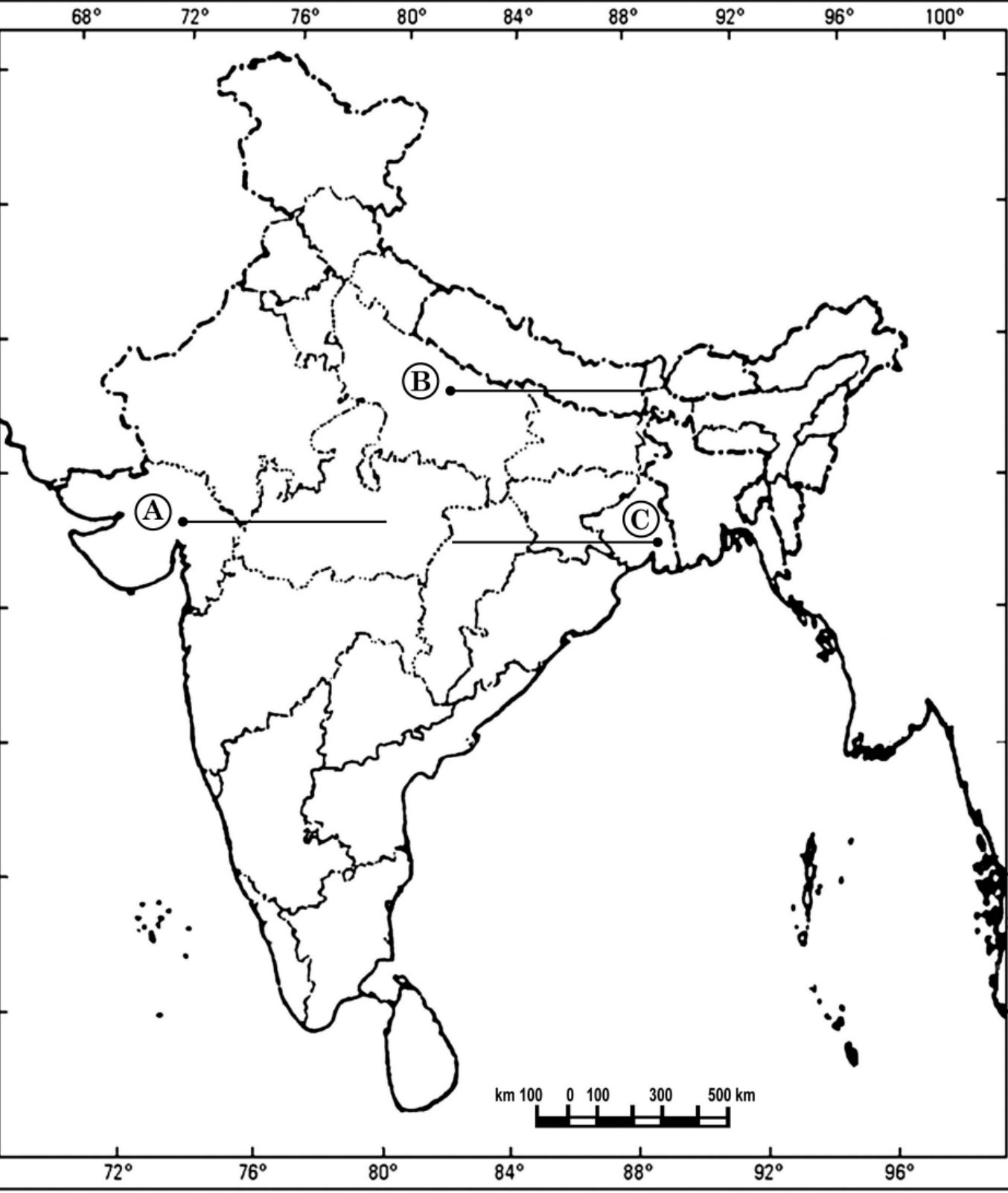
(B) The place related to the calling off the Non-Cooperation Movement.
(C) The place where the Indian National Congress Session was held.
On the given political outline map of India, locate and label: A. Oil Field – Digboi; B. Iron and Steel Plant – Bhilai; C. Major Sea Port – Kochi.
Solutions: CBSE 2016 · 32/1 · Set 1
Duke Metternich, the Austrian Chancellor (in the context of the July Revolution of 1830 in France, which sparked an uprising in Brussels).
Cattle dung is valuable manure: burning it as fuel deprives the fields of the most valuable organic manure. It can be used instead in biogas plants, which give clean fuel and also enriched manure.
India has great social and geographical diversity; such diversity cannot be easily absorbed by two or even three parties, so a multi-party system allows a variety of interests and opinions to enjoy political representation.
To reduce their cost of production and earn greater profits; they also look for regions close to markets, with skilled labour and favourable government policies.
To ensure that banks maintain a minimum cash balance and that they give loans not only to profit-making businesses and traders but also to small cultivators, small-scale industries and small borrowers, at fair rates of interest; the RBI does this supervision.
1. The Ho Chi Minh Trail was an immense network of footpaths and roads used to transport men and materials from the north to the south of Vietnam; it had support and medical camps along the way.
2. Most of it lay in neighbouring Laos and Cambodia, with branch lines extending into South Vietnam; supplies were transported mostly by porters, mostly women, who carried about 25 kg on their backs or about 70 kg on their bicycles.
3. The US regularly bombed the trail to disrupt supplies, but efforts to destroy this important supply line by intensive bombing failed because it was rebuilt very quickly. It became a symbol of how the Vietnamese used limited resources to great advantage.
1. For plantation workers in Assam, freedom meant the right to move freely in and out of the confined space in which they were enclosed, and retaining a link with the village from which they had come.
2. Under the Inland Emigration Act of 1859, plantation workers were not permitted to leave the tea gardens without permission, and in fact they were rarely given such permission.
3. When they heard of the Non-Cooperation Movement, thousands of workers defied the authorities, left the plantations and headed home; they believed that Gandhi Raj was coming and everyone would be given land in their own villages. They never reached their destination, as they were stranded on the way by a railway and steamer strike, caught by the police and brutally beaten up.
1. Promote energy conservation: use public transport instead of individual vehicles, switch off electricity when not in use, use power-saving devices (LED bulbs, star-rated appliances) and check power leakages.
2. Increase the use of renewable energy: solar, wind, tidal, geothermal energy and biogas, which are clean, inexhaustible and cause less pollution.
3. Use energy efficiently: use efficient technology in industry and transport, and develop nuclear energy as an alternative. Energy saved is energy produced.
A regional (state) party is a party that is present in only some states and has a significant influence on the politics of one or a few states.
Conditions (Election Commission):
1. A party that secures at least 6% of the total votes in an election to the Legislative Assembly of a state,
2. and wins at least two seats,
3. is recognised as a state party. Examples: Biju Janata Dal, Sikkim Democratic Front, Mizo National Front.
1. Lack of internal democracy: power is concentrated in one or a few top leaders; parties do not keep membership registers or hold organisational meetings and internal elections regularly.
2. Dynastic succession: in many parties, top positions are always controlled by members of one family, which is unfair to other members and bad for democracy.
3. Growing role of money and muscle power: parties nominate candidates who can raise lots of money; rich people and companies who give funds influence policies, and parties sometimes support criminals who can win elections. (Also: lack of meaningful choice to voters, as parties' policies have become similar.)
1. After independence, the government felt it was necessary to protect producers within the country from foreign competition; industries were just coming up in the 1950s and 1960s.
2. Competition from imports at that stage would not have allowed these industries to grow, so India allowed imports of only essential items such as machinery, fertilisers and petroleum.
3. Barriers (taxes on imports, limits on quantity) helped build domestic industry, save foreign exchange and achieve self-reliance; this policy continued until about 1991.
1. Napoleon destroyed democracy by returning France to monarchy, but the Civil Code of 1804, the Napoleonic Code, did away with all privileges based on birth.
2. It established equality before the law and secured the right to property.
3. The Code was exported to regions under French control; in the Dutch Republic, Switzerland, Italy and Germany, he simplified administrative divisions, abolished the feudal system and freed peasants from serfdom and manorial dues.
4. In towns, guild restrictions were removed; transport and communication systems were improved.
5. Peasants, artisans, workers and new businessmen enjoyed a new-found freedom; businessmen and small producers realised that uniform laws, standardised weights and measures and a common national currency would facilitate the movement and exchange of goods and capital from one region to another.
1. The movement had turned violent in many places: in April 1930 after the arrest of Abdul Ghaffar Khan, crowds clashed with armoured cars and police firing in Peshawar; after Gandhiji's arrest, industrial workers in Sholapur attacked police posts, municipal buildings, law courts and railway stations.
2. The government responded with brutal repression: peaceful satyagrahis were attacked, women and children were beaten, and about 100,000 people were arrested.
3. In this situation, Gandhiji decided to call off the movement and entered into a pact with Irwin on 5 March 1931 (Gandhi–Irwin Pact).
4. By this pact, Gandhiji consented to participate in the Round Table Conference in London, and the government agreed to release the political prisoners.
5. When the conference failed and he returned disappointed, the movement was relaunched, but by 1934 it had lost its momentum (and Gandhiji withdrew it).
1. Construction cost of roads is much lower than that of railway lines.
2. Roads can traverse comparatively more dissected and undulating topography and can negotiate high gradients of slopes; they can reach the mountains such as the Himalayas.
3. Road transport is economical in transporting few persons and relatively smaller amounts of goods over short distances.
4. It provides door-to-door service, so the cost of loading and unloading is much lower.
5. Road transport is also used as a feeder to other modes of transport, providing a link between railway stations, air and sea ports.
1. Without political parties, every candidate in the elections would be independent, so no one would be able to make any promises to the people about any major policy changes.
2. The government might be formed, but its utility would remain ever uncertain: elected representatives would be accountable to their constituencies for what they do in the locality, but no one would be responsible for how the country will be run.
3. The role of the opposition would be absent; the non-party panchayat elections show this, where groups still form.
4. As societies became large and complex, they needed some agency to gather different views on various issues and to present these to the government; parties bring various representatives together so that a responsible government can be formed.
5. Parties provide a mechanism to support or restrain the government, make policies, justify or oppose them; that is why almost every country of the world has political parties, and the rise of political parties is directly linked to the emergence of representative democracies.
1. Greater competition among producers has benefited consumers, particularly the well-off in urban areas: they have greater choice, better quality and lower prices, and enjoy higher standards of living.
2. MNCs have increased their investments in India in industries such as cell phones, automobiles, electronics, soft drinks and fast food, and in services such as banking; new jobs have been created.
3. Local companies supplying raw materials to these industries have prospered; top Indian companies like Tata Motors, Infosys, Ranbaxy and Asian Paints have become multinationals themselves.
4. Globalisation has created new opportunities for companies providing services, particularly IT (data entry, accounting, call centres).
5. However, many small producers (batteries, capacitors, plastics, toys, tyres, dairy products and vegetable oil) were hit hard by competition and many units shut down, rendering workers jobless; workers' jobs have also become less secure.
B – Chauri Chaura, Gorakhpur district, Uttar Pradesh (February 1922).
A. Digboi: north-eastern Assam.
B. Bhilai: Durg district, Chhattisgarh.
C. Kochi: Kerala coast (west coast).
Get every solution for all 17 papers
- Every board question of every chapter, each fully solved the way the board gives marks
- 17 complete board papers, each followed by its solutions
- Weightage and most-asked topics for every chapter
- Instant PDF download, colour and black & white print copies
Revising the chapter first? Complete Social Science Notes for Class 10 (NCERT 2026-27) →
What you get in the pack
- Questions from 126 CBSE papers, 2016 to 2026: every set code available
- Complete: 2341 different questions and parts from all set codes, 20 chapters and 17 full papers
- Part A: all 20 chapters of History, Geography, Pol Science and Economics, sorted by marks
- Year-wise weightage table and most-asked topics for every chapter
- Part B: 17 full board papers, each followed by its complete answers, for timed practice
- Answers written to the marking-scheme points; map questions with the paper's map and every place named
- Questions on topics outside the 2026-27 board exam flagged; only the current syllabus in Part A
All chapters in this pack
- PYQ History 1 The Rise of Nationalism in Europe
- PYQ History 2 Nationalism in India
- PYQ History 3 The Making of a Global World
- PYQ History 5 Print Culture and the Modern World
- PYQ Geography 1 Resources and Development
- PYQ Geography 2 Forest and Wildlife Resources
- PYQ Geography 3 Water Resources
- PYQ Geography 4 Agriculture
- PYQ Geography 5 Minerals and Energy Resources
- PYQ Geography 6 Manufacturing Industries
- PYQ Geography 7 Lifelines of National Economy (Map)
- PYQ Pol Science 1 Power-sharing
- PYQ Pol Science 2 Federalism
- PYQ Pol Science 3 Gender, Religion and Caste
- PYQ Pol Science 4 Political Parties
- PYQ Pol Science 5 Outcomes of Democracy
- PYQ Economics 1 Development
- PYQ Economics 2 Sectors of the Indian Economy
- PYQ Economics 3 Money and Credit
- PYQ Economics 4 Globalisation and the Indian Economy
- Board Paper 2026 Set 32-4-1 with Solutions
- Board Paper 2026 Set 32-5-1 with Solutions
- Board Paper 2025 Set 32-1-1 with Solutions
- Board Paper 2025 Set 32-2-1 with Solutions
- Board Paper 2024 Set 32-2-1 with Solutions
- Board Paper 2024 Set 32-4-1 with Solutions
- Board Paper 2023 Set 32-2-1 with Solutions
- Board Paper 2023 Set 32-4-1 with Solutions
- Board Paper 2022 Term 2 Set 32-1-1 with Solutions
- Board Paper 2022 Term 2 Set 32-3-1 with Solutions
- Board Paper 2020 Set 32-1-1 with Solutions
- Board Paper 2020 Set 32-4-1 with Solutions
- Board Paper 2019 Set 32-2-1 with Solutions
- Board Paper 2019 Set 32-4-1 with Solutions
- Board Paper 2018 Set 32-1 with Solutions
- Board Paper 2017 Set 32-1 with Solutions
- Board Paper 2016 Set 32-1 with Solutions