
Arithmetic Progressions: Class 10 PYQs 2016–2026 with solutions
All 55 CBSE board questions asked from Arithmetic Progressions in 17 board papers, with the year, set and marks of each. 29 are solved free below. The Class 10 Maths PYQ Book: Solved Board Papers 2016-2026 (CBSE) has every solution, all chapters and 17 full board papers.
Subject expert: Dharmendra Kumar, B.Sc., M.Sc. Mathematics, B.Ed. · 5+ years teaching

Free: NCERT solutions for Class 10 Maths →
Arithmetic Progressions: board weightage
Board weightage 2016–2026
| Year | 2016 | 2017 | 2018 | 2019 | 2020 | 2022 | 2023 | 2024 | 2025 | 2026 |
|---|---|---|---|---|---|---|---|---|---|---|
| Questions | 4 | 4 | 3 | 7 | 11 | 5 | 5 | 6 | 5 | 5 |
| Marks | 10 | 10 | 7 | 18 | 21 | 12 | 13 | 13 | 10 | 12 |
Most asked topics
55 questions from 17 papers. Repeated questions are shown once with every year they were asked.
Jump to: 1 mark2 marks3 marks4 marks5 marks
1 mark: MCQ and Assertion–Reason
The term of an A.P. is . Its common difference is
Solution
Answer: (A)
. (When is linear in , the coefficient of is .)
If represents term of the A.P. then value of is
Solution
Answer: (C) 5
. .
If the sum of first terms of an AP is , then its second term is:
Solution
Answer: (B) 9
, . .
The term of the AP is:
Solution
Answer: (A)
. .
Assertion (A): Common difference of the AP: is 4.
Reason (R): Common difference of the AP: is obtained by .
Solution
Answer: (D)
, not 4, so A is false. R correctly gives the rule for .
The common difference of an A.P. in which , is
Solution
Answer: (A) 12
.
Which term of the A.P. is 16?
Solution
Answer: (B)
, . .
Three numbers in A.P. have the sum 30. What is its middle term?
Solution
Answer: (B) 10
.
The next term of the A.P.: is:
Solution
Answer: (b)
The terms are , so and the next term is .
Assertion (A): are in A.P. if and only if .
Reason (R): The sum of first odd natural numbers is .
Solution
Answer: (b)
A is true: . R is true: . But R has nothing to do with A.
The value of for which , and are the three consecutive terms of an AP, is
The first term of an AP is and the common difference is , then its term is
The common difference of an AP, whose term is , is
The value of for which , 10 and are three consecutive terms of an AP is
The number of terms of an AP is
Find the common difference of the Arithmetic Progression (A.P.)
If in an A.P., , and , then find the value of .
In an AP, if the common difference , and the seventh term is 4, then find the first term.
What is the common difference of an A.P. in which ?
For what value of will , and are the consecutive terms of an A.P.?
2 marks: very short answer
Find the sum of first 30 terms of AP:
Solution
, , .
In an AP if , then find the AP.
Solution
. , so . , so . .
The AP is
Find the sum of first 20 terms of an AP in which and .
Solution
.
.
For what value of '', are the terms of the APs: and the same?
Solution
.
(Both 7th terms equal .)
Show that , and are in AP.
Solution
The differences are equal, so the three terms are in AP (common difference ).
Find the term from the last term (towards the first term) of the AP .
Solution
Reading backwards from , the AP has first term and common difference .
term from the end .
Solve the equation:
If , the sum of the first terms of an A.P. is given by , then find its term.
If the term of an A.P. exceeds its term by 7, find the common difference.
Find the sum of first 8 multiples of 3.
Which term of the progression is the first negative term?
The term of an A.P. is zero. Prove that the term of the A.P. is three times its term.
3 marks: short answer
In an A.P., term exceeds the term by 21. If sum of first 10 terms is 55, then form the A.P.
Solution
.
.
The A.P. is
The sum of first terms of an A.P. is . Find its term and hence term.
Solution
:
.
(Check: ✓)
A sum of ₹ 2,000 is invested at 7% per annum simple interest. Calculate the interests at the end of , and year. Do these interests form an AP? If so, find the interest at the end of the year.
Solution
Interest for one year .
Interest at the end of year 1, 2, 3: ₹ 140, ₹ 280, ₹ 420.
, a constant difference, so they form an AP with , .
.
If the sum of first terms of an A.P. is same as sum of its first terms , then show that the sum of its first terms is zero.
Solution
:
Since , divide by : .
In an A.P., the sum of three consecutive terms is 24 and the sum of their squares is 194. Find the numbers.
Solution
Let the terms be , , . Sum .
The numbers are 7, 8, 9 (or 9, 8, 7).
How many terms are there in an A.P. whose first and fifth terms are and 2, respectively and the last term is 62.
Solution
, .
.
There are 20 terms.
Which term of the A.P.: is the first negative term?
Find , and if it is given that the numbers are in AP.
If times the term of an AP is equal to times its term, show that the term of the AP is zero.
The first term of an A.P. is 5, the last term is 45 and the sum of all its terms is 400. Find the number of terms and the common difference of the A.P.
If the ratio of the sum of first terms of two A.P's is , find the ratio of their terms.
4 marks: case-based / source-based
'Kolam' is a decorative art which is made with rice flour in South Indian States. It is drawn on grid pattern of dots. One such art work is shown below.
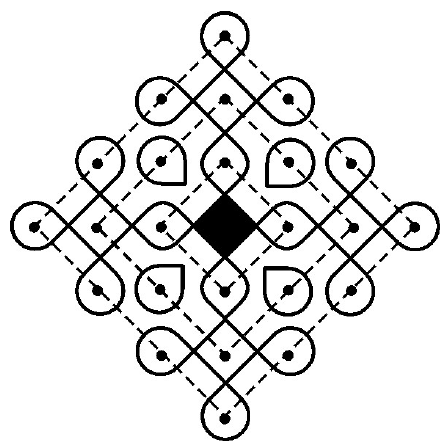
Observe the given figure carefully. There are 4 dots in first square, 8 dots in second square, 12 dots in third square and so on.
(i) Show that number of dots given above form an A.P. Write the first term and common difference. (1)
(ii) Write term of the A.P. formed. (1)
(iii) (a) The pattern is expanded on a large ground. If total 220 dots are used, then find the number of squares formed. (2)
OR
(iii) (b) Is it possible to complete number of squares using 100 dots? If yes, then find the value of . (2)
Solution
(i) Dots: 4, 8, 12, ... Here , a constant difference, so they form an A.P. with , .
(ii) .
(iii)(a) : .
( rejected). 10 squares are formed.
(iii)(b) : .
is not a whole number, so is not a natural number. No, it is not possible to complete squares using exactly 100 dots.
A school is organizing a charity run to raise funds for a local hospital. The run is planned as a series of rounds around a track, with each round being 300 metres. To make the event more challenging and engaging, the organizers decide to increase the distance of each subsequent round by 50 metres. For example, the second round will be 350 metres, the third round will be 400 metres and so on. The total number of rounds planned is 10.

(i) Write the fourth, fifth and sixth term of the Arithmetic Progression so formed. (1)
(ii) Determine the distance of the round. (1)
(iii) (a) Find the total distance run after completing all 10 rounds. (2)
OR
(iii) (b) If a runner completes only the first 6 rounds, what is the total distance run by the runner? (2)
Solution
m, m.
(i) m, m, m.
(ii) m.
(iii)(a) m.
(iii)(b) m.
Treasure Hunt is an exciting and adventurous game where participants follow a series of clues/numbers/maps to discover hidden treasures. While playing a treasure hunt game, some clues (numbers) are hidden in various spots collectively forming an A.P. If the number on the spot is , then answer the following questions to help the players in spotting the clues:
(i) Which number is on first spot? (1)
(ii) (a) Which spot is numbered as 112? (2)
OR
(ii) (b) What is the sum of all the numbers on the first 10 spots? (2)
(iii) Which number is on the spot? (1)
Solution
, so .
(i) .
(ii)(a) . The 23rd spot.
(ii)(b) . .
(iii) .
In Mathematics, relations can be expressed in various ways. The matchstick patterns are based on linear relations. Different strategies can be used to calculate the number of matchsticks used in different figures. One such pattern is shown below. Observe the pattern and answer the following questions using Arithmetic Progression:
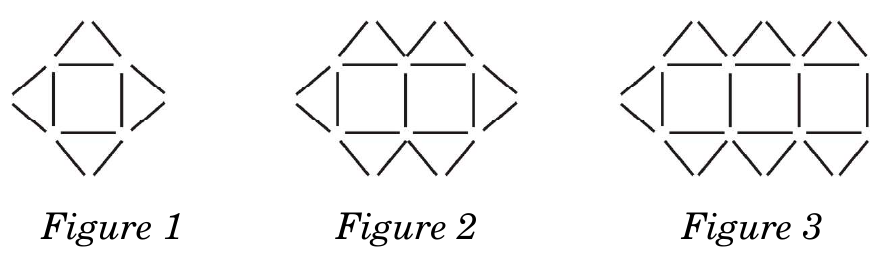
(a) Write the AP for the number of triangles used in the figures. Also, write the term of this AP. (2)
(b) Which figure has 61 matchsticks? (2)
Solution
(a) Figure 1 has 4 triangles (one on each side of the square); each new square adds one triangle above and one below. Triangles: , an AP with , .
.
(b) Matchsticks: Figure 1 uses . Each further figure adds 3 sticks for the new square and 4 for the two new triangles, i.e. 7 more:
. Figure 8 has 61 matchsticks.
The sum of four consecutive numbers in AP is 32 and the ratio of the product of the first and last terms to the product of two middle terms is 7 : 15. Find the numbers.
OR
Solve:
Solution
Let the numbers be . Sum .
The numbers are 2, 6, 10, 14 (or in reverse order).
OR: , , : .
. So .
Which term of the Arithmetic Progression will be ? Is any term of the A.P.? Give reason for your answer.
Solution
, . . The 16th term is .
For : , so , not a natural number. No, is not a term.
How many terms of the Arithmetic Progression must be taken so that their sum is 180? Explain the double answer.
If the sum of the first terms of an A.P. is and the sum of the first terms is ; then show that the sum of the first terms is .
The sum of four consecutive numbers in an AP is 32 and the ratio of the product of the first and the last term to the product of two middle terms is 7 : 15. Find the numbers.
If the ratio of the sum of the first terms of two A.Ps is , then find the ratio of their terms.
The houses in a row are numbered consecutively from 1 to 49. Show that there exists a value of X such that sum of numbers of houses preceding the house numbered X is equal to sum of the numbers of houses following X.
5 marks: long answer
How many terms of the arithmetic progression must be taken so that their sum is 180? Explain the double answer.
Solution
, , :
Explanation: the terms are 45, 39, 33, 27, 21, 15, 9, 3, −3, −9, ... The 7th to 10th terms are 9, 3, −3, −9, whose sum is 0. So adding them to the first 6 terms does not change the sum: .
Get every solution for all chapters
- Every board question of every chapter, each fully solved the way the board gives marks
- 17 complete board papers, each followed by its solutions
- Weightage and most-asked topics for every chapter
- Instant PDF download, colour and black & white print copies
Revising the chapter first? Complete Maths Notes for Class 10 (NCERT 2026-27) →
What you get in the pack
- Questions from 124 CBSE Maths Standard papers, 2016 to 2026: every set code available
- Complete: 2219 different questions and parts from all set codes, 14 chapters and 17 full papers
- Part A: all 14 chapters, questions sorted chapter-wise and by marks
- Year-wise weightage table and most-asked topics for every chapter
- Part B: 17 full board papers, each followed by its complete solutions, for timed practice
- Every step shown the way the board awards marks, with neat graphs and figures
- Questions on topics out of the board syllabus flagged
All chapters in this pack
- PYQ Ch 1 Real Numbers
- PYQ Ch 2 Polynomials
- PYQ Ch 3 Pair of Linear Equations in Two Variables
- PYQ Ch 4 Quadratic Equations
- PYQ Ch 5 Arithmetic Progressions
- PYQ Ch 6 Triangles
- PYQ Ch 7 Coordinate Geometry
- PYQ Ch 8 Introduction to Trigonometry
- PYQ Ch 9 Some Applications of Trigonometry
- PYQ Ch 10 Circles
- PYQ Ch 11 Areas Related to Circles
- PYQ Ch 12 Surface Areas and Volumes
- PYQ Ch 13 Statistics
- PYQ Ch 14 Probability
- Board Paper 2026 Set 30-4-1 with Solutions
- Board Paper 2026 Set 30-5-1 with Solutions
- Board Paper 2025 Set 30-1-1 with Solutions
- Board Paper 2025 Set 30-2-1 with Solutions
- Board Paper 2024 Set 30-2-1 with Solutions
- Board Paper 2024 Set 30-4-1 with Solutions
- Board Paper 2023 Set 30-2-1 with Solutions
- Board Paper 2023 Set 30-4-1 with Solutions
- Board Paper 2022 Term 2 Set 30-1-1 with Solutions
- Board Paper 2022 Term 2 Set 30-3-1 with Solutions
- Board Paper 2020 Set 30-1-1 with Solutions
- Board Paper 2020 Set 30-3-1 with Solutions
- Board Paper 2019 Set 30-2-1 with Solutions
- Board Paper 2019 Set 30-5-1 with Solutions
- Board Paper 2018 Set 30-1 with Solutions
- Board Paper 2017 with Solutions
- Board Paper 2016 Set 30-1 with Solutions