
Probability: Class 10 PYQs 2016–2026 with solutions
All 43 CBSE board questions asked from Probability in 15 board papers, with the year, set and marks of each. 23 are solved free below. The Class 10 Maths PYQ Book: Solved Board Papers 2016-2026 (CBSE) has every solution, all chapters and 17 full board papers.
Subject expert: Dharmendra Kumar, B.Sc., M.Sc. Mathematics, B.Ed. · 5+ years teaching

Free: NCERT solutions for Class 10 Maths →
Probability: board weightage
Board weightage 2016–2026
| Year | 2016 | 2017 | 2018 | 2019 | 2020 | 2022 | 2023 | 2024 | 2025 | 2026 |
|---|---|---|---|---|---|---|---|---|---|---|
| Questions | 3 | 3 | 2 | 3 | 5 | – | 7 | 7 | 6 | 7 |
| Marks | 8 | 8 | 4 | 6 | 7 | – | 11 | 14 | 11 | 10 |
Most asked topics
43 questions from 15 papers. Repeated questions are shown once with every year they were asked.
Jump to: 1 mark2 marks3 marks4 marks
1 mark: MCQ and Assertion–Reason
Two different dice are rolled together. The probability that both the obtained numbers are less than 4, is
Solution
Answer: (C)
Total outcomes = 36. Each die must show 1, 2 or 3: outcomes. .
Assertion (A): If probability of happening of an event is , , then can't be more than 5.
Reason (R): for an event E.
Solution
Answer: (B)
A is true: . R is also true, but A follows from the fact that a probability cannot exceed 1, not from the complement rule. So R does not explain A.
Which of the following can not be the probability of an event?
Solution
Answer: (C)
, and a probability always lies between 0 and 1.
A card is drawn at random from a well shuffled deck of 52 playing cards. The probability that it is either a ten or a king is
Solution
Answer: (B)
There are 4 tens and 4 kings: .
Meena calculates that the probability of her winning the first prize in a lottery is 0.08. If total 800 tickets were sold, the number of tickets bought by her, is
Solution
Answer: (A) 64
her tickets .
A card is selected at random from a deck of 52 playing cards. The probability of it being a red face card is:
Solution
Answer: (D)
Red face cards: J, Q, K of hearts and of diamonds = 6. .
Assertion (A): The probability of selecting a number at random from the numbers 1 to 20 is 1.
Reason (R): For any event E, if , then E is called a sure event.
Solution
Answer: (A)
Whatever number is picked, it is one of the numbers 1 to 20, so this event is certain and its probability is . R correctly states that an event with probability 1 is a sure event, which is exactly why A holds.
The probability of drawing an even prime number out of numbers from 1 to 30 is:
Solution
Answer: (A)
The only even prime is 2. .
In a cricket match, a batsman hits the boundary 7 times out of the 42 balls he plays. The probability of his not hitting a boundary is:
Solution
Answer: (C)
Balls without a boundary . .
Two dice are rolled together. The probability of getting the sum of the two numbers to be more than 10, is
Solution
Answer: (D)
Sum 11: (5, 6), (6, 5); sum 12: (6, 6). 3 outcomes out of 36. .
A box contains cards numbered 6 to 55. A card is drawn at random from the box. The probability that the drawn card has a number which is a perfect square, is
Solution
Answer: (C)
Cards: . Perfect squares: 9, 16, 25, 36, 49, that is 5 cards. .
Two dice are tossed simultaneously. The probability of getting odd numbers on both the dice is:
Solution
Answer: (D)
Each die must show 1, 3 or 5: outcomes out of 36.
For an event E, if , then the value of is:
A bag contains 100 cards numbered 1 to 100. A card is drawn at random from the bag. What is the probability that the number on the card is a perfect cube?
If three coins are tossed simultaneously, what is the probability of getting at most one tail?
Two dice are thrown together. The probability of getting the difference of numbers on their upper faces equals to 3 is:
A card is drawn at random from a well-shuffled pack of 52 cards. The probability that the card drawn is not an ace is:
Assertion (A): The probability that a leap year has 53 Sundays is .
Reason (R): The probability that a non-leap year has 53 Sundays is .
A letter of English alphabet is chosen at random. What is the probability that the chosen letter is a consonant.
A die is thrown once. What is the probability of getting a number less than 3?
OR
If the probability of winning a game is 0.07, what is the probability of losing it?
The probability that it will rain tomorrow is 0.85. What is the probability that it will not rain tomorrow?
The probability of selecting a rotten apple randomly from a heap of 900 apples is 0.18. What is the number of rotten apples in the heap?
A card is drawn at random from a well shuffled pack of 52 playing cards. Find the probability of getting neither a red card nor a queen.
2 marks: very short answer
A bag contains 25 balls. Some of them are yellow and others are green. One ball is drawn at random. If probability of getting a green ball is , then find the number of yellow balls.
Solution
Number of green balls .
Number of yellow balls .
If a fair coin is tossed twice, find the probability of getting 'atmost one head'.
Solution
Outcomes: HH, HT, TH, TT, total 4. At most one head: HT, TH, TT, which is 3.
.
If a number is chosen at random from the numbers . What is probability that ?
Solution
for : 5 favourable out of 7. .
Find the probability that a leap year selected at random will contain 53 Sundays and 53 Mondays.
Solution
366 days = 52 weeks + 2 days. The 2 extra days are one of 7 equally likely pairs: (Sun, Mon), (Mon, Tue), (Tue, Wed), (Wed, Thu), (Thu, Fri), (Fri, Sat), (Sat, Sun).
Only (Sun, Mon) gives 53 Sundays and 53 Mondays. .
The probability of selecting a blue marble at random from a jar that contains only blue, black and green marbles is . The probability of selecting a black marble at random from the same jar is . If the jar contains 11 green marbles, find the total number of marbles in the jar.
Solution
.
If there are marbles, .
A child has a die whose 6 faces show the letters given below: A B C A A B. The die is thrown once. What is the probability of getting (i) A (ii) B?
Cards marked with numbers 5 to 50 (one number on one card) are placed in a box and mixed thoroughly. One card is drawn at random from the box. Find the probability that the number on the card taken out is (i) a prime number less than 10, (ii) a number which is a perfect square.
Two different dice are tossed together. Find the probability: (i) of getting a doublet (ii) of getting a sum 10, of the numbers on the two dice.
An integer is chosen at random between 1 and 100. Find the probability that it is: (i) divisible by 8. (ii) not divisible by 8.
3 marks: short answer
A bag contains 30 balls out of which '' number of balls are blue in colour.
(i) Find the probability that a ball drawn at random from the bag is not blue.
(ii) If 6 more blue balls are added in the bag, then the probability of drawing a blue ball will be times the probability of drawing a blue ball in the first case. Find the value of .
Solution
(i)
(ii) Now there are 36 balls of which are blue.
Two dice are thrown at the same time. Determine the probability that the difference of the numbers on the two dice is 2.
Solution
Total outcomes = 36. Pairs with difference 2:
(1, 3), (3, 1), (2, 4), (4, 2), (3, 5), (5, 3), (4, 6), (6, 4): 8 outcomes.
.
Three coins are tossed simultaneously. What is the probability of getting (i) at least one head? (ii) exactly two tails? (iii) at most one tail?
Solution
Outcomes: HHH, HHT, HTH, THH, HTT, THT, TTH, TTT, total 8.
(i) At least one head: all except TTT, so 7. .
(ii) Exactly two tails: HTT, THT, TTH, so 3. .
(iii) At most one tail: HHH, HHT, HTH, THH, so 4. .
A box contains 90 discs which are numbered 1 to 90. If one disc is drawn at random from the box, find the probability that it bears a: (i) 2-digit number less than 40. (ii) number divisible by 5 and greater than 50. (iii) a perfect square number.
A bag contains 15 white and some black balls. If the probability of drawing a black ball from the bag is thrice that of drawing a white ball, find the number of black balls in the bag.
Three different coins are tossed together. Find the probability of getting (i) exactly two heads (ii) at least two heads (iii) at least two tails.
4 marks: case-based / source-based
Rahul is a lucky charm for his cricket team. He has a jar of cards with numbers from 10 to 74. Before each match, he draws a card from the jar. If the card bears an even number, the team wins. If the number is even and divisible by 5, they win by a big margin. If the number is an odd number less than 30, they win by a small margin. And if the number is a prime number between 50 and 74, they lose. Answer the following questions if Rahul draws a card today:
(i) What is the probability that Rahul draws a card with an even number? (1)
(ii) What is the probability that Rahul draws a card with an odd number less than 30? (1)
(iii) (a) What is the probability that Rahul draws a card with a prime number between 50 and 74? (2)
OR
(iii) (b) What is the probability that Rahul draws a card with an even number divisible by 5? (2)
Solution
Cards 10 to 74: total .
(i) Even numbers 10, 12, ..., 74: . .
(ii) Odd numbers less than 30: 11, 13, ..., 29, that is 10 numbers. .
(iii)(a) Primes between 50 and 74: 53, 59, 61, 67, 71, 73, that is 6 numbers. .
(iii)(b) Even and divisible by 5 means multiples of 10: 10, 20, ..., 70, that is 7 numbers. .
In a survey on holidays, 120 people were asked to state which type of transport they used on their last holiday. The following pie chart shows the results of the survey.
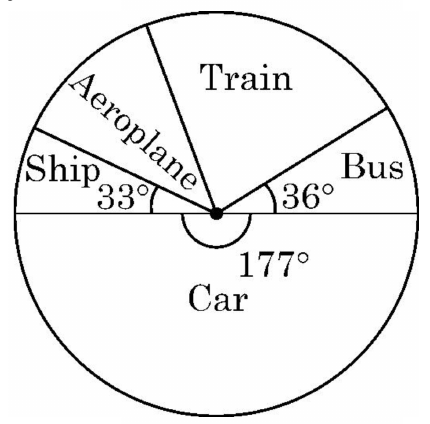
(i) If one person is selected at random, find the probability that he/she travelled by bus or ship. (1)
(ii) Which is most favourite mode of transport and how many people used it? (1)
(iii) (a) A person is selected at random. If the probability that he did not use train is 4/5, find the number of people who used train. (2)
OR
(iii) (b) The probability that randomly selected person used aeroplane is 7/60. Find the revenue collected by air company at the rate of ₹ 5,000 per person. (2)
Solution
Each degree of the pie stands for person.
(i) Bus , ship . .
(ii) Car (largest sector, ): people.
(iii)(a) . People who used train .
(iii)(b) People who used aeroplane . Revenue ₹ 70,000.
Computer-based learning (CBL) refers to any teaching methodology that makes use of computers for information transmission. A survey was done on 1000 elementary and secondary schools of Assam and they were classified by the number of computers they had.
| Number of Computers | 1–10 | 11–20 | 21–50 | 51–100 | 101 and more |
|---|---|---|---|---|---|
| Number of Schools | 250 | 200 | 290 | 180 | 80 |
One school is chosen at random. Then:
(i) Find the probability that the school chosen at random has more than 100 computers. (1)
(ii) (a) Find the probability that the school chosen at random has 50 or fewer computers. (2)
OR
(ii) (b) Find the probability that the school chosen at random has no more than 20 computers. (2)
(iii) Find the probability that the school chosen at random has 10 or less than 10 computers. (1)
Solution
Total schools = 1000.
(i) .
(ii)(a) 50 or fewer: . .
(ii)(b) No more than 20: . .
(iii) 10 or fewer: 250. .
Two different dice are thrown together. Find the probability that the numbers obtained have (i) even sum, and (ii) even product.
A number is selected at random from the numbers 1, 2, 3 and 4. Another number is selected at random from the numbers 1, 4, 9 and 16. Find the probability that product of and is less than 16.
Get every solution for all chapters
- Every board question of every chapter, each fully solved the way the board gives marks
- 17 complete board papers, each followed by its solutions
- Weightage and most-asked topics for every chapter
- Instant PDF download, colour and black & white print copies
Revising the chapter first? Complete Maths Notes for Class 10 (NCERT 2026-27) →
What you get in the pack
- Questions from 124 CBSE Maths Standard papers, 2016 to 2026: every set code available
- Complete: 2219 different questions and parts from all set codes, 14 chapters and 17 full papers
- Part A: all 14 chapters, questions sorted chapter-wise and by marks
- Year-wise weightage table and most-asked topics for every chapter
- Part B: 17 full board papers, each followed by its complete solutions, for timed practice
- Every step shown the way the board awards marks, with neat graphs and figures
- Questions on topics out of the board syllabus flagged
All chapters in this pack
- PYQ Ch 1 Real Numbers
- PYQ Ch 2 Polynomials
- PYQ Ch 3 Pair of Linear Equations in Two Variables
- PYQ Ch 4 Quadratic Equations
- PYQ Ch 5 Arithmetic Progressions
- PYQ Ch 6 Triangles
- PYQ Ch 7 Coordinate Geometry
- PYQ Ch 8 Introduction to Trigonometry
- PYQ Ch 9 Some Applications of Trigonometry
- PYQ Ch 10 Circles
- PYQ Ch 11 Areas Related to Circles
- PYQ Ch 12 Surface Areas and Volumes
- PYQ Ch 13 Statistics
- PYQ Ch 14 Probability
- Board Paper 2026 Set 30-4-1 with Solutions
- Board Paper 2026 Set 30-5-1 with Solutions
- Board Paper 2025 Set 30-1-1 with Solutions
- Board Paper 2025 Set 30-2-1 with Solutions
- Board Paper 2024 Set 30-2-1 with Solutions
- Board Paper 2024 Set 30-4-1 with Solutions
- Board Paper 2023 Set 30-2-1 with Solutions
- Board Paper 2023 Set 30-4-1 with Solutions
- Board Paper 2022 Term 2 Set 30-1-1 with Solutions
- Board Paper 2022 Term 2 Set 30-3-1 with Solutions
- Board Paper 2020 Set 30-1-1 with Solutions
- Board Paper 2020 Set 30-3-1 with Solutions
- Board Paper 2019 Set 30-2-1 with Solutions
- Board Paper 2019 Set 30-5-1 with Solutions
- Board Paper 2018 Set 30-1 with Solutions
- Board Paper 2017 with Solutions
- Board Paper 2016 Set 30-1 with Solutions