
Quadratic Equations: Class 10 PYQs 2016–2026 with solutions
All 52 CBSE board questions asked from Quadratic Equations in 17 board papers, with the year, set and marks of each. 27 are solved free below. The Class 10 Maths PYQ Book: Solved Board Papers 2016-2026 (CBSE) has every solution, all chapters and 17 full board papers.
Subject expert: Dharmendra Kumar, B.Sc., M.Sc. Mathematics, B.Ed. · 5+ years teaching

Free: NCERT solutions for Class 10 Maths →
Quadratic Equations: board weightage
Board weightage 2016–2026
| Year | 2016 | 2017 | 2018 | 2019 | 2020 | 2022 | 2023 | 2024 | 2025 | 2026 |
|---|---|---|---|---|---|---|---|---|---|---|
| Questions | 4 | 4 | 4 | 7 | 4 | 6 | 5 | 6 | 5 | 7 |
| Marks | 13 | 13 | 12 | 18 | 11 | 14 | 9 | 19 | 21 | 20 |
Most asked topics
52 questions from 17 papers. Repeated questions are shown once with every year they were asked.
Jump to: 1 mark2 marks3 marks4 marks5 marks
1 mark: MCQ and Assertion–Reason
If the quadratic equation has real and equal roots, then the value of is
Solution
Answer: (A) 3 or (B) −3 (the board accepted either)
For equal roots, :
The value of for which the equation has real and equal roots, is
Solution
Answer: (C)
Equal roots: .
The value of for which roots of the quadratic equation are rational, is
Solution
Answer: (B)
Roots are rational when is a perfect square (with integer coefficients).
: ✓, roots . For or , ; for , , not a perfect square.
The quadratic equation whose roots are 7 and is:
Solution
Answer: (A)
Sum of roots , product . Equation: .
The quadratic equation has ______ roots.
Solution
Answer: (D) not-real
, so the equation has no real roots.
If the discriminant of the quadratic equation is 16, then the value of is:
Solution
Answer: (C)
.
Which of the following quadratic equations has sum of its roots as 4?
Solution
Answer: (b)
Sum of roots . For (a) the sum is 2, for (c) it is , and for (d) it is 1.
The roots of the equation are:
The value of for which is a perfect square, is
Find the nature of roots of the quadratic equation .
Find the value of for which is a solution of the equation .
Find the value/s of for which the quadratic equation has real and equal roots.
If is one root of the quadratic equation , then find the value of .
2 marks: very short answer
Verify that roots of the quadratic equation are equal when .
Solution
Here , , .
Expand: . So
When , , so the roots are equal. Verified.
Find the sum and product of the roots of the quadratic equation .
Solution
Sum of roots ; product of roots .
(Check: , roots and 4: sum , product 2 ✓)
Find the discriminant of the quadratic equation and hence comment on the nature of roots of the equation.
Solution
, , . .
, so the equation has two distinct real roots ().
Find the value of for which the quadratic equation has two real and equal roots.
Solution
Equal roots:
makes the equation non-quadratic (the term vanishes), so .
Solve the following quadratic equation for :
Solution
Product of first and last coefficients , and :
or .
The product of Rehan's age (in years) 5 years ago and his age 7 years from now, is one more than twice his present age. Find his present age.
Solve the quadratic equation for :
If the quadratic equation has equal and real roots, then prove that:
Find the value of , for which one root of the quadratic equation is 6 times the other.
If is a root of the quadratic equation and the quadratic equation has equal roots, find the value of .
3 marks: short answer
In a 2-digit number, the digit at the unit's place is 5 less than the digit at the ten's place. The product of the digits is 36. Find the number.
Solution
Let the ten's digit be ; the unit's digit is .
( is not a digit.) Unit's digit . The number is 94.
Find the value of '' for which the quadratic equation has two equal real roots.
Solution
. Equal roots: .
or .
is rejected (the equation would not be quadratic). So .
In a flight of 600 km, an aircraft was slowed due to bad weather. Its average speed for the trip was reduced by 200 km/hr and time of flight increased by 30 minutes. Find the original duration of flight.
Solution
Let the original speed be km/h.
km/h.
Original duration 1 hour.
Find the values of , for which the quadratic equation has equal roots.
Solution
.
or .
Write all the values of for which the quadratic equation has equal roots. Find the roots of the equation so obtained.
A plane left 30 minutes late than its scheduled time and in order to reach the destination 1500 km away in time, it had to increase its speed by 100 km/h from the usual speed. Find its usual speed.
If , then prove that the equation has no real roots.
Solve for : ,
4 marks: case-based / source-based
A ball is thrown in the air so that seconds after it is thrown, its height metre above its starting point is given by the polynomial .
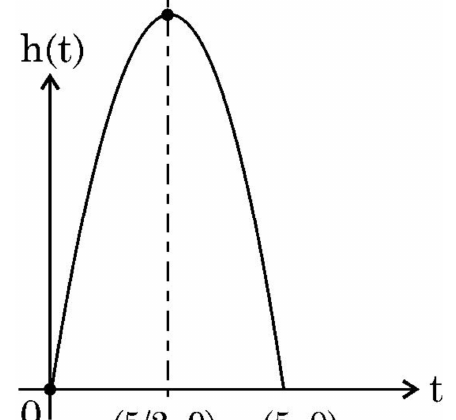
Observe the graph of the polynomial and answer the following questions:
(i) Write zeroes of the given polynomial. (1)
(ii) Find the maximum height achieved by ball. (1)
(iii) (a) After throwing upward, how much time did the ball take to reach to the height of 30 m? (2)
OR
(iii) (b) Find the two different values of when the height of the ball was 20 m. (2)
Solution
(i) or . Zeroes: 0 and 5.
(ii) The maximum is at (midway between the zeroes): m.
(iii)(a) . Going up, the ball first reaches 30 m at s (it is at 30 m again at 3 s, coming down).
(iii)(b) s and s.
In the picture given below, one can see a rectangular in-ground swimming pool installed by a family in their backyard. There is a concrete sidewalk around the pool of width m. The outside edges of the sidewalk measure 7 m and 12 m. The area of the pool is 36 sq. m.
(a) Based on the information given above, form a quadratic equation in terms of . (2)
(b) Find the width of the sidewalk around the pool. (2)
Solution
(a) The pool measures m by m:
(b) or .
is impossible (the width 7 m would become negative), so the sidewalk is 1.5 m wide.
A train covered a certain distance at a uniform speed. If the train would have been 6 km/hr. faster, it would have taken 4 hours less than the scheduled time and if the train were slower by 6 km/hr., it would have taken 6 hrs. more than the scheduled time. Find the length of the journey.
Solution
Let the speed be km/h and the distance km.
...(1)
...(2)
From (1) and (2): .
km. The journey is 720 km.
In a class test, the sum of Arun's marks in Hindi and English is 30. Had he got 2 marks more in Hindi and 3 marks less in English, the product of the marks would have been 210. Find his marks in the two subjects.
Solution
Let Hindi marks be ; English .
Either Hindi 12, English 18, or Hindi 13, English 17.
A train travels 360 km at a uniform speed. If the speed had been 5 km/hr more, it would have taken 1 hr less for the same journey. Find the speed of the train.
Solution
Speed 40 km/h.
Solve for : ; , ,
Solution
Divide by : .
or .
A motor boat whose speed is 18 km/hr in still water takes 1 hr more to go 24 km upstream than to return downstream to the same spot. Find the speed of the stream.
A train travels at a certain average speed for a distance of 63 km and then travels at a distance of 72 km at an average speed of 6 km/hr more than its original speed. If it takes 3 hours to complete total journey, what is the original average speed?
Solve for : ,
Two taps running together can fill a tank in hours. If one tap takes 3 hours more than the other to fill the tank, then how much time will each tap take to fill the tank?
Solve for : ,
A motor boat whose speed is 24 km/h in still water takes 1 hour more to go 32 km upstream than to return downstream to the same spot. Find the speed of the stream.
5 marks: long answer
A person on tour has ₹ 5,400 for his expenses. If he extends his tour by 5 days, he has to cut down his daily expenses by ₹ 180. Find the original duration of the tour and daily expense.
Solution
Let the original duration be days. Daily expense .
With days, daily expense .
Original duration = 10 days; daily expense ₹ 540.
The total cost of certain piece of cloth was ₹ 2,100. During special sale time, the shopkeeper offered 2 m extra cloth for free thus reducing the price of cloth per metre by ₹ 120. What was the original per metre price of cloth and its length?
Solution
Let the original length be m. Original price per metre ; in the sale it becomes .
Original length = 5 m; original price ₹ 420 per metre.
Venkat can row a boat in still water at the speed of 12 km/h. He ferries tourists 15 km upstream and 18 km downstream in 3 hours. Find the speed of the stream.
Solution
Let the speed of the stream be km/h. Upstream speed , downstream speed .
( rejected, speed cannot be negative). Speed of the stream = 4 km/h.
Check: h ✓
The perimeter of a right triangle is 60 cm and its hypotenuse is 25 cm. Find the lengths of other two sides of the triangle.
Solution
Let the other sides be and . Then , so .
By Pythagoras:
or .
The other two sides are 15 cm and 20 cm. (Check: ✓)
A train travels a distance of 480 km at a uniform speed. If the speed had been 8 km/h less, then it would have taken 3 hours more to cover the same distance. Find the speed of the train.
Solution
Let the speed be km/h.
Speed of the train = 40 km/h.
Check: h ✓
The sum of the areas of two squares is 52 cm² and difference of their perimeters is 8 cm. Find the lengths of the sides of the two squares.
The time taken by a person to travel an upward distance of 150 km was hours more than the time taken in the downward return journey. If he returned at a speed of 10 km/h more than the speed while going up, find the speeds in each direction.
A train travels a distance of 90 km at a constant speed. Had the speed been 15 km/h more, it would have taken 30 minutes less for the journey. Find the original speed of the train.
Find the value of '' for which the quadratic equation ; has real and equal roots.
Get every solution for all chapters
- Every board question of every chapter, each fully solved the way the board gives marks
- 17 complete board papers, each followed by its solutions
- Weightage and most-asked topics for every chapter
- Instant PDF download, colour and black & white print copies
Revising the chapter first? Complete Maths Notes for Class 10 (NCERT 2026-27) →
What you get in the pack
- Questions from 124 CBSE Maths Standard papers, 2016 to 2026: every set code available
- Complete: 2219 different questions and parts from all set codes, 14 chapters and 17 full papers
- Part A: all 14 chapters, questions sorted chapter-wise and by marks
- Year-wise weightage table and most-asked topics for every chapter
- Part B: 17 full board papers, each followed by its complete solutions, for timed practice
- Every step shown the way the board awards marks, with neat graphs and figures
- Questions on topics out of the board syllabus flagged
All chapters in this pack
- PYQ Ch 1 Real Numbers
- PYQ Ch 2 Polynomials
- PYQ Ch 3 Pair of Linear Equations in Two Variables
- PYQ Ch 4 Quadratic Equations
- PYQ Ch 5 Arithmetic Progressions
- PYQ Ch 6 Triangles
- PYQ Ch 7 Coordinate Geometry
- PYQ Ch 8 Introduction to Trigonometry
- PYQ Ch 9 Some Applications of Trigonometry
- PYQ Ch 10 Circles
- PYQ Ch 11 Areas Related to Circles
- PYQ Ch 12 Surface Areas and Volumes
- PYQ Ch 13 Statistics
- PYQ Ch 14 Probability
- Board Paper 2026 Set 30-4-1 with Solutions
- Board Paper 2026 Set 30-5-1 with Solutions
- Board Paper 2025 Set 30-1-1 with Solutions
- Board Paper 2025 Set 30-2-1 with Solutions
- Board Paper 2024 Set 30-2-1 with Solutions
- Board Paper 2024 Set 30-4-1 with Solutions
- Board Paper 2023 Set 30-2-1 with Solutions
- Board Paper 2023 Set 30-4-1 with Solutions
- Board Paper 2022 Term 2 Set 30-1-1 with Solutions
- Board Paper 2022 Term 2 Set 30-3-1 with Solutions
- Board Paper 2020 Set 30-1-1 with Solutions
- Board Paper 2020 Set 30-3-1 with Solutions
- Board Paper 2019 Set 30-2-1 with Solutions
- Board Paper 2019 Set 30-5-1 with Solutions
- Board Paper 2018 Set 30-1 with Solutions
- Board Paper 2017 with Solutions
- Board Paper 2016 Set 30-1 with Solutions