
Indian Economy 1950–1990: Class 12 PYQs 2020–2026 with solutions
All 45 CBSE board questions asked from Indian Economy 1950–1990 in 17 board papers, with the year, set and marks of each. 23 are solved free below. The Class 12 Economics PYQ Book: Solved Board Papers 2016-2026 (CBSE) has every solution, all chapters and 15 full board papers.

Indian Economy 1950–1990: board weightage
Board weightage 2020–2026
| Year | 2016 | 2017 | 2018 | 2019 | 2020 | 2022 | 2023 | 2024 | 2025 | 2026 |
|---|---|---|---|---|---|---|---|---|---|---|
| Questions | – | – | – | – | 3 | – | 3 | 14 | 16 | 9 |
| Marks | – | – | – | – | 6 | – | 6 | 44 | 50 | 33 |
Most asked topics
45 questions from 17 papers. Repeated questions are shown once with every year they were asked.
Jump to: 1 mark3 marks4 marks6 marks
1 mark: MCQ and Assertion–Reason
Which is not an advantage of the Green Revolution? (A) increased marketed surplus (B) increase in prices of food grains (C) self-sufficiency in food grains (D) creation of buffer stock
Solution
______ was set up in 1950 to formulate plans for the most effective and balanced utilisation of resources. (A) NITI Aayog (B) Planning Commission (C) Karve Committee (D) WTO
Solution
From the terms given below in Column-I and Column-II, choose the correct pair of statements: Column-I: (i) Subsidies (ii) Land ceiling (iii) Small Scale Industries (iv) Modernisation as a goal of five year plan. Column-II: (a) Maximum quantity of goods that can be imported (b) Element of IPR 1956 (c) Land to the tiller (d) Change in social outlook
Solution
Modernisation included a change in social outlook (e.g. recognising women's rights). Answer: (D)
Study the following image carefully: Identify, the trade practice that has successfully replaced foreign goods with domestic production.
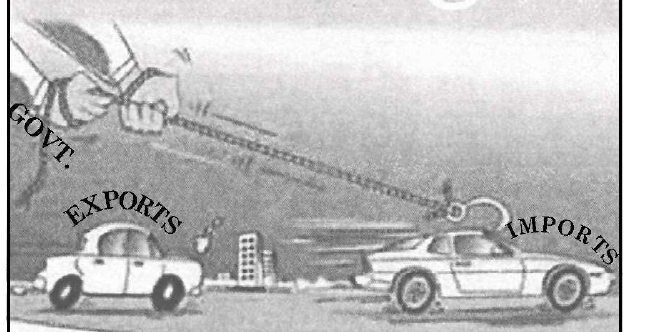
(For visually impaired candidates in lieu of Q. No. 24: _________ refers to a trade policy aimed at reducing reliance on imported goods by encouraging domestic production. (A) Export Promotion (B) Export Substitution (C) Import Substitution (D) Import Proliferation)
Solution
The government holds back imports so that domestic production replaces them. Answer: (D) (Visually impaired: (C).)
Assertion (A) : Under the land reforms, Indian government fixed the minimum land size which could be owned by an individual. Reason (R) : The purpose of land ceiling was to avoid the concentration of land ownership in a few hands.
Solution
Policy makers pushed for self-reliance for the first ______ five-year plans. (A) 8 (B) 7 (C) 6 (D) 5
Solution
Assertion (A): Excessive regulation of permit licence raj prevented certain private firms from becoming more efficient. Reason (R): The private sector wasted much time obtaining licences rather than enhancing quality and competitiveness. (A) Both true, R explains A (B) Both true, R does not explain A (C) A true, R false (D) A false, R true
Solution
Policy makers emphasised self-reliance for the first ______ five-year plans. (A) 6 (B) 7 (C) 8 (D) 9
Solution
"The Indian government adopted a policy of fixing the maximum landholding limit for an individual." It is known as ______. (A) Green Revolution (B) land ceiling (C) marketable surplus (D) Golden Revolution
Solution
Modernisation as a planning objective focuses on: (i) adoption of innovative technology (ii) positive change in social outlook (iii) equal distribution of income (iv) abolition of intermediaries. (A) (i) and (iv) (B) (i) and (iii) (C) (i), (iii) and (iv) (D) (i) and (ii)
Solution
Assertion (A): The excessive regulation of permit license raj prevented certain private firms from becoming fairly competitive. Reason (R): Private sector wasted huge amounts in obtaining licenses rather than on improving the product quality and international competitiveness.
Modernization is an important economic planning objective that focuses on ________. (Choose the correct alternative to fill in the blank) (i) Adoption of innovative technology (ii) Equal distribution of income and wealth (iii) Bringing positive changes in the social outlook
Statement 1: Land ceiling was one of the government policies to promote equity in agriculture. Statement 2: Land reforms resulted in abolition of the zamindari system after independence. (A) 1 true, 2 false (B) 1 false, 2 true (C) both true (D) both false
Assertion (A): Licence permit raj was a major obstacle for growth of the private sector. Reason (R): The private sector wasted huge amounts in obtaining licences rather than on improving the product, quality and international competitiveness. (A) Both true, R explains A (B) Both true, R does not explain A (C) A true, R false (D) A false, R true
The rationale behind choosing modernisation as a planning objective was: I. to bring positive changes in social outlook II. equitable distribution of income III. technological upgradation IV. increase in economic divide. (A) I and II (B) II and III (C) I and III (D) I and IV
Read the following statements carefully: Statement 1: The purchase of food grains made by the Government on the Minimum Support Price (MSP) is maintained as buffer stock. Statement 2: Minimum Support Price safeguards the farmers against any sharp fall in farm product prices. In light of the given statements, choose the correct alternative from the following:
Identify the incorrect statement from the following:
During India's first seven five-year plans, the Government of India adopted ________ policy to protect domestic industries. (Fill up the blank with correct answer)
First Industrial Policy Resolution of Independent India was announced in the year ________. (Fill in the blank with correct alternative)
3 marks: short answer
Critically appraise the industrial licensing policy during the planning period.
Solution
"Some economists argue that once a technology proves profitable and is widely adopted, subsidies should be gradually withdrawn." Defend or refute.
Solution
Explain the planning objective of "growth with equity".
Solution
Elaborate the reasons owing to which the private sector was regulated under the Industrial Policy Resolution, 1956.
Solution
Discuss any two salient features of the Indian industrial sector during 1950–1990.
"Farm subsidies put a huge burden on government finances, but are necessary for poor and marginal farmers." Justify.
Discuss briefly the role of small-scale industries in the growth journey of India.
"The goal of equity was fully served by abolition of intermediaries in agriculture after independence." Do you agree? Support with valid arguments.
4 marks: case-based / source-based
"In the post-independence era, India adopted a protective tariff policy." Do you agree? Justify with two arguments.
Solution
Describe briefly the rationale behind choosing 'Self-reliance' as a planning objective for the Indian economy.
Solution
• To reduce dependence on foreign countries, especially for food, by mobilising domestic resources and producing goods at home.
• It was feared that dependence on imported food, foreign technology and foreign capital would make India vulnerable to foreign interference in its policies and threaten its sovereignty.
State and explain any two steps taken by the government for the protection and promotion of small-scale industries between 1950 and 1990.
Solution
Elaborate the role of land ceiling as an institutional reform in agriculture during planning.
(a) Explain briefly the rationale behind the 'License Raj' under the Industrial Policy Resolution, 1956. (b) Define Multilateral trade.
State the meaning of import substitution. Explain how import substitution can protect the domestic industries.
6 marks: long answer
Read the following text carefully and answer the questions given below: "In India, high-yielding seed varieties were initially brought to the State of Punjab, Haryana and portions of western Uttar Pradesh." (i) Identify the approach initiated by Indian Government in 1966. (ii) State the primary goal of this approach. (iii) Describe any two impacts of this approach.
Solution
(ii) To achieve self-sufficiency in food grains.
(iii) (1) The government could procure enough food grains to build a buffer stock, used in times of shortage. (2) The relative price of food grains fell compared with other goods; this benefited low-income groups, who spend a large share of income on food. (Also: marketed surplus rose; but benefits were initially limited to some regions and to wheat, and it widened disparity between small and big farmers.)
(i) "As per a few scholars, fertiliser subsidies should now be phased out, as they have served their purpose." Do you agree? (ii) State any two ways by which the government can execute disinvestment.
Solution
(ii) (1) Withdrawal of the government from the ownership and management of public sector companies (selling part of its equity). (2) Outright sale of public sector companies.
(i) "IPR 1956 classified all industries based on state ownership and control into various categories." Do you agree? (ii) "The economic reforms of 1991 adversely affected Indian agriculture." Do you agree?
Solution
(ii) Yes. (1) Public investment in agriculture, especially infrastructure (irrigation, power, roads, markets), fell. (2) Reduction of fertiliser subsidy raised the cost of production, hurting small and marginal farmers. (3) Removal of import duties exposed farmers to international competition; a shift from food crops to export-oriented cash crops raised food grain prices.
Giving valid reasons, state whether the following statements are true or false. (i) India followed unbalanced growth during the colonial rule. (ii) The economic policies implemented in India between 1950–1990's sought to promote regional equality. (iii) India has become a favourable destination of outsourcing, in post 1991 period.
Solution
(i) True. The colonial economy stayed agrarian with hardly any capital goods industry; the new industrial sector grew slowly and contributed little to GDP, so growth was uneven.
(ii) True. Industrial licences were granted more easily for units in backward areas, which also received concessions such as tax benefits and electricity at lower tariffs, to spread industry across regions.
(iii) True. After 1991, with the IT revolution and availability of skilled manpower at low cost, MNCs began outsourcing services (call centres, software, accounting) to India.
(i) "To promote green revolution, the Indian government provided fertilizer subsidies to the farmers." Briefly explain any two arguments in favour of such subsidies. (ii) As per a news report dated, 8th Oct. 2021, the Government of India sold its entire 100% stake in Air India. Tata sons, the original founder of Air India won the bid and purchased the airline for ₹ 18,000 crore. (1) Identify the step taken by the Government of India. (2) State any two ways in which identified step can be executed by the government.
Solution
(ii) (1) Privatisation. (2) (a) Withdrawal of the government from the ownership and management of public sector companies; (b) outright sale of public sector companies (or disinvestment of part of the equity to the public).
(i) "Import substitution, if not applied carefully, can prove to be a double-edged sword." Do you agree? Justify. (ii) Distinguish between stabilisation measures and structural measures taken in 1991.
Solution
(ii) Stabilisation measures are short-term measures to correct the weaknesses that had developed in the balance of payments and to bring inflation under control (maintain enough foreign exchange reserves). Structural measures are long-term measures to improve the efficiency of the economy and raise its international competitiveness by removing rigidities in various sectors (liberalisation, privatisation, globalisation).
(i) "Import substitution, if not applied carefully, can be a double-edged sword." Do you agree? Justify. (ii) State how multilateral trade differs from bilateral trade.
(i) "Farm subsidies put a huge burden on government finances, but are necessary for poor and marginal farmers." Justify. (ii) Discuss the role of small-scale industries in generating employment and equity during the planning period.
(i) "Every coin has two sides - debate over farm subsidies is one such classic example of the same." Justify the given statement with two arguments each in favour of and against the continuation of the farm subsidies. (ii) State the importance of "Growth with equity" as the objective of Indian economic planning.
Read the following text carefully: India's industrial policy since independence has been shaped broadly in terms of the Industrial Policy Resolution of 1948. It emphasized on the sole responsibility of the government in the matter of promoting, assisting and regulating the development of industries in the national interest. It envisaged an active and dominant role of public sector. The next Industrial Policy Resolution was placed before the Parliament by the Prime Minister on 30th April, 1956. It suggested that, "There is a need for adoption of the socialist pattern of economy as the national objective, along with the need for planned and rapid development. It required that all industries of basic and strategic importance, or in public utility services, should be in the public sector. Other industries which are essential and require investment on a massive scale (which only the State could provide) have also to be in the public sector. Thus, the State has to assume direct responsibility for the future development of industries." This Resolution classifies industries into three categories: • The first category given in Schedule A, consists of industries the future development of which will be the exclusive responsibility of the State. • In the second category given in Schedule B, are industries which will be progressively State-owned. However, in them, private enterprise will also be expected to participate. • The third category comprises all the remaining industries, the further development of which will be left to the initiative and enterprise of the private sector. On the basis of the given text and common understanding, answer the following questions: (i) "The Government of India, in the initial years of economic development, emphasized on a greater role of the public sector in the industrial development." Justify the statement, giving reasons in support of your answer. (ii) Outline and discuss the classification of industries into various categories as per Industrial Policy Resolution, 1956.
(i) "Every coin has two sides: the debate over farm subsidies is one such example." Give two arguments each in favour of and against continuing farm subsidies. (ii) State the importance of "growth with equity" as an objective of Indian economic planning.
(i) Explain the need and types of land reforms implemented in the agricultural sector. (ii) "The industrial sector performed poorly in the economic reform period." Elucidate.
Get every solution for all chapters
- Every board question of every chapter, each fully solved the way the board gives marks
- 15 complete board papers, each followed by its solutions
- Weightage and most-asked topics for every chapter
- Instant PDF download, colour and black & white print copies
Revising the chapter first? Complete Economics Notes for Class 12 (NCERT 2026-27, CBSE Board 2027) →
What you get in the pack
- Questions from 129 CBSE Economics papers, 2016 to 2026: every set code available
- Complete: 1783 different questions and parts from all set codes, 14 chapters and 15 full papers
- Part A: all 14 chapters, questions sorted chapter-wise and by marks
- Year-wise weightage table and most-asked topics for every chapter
- Part B: each full board paper followed by its complete solutions
- National income, multiplier, budget and BOP numericals worked step by step
- Questions on topics out of the board syllabus flagged
All chapters in this pack
- PYQ Ch 1 Introduction to Macroeconomics
- PYQ Ch 2 National Income and Related Aggregates
- PYQ Ch 3 Money and Banking
- PYQ Ch 4 Determination of Income and Employment
- PYQ Ch 5 Government Budget and the Economy
- PYQ Ch 6 Open Economy: Balance of Payments and Exchange Rate
- PYQ Ch 7 Indian Economy on the Eve of Independence
- PYQ Ch 8 Indian Economy 1950–1990
- PYQ Ch 9 Liberalisation, Privatisation and Globalisation
- PYQ Ch 10 Human Capital Formation in India
- PYQ Ch 11 Rural Development
- PYQ Ch 12 Employment: Growth, Informalisation and Other Issues
- PYQ Ch 13 Environment and Sustainable Development
- PYQ Ch 14 Comparative Development Experiences of India and its Neighbours
- Board Paper 2026 Set 58-1-1 with Solutions
- Board Paper 2026 Set 58-1-2 with Solutions
- Board Paper 2026 Set 58-1-3 with Solutions
- Board Paper 2026 Set 58-2-1 with Solutions
- Board Paper 2025 Set 58-1-1 with Solutions
- Board Paper 2025 Set 58-2-1 with Solutions
- Board Paper 2024 Set 58-1-1 with Solutions
- Board Paper 2024 Set 58-2-1 with Solutions
- Board Paper 2023 Set 58-1-1 with Solutions
- Board Paper 2022 Term 2 Set 58-1-1 with Solutions
- Board Paper 2020 Set 58-1-1 with Solutions
- Board Paper 2019 Set 58-1-1 with Solutions
- Board Paper 2018 Set 58-1 with Solutions
- Board Paper 2017 Set 58-1 with Solutions
- Board Paper 2016 Set 58-1 with Solutions