
Human Capital Formation in India: Class 12 PYQs 2020–2026 with solutions
All 36 CBSE board questions asked from Human Capital Formation in India in 18 board papers, with the year, set and marks of each. 20 are solved free below. The Class 12 Economics PYQ Book: Solved Board Papers 2016-2026 (CBSE) has every solution, all chapters and 15 full board papers.

Human Capital Formation in India: board weightage
Board weightage 2020–2026
| Year | 2016 | 2017 | 2018 | 2019 | 2020 | 2022 | 2023 | 2024 | 2025 | 2026 |
|---|---|---|---|---|---|---|---|---|---|---|
| Questions | – | – | – | – | 1 | – | 2 | 10 | 12 | 12 |
| Marks | – | – | – | – | 3 | – | 4 | 30 | 29 | 29 |
Most asked topics
37 questions from 18 papers. Repeated questions are shown once with every year they were asked.
Jump to: 1 mark3 marks4 marks6 marks
1 mark: MCQ and Assertion–Reason
Assertion (A): Education facilitates the assimilation of knowledge and competencies. It also fosters inventive capacities and enhances the aptitude to integrate advance technology. Reason (R): Education plays a pivotal role in transforming cognitive perspectives and serves as a catalyst for the economic advancement of a nation.
Solution
Both are true, but R is a general statement on the role of education; it does not explain A. Answer: (B)
The steep Indian education pyramid indicates _________. (Choose the correct option to fill in the blank)
Solution
Education provides __________. (Choose the correct option to fill in the blank) (i) Scientific advancements (ii) Facilitate inventions and innovations (iii) Adapting to new technology
Solution
The steep Indian education pyramid indicates ______. (A) equal distribution across levels (B) increase in people reaching higher education (C) low unemployment among educated youth (D) few people reaching higher education
Solution
Assertion (A): Education is one of the important factors for economic growth. Reason (R): A healthy person could provide uninterrupted labour supply for a longer period. (A) Both true, R explains A (B) Both true, R does not explain A (C) A true, R false (D) A false, R true
Solution
In 2009, the Government of India made free education a fundamental right for children aged 6–14 through the ______. (A) Mid-Day Meal Scheme (B) Jan Dhan Yojana (C) Tapas Majumdar Committee (D) Right to Education Act
Solution
Assertion (A): Human capital formation increases the rate of participation of population to economic activities and leads to economic growth. Reason (R): Rate of participation of people refers to the percentage of people engaged in production process of a country.
Solution
Both are true; R only defines the participation rate and does not explain A. Answer: (B)
_____ is based on the idea that education and health are integral to human well-being. (Choose the correct option to fill up the blank)
Solution
Assertion (A): Information plays a crucial role in judicious decision-making about investing in human capital. Reason (R): Individuals invest to acquire information about the labour market and areas such as education and health care. (A) Both true, R explains A (B) Both true, R does not explain A (C) A true, R false (D) A false, R true
Assertion (A): People spend to acquire information related to labour and other markets (education, health). Reason (R): Expenditure on information is necessary for efficient utilisation of the human capital stock. (A) Both true, R explains A (B) Both true, R does not explain A (C) A true, R false (D) A false, R true
Which of the following is not a feature of physical capital? (i) tangibility (ii) tradability (iii) immobility. (A) (i) and (ii) (B) (ii) and (iii) (C) (i) and (iii) (D) (i), (ii) and (iii)
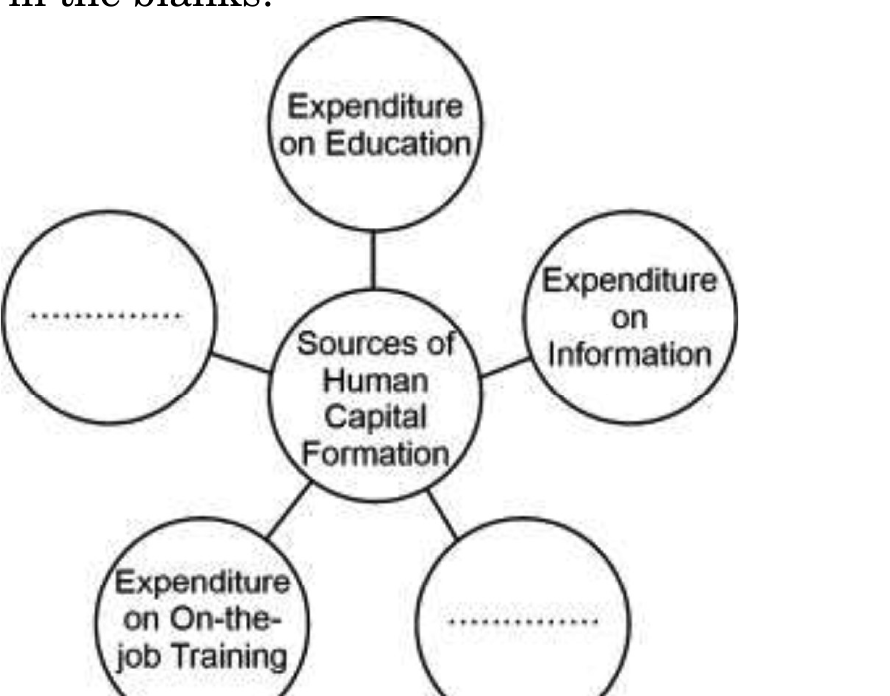
Identify the sources of Human Capital Formation and choose the correct alternative to fill in the blanks.
Which of the following is not a human development indicator? (A) Life expectancy at birth (B) Adult literacy rate (C) Maternal mortality rate (D) Unemployment
Statement 1: Human development is based on the idea that education and health are integral to human well-being. Statement 2: Human capital treats humans as a means to an end. (A) 1 true, 2 false (B) 1 false, 2 true (C) both true (D) both false
"Skill India" programme launched by the Government is not an attempt to increase ___________ in India. (Choose the correct alternative to fill up the blank)
3 marks: short answer
During the 'Mann ki Baat' program aired on 29th June, 2025, Prime Minister shared that World Health Organisation (WHO) has declared India as a Trachoma free (an eye disease). This achievement, he shared, is a result of sustained efforts in health care, sanitation, awareness and medical access. In the light of the above statement, explain how investments in health care contributes to a nation's development. Support your answer with valid arguments.
Solution
Investment in health care gives the nation a healthy workforce. A healthy person is more productive than an unhealthy one, works for more days, and provides an uninterrupted labour supply over a longer working life. Better health also improves children's learning, so education pays off more. Thus health spending raises labour productivity, promotes human capital formation and supports economic development (and reduces the cost of illness to families).
Anaya learnt modern farming techniques and trained workers in crop rotation, soil management and pest control; Rohan invested in advanced machinery, irrigation systems and HYV seeds. "Both invested in human capital." Do you agree?
Solution
"Expenditure on preventive, curative and social medicine helps in building human capital and economic development." Do you agree?
Solution
Trace the relationship between Human capital and Economic growth.
Solution
Human capital (the stock of knowledge, skills and health of people) and economic growth are positively related. Investment in education, health and training raises the efficiency and productivity of workers, increasing output. Human capital also fosters innovation and the ability to adopt new technologies, which drives growth. In turn, growth provides the resources to invest more in human capital: a two-way relationship.
Medhya and Danish both had their own farms. Medhya invested in a few agricultural courses, learnt modern farming techniques and trained her labourers on best practices related to soil fertility, crop management, pest control etc. Whereas, Danish invested heavily in, by purchasing advanced farming machinery, irrigation systems, and high quality seeds. Do you agree that, Danish had made investment in human capital? Give valid reason in support of your answer.
Solution
"Expenditure on preventive medicine, curative medicine and social medicine helps in building human capital and economic development." Do you agree with the given statement ? Give valid arguments in support of your answer.
Solution
On the basis of the given image (students in a classroom), explain the source of human capital formation which may contribute to India's growth. (Visually impaired: explain investment in education as a source of human capital formation.)
"In India, National Education Policy 2020 has stressed a lot on in-service training of the teachers." (a) Identify the source of Human Capital Formation (HCF) indicated in the aforesaid statement. (b) Elaborate the likely impacts of this source on the economic development of India.
Explain the role of affordable healthcare facilities in promoting human capital in a country.
"Dr. Khurana, a dentist, ran his clinic in an economically backward area. He was earning a comparatively low income. So, he decided to move to a city and spent a huge amount for the same." Identify and explain the type of expenditure incurred by Dr. Khurana, which directly contributed to the process of human capital formation.
"Human Capital Formation gives birth to innovation, invention and technological improvements." Do you agree with the given statement ? Support your answer with valid arguments.
4 marks: case-based / source-based
Describe the role of government in improving the efficiency of human capital formation in India.
Solution
(i) Define human capital formation. (ii) Explain expenditure on migration as a source of human capital formation.
Solution
(ii) People migrate in search of jobs with higher earnings; technically qualified persons such as engineers and doctors migrate for better incomes and opportunities. Migration involves transport costs, a higher cost of living and the psychic cost of a new socio-cultural setting. Since the higher earnings at the new place outweigh these costs, migration raises the return on skills: it is a source of human capital formation.
(i) Distinguish between human capital and physical capital. (ii) Describe LPG and gobar gas as strategies for sustainable development in rural areas.
Solution
(ii) LPG is a clean fuel that greatly reduces indoor (household) pollution from burning wood and dung cakes and reduces energy wastage and deforestation. Gobar gas: cattle dung is fed into a plant and the gas produced is used as cooking fuel; the slurry left over is a very good organic manure and soil conditioner.
(i) Distinguish between human capital and physical capital. (ii) Define sustainable development.
Solution
(ii) Development that meets the needs of the present generation without compromising the ability of future generations to meet their own needs.
Argue in favour of the need for different forms of government intervention in education and health.
(i) Elaborate the need to promote women's education in India. (ii) Mention any two examples of diversification activities in the non-agro processing industries.
"There exists a positive correlation between human capital formation and economic growth of a nation." Justify the given statement with valid explanation.
"National Education Policy 2020 stresses a lot on in-service teacher training." (i) State and explain any two advantages of such on-the-job training in uplifting the education sector. (ii) Define casual wage labourer.
6 marks: long answer
Read the following text carefully: To ensure inclusive and quality education for all, the Indian government has launched several important schemes. These schemes aimed at improving access, equity and learning outcomes, especially among disadvantaged group. The Right to Education (RTE) Act, passed by the India Parliament on August 4, 2009, guarantees free and compulsory education to every child between 6-14 years of age. It ensures that all children have access to education in neighbourhood schools, until they complete elementary education. Another key initiative is Sarva Siksha Abhiyan (SSA). It was introduced in 2001. It is one of India's flagship programmes for the Universalisation of Elementary Education. Digital India Campaign, launched on July 1, 2015, focuses on transforming India into a digitally empowered society by improving mobile and internet connectivity, particularly in rural and remote regions. This initiative supports digital learning & access to educational resources. Through these initiatives, the government strives to create an equitable, accessible & quality driven educational environment for all children, laying a strong foundation for national development. On the basis of the given text and common understanding, answer the following questions: (i) Identify, which law guarantees free and compulsory education upto the age of 14 years. Explain, how does it help in enhancing access to education. (ii) In your opinion, how has the increase in public spending on education contributed to India's social and economic transformation? Support your answer with valid arguments.
Solution
(i) The Right to Education (RTE) Act, 2009. It makes education free and compulsory for every child aged 6–14, so poverty is no barrier, and requires schools in the neighbourhood, so distance is no barrier. Children from disadvantaged groups are included, and all children are helped to complete elementary education.
(ii) Higher public spending on education has made schooling accessible to weaker sections, promoting social equality (including for girls). It has raised skills and knowledge, leading to better jobs, higher productivity and incomes. A more educated population has better health awareness and a higher standard of living. Together these have driven India's social and economic development.
(i) "India can transform itself into a knowledge-based economy by using information technology." Justify. (ii) "It is necessary to generate employment in the formal sector rather than the informal sector." Justify.
Solution
(ii) Formal sector workers can form trade unions, get fair wages, regular income and social security (PF, gratuity, pension) and are protected by labour laws. Informal sector workers get irregular incomes, no protection or regulation by the government, and can be dismissed without compensation. So formal employment gives far better security and welfare, and it is necessary to generate employment in the formal sector.
Get every solution for all chapters
- Every board question of every chapter, each fully solved the way the board gives marks
- 15 complete board papers, each followed by its solutions
- Weightage and most-asked topics for every chapter
- Instant PDF download, colour and black & white print copies
Revising the chapter first? Complete Economics Notes for Class 12 (NCERT 2026-27, CBSE Board 2027) →
What you get in the pack
- Questions from 129 CBSE Economics papers, 2016 to 2026: every set code available
- Complete: 1783 different questions and parts from all set codes, 14 chapters and 15 full papers
- Part A: all 14 chapters, questions sorted chapter-wise and by marks
- Year-wise weightage table and most-asked topics for every chapter
- Part B: each full board paper followed by its complete solutions
- National income, multiplier, budget and BOP numericals worked step by step
- Questions on topics out of the board syllabus flagged
All chapters in this pack
- PYQ Ch 1 Introduction to Macroeconomics
- PYQ Ch 2 National Income and Related Aggregates
- PYQ Ch 3 Money and Banking
- PYQ Ch 4 Determination of Income and Employment
- PYQ Ch 5 Government Budget and the Economy
- PYQ Ch 6 Open Economy: Balance of Payments and Exchange Rate
- PYQ Ch 7 Indian Economy on the Eve of Independence
- PYQ Ch 8 Indian Economy 1950–1990
- PYQ Ch 9 Liberalisation, Privatisation and Globalisation
- PYQ Ch 10 Human Capital Formation in India
- PYQ Ch 11 Rural Development
- PYQ Ch 12 Employment: Growth, Informalisation and Other Issues
- PYQ Ch 13 Environment and Sustainable Development
- PYQ Ch 14 Comparative Development Experiences of India and its Neighbours
- Board Paper 2026 Set 58-1-1 with Solutions
- Board Paper 2026 Set 58-1-2 with Solutions
- Board Paper 2026 Set 58-1-3 with Solutions
- Board Paper 2026 Set 58-2-1 with Solutions
- Board Paper 2025 Set 58-1-1 with Solutions
- Board Paper 2025 Set 58-2-1 with Solutions
- Board Paper 2024 Set 58-1-1 with Solutions
- Board Paper 2024 Set 58-2-1 with Solutions
- Board Paper 2023 Set 58-1-1 with Solutions
- Board Paper 2022 Term 2 Set 58-1-1 with Solutions
- Board Paper 2020 Set 58-1-1 with Solutions
- Board Paper 2019 Set 58-1-1 with Solutions
- Board Paper 2018 Set 58-1 with Solutions
- Board Paper 2017 Set 58-1 with Solutions
- Board Paper 2016 Set 58-1 with Solutions