
Introduction to Macroeconomics: Class 12 PYQs 2016–2026 with solutions
All 10 CBSE board questions asked from Introduction to Macroeconomics in 10 board papers, with the year, set and marks of each. 7 are solved free below. The Class 12 Economics PYQ Book: Solved Board Papers 2016-2026 (CBSE) has every solution, all chapters and 15 full board papers.

Introduction to Macroeconomics: board weightage
Board weightage 2016–2026
| Year | 2016 | 2017 | 2018 | 2019 | 2020 | 2022 | 2023 | 2024 | 2025 | 2026 |
|---|---|---|---|---|---|---|---|---|---|---|
| Questions | 1 | – | – | 1 | 1 | 1 | 1 | 3 | 1 | 1 |
| Marks | 1 | – | – | 1 | 3 | 2 | 1 | 15 | 6 | 1 |
Most asked topics
10 questions from 10 papers. Repeated questions are shown once with every year they were asked.
Jump to: 1 mark2 marks3 marks6 marks
1 mark: MCQ and Assertion–Reason
In a two sector economy, the flow of factor payments moves from __________ to __________. (Choose the correct option to fill in the blanks)
Solution
Households supply factor services to firms, and firms pay them rent, wages, interest and profit. Answer: (A)
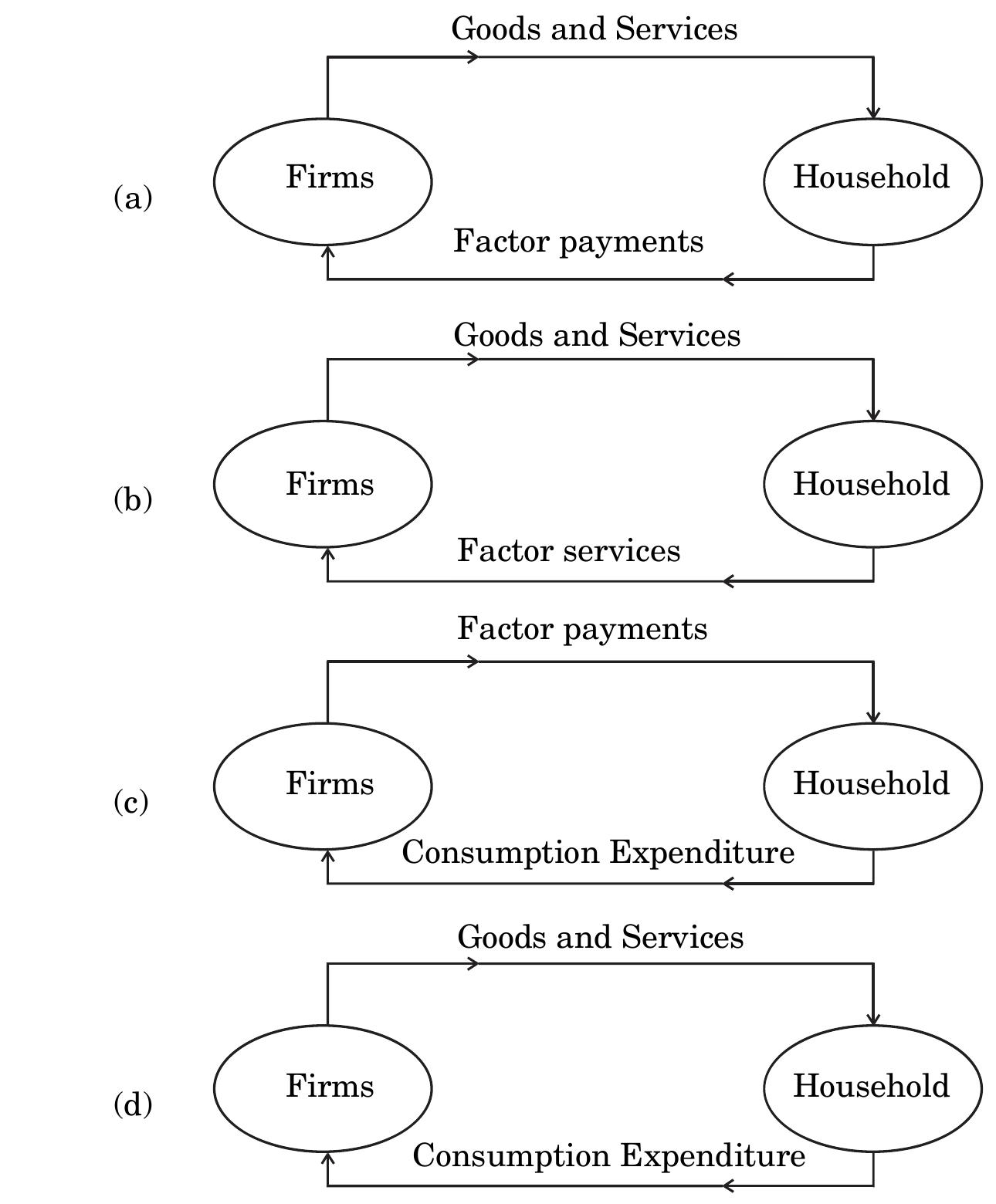
Identify which of the following represents only the real flow :
Solution
A real flow is a flow of goods and services or of factor services; money payments are money flows. Only diagram (b) shows goods and services going to households and factor services going to firms. Answer: (b)
Give any two examples of flow concept.
Define flows.
2 marks: very short answer
Using a suitable example, distinguish between stock variables and flow variables.
Solution
A stock variable is measured at a point of time (e.g. wealth, capital, money supply on 31 March). A flow variable is measured over a period of time (e.g. income per year, investment per year).
3 marks: short answer
"The disposition phase of the circular flow of income involves the flow of factor income (rent, wages, interest and profit) from firms to households." Defend or refute with valid reasons.
Solution
"Circular flow principle is based on the assumption that one's expenditure will become other's income." Explain the given statement.
Solution
In the circular flow, households spend their income on goods and services produced by firms. This expenditure becomes the firms' income (sales revenue). Firms use it to pay rent, wages, interest and profit to the households who supplied the factor services, so it becomes household income again. Thus expenditure of one sector is the income of another, and income keeps flowing in a circle: production → income → expenditure → production.
6 marks: long answer
(i) "In a two-sector economy, consumption expenditure by households is always equal to aggregate expenditure on goods and services produced by firms." Do you agree? Explain. (ii) "Double counting leads to overestimation of output." Justify with an example.
Solution
(ii) Double counting is counting the value of a commodity more than once, which overstates output. Example: a farmer produces wheat worth ₹ 100 (no inputs) and sells ₹ 50 of it to a baker, who makes bread worth ₹ 200. If we add 100 + 200 = 300, the ₹ 50 of wheat is counted twice (once as wheat, once inside the bread). Correct output = value added: farmer 100 + baker (200 − 50) 150 = ₹ 250.
(a) Discuss briefly the concept of circular flow of income in a two-sector model. (b) "Real Gross Domestic Product (GDP) is a better indicator of economic growth of a nation as compared to the Nominal Gross Domestic Product (GDP)." Do you agree with the given statement? Justify your answer with a valid hypothetical numerical example.
Solution
(b) Yes. Real GDP values the final output at base year (constant) prices; nominal GDP values it at current year prices. Nominal GDP can rise only because prices rise, even when output is unchanged.
| Year | Price (₹) | Output (units) | Real GDP (P0Q) | Nominal GDP (PQ) |
|---|---|---|---|---|
| 2010 (base) | 10 | 100 | 1,000 | 1,000 |
| 2011 | 15 | 100 | 1,000 | 1,500 |
Nominal GDP rose by 50% but output did not change; real GDP correctly shows no growth. Real GDP removes the effect of price changes and measures change in physical output, so it is the better indicator of economic growth.
(i) Explain the concept of circular flow of income in a two-sector economy. (ii) "GDP and the sum of gross value added (GVA) in an economy are always equal." Justify.
Get every solution for all chapters
- Every board question of every chapter, each fully solved the way the board gives marks
- 15 complete board papers, each followed by its solutions
- Weightage and most-asked topics for every chapter
- Instant PDF download, colour and black & white print copies
Revising the chapter first? Complete Economics Notes for Class 12 (NCERT 2026-27, CBSE Board 2027) →
What you get in the pack
- Questions from 129 CBSE Economics papers, 2016 to 2026: every set code available
- Complete: 1783 different questions and parts from all set codes, 14 chapters and 15 full papers
- Part A: all 14 chapters, questions sorted chapter-wise and by marks
- Year-wise weightage table and most-asked topics for every chapter
- Part B: each full board paper followed by its complete solutions
- National income, multiplier, budget and BOP numericals worked step by step
- Questions on topics out of the board syllabus flagged
All chapters in this pack
- PYQ Ch 1 Introduction to Macroeconomics
- PYQ Ch 2 National Income and Related Aggregates
- PYQ Ch 3 Money and Banking
- PYQ Ch 4 Determination of Income and Employment
- PYQ Ch 5 Government Budget and the Economy
- PYQ Ch 6 Open Economy: Balance of Payments and Exchange Rate
- PYQ Ch 7 Indian Economy on the Eve of Independence
- PYQ Ch 8 Indian Economy 1950–1990
- PYQ Ch 9 Liberalisation, Privatisation and Globalisation
- PYQ Ch 10 Human Capital Formation in India
- PYQ Ch 11 Rural Development
- PYQ Ch 12 Employment: Growth, Informalisation and Other Issues
- PYQ Ch 13 Environment and Sustainable Development
- PYQ Ch 14 Comparative Development Experiences of India and its Neighbours
- Board Paper 2026 Set 58-1-1 with Solutions
- Board Paper 2026 Set 58-1-2 with Solutions
- Board Paper 2026 Set 58-1-3 with Solutions
- Board Paper 2026 Set 58-2-1 with Solutions
- Board Paper 2025 Set 58-1-1 with Solutions
- Board Paper 2025 Set 58-2-1 with Solutions
- Board Paper 2024 Set 58-1-1 with Solutions
- Board Paper 2024 Set 58-2-1 with Solutions
- Board Paper 2023 Set 58-1-1 with Solutions
- Board Paper 2022 Term 2 Set 58-1-1 with Solutions
- Board Paper 2020 Set 58-1-1 with Solutions
- Board Paper 2019 Set 58-1-1 with Solutions
- Board Paper 2018 Set 58-1 with Solutions
- Board Paper 2017 Set 58-1 with Solutions
- Board Paper 2016 Set 58-1 with Solutions