
Open Economy: Balance of Payments and Exchange Rate: Class 12 PYQs 2016–2026 with solutions
All 71 CBSE board questions asked from Open Economy: Balance of Payments and Exchange Rate in 22 board papers, with the year, set and marks of each. 37 are solved free below. The Class 12 Economics PYQ Book: Solved Board Papers 2016-2026 (CBSE) has every solution, all chapters and 15 full board papers.

Open Economy: Balance of Payments and Exchange Rate: board weightage
Board weightage 2016–2026
| Year | 2016 | 2017 | 2018 | 2019 | 2020 | 2022 | 2023 | 2024 | 2025 | 2026 |
|---|---|---|---|---|---|---|---|---|---|---|
| Questions | 2 | 2 | 1 | 1 | 3 | – | 4 | 21 | 22 | 16 |
| Marks | 7 | 7 | 6 | 6 | 6 | – | 6 | 33 | 51 | 30 |
Most asked topics
72 questions from 22 papers. Repeated questions are shown once with every year they were asked.
Jump to: 1 mark3 marks4 marks6 marks
1 mark: MCQ and Assertion–Reason
Read the following statements carefully: Statement 1: Depreciation of currency is an economic action undertaken by the government of a nation under the fixed exchange rate system. Statement 2: Under the floating exchange Rate system, authorities actively intervene in the foreign exchange market by way of maintaining foreign exchange reserves. In the light of the given statements, choose the correct option from the following:
Solution
A deliberate cut in value under a fixed rate is devaluation; depreciation is market-driven under a flexible rate. Under a (free) floating system, authorities do not actively intervene. Answer: (D)
Assertion (A): Unilateral Transfers are recorded in the Current Account of the Balance of Payments (BoP) of a nation. Reason (R): Capital account records transactions which cause a change in the assets or liabilities of the country.
Solution
Both are true, but R describes the capital account, so it does not explain why transfers go into the current account. Answer: (B)
Read the following statements carefully: Statement 1: Under the flexible exchange rate system, a deficit / surplus in the Balance of Payments is automatically corrected. Statement 2: Under the flexible exchange rate system, there is always a possibility of over/under valuation of currency. In the light of the above given statements, choose the correct option from the following:
Solution
Assertion (A): Increase in exchange rate implies that the price of foreign currency in terms of domestic currency has increased. Reason (R): Balance of trade records the inflows and outflows of foreign exchange.
Solution
Identify the factor which influences the demand for foreign exchange: (A) investments made by Indians in Japan (B) Indian producers exporting fabrics to the USA (C) remittances by Indian workers from Gulf countries (D) an Indian software company providing services abroad
Solution
Statement I: Trade in services includes both factor income and non-factor income transactions. Statement II: The current account includes transactions in goods, services and unilateral transfers. (A) I true, II false (B) I false, II true (C) both true (D) both false
Solution
Under the fixed exchange rate system, if the government decreases the value of the domestic currency in terms of a foreign currency, it is called ______. (A) devaluation (B) depreciation (C) appreciation (D) revaluation
Solution
Under ______ exchange rate system, the competent authority may devalue currency to increase exports. (A) fixed (B) floating (C) managed (D) fixed floating
Solution
Purchase of a property by an Indian resident abroad is recorded on the ______ side of the ______ account of BoP. (A) credit, capital (B) credit, current (C) debit, current (D) debit, capital
Solution
Under the flexible exchange rate system, the exchange rate is determined by: (i) government (ii) demand and supply (iii) intervention of the central bank. (A) only (i) (B) only (ii) (C) only (iii) (D) (ii) and (iii)
Solution
Assertion (A): Transfers from abroad (remittances) are recorded on the credit side of the capital account of BoP. Reason (R): All transactions that lead to inflow of foreign currency are recorded on the credit side of BoP. (A) Both true, R explains A (B) Both true, R does not explain A (C) A true, R false (D) A false, R true
Solution
In the context of Current Account transactions of Balance of Payment, identify the incorrect statement from the following: (Choose the correct option)
Solution
Transfer receipts bring foreign exchange in, so they are credit items; (D) is incorrect. Answer: (D)
Read the following statements carefully: Statement-1: Managed floating exchange rate system is an amalgamation of fixed and flexible exchange rate system. Statement-2: Managed floating exchange rate system is also known as 'hybrid system'. In the light of the given statements, choose the correct option from the following:
Solution
The market sets the rate, but the central bank intervenes to limit fluctuations, combining both systems; it is called a hybrid (dirty floating) system. Answer: (C)
If a country exports goods worth of ₹ 600 crores and imports goods worth of ₹ 450 crores, the value of Balance of Trade of the country would be _______ of ₹_______ crores.
Solution
600 − 450 = ₹ 150 crore surplus. Answer: (B)
Under the ______ exchange rate system, the central bank can control the exchange rate in a range-bound manner. (A) fixed (B) flexible (C) managed floating (D) gold standard
Solution
Statement 1: Import of heavy machinery from Japan is a source of demand for foreign exchange. Statement 2: Financial aid by IBRD for the Wayanad landslide is a source of supply of foreign exchange. (A) 1 true, 2 false (B) 1 false, 2 true (C) both true (D) both false
Solution
Market forces of demand and supply interact under the ______ exchange rate system to determine the exchange rate. (A) fixed (B) flexible (C) managed floating (D) fixed floating
Solution
Which situation indicates a current account surplus? (A) excess of current receipts over current payments (B) equality of current receipts and payments (C) excess of current payments over current receipts (D) excess of current payments over capital receipts
Solution
Assertion (A): Other things constant, devaluation of domestic currency may lead to a rise in national income. Reason (R): Devaluation refers to reduction in the value of domestic currency by the government against foreign currency under a fixed exchange rate system. (A) Both true, R explains A (B) Both true, R does not explain A (C) A true, R false (D) A false, R true
Solution
Which is not a source of demand for foreign exchange? (A) imports of goods and services (B) gifts by Indians to their families abroad (C) Indian tourists visiting foreign countries (D) loans from the rest of the world
Solution
Statement 1: The price of a given currency in terms of another is known as bank rate. Statement 2: The demand curve for foreign exchange slopes downward. (A) 1 true, 2 false (B) 1 false, 2 true (C) both true (D) both false
Solution
Statement 1: Other things constant, there is a positive correlation between the price of foreign exchange and its demand. Statement 2: The foreign exchange rate indicates a country's purchasing power in international markets. (A) 1 true, 2 false (B) 1 false, 2 true (C) both true (D) both false
Solution
Assertion (A): Shipping service provided by an Indian company to foreign companies will be recorded in the current account of the BOP. Reason (R): The current account does not alter the status of assets or liabilities of residents. (A) Both true, R explains A (B) Both true, R does not explain A (C) A true, R false (D) A false, R true
"As per the National Stock Exchange (NSE) data, dated 9th June, 2023, there was a net selling off worth ₹ 309 crore by Foreign Institutional Investors (FIIs) over the period of one month i.e., 9th May, 2023 - 9th June, 2023." The above mentioned transactions will be recorded on __________ side of ___________ account of Balance of Payments of India. (Choose the correct alternative to fill in the blanks)
Surplus in Balance of Payments (BOP) refers to the excess of ___________. (Choose the correct alternative to fill in the blank)
Suppose, the Balance of Trade of an imaginary economy shows a favourable balance of ₹ 500 crore. The values of merchandise exports are ₹ 1200 crore and transfer payments are ₹ 400 crore. The value of merchandise imports would be ₹ __________ crore. (Choose the correct alternative to fill in the blank)
Identify which of the following is not one of the merits of fixed exchange rate system.
Identify which of the following will appear on the debit side in the Capital Account of India's Balance of Payments.
Study the following figure carefully and choose the correct alternative to fill in the blank :
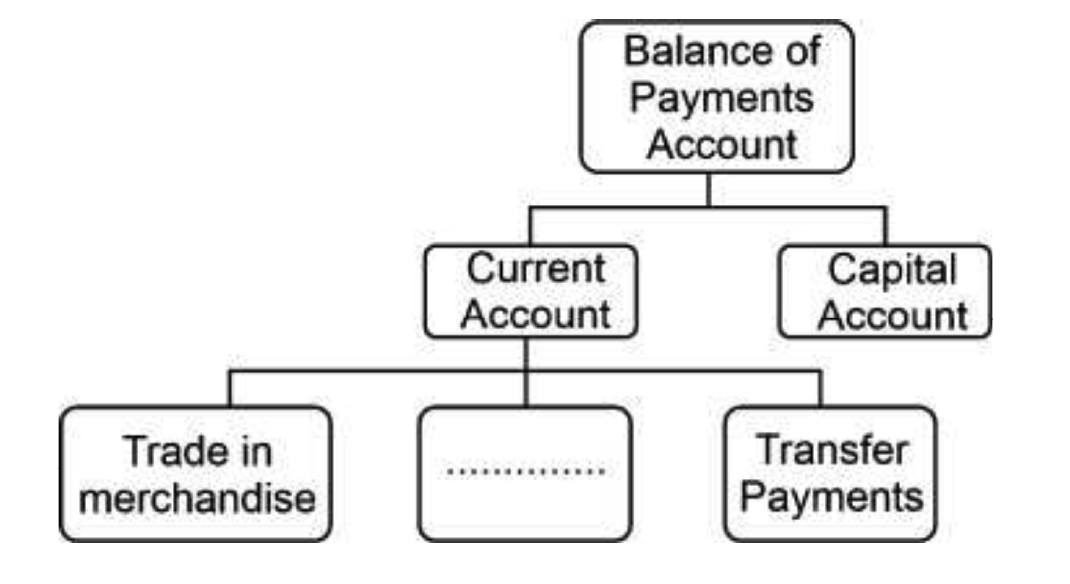
"India's foreign exchange reserves grew for the third straight week to about $ 600 billion" (RBI, 19 May 2023). This situation will ______ the ______ side of India's BOP account. (A) Increase, credit (B) Decrease, credit (C) Decrease, debit (D) Increase, debit
Identify the correct pair: 1. Remittances from abroad – (i) Accommodating transaction; 2. Government's policy of decreasing the value of the nation's currency against foreign currencies – (ii) Devaluation; 3. Difference between visible exports and visible imports – (iii) Balance of payments; 4. Government as sole authority of determining exchange rates – (iv) Flexible exchange rate system. (A) 1→(i) (B) 2→(ii) (C) 3→(iii) (D) 4→(iv)
Assertion (A): In case of an unfavourable balance of trade, the current account of the nation may be in surplus. Reason (R): Net invisible receipts of a nation can exceed the net visible receipts. (A) Both true, R explains A (B) Both true, R does not explain A (C) A true, R false (D) A false, R true
Assertion (A): Ceteris paribus, devaluation of domestic currency leads to an increase in national income of a nation. Reason (R): Devaluation refers to reduction in the value of domestic currency with respect to foreign currency under the fixed exchange rate system. (A) Both true, R explains A (B) Both true, R does not explain A (C) A true, R false (D) A false, R true
Which is not a source of demand for foreign exchange for the Indian economy? (A) Import of goods and services (B) Remittances by foreigners living in India to their families abroad (C) Indian tourists visiting foreign countries (D) Loans from the rest of the world
The balance of trade shows a deficit of ₹ 200 crore and imports are ₹ 900 crore. Exports would be ₹ ______ crore. (A) 200 (B) 1100 (C) 700 (D) 900
Identify the reasons that may affect the supply of foreign exchange: I. purchase of land in England by an Indian II. foreign tourists visiting the Taj Mahal III. donation of $ 500 million from Microsoft IV. Indian students going to Australia for studies. (A) I and II (B) II and IV (C) II and III (D) I and IV
Measurement of BOP deficit is based on ______ transactions. (A) autonomous (B) accommodating (C) current account (D) capital account
Read the following statements carefully: Statement 1: Borrowings by a nation from the World Bank to finance Balance of Payment (BOP) deficit will be recorded in the capital account. Statement 2: Autonomous transactions are independent of the condition of Balance of Payment (BOP) account. In light of the given statements, choose the correct alternative from the following:
Suppose that, the Balance of Trade of a nation exhibits a deficit of ₹ 50,000 crore. The import of visible items are five times of the exports of visible items. The value of exports of visible items would be ₹_______ crore. (Choose the correct alternative to fill up the blank)
Gifts and remittances sent abroad are recorded on the _______ side of the _________ account in Balance of Payment. (Choose the correct alternative to fill up the blanks)
________ is one of the most important sources of demand for foreign currency. (Fill in the blank with the correct answer)
Define 'Trade Surplus'.
What is meant by depreciation of the domestic currency?
Foreign exchange transactions which are independent of other transactions in the Balance of Payments Account are called : (Choose the correct alternative)
3 marks: short answer
"The US administration has recently imposed a tariff of 50%." Explain the likely impact on India's exports.
Solution
Distinguish between Net Factor Income from Abroad (NFIA) and Net Exports (X - M).
Solution
NFIA = factor income received from the rest of the world − factor income paid to the rest of the world (wages, rent, interest, profit). It converts domestic aggregates into national aggregates.
Net exports (X − M) = value of exports of goods and services − value of imports of goods and services. It is a component of aggregate demand / GDP by the expenditure method.
"The Government had launched Incredible India Campaign to promote tourism in various parts of the country." Elaborate the impact of this campaign on foreign exchange reserves and Balance of Payment of India.
Solution
The campaign attracts more foreign tourists, who spend foreign currency in India. These receipts (export of services) are recorded on the credit side of the current account of the BoP. The inflow raises the supply of foreign exchange, increasing India's foreign exchange reserves and improving its BoP position (a smaller deficit or a larger surplus).
Distinguish between autonomous and accommodating transactions in the BOP.
Solution
Distinguish between fixed exchange rate system and flexible exchange rate system.
Solution
"Accommodating transactions are undertaken to maintain stability in the Balance of Payments Account." Justify the given statement with valid explanation.
Solution
"Depreciation of currency may promote exports of a nation." Defend or refute the given statement with valid arguments.
Discuss any two factors which directly affect the demand for foreign exchange of a nation.
State the meaning of autonomous and accommodating items under the BOP, with an example of each.
"Trade deficit must exist if a country is facing a current account deficit (CAD)." Defend or refute with valid arguments.
"There exists a positive relation between foreign exchange rate and supply of foreign exchange." Do you agree with the given statement? Justify your answer with valid arguments.
4 marks: case-based / source-based
Michel, an entrepreneur of Country Zeta, borrowed $ 5 million from an overseas bank to expand his textile business. During the same financial year, the Government of Country Zeta secured a loan of $ 30 Billion from an International Financial Institution to manage the ongoing Balance of Payments. Samuel, an Economics student categorised both of these transactions as 'autonomous transactions' in the BoP account of the country. Do you agree with his classification? Justify your answer with valid reasons.
Solution
No.
• Michel's borrowing is an autonomous transaction: it is undertaken with an economic (profit) motive, independent of the BoP position.
• The government's loan from an international institution is an accommodating transaction: it is undertaken specifically to cover the deficit in the BoP, not for any economic motive of its own.
(a) Explain the likely impacts of the 'Make in India' policy initiated by Government of India on the Balance of Payments (BoP) of India (assuming all other factors constant). (b) State the meaning of Balance of Payment (BoP) surplus and deficit.
Solution
(b) BOP surplus: autonomous inflows of foreign exchange exceed autonomous outflows over a period. BOP deficit: autonomous inflows fall short of autonomous outflows.
(a) Define accommodating items under BoP. (b) "Economic transactions recorded in the current account can be classified in two parts — merchandise and invisibles. Net inflows from both the transactions are referred to as trade surplus." Do you agree? Give valid arguments.
Solution
(b) No. The current account includes merchandise (visibles) and invisibles, but the trade balance covers merchandise only: a trade surplus means exports of goods exceed imports of goods. Net inflows from merchandise and invisibles together give the current account balance (current account surplus), not the trade surplus.
(a) Define the balance of payments account. (b) Differentiate between autonomous and accommodating transactions in BoP.
Solution
(b) Autonomous transactions are undertaken for an economic motive (profit, income), independent of the state of the BoP; they are "above the line" items and cause a surplus or deficit. Accommodating transactions are undertaken by the monetary authorities to cover that surplus or deficit (e.g. drawing on foreign exchange reserves), without any economic motive; they are "below the line" items.
Elaborate any two components of the capital account of the BOP.
Solution
Distinguish between autonomous and accommodating transactions.
Solution
"India saw FDI inflows of US$ 70.9 bn and net FPI inflows of US$ 32.4 bn in 2023-24." (i) Distinguish between the two variables. (ii) In which account of the BOP are they entered, and why?
Explain how accommodating transactions differ from autonomous transactions.
(i) Distinguish between balance of payments and balance of trade. (ii) Define current account surplus.
(i) Distinguish between FDI and FII with suitable examples. (ii) State one example of external assistance as a component of the capital account.
"India is taking huge leaps in the index of Ease of Doing Business, as a result many MNCs are shifting their production base to India." In the light of the above statement, comment upon the flow of foreign exchange and its likely impact on the Indian Economy.
6 marks: long answer
Read the following text carefully : Balance of Payments (BoP) systematically summarise, the economic transactions of an economy with the rest of the world, over a given period of time. The BoP can be broadly divided into two accounts namely: • current account • capital account. The current account measures the transfer of goods, services, income and transfers between an economy and rest of the world. The current account may be sub-divided into merchandise account and invisible account. Merchandise account consists of transactions related to export and import of goods. In the invisible account, there are three broad categories : • Non-factor services such as travel, transportation, insurance etc. • Transfer which do not involve any value in exchange. • Income which includes compensation of employees and investment income. The capital account reflects the net changes in financial claims on rest of the world. The capital account can be broadly broken up into two categories : • Non-debt flows such as direct and portfolio investments. • Debt flows such as external assistance, commercial borrowings, non-resident deposits etc. The sum of the two accounts indicates the overall balance, which could be either be in surplus or deficit. The movement in overall balance is reflected in changes in international reserves of the country. (Source: mospi.gov.in, adopted and modified) On the basis of the given text and common understanding, answer the following questions : (a) Define Balance of Payments. (b) Differentiate between the two accounts of Balance of Payments. (c) Give the meaning of Balance of Payments deficit with formula.
Solution
(b) The current account records trade in goods (merchandise), services, income and transfers; it includes items that do not change assets or liabilities, and is divided into the merchandise and invisible accounts. The capital account records transactions that change the assets or liabilities (financial claims) of residents with the rest of the world; it is divided into non-debt flows (FDI, portfolio investment) and debt flows (borrowings, assistance, NRI deposits).
(c) A BOP deficit arises when, during the year, autonomous outflows (payments) of foreign exchange exceed autonomous inflows (receipts). BOP deficit = autonomous payments − autonomous receipts (> 0); it is financed by accommodating items such as a fall in foreign exchange reserves.
(a) Define "Trade surplus". How is it different from "Current account surplus" ? (b) "Indian Rupee (₹) plunged to all time low of ₹ 74.48 against the US Dollar ($)". – The Economic Times. In the light of the above report, discuss the impact of the situation on Indian Imports.
Solution
(a) Trade surplus: excess of exports of goods (visible items) over imports of goods.
Current account surplus is wider: excess of receipts from exports of goods, services (invisibles) and transfers over payments for imports of goods, services and transfers. A trade surplus considers goods only; the current account also includes services, income and transfers.
(b) The fall of the rupee to ₹ 74.48 per dollar is a depreciation of the rupee. Each dollar's worth of imports now costs more rupees, so imported goods become dearer for Indian buyers. Imports tend to fall (or the import bill rises for essentials like crude oil, which is inelastic), while Indian exports become cheaper abroad.
(a) Explain the impact of rise in exchange rate on national income. (b) Explain the concept of 'deficit' in balance of payments.
Solution
(a) A rise in the exchange rate (depreciation of the domestic currency) makes domestic goods cheaper for foreigners and imports dearer at home. Exports rise and imports fall, so net exports rise. Aggregate demand increases, and through the multiplier, output, employment and national income rise.
(b) A BOP deficit occurs when autonomous payments (made for their own sake: imports, investment abroad) exceed autonomous receipts. The gap is met by accommodating transactions: drawing down foreign exchange reserves or borrowing from abroad (e.g. from the IMF).
Distinguish (a) between current account and capital account, and (b) between autonomous transactions and accommodating transactions of balance of payments account.
Indian investors lend abroad. Answer the following questions : (a) In which sub-account and on which side of the Balance of Payments Account such lending is recorded ? Give reasons. (b) Explain the impact of this lending on market exchange rate.
Get every solution for all chapters
- Every board question of every chapter, each fully solved the way the board gives marks
- 15 complete board papers, each followed by its solutions
- Weightage and most-asked topics for every chapter
- Instant PDF download, colour and black & white print copies
Revising the chapter first? Complete Economics Notes for Class 12 (NCERT 2026-27, CBSE Board 2027) →
What you get in the pack
- Questions from 129 CBSE Economics papers, 2016 to 2026: every set code available
- Complete: 1783 different questions and parts from all set codes, 14 chapters and 15 full papers
- Part A: all 14 chapters, questions sorted chapter-wise and by marks
- Year-wise weightage table and most-asked topics for every chapter
- Part B: each full board paper followed by its complete solutions
- National income, multiplier, budget and BOP numericals worked step by step
- Questions on topics out of the board syllabus flagged
All chapters in this pack
- PYQ Ch 1 Introduction to Macroeconomics
- PYQ Ch 2 National Income and Related Aggregates
- PYQ Ch 3 Money and Banking
- PYQ Ch 4 Determination of Income and Employment
- PYQ Ch 5 Government Budget and the Economy
- PYQ Ch 6 Open Economy: Balance of Payments and Exchange Rate
- PYQ Ch 7 Indian Economy on the Eve of Independence
- PYQ Ch 8 Indian Economy 1950–1990
- PYQ Ch 9 Liberalisation, Privatisation and Globalisation
- PYQ Ch 10 Human Capital Formation in India
- PYQ Ch 11 Rural Development
- PYQ Ch 12 Employment: Growth, Informalisation and Other Issues
- PYQ Ch 13 Environment and Sustainable Development
- PYQ Ch 14 Comparative Development Experiences of India and its Neighbours
- Board Paper 2026 Set 58-1-1 with Solutions
- Board Paper 2026 Set 58-1-2 with Solutions
- Board Paper 2026 Set 58-1-3 with Solutions
- Board Paper 2026 Set 58-2-1 with Solutions
- Board Paper 2025 Set 58-1-1 with Solutions
- Board Paper 2025 Set 58-2-1 with Solutions
- Board Paper 2024 Set 58-1-1 with Solutions
- Board Paper 2024 Set 58-2-1 with Solutions
- Board Paper 2023 Set 58-1-1 with Solutions
- Board Paper 2022 Term 2 Set 58-1-1 with Solutions
- Board Paper 2020 Set 58-1-1 with Solutions
- Board Paper 2019 Set 58-1-1 with Solutions
- Board Paper 2018 Set 58-1 with Solutions
- Board Paper 2017 Set 58-1 with Solutions
- Board Paper 2016 Set 58-1 with Solutions