
Government Budget and the Economy: Class 12 PYQs 2016–2026 with solutions
All 62 CBSE board questions asked from Government Budget and the Economy in 22 board papers, with the year, set and marks of each. 32 are solved free below. The Class 12 Economics PYQ Book: Solved Board Papers 2016-2026 (CBSE) has every solution, all chapters and 15 full board papers.

Government Budget and the Economy: board weightage
Board weightage 2016–2026
| Year | 2016 | 2017 | 2018 | 2019 | 2020 | 2022 | 2023 | 2024 | 2025 | 2026 |
|---|---|---|---|---|---|---|---|---|---|---|
| Questions | 4 | 3 | 2 | 4 | 4 | – | 2 | 12 | 22 | 9 |
| Marks | 14 | 8 | 12 | 7 | 7 | – | 12 | 60 | 55 | 40 |
Most asked topics
62 questions from 22 papers. Repeated questions are shown once with every year they were asked.
Jump to: 1 mark3 marks4 marks6 marks
1 mark: MCQ and Assertion–Reason
Assertion (A): Borrowing requirements of the government include interest obligations on debt as well. Reason (R): The goal of measuring primary deficit is to correct the prevailing fiscal imbalances. (A) Both true, R explains A (B) Both true, R does not explain A (C) A true, R false (D) A false, R true
Solution
"Consumption of a good by a person does not reduce the amount available for others. Consumers of such goods are known as free-riders." Identify the type of goods: (A) public goods (B) private goods (C) joint venture goods (D) self-consumption goods
Solution
Assertion (A): Public goods are those goods that are collectively consumed by the public. Reason (R): Public goods are excludable and rivalrous in nature.
Solution
Public goods are non-excludable and non-rivalrous, so R is false. Answer: (C)
From the set of terms given in Column-I and Column-II, choose the correct pair: Column-I: (a) Non-tax Revenue (b) Indirect Tax (c) Capital expenditure (d) Private goods. Column-II: (i) Goods and Services Tax (ii) Free-rider (iii) Borrowings (iv) Rivalrous in nature
Solution
Private goods are rivalrous (one person's use reduces another's). Answer: (D)
Identify, which of the following is not to be considered while estimating Revenue Deficit of a country. (Choose the correct option)
Solution
Assertion (A): In case of public goods no one can be excluded from enjoying the benefits. Reason (R): Public goods are non-rivalrous and non-excludable in nature.
Solution
The budget under, which the government may spend an amount equal to the revenue it collects is referred as _____ Budget. (Choose the correct option to fill up the blank)
Solution
Statement 1: Public goods are those for which payments are made by all entities in the country. Statement 2: Private goods are those provided by the government at subsidised rates. (A) 1 true, 2 false (B) 1 false, 2 true (C) both true (D) both false
Solution
Assertion (A): Direct taxes are imposed on income/profits of individuals/companies. Reason (R): The burden of payment of direct taxes cannot be shifted to any other entity. (A) Both true, R explains A (B) Both true, R does not explain A (C) A true, R false (D) A false, R true
Solution
The main objective of measuring the primary deficit is to highlight present ______. (A) fiscal imbalances (B) fiscal balances (C) recovery of loans (D) cash grant-in-aid
Solution
Which does not represent a public good? (A) free vaccines provided by the government (B) defence services (C) purchase of a railway ticket by an individual (D) street light installed by a municipality
Solution
In the Union Budget 2023-24, total receipts (other than borrowings) are ₹ 20 lakh crore and total expenditure ₹ 45 lakh crore. The value of ______ deficit would be ₹ 25 lakh crore. (A) revenue (B) fiscal (C) trade (D) primary
Solution
Statement 1: Foreign aids are capital receipts for the government. Statement 2: Disinvestment may lead to a decrease in the assets of the government. (A) 1 true, 2 false (B) 1 false, 2 true (C) both true (D) both false
In order to discourage any fall in aggregate demand, the Government of India may ______ the ______. (A) decrease, repo rate (B) increase, reverse repo rate (C) decrease, government expenditure (D) decrease, tax rate
Arrange in the correct sequence if the government is trying to curtail an inflationary gap: (i) decrease in disposable income (ii) increase in taxes (iii) decrease in aggregate demand. (A) (i), (ii), (iii) (B) (iii), (ii), (i) (C) (ii), (iii), (i) (D) (ii), (i), (iii)
State whether the following statement is true or false : "Government Budget is an important monetary policy instrument."
Disinvestment is a ________ (capital/revenue) receipt of the government. (Choose the correct alternative)
Fiscal deficit can be estimated using the formula ________. (Fill in the blank with the correct formula)
Define the term 'tax'.
What is meant by primary deficit ?
What is meant by fiscal deficit ?
Define Government budget.
What are revenue receipts in a government budget ?
Primary deficit equals : (Choose the correct alternative)
3 marks: short answer
"The government generally levies higher Goods and Services Tax (GST) on socially undesirable products like cigarettes, tobacco, liquor etc." Identify and explain the indicated government budget objective in the above statement.
Solution
Two friends Ramesh (a software engineer) and Pihu (a bakery owner) are discussing their contribution to the nation's economy through tax payments. Ramesh earns ₹ 8,00,000 per year, which makes him liable to pay income tax. Pihu pays Goods and Service Tax (GST) on the sale of cakes and pastries. On the basis of the given text, identify whether Ramesh is paying a direct tax or an indirect tax. Explain valid differences between two types of taxes.
Solution
"Taxation is an effective tool to reduce inequalities of income." Justify.
Solution
"As per the Economic Survey 2022-23, geopolitical conflict raised international prices of fertiliser and fuel; so there was a higher fuel and fertiliser subsidy requirement to support the people." Identify and explain the budget objective indicated.
Distinguish between direct taxes and indirect taxes. Give an example of each.
4 marks: case-based / source-based
Distinguish between revenue expenditure and capital expenditure with suitable examples.
Solution
Distinguish between revenue receipts and capital receipts with suitable examples.
Solution
"Under the Ayushmaan Bharat Scheme, the government provides free medical treatment to the poorer section of the society." Identify and explain the nature of budget expenditure and its objective, indicated in the given statement.
Solution
Nature: revenue expenditure: it neither creates assets nor reduces the government's liabilities.
Objective: redistribution of income: free treatment reduces the medical expenses of the poor, leaving them more disposable income. It thus narrows the gap between rich and poor and promotes equity.
(A) On the basis of the given image, explain the steps which may be taken by the Government of India to control the indicated macro-economic issue.
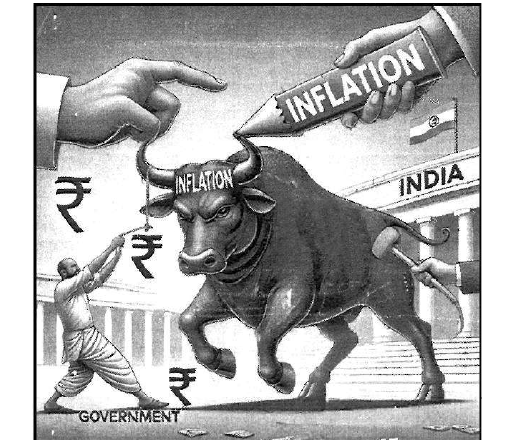
(B) Define 'Open Market Operations'.
(For Visually Impaired Candidates only in lieu of Q. No. 13: (A) Explain any one fiscal policy measure that can be taken up by the Government to control the situation of inflation prevailing in an economy. (B) Define 'Open Market Operations'.)
Solution
(B) Open market operations are the buying and selling of government securities by the central bank to and from the public and banks in the open market, to regulate the money supply.
"According to a research organisation, there is a sharp decline in overall demand, particularly in private consumption…; urgent need for strategic actions to stimulate economic activities." Explain the measures the government may take to solve the indicated problem.
Solution
"A significant reduction in aggregate demand raised concerns about future growth; urgent need for strategic measures to boost household confidence and stimulate economic activity." Explain the measures the government may take to stabilise the situation.
Solution
"An economy is operating at an under-employment level of income." What does this indicate? Discuss any one fiscal measure to tackle it.
(i) "With an objective to reduce inflation, the government may reduce public expenditure." Discuss the rationale. (ii) Define the effective demand principle.
(a) Define 'Revenue Expenditure'. (b) Distinguish between Direct tax and Indirect tax.
How are capital receipts different from revenue receipts ? Discuss briefly.
Explain how government budget can be helpful in bringing economic stabilization in the economy.
6 marks: long answer
Refer the given text carefully: According to the Economic Survey 2024-25, the government budget's projections for the fiscal year 2025-26 indicate that gross direct tax revenue will rise by 12.7%, while gross indirect tax collections are expected to grow by 8.3% relative to FY 2024-25. Direct taxes include income tax and corporate tax, reflecting earnings and profits of households and firms. It plays a key role in revenue growth of the government. Indirect taxes encompass Goods and Services Tax (GST), custom duties and other transaction-based levies. Higher growth rate projected for direct taxes suggests a push to enhance tax buoyancy through improved compliance and reforms. On the other hand, indirect taxes are expected to benefit from consumption trends and Goods and Services Tax (GST) administration improvements. The balance tax strategy aims to mobilise resources while supporting fiscal consolidation and sustainable economic growth. On the basis of the above passage and common understanding, answer the following questions: (i) Differentiate between the two types of taxes indicated in the above text, with suitable examples. (ii) Elaborate the likely consequences of the tax projections made by the government.
Solution
(i) Direct taxes: impact and incidence fall on the same person, so the burden cannot be shifted; e.g. income tax, corporate tax. Indirect taxes: impact and incidence fall on different persons, so the burden can be shifted (usually to consumers); e.g. GST, customs duty.
(ii) Higher direct and indirect tax collections will strengthen the government's revenue base. This lets it reduce borrowing and the fiscal deficit (fiscal consolidation) and spend more on development without excess debt. The faster rise in direct taxes makes the tax system more progressive. Overall the balanced strategy mobilises resources and supports sustainable economic growth.
Read the following text carefully: The government has allocated ₹ 15.27 lakh crore for major sectors, ranging from defence to rural development to social welfare to commerce and so on. Government expenditure goes to paying states' share of taxes and duties. Around 19% is spent on interest payments and 16% on central sector schemes, with subsidies, pension and other payments contributing 19%. Government revenue is divided between borrowings and other liabilities, which account for massive 27% of the incoming cash, Income tax revenue of around 19% Goods and Services Taxes (GST) and other taxes of around 18%; Corporation taxes account for around 17%. The next highest provision on this list is ₹ 2.66 lakh crore for rural development. This will include expenditure on rural infrastructure project and increased outlay for the popular MGNREGA scheme. On the basis of given text and common understanding, answer the following questions: (i) Identify the major sources of government revenue and state what percentage does each one of them contribute. (ii) Discuss the need to allocate funds among different sectors of the economy.
Solution
(ii) Allocating funds across defence, rural development, social welfare, infrastructure and commerce is needed to strengthen national security, promote rural growth and employment (MGNREGA, rural roads), enhance social welfare (health, education, pensions) and boost economic activity. Resources are limited, so allocation reflects priorities and ensures balanced and comprehensive development, infrastructure upgradation, employment generation and overall economic growth (allocation function of the budget).
(i) "The Credit Linked Subsidy Scheme (CLSS) is a key component of PMAY, aimed at providing affordable housing for the EWS, LIG and MIG in India." Identify and explain the budget objective highlighted. (ii) Differentiate between the two types of tax revenue of the government.
Solution
(ii) Direct taxes: impact and incidence fall on the same person; the burden cannot be shifted (income tax, corporation tax). Indirect taxes: impact and incidence may fall on different persons; the burden can be shifted (GST, customs duty).
(i) Medha classified defence expenditure on acquiring new platforms (jets, submarines) and on salaries and pensions of armed forces personnel as capital expenditure. Do you agree? (ii) Primary deficit is ₹ 1,000 crore and interest payments are 20% of total borrowings. Calculate fiscal deficit.
Solution
(ii) Total borrowing = fiscal deficit. PD = FD − interest: 1,000 = FD − 0.2 FD = 0.8 FD, so FD = 1,000 × 100/80 = ₹ 1,250 crore.
Read the passage (Economic Survey 2024–25: gross direct tax revenue projected to rise 12.7% and indirect taxes 8.3% in FY 2025–26; direct taxes include income tax and corporate tax; indirect taxes include GST and customs; higher direct tax growth suggests a push for tax buoyancy through compliance and reforms; indirect taxes to benefit from consumption trends and better GST administration; aim: mobilise resources while supporting fiscal consolidation). (i) Differentiate between the two types of taxes with examples. (ii) Elaborate the likely consequences of the tax projections.
Solution
(ii) Faster growth of direct taxes reflects higher tax buoyancy through better compliance and reforms, and makes the tax system more progressive; indirect taxes gain from consumption trends and improved GST administration. Higher revenue receipts reduce the need to borrow, supporting fiscal consolidation (lower fiscal deficit) and providing resources for development expenditure and sustainable growth.
Read the text on public goods (national defence, roads, administration; non-rival and non-excludable; non-paying users are free-riders, so the link between producer and consumer through payment is broken and the government must provide them). (a) Describe how the government's role in providing public goods impacts community welfare. (b) Define free-riders and explain the challenges they pose.
Solution
(b) Free-riders are non-paying users who enjoy public goods without paying for them. Since no one can be excluded, people do not voluntarily pay; fees are difficult or impossible to collect and private firms cannot recover costs, so they will not supply such goods. The government must step in and bear their financial burden, financing them from taxes.
Read the text on the Union Budget 2025-26 and MSMEs (MSMEs as a key engine of development with agriculture, investment and exports; crucial role in manufacturing, exports and employment; initiatives like the Udyam portal, PM Vishwakarma, PMEGP, SFURTI and the Public Procurement Policy). (a) "MSMEs play a pivotal role in India's journey of development." Do you agree? Give reasons. (b) Explain the key measures initiated by the government for strengthening MSMEs.
Solution
(b) The budget aims to foster innovation, enhance competitiveness and improve access to resources (credit, markets). Ongoing initiatives include the Udyam registration portal (easy formal registration), PM Vishwakarma (support to artisans), PMEGP (credit-linked subsidy for new enterprises), SFURTI (clusters for traditional industries) and the Public Procurement Policy (a share of government purchases reserved for MSMEs), together integrating and empowering MSMEs.
Classify the following as Revenue receipts or Capital receipts. Give valid arguments in support of your answer: (i) Interest received on loan. (ii) Disinvestment receipts from the sale of a government company. (iii) Financial assistance by the Government of USA for promoting girl education in India.
Solution
(ii) Capital receipt: disinvestment means selling the government's shares in a public enterprise, so it reduces the assets of the government.
(iii) Revenue receipt: a grant or financial assistance from a foreign government need not be repaid, so it creates no liability, and it does not reduce any asset.
(i) Study the following chart carefully and analyse the changing trends in the government expenditure on: (I) Transport (II) Rural Development [Chart: Transport – ₹ 3.32 lakh crore (2021-22), ₹ 3.90 lakh crore (2022-23), ₹ 5.17 lakh crore (2023-24); Rural Development – ₹ 2.29 lakh crore (2021-22), ₹ 2.43 lakh crore (2022-23), ₹ 2.38 lakh crore (2023-24)] (ii) Distinguish between 'fiscal deficit' and 'revenue deficit'. (For Visually Impaired Candidates only in lieu of Q. No. 16 (b)(i): Explain the stabilisation function of the Government Budget.)
Solution
(ii) Fiscal deficit = total expenditure − total receipts excluding borrowings; it shows the total borrowing needed by the government in the year. Revenue deficit = revenue expenditure − revenue receipts; it shows that the government is borrowing (or using capital receipts) to meet its current, consumption-type expenditure.
(i) Distinguish between direct tax and indirect tax with the help of suitable examples. (ii) Explain the 'redistribution of income' objective of the Government Budget.
Solution
(ii) The budget aims at a fair distribution of income and wealth. The government uses taxes and expenditure: it imposes high (progressive) taxes on the rich and luxury goods, reducing their disposable income; and it spends more on the welfare of the poor: free or subsidised education and health, food subsidies, pensions and employment schemes, raising their income. These measures narrow the gap between the rich and the poor.
(i) Suppose the following data is presented for an imaginary economy: (₹ crore) (i) Tax Receipts 1,200 (ii) Revenue Expenditure 3,700 (iii) Non-Tax Receipts 2,000 (iv) Recovery of Loans 145 (v) Capital Expenditure 500 (vi) Disinvestment 120 (vii) Interest Payments 1,070. Calculate Revenue Deficit and Fiscal Deficit. (ii) Differentiate between public provision and public production.
Solution
Revenue deficit = revenue expenditure − revenue receipts = 3,700 − 3,200 = ₹ 500 crore.
Fiscal deficit = total expenditure − (revenue receipts + non-debt capital receipts) = (3,700 + 500) − (3,200 + 145 + 120) = 4,200 − 3,465 = ₹ 735 crore. (Interest payments are already part of revenue expenditure.)
(ii) Public provision: goods and services financed through the government budget and made available to people without direct payment (e.g. free education, public roads), whoever produces them. Public production: goods produced directly by the government (e.g. by public sector units).
(a) Calculate (i) fiscal deficit (ii) primary deficit (₹ crore): capital expenditure 30; revenue receipts 20; revenue deficit 20; interest payments 10; non-debt creating capital receipts 50% of revenue receipts. (b) State any two examples of private goods. (c) Distinguish between public provision and public production.
Classify as capital or revenue receipts with reasons: (i) dividend received by the government from a Maharatna company; (ii) receipts from the sale of shares of a PSU in the open market; (iii) debt cleared by the Sri Lanka Government to the Indian Government.
(i) "The government budget can be a useful instrument in reducing inequalities in the distribution of income and wealth." Do you agree? Give arguments. (ii) State the meaning and formula of fiscal deficit.
(i) Distinguish between revenue expenditure and capital expenditure with suitable examples. (ii) "Under the Production Linked Incentive scheme, the Government of India offers benefits like reduced import-export duties, incentives to investors, tax rebates, etc." Identify and explain the budget objective and its likely consequences.
(i) "Under the Zero Defect, Zero Effect (ZED) scheme, the Government of India provides up to 80% subsidy to MSMEs." Identify and explain the budget objective highlighted. (ii) Distinguish between direct tax and indirect tax with suitable examples.
(i) From the information given in the diagram, categorize the items into revenue receipts and capital receipts, stating valid reasons.
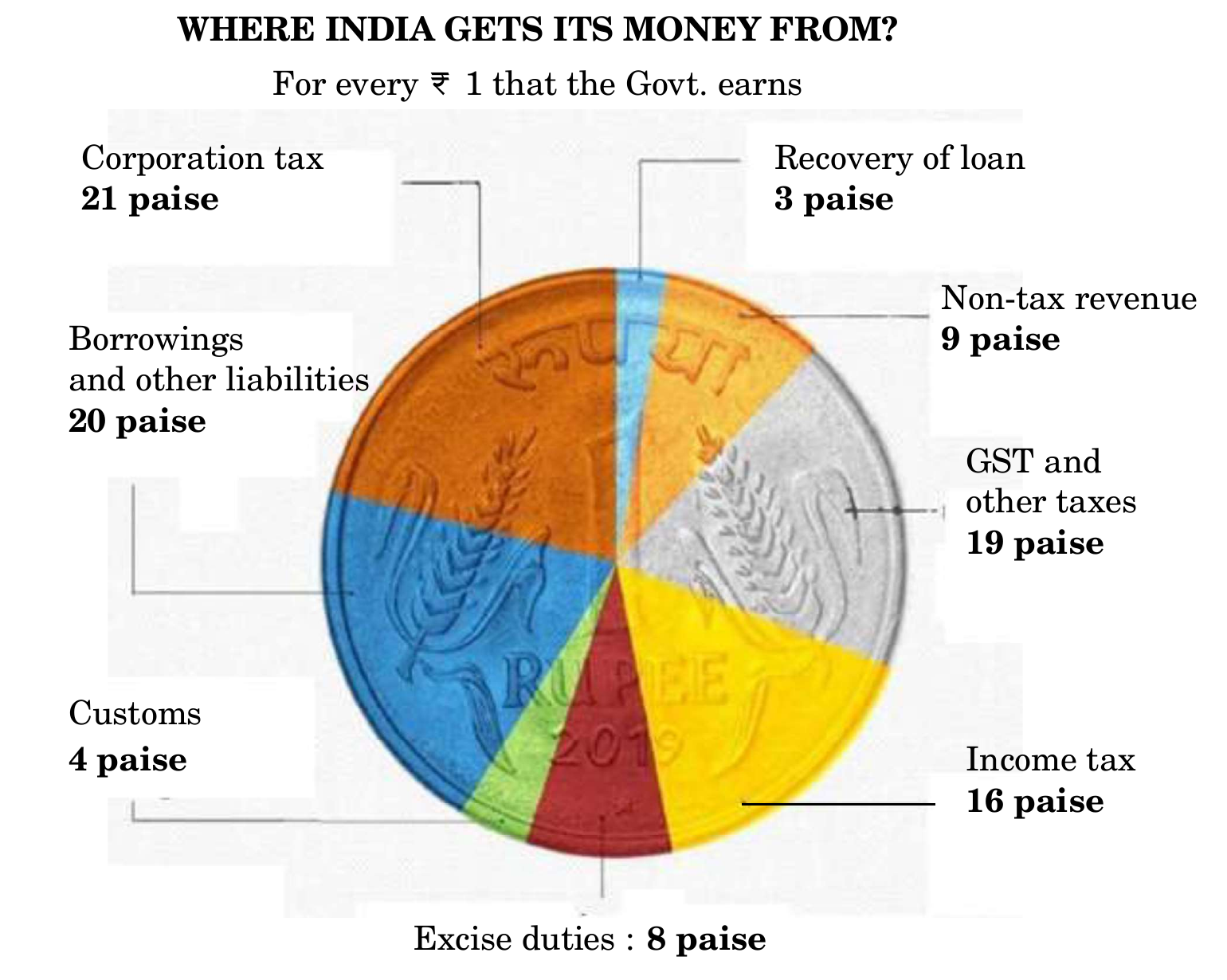
(ii) Distinguish between Revenue deficit and Fiscal deficit.
(i) From the following data, calculate the primary deficit. (i) Revenue deficit ₹ 40 crore (ii) Non-debt creating capital receipts ₹ 190 crore (iii) Tax revenue ₹ 125 crore (iv) Capital expenditure ₹ 220 crore (v) Interest payments ₹ 20 crore (ii) Elaborate 'Economic stability' function of the Government Budget.
Explain the meaning of the following : (a) Revenue deficit (b) Fiscal deficit (c) Primary deficit
Explain the following objectives of government budget : (a) Allocation of resources (b) Reducing income inequalities
What is the difference between revenue expenditure and capital expenditure ? Explain how taxes and government expenditure can be used to influence distribution of income in the society.
What is the difference between direct tax and indirect tax ? Explain the role of government budget in influencing allocation of resources.
Get every solution for all chapters
- Every board question of every chapter, each fully solved the way the board gives marks
- 15 complete board papers, each followed by its solutions
- Weightage and most-asked topics for every chapter
- Instant PDF download, colour and black & white print copies
Revising the chapter first? Complete Economics Notes for Class 12 (NCERT 2026-27, CBSE Board 2027) →
What you get in the pack
- Questions from 129 CBSE Economics papers, 2016 to 2026: every set code available
- Complete: 1783 different questions and parts from all set codes, 14 chapters and 15 full papers
- Part A: all 14 chapters, questions sorted chapter-wise and by marks
- Year-wise weightage table and most-asked topics for every chapter
- Part B: each full board paper followed by its complete solutions
- National income, multiplier, budget and BOP numericals worked step by step
- Questions on topics out of the board syllabus flagged
All chapters in this pack
- PYQ Ch 1 Introduction to Macroeconomics
- PYQ Ch 2 National Income and Related Aggregates
- PYQ Ch 3 Money and Banking
- PYQ Ch 4 Determination of Income and Employment
- PYQ Ch 5 Government Budget and the Economy
- PYQ Ch 6 Open Economy: Balance of Payments and Exchange Rate
- PYQ Ch 7 Indian Economy on the Eve of Independence
- PYQ Ch 8 Indian Economy 1950–1990
- PYQ Ch 9 Liberalisation, Privatisation and Globalisation
- PYQ Ch 10 Human Capital Formation in India
- PYQ Ch 11 Rural Development
- PYQ Ch 12 Employment: Growth, Informalisation and Other Issues
- PYQ Ch 13 Environment and Sustainable Development
- PYQ Ch 14 Comparative Development Experiences of India and its Neighbours
- Board Paper 2026 Set 58-1-1 with Solutions
- Board Paper 2026 Set 58-1-2 with Solutions
- Board Paper 2026 Set 58-1-3 with Solutions
- Board Paper 2026 Set 58-2-1 with Solutions
- Board Paper 2025 Set 58-1-1 with Solutions
- Board Paper 2025 Set 58-2-1 with Solutions
- Board Paper 2024 Set 58-1-1 with Solutions
- Board Paper 2024 Set 58-2-1 with Solutions
- Board Paper 2023 Set 58-1-1 with Solutions
- Board Paper 2022 Term 2 Set 58-1-1 with Solutions
- Board Paper 2020 Set 58-1-1 with Solutions
- Board Paper 2019 Set 58-1-1 with Solutions
- Board Paper 2018 Set 58-1 with Solutions
- Board Paper 2017 Set 58-1 with Solutions
- Board Paper 2016 Set 58-1 with Solutions