
Money and Banking: Class 12 PYQs 2016–2026 with solutions
All 84 CBSE board questions asked from Money and Banking in 22 board papers, with the year, set and marks of each. 43 are solved free below. The Class 12 Economics PYQ Book: Solved Board Papers 2016-2026 (CBSE) has every solution, all chapters and 15 full board papers.

Money and Banking: board weightage
Board weightage 2016–2026
| Year | 2016 | 2017 | 2018 | 2019 | 2020 | 2022 | 2023 | 2024 | 2025 | 2026 |
|---|---|---|---|---|---|---|---|---|---|---|
| Questions | 3 | 5 | 3 | 2 | 4 | – | 6 | 18 | 19 | 24 |
| Marks | 12 | 15 | 6 | 12 | 10 | – | 15 | 42 | 48 | 56 |
Most asked topics
84 questions from 22 papers. Repeated questions are shown once with every year they were asked.
Jump to: 1 mark3 marks4 marks6 marks
1 mark: MCQ and Assertion–Reason
Assertion (A): Money is of perishable nature and is generally accepted by all at any point of time. Reason (R): Money serves as a store of value, facilitating individuals to transfer purchasing power from the present to the future.
Solution
Money is durable, not perishable, so A is false. R is true: money is a store of value. Answer: (D)
"In the Indian Banking System, the Statutory Liquidity Ratio (SLR) plays a vital role in controlling the credit creation capacity of the Commercial Banks, as it __________." (Choose the correct option to fill in the blank)
Solution
SLR is the percentage of deposits banks must keep in liquid assets (cash, gold, approved securities), reducing the funds available for lending. Answer: (B)
'In an economy, the currency held by the public, Net Demand Deposits with Commercial Banks and Net Time Deposits with Commercial Banks stand at ₹ 1,42,000 crore, ₹ 22,000 crore and ₹ 86,000 crore respectively. The value of Money Supply (M1) would be ₹ __________ crore. (Choose the correct option to fill in the blank)
Solution
M1 = Currency with the public + Net demand deposits (+ other deposits with RBI) = 1,42,000 + 22,000 = ₹ 1,64,000 crore. Time deposits are part of M3, not M1. Answer: (C)
Identify, that function of money, which has effectively solved the problem of 'double coincidence of wants' in a transaction.
Solution
Sumit deposited ₹ 10 lakh in his savings account. The deposits made by him is a part of ________ in the M1 measure of money supply. (Choose the correct option to fill in the blank)
Solution
Identify, which one of the following is not a function of Reserve Bank of India as a bank, agent and advisor to the government.
Solution
Statement I: The measurement of value makes it easier to compare the relative worth of two commodities. Statement II: Money facilitates the act of sale and purchase of goods and services. (A) I true, II false (B) I false, II true (C) both true (D) both false
Solution
Primary deposits of ₹ 1,000 lead commercial banks to create credit of ₹ 5,000. The reserve ratio is ______ percent. (A) 10 (B) 20 (C) 25 (D) 40
Solution
RBI performs the function of banker to the banks by acting as a: (i) clearing house (ii) custodian of cash reserves (iii) lender to the government (iv) periodic inspection of banks. (A) (i) and (ii) (B) (ii) and (iii) (C) (i), (ii) and (iv) (D) (i) and (iv)
Solution
Money supply is a ______ variable, as it refers to the total volume of money held by the ______ at a particular point of time. (A) stock, banks (B) flow, banks (C) stock, public (D) flow, public
Solution
If the reserve ratio decreases from 25% to 20%, total deposits would ______ to ₹ ______, if primary deposits are ₹ 1,000. (A) increase, 5,000 (B) decrease, 5,000 (C) increase, 4,000 (D) decrease, 4,000
Solution
Liabilities of a firm are what it owes to others; for a bank, ______ are the main liability. (A) loans (B) reserves (C) deposits (D) assets
Solution
"Irfaan (a student) borrows ₹ 80,000 to finance his college fee. He plans to begin repaying the loan six months after his graduation, making payments over a span of ten years." Based on above text, identify the indicated function of money. (Choose the correct option)
Solution
Future repayments are expressed in money. Answer: (C)
In the context of the Commercial Banks, which of the following statements are correct? (Choose the correct option) (I) Deposits received are liabilities for Commercial Banks. (II) They are creator of credit in the economy. (III) They accept deposits from general public. (IV) They accept deposits on behalf of Reserve Bank of India.
Solution
Banks accept deposits from the public (their liabilities) and create credit; they do not accept deposits on behalf of the RBI. Answer: (A)
The monetary policy is formulated by the _____ in the Indian economy. (Choose the correct option to fill up the blank)
Solution
As the Banker to the Bank, Reserve Bank of India performs all functions except _____. (Choose the correct option to fill up the blank)
Solution
Statement 1: The government may reduce the repo rate to control the deflationary gap. Statement 2: The government may reduce the deflationary gap by selling government securities in the open market. (A) 1 true, 2 false (B) 1 false, 2 true (C) both true (D) both false
Solution
Statement 1: During a deflationary gap, the central bank may increase the repo rate. Statement 2: The government can reduce the deflationary gap by purchasing government securities in the open market. (A) 1 true, 2 false (B) 1 false, 2 true (C) both true (D) both false
Solution
The central bank can decrease the money supply by ______. (A) lowering the cash reserve (B) increasing the bank rate (C) lowering the bank rate (D) purchase of government securities
Solution
If the total credit created by banks is ₹ 500 and the reserve ratio is 20%, primary deposits would be: (A) ₹ 200 (B) ₹ 300 (C) ₹ 100 (D) ₹ 500
Solution
______ releases data on money supply in India. (A) Corporation Bank (B) Reserve Bank of India (C) commercial banks (D) State Bank of India
Solution
Commercial banks are regarded as money creators because: (A) they purchase securities from the central bank (B) loans provided by them create deposits (C) they act as banker to the government (D) they regulate the lending rate
Statement 1: Open market operations refer to purchase/sale of government securities by the central bank. Statement 2: To decrease money supply, the central bank will sell government securities to commercial banks. (A) 1 true, 2 false (B) 1 false, 2 true (C) both true (D) both false
Identify the incorrect feature(s) of money supply (M1) from the following: (i) It is measured at a point of time. (ii) It does not include stock of money held by the government. (iii) It is always the currency in the hands of the Central Bank of a nation.
Find the missing figures and choose the correct alternative:
| Round | Deposits | Loans (80%) | Reserve Ratio (20%) |
|---|---|---|---|
| I | 5000 | 4000 | ..(i).. |
| II | 4000 | ..(ii).. | 800 |
| … | … | … | … |
| Total | ..(iii).. | ..(iv).. | 5000 |
Read the following statements carefully: Statement 1: Money is a commodity which is generally accepted as a medium of exchange. Statement 2: Money solved the problem of double coincidence of wants. In the light of the given statements, choose the correct alternative from the following:
Identify the incorrect statement with reference to Cash Reserve Ratio (CRR):
Statement 1: Reserve ratio and the credit creation process are inversely related. Statement 2: The central bank performs the vital function of controlling the credit creation process. (A) 1 true, 2 false (B) 1 false, 2 true (C) both true (D) both false
Complete the schedule (loans 90%, reserve ratio 10%): Round I: deposits 2000, loans 1800, reserves 200; Round II: deposits (i), loans (ii), reserves 180; Total: deposits (iii), loans (iv), reserves 2000. (A) 2000, 1620, 20000, 18000 (B) 1800, 180, 2000, 18000 (C) 1620, 180, 2000, 18000 (D) 1800, 1620, 20000, 18000
The central bank can reduce the money supply by ______ the ______. (A) increasing, bank rate (B) decreasing, cash reserve ratio (C) decreasing, bank rate (D) buying, government securities
Identify the incorrect feature(s) of money supply: (i) It is measured during a period of time. (ii) It includes stock of money held by the government. (iii) It always represents the currency held with the central bank. (A) (i) only (B) (ii) and (iii) (C) (i) and (ii) (D) (i), (ii) and (iii)
"Mr Sahotra borrowed funds from a bank for purchasing a new house." Identify the function of money indicated: (A) medium of exchange (B) store of value (C) unit of account (D) standard of deferred payments
Initial deposits are ₹ 4,000 crore and the reserve ratio is 10%. Total deposits created would be ₹ ______ crore. (A) 4,000 (B) 40,000 (C) 2,000 (D) 20,000
Read the following statements carefully: Statement 1: Primary deposits are the cash deposits by general public with commercial banks. Statement 2: Secondary deposits are those deposits which arise on account of credit provided by the commercial banks to the people. In light of the given statements, choose the correct alternative from the following:
The rate at which commercial banks borrow from the Reserve Bank of India to meet their long-term requirements is known as ______ (Choose the correct alternative to fill up the blank)
Read the following news report carefully: "The central bank has imposed fine on Hisar Urban Cooperative Bank Ltd. and Andaman and Nicobar State Cooperative Bank Ltd. for violation of banking norms" According to the given report, identify the function of the central bank.
In order to control the money supply in the economy, the Central Bank may ________. (Choose the correct alternative)
Two components of money supply are ________ and ________. (Fill in the blanks with correct answers)
Define money supply.
The central bank can increase availability of credit by : (Choose the correct alternative)
Demand deposits include (Choose the correct alternative)
3 marks: short answer
"Under the provisions stated in the Section 20 and Section 21 of the Reserve Bank of India (RBI) Act, 1934, the RBI is mandated to handle the banking operations of the Government of India." In the light of the given statement, elaborate the indicated function of the Reserve Bank of India.
Solution
The function is banker to the government. The RBI keeps the accounts of the central (and state) governments, receives their deposits and makes payments on their behalf. It handles remittances, exchange and other banking operations for them. It manages public debt and gives credit to the government when needed (e.g. during a financial crisis), so that the government can run smoothly and meet its obligations. It also acts as the government's financial adviser.
"When initial deposits in the credit creation process remains same, the total amount of credit created rises as the value of money multiplier increases." Defend or refute the above statement with the help of hypothetical numerical example.
Solution
| Case | Initial deposit | Money multiplier (1/RR) | Credit created |
|---|---|---|---|
| I (RR 25%) | 1,000 | 4 | ₹ 4,000 |
| II (RR 20%) | 1,000 | 5 | ₹ 5,000 |
With the same initial deposit, a higher multiplier (lower reserve ratio) creates more credit: they are directly related.
"The Central Bank maintains reserves of all commercial banks and use to settle interbank claims." Do you agree with the given statement ? Give valid explanation in support of your answer.
Solution
(a) Define money supply. (b) Explain any one component of money supply.
Solution
(b) Net demand deposits held by commercial banks: chequable deposits (current, savings) which the account-holder can withdraw on demand; they are used as money through cheques. (Or currency held by the public: notes and coins.)
"Repo rate and bank rate are two different measures, but a change in either may have a similar implication on the money supply." Defend or refute.
Solution
"RBI is the sole authority for issuing currency notes in India, except the ₹ 1 denomination, issued by the Ministry of Finance." Do you agree? Explain the rationale behind RBI's monopoly.
Identify and explain any one function of the central bank indicated in the given image (RBI and commercial banks). (Visually impaired: explain any one function of the central bank.)
Explain "difficulty in storing wealth" problem faced in the barter system of exchange.
Explain the "medium of exchange" function of money.
4 marks: case-based / source-based
Refer the given image carefully: Explain any two measures that can be taken by the Central Bank to control the indicated macroeconomic problem.
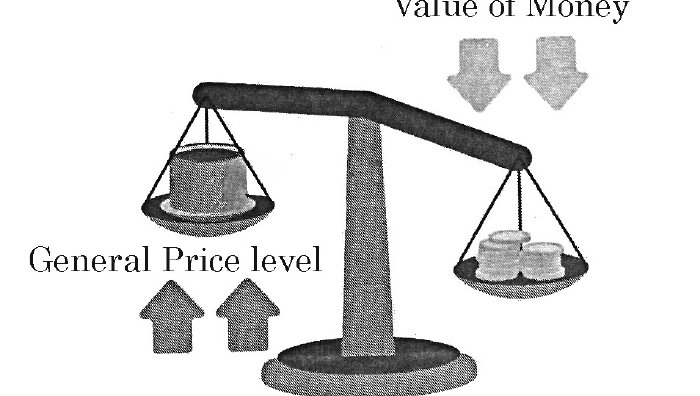
(For Visually Impaired Candidates only, in lieu of Q. No. 15: State and explain any two measures that can be taken by the Central Bank to control the situation of deficient demand.)
Solution
The image shows the general price level rising and the value of money falling: inflation (excess demand).
1. Raise the repo rate: banks' cost of borrowing from the RBI rises, so they raise lending rates. Credit becomes dearer, borrowing and spending fall, and AD falls, checking inflation.
2. Open market operations (sale of securities): the RBI sells government securities, absorbing funds from banks. Their lending capacity falls, so credit and AD fall.
(Visually impaired candidates, deficient demand: the RBI lowers the repo rate and buys securities in the open market, making credit cheaper and more plentiful, which raises AD.)
Read the following text carefully: "The Reserve Bank of India (RBI) announced a 50 basis point Repo Rate cut to 5.50% from 6%." In the light of the given text and common understanding, answer the following questions: (i) Identify the economic issue indicated in the above text. (ii) Explain the likely causes and consequences of this step of RBI on the economy.
Solution
(ii) Cause: the RBI wants to raise aggregate demand to support growth when inflation is under control. Consequences: commercial banks can borrow more cheaply, so they lower their lending rates; credit becomes more affordable, borrowing for consumption and investment rises, and AD, output and employment increase.
"The RBI has decided to increase the loan amount to 90% of the security value from 80%." Identify the monetary measure and its likely impact on aggregate demand.
Solution
"The RBI Governor announced a 50 basis points reduction in the Cash Reserve Ratio (CRR) to 4% during the MPC address on December 6, reflecting a balanced approach towards managing liquidity while ensuring economic stability." (i) Explain the rationale and the likely impact of the decision. (ii) Define CRR.
Solution
(ii) CRR is the percentage of deposits which commercial banks must keep as cash reserves with the central bank.
"To improve growth momentum by stimulating domestic private consumption and investment, RBI announced a reduction in CRR by 100 basis points (1%)." (i) Explain the likely cause behind the step. (ii) Explain its impact on aggregate demand.
Solution
(ii) Lower CRR leaves more funds with commercial banks; their lending capacity and credit creation rise, money supply increases, borrowing for consumption and investment rises, so AD increases.
Suppose in an economy, primary deposits are ₹ 500, if the Reserve Ratio is 25%. Estimate the total deposits created and the total lending by the banking system.
Solution
Money multiplier = 1/RR = 1/0.25 = 4.
Total deposits = 500 × 4 = ₹ 2,000.
Total lending (credit created) = Total deposits − Primary deposits = 2,000 − 500 = ₹ 1,500.
Assuming for a hypothetical economy, Central Bank increases the Reserve Ratio from 20% to 25% and the total primary deposits stand at ₹ 1,000. Explain the effect of rise in Reserve Ratio on credit creation by commercial banks.
Solution
| Case | Reserve ratio | Money multiplier (1/RR) | Total deposits created |
|---|---|---|---|
| I | 20% | 5 | 1,000 × 5 = ₹ 5,000 |
| II | 25% | 4 | 1,000 × 4 = ₹ 4,000 |
A higher reserve ratio means banks must keep more of each deposit as reserves and can lend less in each round. Credit (total deposits) created falls from ₹ 5,000 to ₹ 4,000. Reserve ratio and credit creation are inversely related.
"In the 1990s, on the advice of the RBI, the Government of India decided to pledge (hypothecate) gold reserves to different nations." Discuss briefly the role of the central bank as banker, agent and adviser to the government.
Solution
"Margin requirements are extremely helpful in correcting a deflationary gap." Justify.
Solution
Justify the following statements with valid arguments: (a) The Central Bank is the sole currency issuing authority of an economy. (b) Money serves as a measure of standard of deferred payments.
Solution
(b) Deferred payments are payments to be made in the future, such as repayment of loans, interest, salaries and pensions. Money has general acceptability and a relatively stable value, so loans and future obligations are contracted and settled in money. It thus facilitates borrowing and lending and serves as a standard of deferred payments.
Read the following text carefully from 'The Economic Times' dated 8th June, 2023: The Reserve Bank of India's (RBI's) rate setting panel unanimously decided to keep the benchmark lending rate unchanged at 6·5%. The committee voted to remain focused on the withdrawal of accommodating monetary policy. On the basis of given text and common understanding, answer the following questions: (a) Identify and discuss the economic issue indicated in the above text. (b) Discuss the likely consequence on money supply if the rate setting panel would have decreased the said rate.
Solution
(b) If the repo (benchmark) rate were cut, commercial banks could borrow from the RBI more cheaply and would lower their own lending rates. Cheaper credit would encourage the public and firms to borrow more, so bank credit and hence the money supply would increase (which could fuel inflation further).
Reserve Bank of India undertakes the important function of managing the government's banking transactions. Discuss the above stated function performed by the Reserve Bank of India.
Solution
"Open market operations by the RBI help in regulating money supply in the economy." Justify with valid arguments.
Solution
Elaborate the "Government's bank and advisor" function of the central bank.
Solution
Elaborate the "banker's bank and supervisor" function of the RBI.
"With the objective to correct deflation, the RBI may decrease the bank rate." Discuss the rationale.
"Open market operations by the RBI help in regulating money supply." Justify.
Read the following news published on September 26, 2022: "The central bank has increased the benchmark lending rate by 140 basis points" Identify the likely cause and consequences behind this action taken by the Reserve Bank of India.
Explain the 'Government's Bank' function of the central bank.
Using a hypothetical numerical example, explain the effect of rise in Reserve Ratio on credit creation by the commercial banks.
Using a hypothetical numerical example, explain the process of credit creation by a commercial bank.
"Central Bank acts as the banker to the government." Elaborate the given statement.
Explain the role of the Reserve Bank of India as the "lender of last resort".
Explain the "bankers' bank" function of the central bank.
Explain the process of credit creation by commercial banks.
Explain the medium of exchange function of money. How has it solved the related problem created by barter ?
Explain the standard of deferred payment function of money. How has it solved the related problem created by barter ?
Explain how Repo Rate can be helpful in controlling credit creation.
6 marks: long answer
Read the passage on banks (a bank accepts deposits and advances loans; commercial and central banks; banks keep a fraction of deposits as reserves; the central bank controls credit; RBI regulates money supply through monetary policy). (i) State the meaning of a bank. (ii) Mention any two traits that distinguish the central bank from commercial banks. (iii) "Open market operation is the tool used by the RBI to regulate money supply." Justify.
Solution
(ii) (1) Commercial banks deal directly with the public (deposits and loans); the central bank does not deal with the public, it deals with banks and the government. (2) Commercial banks create credit; the central bank controls credit creation. (Also: the central bank issues currency and is not profit-driven.)
(iii) When the RBI sells government securities, funds of commercial banks fall and their lending capacity is curtailed, so money supply falls. When it buys securities, banks' funds and lending capacity rise, so money supply rises. Thus OMO regulates money supply.
Read the following text carefully: Union Food and Consumer Affairs Minister said that the Central Government has taken many proactive steps in the past few years to control retail prices of food items. He said that the government aims to keep inflation under control without compromising the country's economic growth. Retail inflation inched up to a three-month high of 5.55% in November 2023 driven by higher food prices. Inflation has been declining since August 2023, when it touched 6.83%. 140 new price monitoring centres had been set up by the Central Government to keep a close watch on wholesale and retail prices of essential commodities. The Government has banned the export of many food items like wheat, broken rice, non-basmati white rice, onions etc. It has also reduced import duties on edible oils and pulses to boost domestic supply and control price rise. On the basis of the given text and common understanding, answer the following questions: (a) Mention the number of new price monitoring centres set up by government. (b) State any two proactive measures taken by government to boost domestic supply and reduction in prices. (c) Explain any one monetary measure used to control inflation.
Solution
(a) 140 new price monitoring centres.
(b) (i) A ban on the export of many food items (wheat, broken rice, non-basmati white rice, onions). (ii) Reduction of import duties on edible oils and pulses.
(c) Raising the repo rate: commercial banks' cost of borrowing from the RBI rises, so they raise their lending rates. Credit becomes costlier, borrowing and spending by the public fall, and aggregate demand falls, controlling inflation. (Also: selling securities through open market operations; raising the CRR.)
(a) Elaborate the process of credit creation with a suitable numerical example. (b) "This function of money provides different items to be evaluated against a common standard. It allows comparison of prices and keeping financial records." (i) Identify the function. (ii) List any two other functions of money.
Solution
| Round | Deposits | Loans (80%) | Reserves (20%) |
|---|---|---|---|
| I | 1,000 | 800 | 200 |
| II | 800 | 640 | 160 |
| III | 640 | 512 | 128 |
| … | … | … | … |
| Total | 5,000 | 4,000 | 1,000 |
Total deposits = primary deposits × 1/reserve ratio = 1,000 × 1/0.2 = ₹ 5,000. The process continues until total reserves equal the primary deposit (₹ 1,000).
(b) (i) Unit of account (measure of value). (ii) Medium of exchange; standard of deferred payments (also store of value).
(a) "In a country, routine economic operations rely on a stable medium to facilitate transactions." Discuss the indicated function of money. (b) State the meaning and components of the M1 measure of money supply. (c) State the formula for the credit multiplier.
(a) State any two components of M1 measure of money supply. (b) Elaborate any two instruments of Credit Control, as exercised by the Reserve Bank of India.
Define Credit Multiplier. What role does it play in determining the credit creation power of the banking system ? Use a numerical illustration to explain.
Get every solution for all chapters
- Every board question of every chapter, each fully solved the way the board gives marks
- 15 complete board papers, each followed by its solutions
- Weightage and most-asked topics for every chapter
- Instant PDF download, colour and black & white print copies
Revising the chapter first? Complete Economics Notes for Class 12 (NCERT 2026-27, CBSE Board 2027) →
What you get in the pack
- Questions from 129 CBSE Economics papers, 2016 to 2026: every set code available
- Complete: 1783 different questions and parts from all set codes, 14 chapters and 15 full papers
- Part A: all 14 chapters, questions sorted chapter-wise and by marks
- Year-wise weightage table and most-asked topics for every chapter
- Part B: each full board paper followed by its complete solutions
- National income, multiplier, budget and BOP numericals worked step by step
- Questions on topics out of the board syllabus flagged
All chapters in this pack
- PYQ Ch 1 Introduction to Macroeconomics
- PYQ Ch 2 National Income and Related Aggregates
- PYQ Ch 3 Money and Banking
- PYQ Ch 4 Determination of Income and Employment
- PYQ Ch 5 Government Budget and the Economy
- PYQ Ch 6 Open Economy: Balance of Payments and Exchange Rate
- PYQ Ch 7 Indian Economy on the Eve of Independence
- PYQ Ch 8 Indian Economy 1950–1990
- PYQ Ch 9 Liberalisation, Privatisation and Globalisation
- PYQ Ch 10 Human Capital Formation in India
- PYQ Ch 11 Rural Development
- PYQ Ch 12 Employment: Growth, Informalisation and Other Issues
- PYQ Ch 13 Environment and Sustainable Development
- PYQ Ch 14 Comparative Development Experiences of India and its Neighbours
- Board Paper 2026 Set 58-1-1 with Solutions
- Board Paper 2026 Set 58-1-2 with Solutions
- Board Paper 2026 Set 58-1-3 with Solutions
- Board Paper 2026 Set 58-2-1 with Solutions
- Board Paper 2025 Set 58-1-1 with Solutions
- Board Paper 2025 Set 58-2-1 with Solutions
- Board Paper 2024 Set 58-1-1 with Solutions
- Board Paper 2024 Set 58-2-1 with Solutions
- Board Paper 2023 Set 58-1-1 with Solutions
- Board Paper 2022 Term 2 Set 58-1-1 with Solutions
- Board Paper 2020 Set 58-1-1 with Solutions
- Board Paper 2019 Set 58-1-1 with Solutions
- Board Paper 2018 Set 58-1 with Solutions
- Board Paper 2017 Set 58-1 with Solutions
- Board Paper 2016 Set 58-1 with Solutions