
National Income and Related Aggregates: Class 12 PYQs 2016–2026 with solutions
All 98 CBSE board questions asked from National Income and Related Aggregates in 23 board papers, with the year, set and marks of each. 51 are solved free below. The Class 12 Economics PYQ Book: Solved Board Papers 2016-2026 (CBSE) has every solution, all chapters and 15 full board papers.

National Income and Related Aggregates: board weightage
Board weightage 2016–2026
| Year | 2016 | 2017 | 2018 | 2019 | 2020 | 2022 | 2023 | 2024 | 2025 | 2026 |
|---|---|---|---|---|---|---|---|---|---|---|
| Questions | 4 | 4 | 4 | 3 | 4 | 5 | 4 | 17 | 28 | 28 |
| Marks | 14 | 21 | 13 | 12 | 16 | 18 | 13 | 53 | 106 | 77 |
Most asked topics
101 questions from 23 papers. Repeated questions are shown once with every year they were asked.
Jump to: 1 mark2 marks3 marks4 marks5 marks6 marks
1 mark: MCQ and Assertion–Reason
In an economy, exclusion of ___________ may lead to under estimation of the value of Gross Domestic Product (GDP). (Choose the correct option to fill in the blank) (i) Barter Transactions (ii) Services provided by family members (iii) Illegal activities (iv) Depreciation of Assets
Solution
Barter transactions and unpaid family services are genuine production left out of GDP because they are non-monetary. Illegal activities are deliberately excluded, and depreciation is part of GDP anyway. Answer: (A)
Read the following statements carefully: Statement 1: Final goods are those goods which normally lose their identity in the production process. Statement 2: Final goods may get transformed during the consumption process by a consumer. (Choose the correct option)
Solution
Goods that lose their identity in production are intermediate goods, so Statement 1 is false. A final good may be transformed while being consumed (e.g. a consumer cooking vegetables), so Statement 2 is true. Answer: (B)
Income generated from Aircrafts of Air India operating between Canada and England would be added to the domestic income (NDPFC) of ________. (Choose the correct option to fill in the blank)
Solution
Read the following Flow chart carefully and choose the correct option:
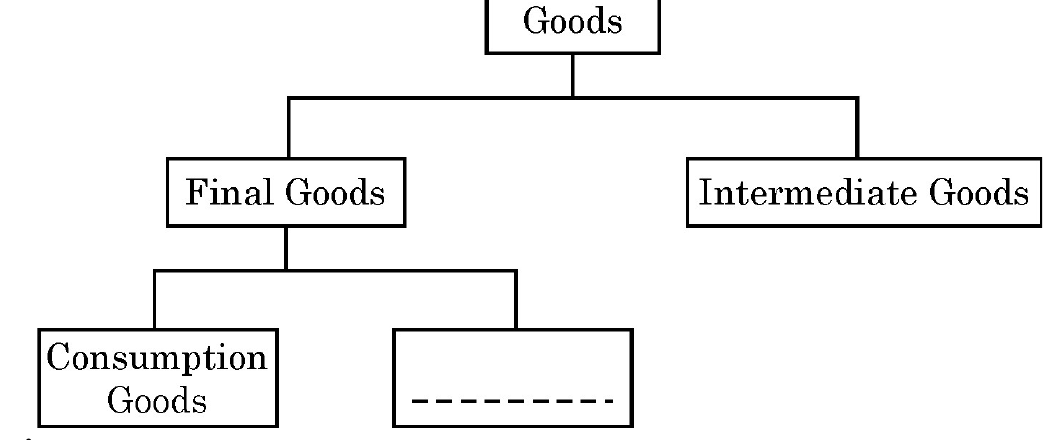
Solution
Read the following statements carefully: Statement 1: Brokerage earned by a dealer of second hand cars is included in the estimation of National Income. Statement 2: Imputed value of production for self-consumption is included in National Income. In the light of the above given statements, choose the correct option from the following:
Solution
Identify the variable(s) that may add to the future productive capacity of an economy: I. raw material II. fixed investment III. inventories with producers. (A) only I (B) only II (C) II and III (D) I, II and III
Solution
From the table (farmer: production 100, intermediate consumption 0, value added 100; baker: production 200, intermediate consumption 50, value added (i)), estimate the value added by the baker. (A) 200 (B) 250 (C) 100 (D) 150
Solution
To arrive at National Income (NNPFC), ______ must be added to ______ at factor cost. (A) depreciation, NDP (B) depreciation, GDP (C) NFIA, NDP (D) net indirect taxes, GDP
Solution
"MoSPI is revising the base year of GDP to better capture structural changes; the proposed new base year is 2022–23." The step is for revision of ______ GDP, as it is measured at ______ prices. (A) real, constant (B) nominal, current (C) real, current (D) nominal, constant
Solution
Arrange the steps of the value added method: (i) calculate NDPFC by subtracting depreciation and NIT from GDPMP (ii) estimate GDPMP by adding GVA of each firm (iii) add NFIA to NDPFC to get NNPFC (iv) identify and classify production units into sectors. (A) ii, iii, i, iv (B) iv, ii, i, iii (C) iv, ii, iii, i (D) iii, iv, ii, i
Solution
Statement I: Positive externalities refer to benefits a firm/individual provides to another for which they are paid. Statement II: In case of positive externalities, GDP might overestimate the actual welfare. (A) I true, II false (B) I false, II true (C) both true (D) both false
Solution
From the items given in Column-I and Column-II, choose the correct pair. Column-I: (a) Income from Property (b) Income from Entrepreneurship (c) Mixed Income (d) Compensation of Employees. Column-II: (i) Old age pension (ii) Profit (iii) Rent free accommodation from an employer (iv) Interest from capital
Solution
Profit is income from entrepreneurship. (Old-age pension is a transfer; rent-free accommodation is compensation of employees in kind; interest is income from property.) Answer: (B)
Value Addition = _____ – Value of Intermediate Consumption. (Choose the correct option(s) to complete the stated formula.) (i) Domestic sales (ii) Sales – change in stock (iii) Value of output (iv) (Number of units produced) × (Price per unit)
Solution
To arrive at GVAFC, ______ must be ______ to/from GVAMP. (A) depreciation, added (B) depreciation, subtracted (C) net indirect taxes, added (D) net indirect taxes, subtracted
Which item will not be included in estimating the national income of India? (A) salary to Indian residents working at the Russian Embassy in India (B) income from smuggling (C) payments to farm workers in the form of food grains (D) interest paid by a firm to a bank
Complete the table: 2014-15 (base): nominal GDP 6.5, real GDP (i), GDP deflator 100; 2016-17: nominal GDP 9, real GDP 7.2, GDP deflator (ii). (A) 125, 100 (B) 125, 110 (C) 6.5, 125 (D) 100, 6.5
Identify the correct equation from the following:
Read the following statements carefully: Statement 1: Economic territory and political frontier of a nation are one and the same thing. Statement 2: American Embassy in India is a part of the economic territory of India. In the light of the given statements, choose the correct alternative from the following :
Identify the incorrect statement with reference to an economy: (A) Excess of GNP over GDP is possible (B) Excess of GDP over GNP is possible (C) Equality between GNP and GDP is possible (D) Sum of GNP and GDP is always equal to zero
Assertion (A): Real GDP is a better indicator of economic growth than nominal GDP. Reason (R): Real GDP measures the value of goods and services at current year prices. (A) Both true, R explains A (B) Both true, R does not explain A (C) A true, R false (D) A false, R true
Which of the following is not a normal resident of India? (A) An Indian citizen working in the USA embassy in New Delhi (B) Indian officials working in the Indian embassy in China (C) Indian diplomats visiting Canada for a summit (D) An Indian working in an American company in New York for more than one year
The difference between National Income at market price and National Income at factor cost is ________. (Choose the correct alternative to fill up the blank)
State whether the following statement is true or false : "Expected obsolescence is included in depreciation."
Which of the following affects national income ? (Choose the correct alternative)
National income is the sum of factor incomes accruing to : (Choose the correct alternative)
2 marks: very short answer
Using a suitable example, distinguish between positive externalities and negative externalities.
Solution
Positive externalities are benefits caused by one person or firm to others, for which the beneficiaries do not pay. Negative externalities are harms caused to others, for which the person causing them is not penalised.
Example: a new park developed by the municipal corporation raises the welfare of residents (positive). If the same park becomes a spot for anti-social activities that make residents feel unsafe, that is a negative externality.
3 marks: short answer
Meera and Shahid are two classmates, who were comparing India's economic growth over the years. Meera referred to the increase in Gross Domestic Product (GDP) at current prices prevailing in market, while Sahid insisted on considering GDP after adjusting for inflation. Their debate on which of the two measures gives a true picture of people's well-being, remained inconclusive. Considering the above mentioned situation, elaborate with valid reason, which of the two variables is considered a better indicator of welfare and why?
Solution
GDP after adjusting for inflation (real GDP) is the better indicator of welfare.
Real GDP is measured at constant (base-year) prices, so it changes only when the physical output of goods and services changes. Nominal GDP (at current prices) can rise merely because prices rise, even if output does not, and then overstates growth. Since welfare depends on the quantity of goods and services available to people, real GDP gives the truer picture.
Two friends, Ravi and Harry were discussing whether the money received from sale of an old car should be included in India's National income. Ravi was of the view that it should be included in India's National income while Harry did not agree with him. They also had difference of opinion on the treatment of brokerage paid to the car dealer. As their Economics teacher, state the treatments with valid arguments.
Solution
Harry is correct. The sale of an old car is not included in national income, because the car's value was counted in the year it was produced; its resale adds nothing to current production.
The brokerage paid to the car dealer is included, because it is payment for a productive service rendered in the current year.
Calculate compensation of employees from the data given below: (₹ crore) (i) Interest 45 (ii) Profits after tax 20 (iii) Consumption of fixed capital 50 (iv) Gross Domestic Product at market price (GDPMP) 200 (v) Rent 25 (vi) Corporate tax 5 (vii) Goods and Services tax 10
Solution
NDPFC = COE + rent + interest + profit (corporate tax + profit after tax)
140 = COE + 25 + 45 + 5 + 20, so COE = ₹ 45 crore.
State the meaning and any two components of gross domestic capital formation.
Solution
"It is not the nature of a good, but the economic nature of its use, which determines whether it is a final good or not." Justify.
Solution
Estimate GDPFC (₹ crore): (i) private final consumption expenditure 800 (ii) government final consumption expenditure 700 (iii) net imports 200 (iv) gross public investment 100 (v) inventory investment 50 (vi) gross residential construction investment 300 (vii) net indirect taxes 70 (viii) gross business fixed investment 130 (ix) consumption of fixed capital 20 (x) interest 150 (xi) net factor income paid to abroad 100
Solution
GDPFC = GDPMP − NIT = 1,880 − 70 = ₹ 1,810 crore. (CFC, interest and NFIA are not needed: investment is already gross and the aggregate is domestic.)
Explain any two precautions to be kept in mind while estimating national income by the income method.
Solution
Estimate income from property and entrepreneurship (₹ crore): (i) wages and salaries 1,300 (ii) rent 700 (iii) employer's contribution to social security 300 (iv) royalty 200 (v) corporate tax 100 (vi) interest 350 (vii) consumption of fixed capital 50 (viii) dividends 150 (ix) savings of private corporate sector 200
Solution
Calculate the value of Net Value Added at Factor Cost (NVAFC): (₹ crore) (i) Operating Surplus 3,740 (ii) Increase in unsold stock 600 (iii) Sales 10,625 (iv) Purchase of raw materials 2,625 (v) Consumption of fixed capital 500 (vi) Subsidies 400 (vii) Indirect taxes 1,200
Solution
Value of output = Sales + Change in stock = 10,625 + 600 = 11,225.
GVAMP = 11,225 − 2,625 = 8,600; NVAMP = 8,600 − 500 = 8,100.
NVAFC = NVAMP − Net indirect taxes = 8,100 − (1,200 − 400) = ₹ 7,300 crore.
(Operating surplus is not needed.)
State the meaning and significance of Gross Domestic Product (GDP) deflator.
Solution
Explain any two precautions for the expenditure method of estimating national income.
Solution
From the data (₹ crore): nominal GDP 2020-21 3,000, 2022-23 4,000; nominal GDP adjusted to base-year prices 5,000 and 6,000, calculate the percentage change in real GDP in 2022-23 with 2020-21 as base year.
Solution
% change in real GDP = (6,000 − 5,000) ÷ 5,000 × 100 = 20%.
State the steps for estimating national income by the income method.
Solution
Calculate domestic income (NDPFC) (₹ lakh): (i) GNPMP 2,500 (ii) consumption of fixed capital 200 (iii) GST 20 (iv) subsidies 50 (v) NFIA 50 (vi) changes in stock 30 (vii) unexpected loss of a fixed asset 500
Solution
= 2,500 − 200 − 50 − (20 − 50) = 2,250 + 30 = ₹ 2,280 lakh.
(Change in stock is already part of GNP; the unexpected loss of an asset is a capital loss, not part of depreciation.)
Define net factor income from abroad (NFIA) and discuss its components.
Solution
Calculate the value of sales (₹ lakh): (i) subsidies 200 (ii) operating surplus 500 (iii) opening stock 100 (iv) closing stock 600 (v) intermediate consumption 3,000 (vi) consumption of fixed capital 700 (vii) profits 750 (viii) NVAFC 2,000
Solution
2,000 = sales + (600 − 100) − 3,000 − 700 + 200
Sales = 2,000 − 500 + 3,000 + 700 − 200 = ₹ 5,000 lakh.
State and explain any two precautions while estimating national income by the income method.
Solution
On the basis of the data given below for an imaginary economy, estimate the value of Net Domestic Product at Factor Cost (NDPFC): (₹ crore) (i) Gross Domestic Fixed Capital Formation 200 (ii) Exports 50 (iii) Government Final Consumption Expenditure 320 (iv) Consumption of Fixed Capital 35 (v) Household Final Consumption Expenditure 470 (vi) Inventory Investment (Net) (-)40 (vii) Imports 60 (viii) Net Indirect Taxes 50 (ix) Net Factor Income from Abroad 20
Solution
= 470 + 320 + 200 + (−40) + (50 − 60) − 35 − 50
= 940 − 35 − 50 = ₹ 855 crore. (NFIA is not used for a domestic aggregate.)
(i) Elaborate the concept of Externalities with the help of suitable example. (ii) Define Operating Surplus.
On the basis of the data given below, estimate the value of Gross National Product at Factor Cost (GNPFC): (₹ crore) (i) Wages and Salaries 2,000 (ii) Rent and Interest 700 (iii) Corporate Tax 500 (iv) Undistributed Profit 300 (v) Consumption of Fixed Capital 150 (vi) Dividend 200 (vii) Net factor income from abroad (-) 50
Estimate National Income (₹ crore): (i) government final consumption expenditure 110 (ii) private final consumption expenditure 200 (iii) gross domestic fixed capital formation 30 (iv) net exports (−)40 (v) increase in stock 20 (vi) consumption of fixed capital 15 (vii) indirect taxes 60 (viii) subsidies 15 (ix) NFIA (−)40
State any three precautions to be taken while estimating national income by the expenditure method.
Estimate NNPFC (₹ crore): (i) household consumption expenditure 1,200 (ii) business fixed investment 800 (iii) government final consumption expenditure 500 (iv) excess of imports over exports 100 (v) net indirect taxes 150 (vi) change in inventory (−)50 (vii) consumption of fixed capital 200 (viii) NFIA 80 (ix) public fixed investment 70
Calculate net value added at factor cost (₹ lakh): (i) fixed capital goods 15 (expected life 5 years) (ii) domestic sales 200 (iii) change in stock (−)10 (iv) exports 10 (v) single-use producer goods 120 (vi) net indirect taxes 20
Estimate net indirect taxes (₹ crore): (i) NNPMP 1,400 (ii) NFIA (−)20 (iii) GNPFC 1,300 (iv) consumption of fixed capital 100
Distinguish between 'Value Addition' and 'Final Value of Output'.
Find the Value Added by Firm A, from the following information: (i) Purchase of factor inputs by Firm A ₹ 5 crore (ii) Purchase of non-factor inputs by Firm A ₹ 2 crore (iii) Sales by Firm A to other firms in the domestic economy ₹ 10 crore (iv) Import of raw materials by firm A from rest of the world ₹ 50 crore (v) Excess of opening stock over closing stock ₹ 3 crore
Estimate the value of Nominal Gross Domestic Product (GDP) for a hypothetical economy. The values of Real Gross Domestic Product (GDP) and Price Index are given as ₹ 500 crore and 125 respectively.
Giving valid reasons explain, which of the following will not be included in the estimation of National Income of India ? (i) Purchase of shares of Sethi Ltd. by an investor in the Bombay Stock Exchange. (ii) Salaries paid by Indian Embassy situated at Japan, to the local workers. (iii) Depreciation on capital assets charged by firms.
"Final goods include only those goods which are consumed by the households." Defend or refute the given statement with valid reason.
Define the problem of double counting in the computation of national income. State any two approaches to correct the problem of double counting.
"Gross Domestic Product (GDP) does not give us a clear indication of economic welfare of a country." Defend or refute the given statement with valid reason.
Which among the following are final goods and which are intermediate goods ? Give reasons. (a) Milk purchased by a tea stall (b) Bus purchased by a school (c) Juice purchased by a student from the school canteen
Given nominal income, how can we find real income ? Explain.
Explain with the help of an example, the basis of classifying goods into final goods and intermediate goods.
Assuming real income to be ₹ 200 crore and price index to be 135, calculate nominal income.
4 marks: case-based / source-based
For a hypothetical economy, assuming there are only two firms (X and Y) with equal values of Gross Value Added (GVA). On the basis of the following data, estimate the value of Domestic Sales of both the firms (X and Y): (₹ crore) (i) Value of Output of firm Y 700 (ii) Purchases by firm X from firm Y 200 (iii) Exports by firm X 100 (iv) Purchases by firm Y from firm X 150 (v) Additions to Stock of firm X 50
Solution
GVA of Y = Value of output − Intermediate consumption (purchases from X) = 700 − 150 = ₹ 550 crore.
No exports or change in stock are given for Y, so its value of output equals its domestic sales: Domestic sales of Y = ₹ 700 crore (= GVA 550 + intermediate consumption 150).
GVA of X = GVA of Y = ₹ 550 crore. Intermediate consumption of X = purchases from Y = ₹ 200 crore.
Value of output of X = 550 + 200 = ₹ 750 crore = Domestic sales + Exports + Change in stock.
Domestic sales of X = 750 − 100 − 50 = ₹ 600 crore.
Ms. Reeta D'Costa, retired from the post of Income Tax Commissioner in the year 2023. Apart from her pension, she also receives the following from various sources : • Rental income from a flat she owns. • Interest income from her fixed deposits. • Money sent by her children settled abroad. Identify and classify, her monthly incomes into 'factor income' and 'transfer income', with valid reasons.
Solution
Factor income (earned by providing factor services): rental income from her flat (land/building), interest on fixed deposits (capital), and her retirement pension (a deferred payment for her past services as an employee).
Transfer income (received without any productive service in return): money sent by her children settled abroad.
Read the following text carefully: "A country's total National Income (NI) at the end of the year is ₹ 80,000 crore. During the same year, the Gross Domestic Product (GDP) increased by ₹ 10,000 crore. The depreciation on capital goods was ₹ 2,000 crore and National savings at the end of year is ₹ 15,000 crore. Additionally, country invested ₹ 8,000 crore in new capital goods industries." In the light of above text, categorise the items as 'stock' or 'flow' variables with valid arguments.
Solution
The value of Nominal Gross National Product (GNP) of an economy was ₹ 2,500 crore in a particular year. The value of Gross National Product (GNP) of that country during the same year, estimated at the prices of base year was ₹ 3,000 crore. (i) Estimate the value of Gross National Product (GNP) deflator (in percentage). (ii) "The price level has risen between the base year and the year under consideration." Defend or refute the statement with suitable argument.
Solution
(ii) Refuted. A deflator below 100 means current prices are lower than base-year prices: the price level has fallen by about 16.67% (100 − 83.33).
Tech Info Ltd buys machinery from Germany to make printers, which are sold to households and dealers at home and abroad. "The machinery purchased and printers manufactured, both are final goods." Do you agree?
(i) Define gross investment. (ii) Identify two components of gross investment shown in the image (a flyover under construction and a residential housing complex). (iii) Explain any one component. (Visually impaired: explain any two components of gross investment.)
Justify the following statements with valid arguments : (i) Money supply in an economy is an example of a stock variable. (ii) The Central Bank provides several Banking services to the government.
Sale of petrol and diesel cars is rising particularly in big cities. Analyse its impact on gross domestic product and welfare.
5 marks: long answer
(i) From the following data, calculate the value of Gross National Product at Factor Cost (GNPFC): (i) Compensation of Employees ₹ 12,000 crore (ii) Rent and Interest 1,800 (iii) Indirect taxes 1,120 (iv) Profits 1,500 (v) Depreciation 1,100 (vi) Subsidies 210 (vii) Net Factor Income from Abroad (–)120 (viii) Mixed Income of Self Employed 1,300 (ii) Distinguish between Rent and Royalty.
Solution
(i) Income method:
GNPFC = Compensation of employees + Rent and interest + Profits + Mixed income + Depreciation + NFIA
= 12,000 + 1,800 + 1,500 + 1,300 + 1,100 + (−120) = ₹ 17,580 crore
(Indirect taxes and subsidies are not used at factor cost.)
(ii) Rent is the factor income earned by owners of land and buildings for allowing others to use them. Royalty is income earned for allowing others to use intellectual property (patents, copyrights) or sub-soil assets (mines).
(i) Calculate the value of 'Net Value Added at Factor Cost' (NVAFC) using the given data (₹ '000): (i) Sale of Rice in the market 580 (ii) Purchase of Tractor and Thrasher 400 (iii) Procurement of Rice by the government 20 (iv) Self consumption of Rice during the year 15 (v) Expenditure on running and maintenance of Tractor and Thrasher 20 (vi) Fertilizer subsidies received from the government 3 (ii) Distinguish between 'value of output' and 'value addition'.
Solution
(i) Value of output = sales 580 + procurement 20 + self-consumption 15 = 615.
Intermediate consumption = running and maintenance 20.
NVAFC = 615 − 20 + subsidy 3 = ₹ 598 thousand. (The tractor is a capital good, not intermediate consumption; no depreciation is given.)
(ii) Value of output is the money value of all goods and services produced, including change in stock and production for self-consumption. Value added is value of output minus intermediate consumption: the firm's own contribution.
6 marks: long answer
Calculate operating surplus and GDPMP (₹ crore): (i) rent 120 (ii) profits 200 (iii) domestic income 720 (iv) mixed income 70 (v) wages and salaries 300 (vi) indirect taxes 150 (vii) subsidies 50 (viii) consumption of fixed capital 200 (ix) interest 30 (x) dividend 120 (xi) NFIA 20
Solution
GDPMP = domestic income (NDPFC) + CFC + (indirect taxes − subsidies) = 720 + 200 + (150 − 50) = ₹ 1,020 crore. (NFIA is not needed for domestic aggregates.)
(i) Distinguish between real GDP and nominal GDP with a numerical example. (ii) Define externalities.
Solution
| Year | Price (₹) | Output | Real GDP (P0Q) | Nominal GDP (PQ) |
|---|---|---|---|---|
| 2022 (base) | 10 | 100 | 1,000 | 1,000 |
| 2025 | 15 | 100 | 1,000 | 1,500 |
Output is unchanged, so real GDP is unchanged; nominal GDP rose 50% only because of higher prices.
(ii) Externalities are benefits or harms caused by one entity to others without being paid or penalised for them.
Read the passage (domestic product measures the value of goods and services arising within a country; national income is income earned by factors of production; national income at current prices reflects both output and price changes; to eliminate prices it is recomputed at base-year prices: national income at constant prices). (i) Differentiate between domestic product and national product. (ii) "National income measured at constant prices is a better measure of the overall real increase in production." Justify.
Solution
(ii) National income at constant prices values output at base-year prices, so it changes only when physical output changes; the effect of price changes is eliminated and it shows the real growth of the economy. National income at current prices may rise only because prices rise, with no rise in output, so it overstates growth.
(i) Explain any two precautions to be adopted while estimating National Income by Expenditure method. (ii) "Higher Gross Domestic Product (GDP) always means higher per capita availability of goods in the economy." Defend or refute the given statement as the index of welfare of the people of that country.
Solution
(i) 1. Expenditure on intermediate goods must not be included, as it causes double counting. 2. Expenditure on second-hand goods must not be included, as it adds nothing to current production. (Also exclude transfer payments and purchase of financial assets.)
(ii) Refuted. A rise in GDP need not raise per capita availability of goods or welfare: if the extra income goes to a few rich people, most people may get no more goods (their income may even fall). If population grows faster than GDP, per capita availability falls. Hence higher GDP does not always mean higher welfare.
(i) Distinguish between Stock and flow variables, using suitable examples. (ii) Explain the components of 'Profit' as per Income Method of estimating National Income (NNPFC).
Solution
(i) Stock variables are measured at a point of time, e.g. national wealth, capital. Flow variables are measured over a period of time, e.g. national income, investment.
(ii) Profit has three components:
• Corporate (profit) tax: tax paid by companies on their profits.
• Dividends: the part of profit distributed among shareholders.
• Undistributed profits (retained earnings): the part kept by the firm for future use.
(i) On the basis of the data given below, estimate the value of National Income (NNPFC): (₹ in crore) (1) Private final consumption expenditure 2,000 (2) Government final consumption expenditure 1,500 (3) Gross domestic fixed capital formation 1,000 (4) Addition to stock 400 (5) Consumption of fixed capital 50 (6) Net factor income from abroad 100 (7) Net indirect Taxes 200 (8) Net Exports 700 (ii) Differentiate between Real flow and Money flow.
Solution
NNPFC = 5,600 − 50 + 100 − 200 = ₹ 5,450 crore.
(ii) Real flow: the flow of factor services from households to firms and of goods and services from firms to households. Money flow: the flow of money as factor payments (rent, wages, interest, profit) from firms to households and as payment for goods and services (consumption expenditure) from households to firms.
(i) Gauhar, has recently completed her fashion designing studies and started a boutique. To produce dresses for sale, she purchased various materials, including a sewing machine, fabric, buttons and thread. These items are essential for producing the dresses. Classify the material purchased by Gauhar as Final or Intermediate goods, giving valid reasons in support of the classifications. (ii) "National Income is always equal to Domestic income in a two sector economy." Defend or refute the given statement with valid reasons.
Solution
(ii) Defended. National income = domestic income + NFIA. A two-sector economy (households and firms only) is a closed economy with no dealings with the rest of the world, so NFIA = 0 and national income equals domestic income.
(i) Three firms X, Y and Z: X sold goods worth ₹ 20,000 to Y and ₹ 12,000 to Z; Y sold goods worth ₹ 11,000 to X and ₹ 35,000 to Z; Z sold goods worth ₹ 57,000 to households for final consumption. Calculate GDPMP. (ii) Elaborate the likely impact of construction of two new express highways on GDP and welfare.
Solution
| Firm | Value of output | Intermediate consumption | Value added |
|---|---|---|---|
| X | 20,000 + 12,000 = 32,000 | 11,000 | 21,000 |
| Y | 11,000 + 35,000 = 46,000 | 20,000 | 26,000 |
| Z | 57,000 | 12,000 + 35,000 = 47,000 | 10,000 |
| Total | 1,35,000 | 78,000 | 57,000 |
GDPMP = sum of value added = ₹ 57,000 (equal to the final consumption expenditure).
(ii) Building the highways adds to output and employment directly; better infrastructure attracts more investment, so GDP rises. Highways reduce travel time and transport costs and connect markets, which raises the well-being of citizens (positive externality), so welfare also rises (though there may be some negative effects such as loss of green cover or noise).
(i) Estimate national income (₹ crore): household consumption 800; gross business fixed capital formation 150; gross residential construction investment 120; government final consumption 270; excess of imports over exports 20; inventory investment 50; gross public investment 130; net indirect taxes 20; NFIA (−)25; consumption of fixed capital 40. (ii) "All producer goods are essentially capital goods." Defend or refute with an example.
Solution
NNPFC = 1,500 − 40 + (−25) − 20 = ₹ 1,415 crore.
(ii) Refuted. Producer goods are goods used for further production. They are of two kinds: single-use producer goods (intermediate goods), completely used up in production within the year, e.g. raw cotton used by a textile mill; and durable-use producer goods (capital goods), used for many years, e.g. the mill's looms. So not all producer goods are capital goods.
(i) Three firms A, B and C: A sold goods worth ₹ 2,000 to B and ₹ 1,200 to C; B sold goods worth ₹ 1,100 to A and ₹ 3,500 to C; C sold goods worth ₹ 5,700 to households for final consumption. Estimate NDPMP, depreciation being ₹ 120. (ii) Explain the likely impact of building 2,000 new high-quality schools on GDP and welfare.
Solution
| Firm | Value of output | Intermediate consumption | Value added |
|---|---|---|---|
| A | 2,000 + 1,200 = 3,200 | 1,100 | 2,100 |
| B | 1,100 + 3,500 = 4,600 | 2,000 | 2,600 |
| C | 5,700 | 1,200 + 3,500 = 4,700 | 1,000 |
| Total | 13,500 | 7,800 | 5,700 |
GDPMP = ₹ 5,700; NDPMP = 5,700 − 120 = ₹ 5,580.
(ii) Construction of schools adds to investment, output and employment, so GDP rises (and the education services they provide add to GDP each year). High-quality education raises knowledge, skills and efficiency, improves health awareness and civic engagement, and raises future productivity; so the welfare of citizens increases as well.
(i) "All consumption goods are durable in nature." Defend or refute. (ii) Estimate national income (₹ crore): household consumption 1,800; gross business fixed capital formation 1,150; gross residential construction 1,020; government final consumption 2,170; excess of imports over exports 720; inventory investment 540; gross public investment 1,300; net indirect taxes 240; NFIA (−)250; consumption of fixed capital 440.
Solution
(ii) GDPMP = 1,800 + 2,170 + 1,150 + 1,020 + 1,300 + 540 − 720 = 7,260.
NNPFC = 7,260 − 440 + (−250) − 240 = ₹ 6,330 crore.
(i) Distinguish between real GDP and nominal GDP. (ii) "Electric vehicle sales crossed one million in FY 2023" (news report, 11 April 2023). Analyse its impact on GDP and welfare. (Visually impaired, in place of (ii): explain how non-monetary transactions limit GDP as an indicator of welfare.)
Solution
(ii) More EVs produced and sold add value to the economy, so GDP rises. EVs produce no exhaust pollution and are energy-efficient, reducing a negative externality, so the well-being (welfare) of citizens increases too. (Visually impaired: many activities that add to welfare are not paid for in money, e.g. a homemaker's services or kitchen gardening; they are not included in GDP, so GDP understates welfare.)
(i) "Domestic income is always less than national income." Do you agree? Support with arguments. (ii) Distinguish between positive and negative externalities with suitable examples.
Solution
(ii) Positive externality: a benefit caused to others without being paid for it, e.g. a newly developed public park. Negative externality: a harm caused to others without being penalised, e.g. smoke emitted by a factory.
Read the following text carefully: Decisions taken by factors of production in the production process often may affect the stakeholders indirectly. Such impacts at times are huge but are not accounted for, while estimating national income. Economists call them as externalities and they can be positive or negative. In this regard, many economists suggest carbon pricing as an important tool to ensure ecological balance. Carbon pricing tries to control greenhouse gas emissions by either placing a fee on emitting or offering subsidies on lesser emission. Through instruments like carbon tax, green cess, eco tax, etc. economists suggest moving towards greener technology eliminating such negative externalities. On the basis of the given text and common understanding, answer the following questions: (i) Define externalities. (ii) Differentiate between positive and negative externalities. (iii) Elaborate how and why carbon pricing should be promoted.
(i) "GDP deflator is represented by the ratio of real GDP and nominal GDP." Do you agree? Justify with valid arguments and a hypothetical numerical example. (ii) State the meaning of "income from property and entrepreneurship".
(a) "In the past few decades, the Indian economy has benefited from positive externalities created by the rapid rise in infrastructure." Justify. (b) State the steps for estimating national income by the value added method.
(a) "Electric vehicle sales cross 10 lakh mark in 2022-23" (The Economic Times, 11 April 2023). Analyse the likely impact on GDP and welfare. (b) Discuss briefly the circular flow of income in a two-sector economy.
(a) "National Income is always greater than Domestic Income." Do you agree with the given statement ? Support your answer with a valid reason. (b) "In the estimation of Gross Domestic Product (GDP) using expenditure method, focus lies only on expenditure by the residents of the country." Do you agree with the given statement ? Give valid reasons for your answer.
(a) Calculate the value of 'Change in Stock' from the following data (₹ crores): (i) Sales 400 (ii) Net Value Added at Factor Cost (NVAFC) 200 (iii) Subsidies 10 (iv) Change in Stock ? (v) Depreciation 40 (vi) Intermediate Consumption 100 (b) Define Real Gross Domestic Product.
(a) Discuss briefly the three components of 'Income from Property and Entrepreneurship'. (b) What are 'externalities' ? State its types with suitable examples.
Given the following data, find the missing value of 'Government Final Consumption Expenditure' and 'Mixed Income of Self Employed'. (₹ crores) (i) National Income 71,000 (ii) Gross Domestic Capital Formation 10,000 (iii) Government Final Consumption Expenditure ? (iv) Mixed Income of Self-Employed ? (v) Net Factor Income from Abroad 1,000 (vi) Net Indirect Taxes 2,000 (vii) Profits 1,200 (viii) Wages and Salaries 15,000 (ix) Net Exports 5,000 (x) Private Final Consumption Expenditure 40,000 (xi) Consumption of Fixed Capital 3,000 (xii) Operating Surplus 30,000
Calculate (a) Net National Product at market price, and (b) Gross Domestic Product at factor cost (₹ in crores): (i) Rent and interest 6,000 (ii) Wages and salaries 1,800 (iii) Undistributed profit 400 (iv) Net indirect taxes 100 (v) Subsidies 20 (vi) Corporation tax 120 (vii) Net factor income to abroad 70 (viii) Dividends 80 (ix) Consumption of fixed capital 50 (x) Social security contribution by employers 200 (xi) Mixed income 1,000
Explain the precautions that should be taken while estimating national income by expenditure method.
Will the following be included in the domestic product of India? Give reasons for your answer. (a) Profits earned by foreign companies in India (b) Salaries of Indians working in the Russian Embassy in India (c) Profits earned by a branch of State Bank of India in Japan
Calculate (a) National Income, and (b) Net National Disposable Income: (₹ in crores) (i) Compensation of employees 2,000 (ii) Rent 400 (iii) Profit 900 (iv) Dividend 100 (v) Interest 500 (vi) Mixed income of self-employed 7,000 (vii) Net factor income to abroad 50 (viii) Net exports 60 (ix) Net indirect taxes 300 (x) Depreciation 150 (xi) Net current transfers to abroad 30
Find Gross National Product at Market Price and Private Income : (₹ crores) (i) Private final consumption expenditure 800 (ii) Net current transfers to abroad 20 (iii) Net factor income to abroad (–) 10 (iv) Government final consumption expenditure 300 (v) Net indirect tax 150 (vi) Net domestic capital formation 200 (vii) Current transfers from government 40 (viii) Depreciation 100 (ix) Net imports 30 (x) Income accruing to government 90 (xi) National debt interest 50
Get every solution for all chapters
- Every board question of every chapter, each fully solved the way the board gives marks
- 15 complete board papers, each followed by its solutions
- Weightage and most-asked topics for every chapter
- Instant PDF download, colour and black & white print copies
Revising the chapter first? Complete Economics Notes for Class 12 (NCERT 2026-27, CBSE Board 2027) →
What you get in the pack
- Questions from 129 CBSE Economics papers, 2016 to 2026: every set code available
- Complete: 1783 different questions and parts from all set codes, 14 chapters and 15 full papers
- Part A: all 14 chapters, questions sorted chapter-wise and by marks
- Year-wise weightage table and most-asked topics for every chapter
- Part B: each full board paper followed by its complete solutions
- National income, multiplier, budget and BOP numericals worked step by step
- Questions on topics out of the board syllabus flagged
All chapters in this pack
- PYQ Ch 1 Introduction to Macroeconomics
- PYQ Ch 2 National Income and Related Aggregates
- PYQ Ch 3 Money and Banking
- PYQ Ch 4 Determination of Income and Employment
- PYQ Ch 5 Government Budget and the Economy
- PYQ Ch 6 Open Economy: Balance of Payments and Exchange Rate
- PYQ Ch 7 Indian Economy on the Eve of Independence
- PYQ Ch 8 Indian Economy 1950–1990
- PYQ Ch 9 Liberalisation, Privatisation and Globalisation
- PYQ Ch 10 Human Capital Formation in India
- PYQ Ch 11 Rural Development
- PYQ Ch 12 Employment: Growth, Informalisation and Other Issues
- PYQ Ch 13 Environment and Sustainable Development
- PYQ Ch 14 Comparative Development Experiences of India and its Neighbours
- Board Paper 2026 Set 58-1-1 with Solutions
- Board Paper 2026 Set 58-1-2 with Solutions
- Board Paper 2026 Set 58-1-3 with Solutions
- Board Paper 2026 Set 58-2-1 with Solutions
- Board Paper 2025 Set 58-1-1 with Solutions
- Board Paper 2025 Set 58-2-1 with Solutions
- Board Paper 2024 Set 58-1-1 with Solutions
- Board Paper 2024 Set 58-2-1 with Solutions
- Board Paper 2023 Set 58-1-1 with Solutions
- Board Paper 2022 Term 2 Set 58-1-1 with Solutions
- Board Paper 2020 Set 58-1-1 with Solutions
- Board Paper 2019 Set 58-1-1 with Solutions
- Board Paper 2018 Set 58-1 with Solutions
- Board Paper 2017 Set 58-1 with Solutions
- Board Paper 2016 Set 58-1 with Solutions