
Employment: Growth, Informalisation and Other Issues: Class 12 PYQs 2020–2026 with solutions
All 52 CBSE board questions asked from Employment: Growth, Informalisation and Other Issues in 19 board papers, with the year, set and marks of each. 28 are solved free below. The Class 12 Economics PYQ Book: Solved Board Papers 2016-2026 (CBSE) has every solution, all chapters and 15 full board papers.

Employment: Growth, Informalisation and Other Issues: board weightage
Board weightage 2020–2026
| Year | 2016 | 2017 | 2018 | 2019 | 2020 | 2022 | 2023 | 2024 | 2025 | 2026 |
|---|---|---|---|---|---|---|---|---|---|---|
| Questions | – | – | – | – | 2 | 1 | 5 | 12 | 17 | 15 |
| Marks | – | – | – | – | 7 | 5 | 16 | 37 | 41 | 36 |
Most asked topics
52 questions from 19 papers. Repeated questions are shown once with every year they were asked.
Jump to: 1 mark3 marks4 marks5 marks6 marks
1 mark: MCQ and Assertion–Reason
Identify, which of the following, highlights a highly relevant issue associated with evolving employment trends in India's labour market?
Solution
Casualisation of the workforce is a key concern. Answer: (B)
Match the terms given in Column-I with their respective meaning in Column-II. Select the correct option : Column-I: (i) Seasonal Unemployment (ii) Self-employed (iii) Unorganised sector (iv) Disguised Unemployment. Column-II: (a) Private enterprises hiring less than 10 employees (b) Workers using their own resources to earn livelihood (c) Unemployment occurring in specific season (d) Zero Marginal Productivity
Solution
Answer: (C)
From the types of unemployment/employment given in Column-I and corresponding features given in Column-II, choose the correct pair: Column-I: (i) Disguised Unemployment (ii) Seasonal Unemployment (iii) Indirect employment by government (iv) Direct employment by government. Column-II: (a) Concentrated to a given season (b) Marginal productivity is zero (c) Indian Railways (d) Indian Oil Corporation (IOC)
Solution
Assertion (A): The unemployment problem in India is multifaceted. Reason (R): Some individuals work round the year, while others work only a few months in a year. (A) Both true, R explains A (B) Both true, R does not explain A (C) A true, R false (D) A false, R true
Solution
Statement I: Worker-population ratio is used for analysing the overall employment situation of a country. Statement II: A garment company has hired two workers on a daily wage basis; this is formal sector employment. (A) I true, II false (B) I false, II true (C) both true (D) both false
Solution
The image shows a small roadside enterprise (informal sector). Choose the incorrect option: (A) Information related to employment is collected by the Union Ministry of Labour. (B) ILO has initiated modernisation of this enterprise and social security for workers. (C) Highly vulnerable to uncertainties of the market. (D) An enterprise hires 10 or less than 10 workers.
Solution
Which option shows the primary sector? (A) agriculture (B) agriculture, mining and quarrying (C) agriculture, electricity, gas and water supply (D) transport and storage
Solution
A village has population 2,000; people willing and able to work 1,200; people employed 800. The worker-population ratio is ______%. (A) 80 (B) 40 (C) 60 (D) 20
Solution
Read the following statements carefully: Statement-1: Hired workers may be regular salaried workers or casual workers. Statement-2: Regular salaried employment is a major source of employment in rural areas in India. In the light of the given statements, choose the correct option from the following:
Solution
In rural areas, self-employment and casual work dominate; regular salaried jobs are mainly urban. Answer: (A)
"It is short-term unemployment occurring, as people transit between jobs." On the basis of the given definition, identify the type of unemployment indicated. (Choose the correct option)
Solution
Answer: (D) Frictional Unemployment
_____ are the people who operate their own farms / enterprises. (Choose the correct option to fill up the blank)
Solution
The given chart indicates the problem of _____ in the Indian Economy, post 1990-92. (Choose the correct option to fill up the blank)
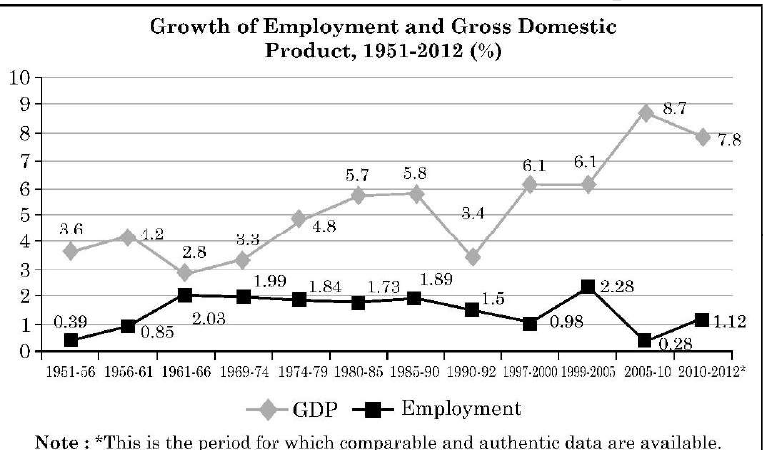
(For Visually Impaired Candidates only in lieu of Q. No. 26: The situation under which an economy attains economic growth without corresponding rise in employment is known as _____. Options as above.)
Solution
An economy experiences a rise in real GDP without a corresponding rise in employment. Such a situation is termed ______ growth. (A) casual (B) informal (C) formal (D) jobless
Solution
Real GDP rises without an adequate rise in employment. Such growth is termed ______ growth. (A) casual (B) informal (C) formal (D) jobless
Statement 1: Employment is an activity which enables a person to earn a livelihood for his/her family. Statement 2: A worker is one who contributes to GDP by rendering productive services. (A) 1 true, 2 false (B) 1 false, 2 true (C) both true (D) both false
Identify the incorrect feature of the formal sector: (A) job security (B) social security benefits (C) irregular payments (D) fixed working hours
Under ______ unemployment the marginal productivity of a worker is zero. (A) seasonal (B) structural (C) involuntary (D) disguised
The percentage of casual workers rises compared with regular workers. This is ______ of the workforce: (i) formalisation (ii) casualisation (iii) unemployment. (A) (i) and (ii) (B) (ii) and (iii) (C) only (ii) (D) only (i)
Read the following statements carefully: Statement 1: As per the National Sample Survey Organization (NSSO), unemployment is a situation in which all those who, owing to lack of work, are not working, but are seeking work from prospective employers. They express their willingness/availability to work under the prevailing conditions of work and remuneration. Statement 2: Disguised Unemployment is generally a massive problem in a highly populated country like India. In the light of the given statements, choose the correct alternative from the following :
From the type of workers given in Column I, identify the correct nature of work in Column II: Column I: 1. Cement shop owner 2. Construction worker 3. Civil engineer. Column II: (i) Regular salaried (ii) Casual wage workers (iii) Self-employed
Assertion (A): In the recent past, Indian economy has been facing the problem of jobless growth. Reason (R): Jobless growth refers to a situation where an economy is able to produce more goods and services without generating additional employment.
Statement 1: As per NSSO, unemployment is a situation in which all those who, owing to lack of work, are not working but seeking work and express willingness to work under prevailing conditions. Statement 2: Disguised unemployment is a massive problem in a highly populated country like India. (A) 1 true, 2 false (B) 1 false, 2 true (C) both true (D) both false
Statement 1: Casual workers are hired on a permanent basis and also get social security benefits. Statement 2: Workforce comprises both employed and unemployed persons. (A) 1 true, 2 false (B) 1 false, 2 true (C) both true (D) both false
Workers who are on the permanent pay-roll of their employer are called ___________ workers. (Choose the correct alternative to fill up the blank)
Jobless growth leads to unemployment because __________ . (Choose the correct alternative to fill up the blank)
State whether the following statement is true or false : "In the past few decades, primary sector has created maximum jobs in India."
3 marks: short answer
"Employment in the formal sector guarantees better income and social benefits compared to informal sector job." Defend or refute the above statement with valid reason and example.
Solution
Defended. Formal-sector workers get regular, fair wages and social security benefits (provident fund, pension, paid leave, medical benefits) and are protected by labour laws. Informal-sector workers get irregular incomes and no social security, and can be dismissed without compensation. E.g. a government employee gets a regular salary, pension and social security, while a daily-wage construction worker gets none.
Distinguish between formal and informal sector of employment with the help of suitable examples.
Solution
Explain the reasons behind less number of regular salaried employees in rural areas as compared to urban areas.
4 marks: case-based / source-based
(A) State the meaning of 'Disguised Unemployment'. (B) In the light of the given chart, analyse the gender-wise sectoral distribution of workers.
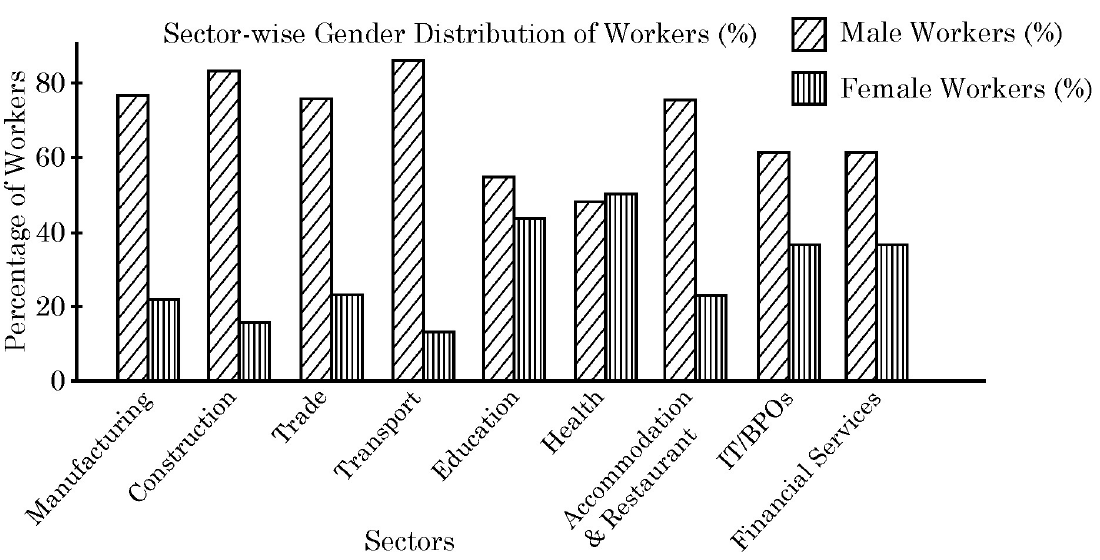
(For Visually Impaired Candidates only, in lieu of Q. No. 32 (B): Elaborate any two reasons behind more women employed in economic activities in Rural areas as compared to Urbans areas.)
Solution
(A) Disguised unemployment: more people are engaged in a job than are needed, so the marginal productivity of the extra workers is zero; withdrawing them would not reduce output.
(B) • Male workers dominate most sectors (manufacturing, construction, trade, transport, accommodation and restaurants), each about 75–85% male.
• Female participation is lowest in transport and construction (about 13–16%), showing gender inequality in these jobs.
• Education and health are relatively balanced; in health, women are about equal to men.
• IT/BPOs and financial services have moderate female shares (about 35–37%).
(Visually impaired: rural women work more because poverty compels them to supplement family income, and farm work near home is available; in urban areas higher male earnings and social norms discourage women from seeking jobs.)
(a) Refer the given image carefully: Compare and analyse the distribution of work force with respect to gender.
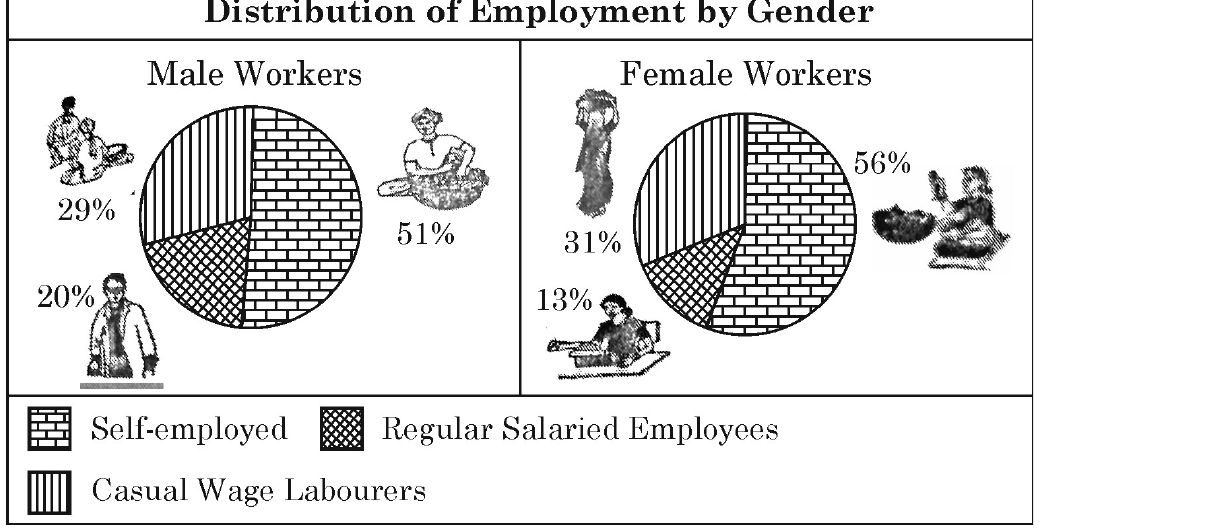
(For Visually Impaired Candidates only in lieu of Q. No. 31(a): "Compared to 1970's, there has hardly been any change in the distribution of workforce across various industries." Defend or refute the above statement with valid explanation.)
(b) State the meaning of worker-population ratio.
Solution
(b) Worker-population ratio = (number of workers ÷ total population) × 100.
Elaborate how the efforts of various governments in India have helped in generating employment, directly or indirectly.
Solution
Rayansh, a school teacher, gets a fixed monthly salary, social security, paid leave and medical allowance. His friend Mohan works at a small toy shop with very little income and no provident fund, paid leave or health insurance. Classify their sectors and distinguish between the two.
Solution
"In recent times through various schemes and policies, the Government of India has taken vital initiatives to generate employment directly/indirectly." Justify the statement giving valid arguments.
Solution
True or false, with arguments: (a) The Indian economy has shown satisfactory progress towards formalisation of the workforce in recent years. (b) In rural India, agricultural diversification has emerged as a reasonable alternative to fill gaps in income.
Solution
(b) True. Depending only on farming is risky; diversification into other crops and non-farm activities (livestock, fisheries, horticulture, rural industry) reduces risk and provides productive, sustainable livelihoods and extra income, especially in the off-season.
"It is necessary to generate more employment in the formal sector rather than the informal sector." Justify.
Solution
Compare and analyse the distribution of employment in India by sector and sex: primary sector female 57.1%, male 40.7%; secondary female 17.7%, male 26.5%; services female 25.2%, male 32.8%. (Visually impaired: "Compared to urban women, more rural women are found working." Justify.)
Solution
(i) Define worker-population ratio and describe its usefulness. (ii) State the meaning of disguised unemployment.
Study the given image (workers in informal work) and identify the situation depicted; suggest its impact on the Indian economy.
(For visually impaired candidates, in place of Q 32) "It is necessary to generate employment in the formal sector rather than in the informal sector." Justify.
(i) Elaborate any two reasons why fewer women are found in regular salaried employment. (ii) Define worker-population ratio.
"In a nation like India, self-employment provides an important avenue for employment generation." Defend or refute.
(i) Study the chart of employment and GDP growth (GDP growth rose from 3.4% in 1990 to 7.8% in 2012; employment growth fell from 1.5% to 1.12%; in 2005-10, employment grew 0.28% while GDP grew 8.7%). Analyse the trend of the two variables in 1990–2012. (ii) Define worker-population ratio. (Visually impaired, in place of (i): explain why regular salaried employees are more in urban areas than in rural areas.)
State and elaborate whether the following statement is true or false, with valid arguments: "Indian economy has showed satisfactory progress towards formalization of workforce in the recent past."
"In India, the self-employed constitute around 60% employees. The possible incidence of under employment is the highest among the self-employed." As an economist, suggest and elaborate any two measures that may be taken to ensure more productive employment for the self-employed.
5 marks: long answer
(i) 'In the recent past the Government of India has taken vital steps to revive and popularise Indian System of Medicine (ISM)'. Do you agree with the given statement? Justify your answer with valid reasons. (ii) 'Casualization of workforce has became a perennial problem of the Indian economy.' Justify the given statement with valid arguments.
Solution
(i) Yes. The Indian Systems of Medicine (Ayurveda, Yoga, Unani, Siddha, Homoeopathy: AYUSH) are effective, safe and inexpensive, and can meet a large part of health needs. The government set up the Ministry of AYUSH, which stresses preventive care. It promotes research, standardisation and AYUSH hospitals and dispensaries.
(ii) Casualisation (the rising share of casual wage workers) persists because:
• employment in the organised (formal) sector has grown slowly;
• the fast-growing construction and allied services sector demands casual labour;
• small and marginal farmers, earning little from agriculture, take up casual work to supplement their income.
6 marks: long answer
(i) Distinguish between the formal and informal sectors with examples. (ii) Define worker-population ratio and its significance.
Solution
(ii) Worker-population ratio = (workers ÷ population) × 100. It is used to analyse the employment situation: it shows the proportion of the population actively contributing to the production of goods and services; a higher ratio means greater engagement of people in economic activity.
Read the text on India's labour market (PLFS: unemployment fell to 3.2% in 2022-23; rising youth and female participation offer a demographic and gender dividend; organised manufacturing employment bounced back; EPFO payroll additions doubled; agro-processing and the care economy are promising for quality jobs). (a) State one significance of rising youth and female participation. (b) Identify two promising sectors for quality employment. (c) Elaborate disguised unemployment with an example.
Solution
(b) Agro-processing and the care economy.
(c) Disguised unemployment: a person seems employed but adds nothing to output, i.e. marginal productivity is zero. Example: a farmer with 4 acres and two workers produces 100 quintals of wheat; if a third family member also works on the farm, output stays at 100 quintals. The extra worker's contribution is zero; he is disguisedly unemployed and could be shifted to other work without reducing output.
Read the text on India's labour force participation rate (LFPR measures the percentage of population employed or seeking work; labour force grew from 396.3 to 495.5 million in 2000-19 without matching employment; women's LFPR 32.8% vs men's 77.2% in 2022; rural LFPR fell 14.1% vs urban 3.5% in 2000-19, then rose 6% and 2.1% in 2019-22). (a) Define unemployment. (b) Write the meaning of LFPR. (c) Comment on the gender disparities in rural and urban LFPR during 2000-2019.
Solution
(b) LFPR is the percentage of the population that is either employed or actively seeking employment.
(c) There is a large gender gap: women's LFPR was only 32.8% in 2022 against 77.2% for men, which keeps India's overall LFPR below the global average of 47.3%. During 2000–2019, rural LFPR declined by 14.1% compared with 3.5% in urban areas, largely because rural women withdrew from the labour force (they join in hardship and leave when conditions improve).
(i) "Amita is a regular worker in a private firm that employs twelve hired workers." Is she working in the formal/informal sector? Give valid reasons in support of your answer. (ii) State any two sources of data on unemployment in India. (iii) Elaborate the need to promote women's education in India.
Solution
(ii) (1) Reports of the Census of India. (2) NSO (National Statistical Office) reports on the employment and unemployment situation, including the Periodic Labour Force Survey. (Also: Directorate General of Employment and Training data of Employment Exchanges.)
(iii) Educated women can enter the workforce and earn, adding to economic growth; they take informed decisions about their lives; women's education lowers the fertility rate and improves the health care and nutrition of women and children; it also improves the education of the next generation. So investing in women's education promotes gender equality and sustainable development.
(i) "The participation rate of people in economic activities in rural areas is more than that in urban areas." Justify the given statement. (ii) Define disguised unemployment. State its implications on output and employment in a country.
(i) Why are less women found in regular salaried employment? (ii) Distinguish between human capital and physical capital.
(a) Why are less women found in regular salaried employment ? (b) Analyse the recent trends in sectoral distribution of workforce in India : Trends in Employment Pattern (Sector-wise), 1993 – 2012 (in %)
| Sector | 1993–94 | 1999–2000 | 2011–2012 |
|---|---|---|---|
| Primary | 64 | 60.4 | 48.9 |
| Secondary | 16 | 15.8 | 24.3 |
| Services | 20 | 23.8 | 26.8 |
Get every solution for all chapters
- Every board question of every chapter, each fully solved the way the board gives marks
- 15 complete board papers, each followed by its solutions
- Weightage and most-asked topics for every chapter
- Instant PDF download, colour and black & white print copies
Revising the chapter first? Complete Economics Notes for Class 12 (NCERT 2026-27, CBSE Board 2027) →
What you get in the pack
- Questions from 129 CBSE Economics papers, 2016 to 2026: every set code available
- Complete: 1783 different questions and parts from all set codes, 14 chapters and 15 full papers
- Part A: all 14 chapters, questions sorted chapter-wise and by marks
- Year-wise weightage table and most-asked topics for every chapter
- Part B: each full board paper followed by its complete solutions
- National income, multiplier, budget and BOP numericals worked step by step
- Questions on topics out of the board syllabus flagged
All chapters in this pack
- PYQ Ch 1 Introduction to Macroeconomics
- PYQ Ch 2 National Income and Related Aggregates
- PYQ Ch 3 Money and Banking
- PYQ Ch 4 Determination of Income and Employment
- PYQ Ch 5 Government Budget and the Economy
- PYQ Ch 6 Open Economy: Balance of Payments and Exchange Rate
- PYQ Ch 7 Indian Economy on the Eve of Independence
- PYQ Ch 8 Indian Economy 1950–1990
- PYQ Ch 9 Liberalisation, Privatisation and Globalisation
- PYQ Ch 10 Human Capital Formation in India
- PYQ Ch 11 Rural Development
- PYQ Ch 12 Employment: Growth, Informalisation and Other Issues
- PYQ Ch 13 Environment and Sustainable Development
- PYQ Ch 14 Comparative Development Experiences of India and its Neighbours
- Board Paper 2026 Set 58-1-1 with Solutions
- Board Paper 2026 Set 58-1-2 with Solutions
- Board Paper 2026 Set 58-1-3 with Solutions
- Board Paper 2026 Set 58-2-1 with Solutions
- Board Paper 2025 Set 58-1-1 with Solutions
- Board Paper 2025 Set 58-2-1 with Solutions
- Board Paper 2024 Set 58-1-1 with Solutions
- Board Paper 2024 Set 58-2-1 with Solutions
- Board Paper 2023 Set 58-1-1 with Solutions
- Board Paper 2022 Term 2 Set 58-1-1 with Solutions
- Board Paper 2020 Set 58-1-1 with Solutions
- Board Paper 2019 Set 58-1-1 with Solutions
- Board Paper 2018 Set 58-1 with Solutions
- Board Paper 2017 Set 58-1 with Solutions
- Board Paper 2016 Set 58-1 with Solutions