
CBSE Class 12 Economics Question Paper 2026 (58/1/1) with Solutions
The complete CBSE Class 12 Economics board paper of 2026, Q.P. code 58/1/1: all 34 questions exactly as set, with marks. 20 solutions are free below. The Class 12 Economics PYQ Book: Solved Board Papers 2016-2026 (CBSE) solves all 15 papers in full and sorts every question chapter-wise.

Question paper
Jump to: Question paperSolutions
2026 · Q.P. Code 58/1/1
Maximum marks: 80
Section A · Macroeconomics
In a two sector economy, the flow of factor payments moves from __________ to __________. (Choose the correct option to fill in the blanks)
Assertion (A): Money is of perishable nature and is generally accepted by all at any point of time. Reason (R): Money serves as a store of value, facilitating individuals to transfer purchasing power from the present to the future.
Read the following statements carefully: Statement 1: Depreciation of currency is an economic action undertaken by the government of a nation under the fixed exchange rate system. Statement 2: Under the floating exchange Rate system, authorities actively intervene in the foreign exchange market by way of maintaining foreign exchange reserves. In the light of the given statements, choose the correct option from the following:
In an economy, when __________ is insufficient to achieve the level of output corresponding to the full employment, the difference is termed a deflationary gap. (Choose the correct option to fill in the blank)
In an economy, exclusion of ___________ may lead to under estimation of the value of Gross Domestic Product (GDP). (Choose the correct option to fill in the blank) (i) Barter Transactions (ii) Services provided by family members (iii) Illegal activities (iv) Depreciation of Assets
Identify, which of the following is true at the Break Even level of Income. (Choose the correct option)
Read the following statements carefully: Statement 1: Final goods are those goods which normally lose their identity in the production process. Statement 2: Final goods may get transformed during the consumption process by a consumer. (Choose the correct option)
Assertion (A): Unilateral Transfers are recorded in the Current Account of the Balance of Payments (BoP) of a nation. Reason (R): Capital account records transactions which cause a change in the assets or liabilities of the country.
"In the Indian Banking System, the Statutory Liquidity Ratio (SLR) plays a vital role in controlling the credit creation capacity of the Commercial Banks, as it __________." (Choose the correct option to fill in the blank)
'In an economy, the currency held by the public, Net Demand Deposits with Commercial Banks and Net Time Deposits with Commercial Banks stand at ₹ 1,42,000 crore, ₹ 22,000 crore and ₹ 86,000 crore respectively. The value of Money Supply (M1) would be ₹ __________ crore. (Choose the correct option to fill in the blank)
(a) Meera and Shahid are two classmates, who were comparing India's economic growth over the years. Meera referred to the increase in Gross Domestic Product (GDP) at current prices prevailing in market, while Sahid insisted on considering GDP after adjusting for inflation. Their debate on which of the two measures gives a true picture of people's well-being, remained inconclusive. Considering the above mentioned situation, elaborate with valid reason, which of the two variables is considered a better indicator of welfare and why?
(b) Two friends, Ravi and Harry were discussing whether the money received from sale of an old car should be included in India's National income. Ravi was of the view that it should be included in India's National income while Harry did not agree with him. They also had difference of opinion on the treatment of brokerage paid to the car dealer. As their Economics teacher, state the treatments with valid arguments.
"Under the provisions stated in the Section 20 and Section 21 of the Reserve Bank of India (RBI) Act, 1934, the RBI is mandated to handle the banking operations of the Government of India." In the light of the given statement, elaborate the indicated function of the Reserve Bank of India.
(a) For a hypothetical economy, assuming there are only two firms (X and Y) with equal values of Gross Value Added (GVA). On the basis of the following data, estimate the value of Domestic Sales of both the firms (X and Y): (₹ crore) (i) Value of Output of firm Y 700 (ii) Purchases by firm X from firm Y 200 (iii) Exports by firm X 100 (iv) Purchases by firm Y from firm X 150 (v) Additions to Stock of firm X 50
(b) Ms. Reeta D'Costa, retired from the post of Income Tax Commissioner in the year 2023. Apart from her pension, she also receives the following from various sources : • Rental income from a flat she owns. • Interest income from her fixed deposits. • Money sent by her children settled abroad. Identify and classify, her monthly incomes into 'factor income' and 'transfer income', with valid reasons.
Michel, an entrepreneur of Country Zeta, borrowed $ 5 million from an overseas bank to expand his textile business. During the same financial year, the Government of Country Zeta secured a loan of $ 30 Billion from an International Financial Institution to manage the ongoing Balance of Payments. Samuel, an Economics student categorised both of these transactions as 'autonomous transactions' in the BoP account of the country. Do you agree with his classification? Justify your answer with valid reasons.
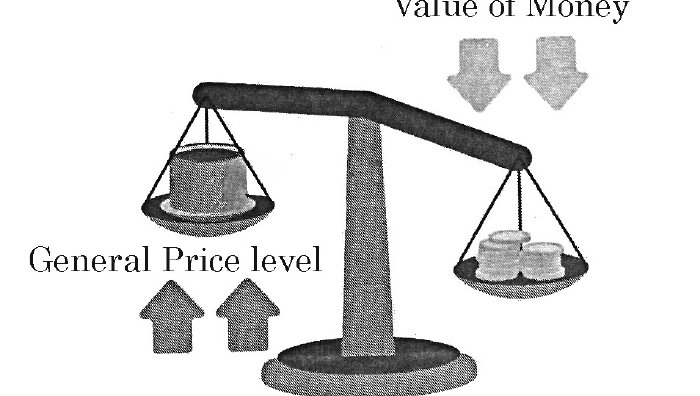
Refer the given image carefully: Explain any two measures that can be taken by the Central Bank to control the indicated macroeconomic problem.
(For Visually Impaired Candidates only, in lieu of Q. No. 15: State and explain any two measures that can be taken by the Central Bank to control the situation of deficient demand.)
(a) "Income of an economy increased from ₹ 20,000 to ₹ 50,000 crore. Savings of the economy increased from ₹ 2,000 crore to ₹ 10,000 crore." (i) Calculate Average Propensity to Consume (APC) and Average Propensity to Save (APS), before and after the rise in income. (ii) Draw appropriate conclusion regarding the behaviour of Average Propensity to Consume (APC) as his income increases.
(b) "Under a study, examining the spending habits of a hypothetical economy, it was observed that even households with zero income managed to consume basic necessities. As the income of people increased, their consumption also increased, but not as rapidly as income." Based on the given text and common understanding, answer the following questions: (i) Identify and elaborate the type of consumption indicated in the first para of the above text. (ii) Explain, the reason behind the positive slope of Aggregate Demand Curve.
Refer the given text carefully: According to the Economic Survey 2024-25, the government budget's projections for the fiscal year 2025-26 indicate that gross direct tax revenue will rise by 12.7%, while gross indirect tax collections are expected to grow by 8.3% relative to FY 2024-25. Direct taxes include income tax and corporate tax, reflecting earnings and profits of households and firms. It plays a key role in revenue growth of the government. Indirect taxes encompass Goods and Services Tax (GST), custom duties and other transaction-based levies. Higher growth rate projected for direct taxes suggests a push to enhance tax buoyancy through improved compliance and reforms. On the other hand, indirect taxes are expected to benefit from consumption trends and Goods and Services Tax (GST) administration improvements. The balance tax strategy aims to mobilise resources while supporting fiscal consolidation and sustainable economic growth. On the basis of the above passage and common understanding, answer the following questions: (i) Differentiate between the two types of taxes indicated in the above text, with suitable examples. (ii) Elaborate the likely consequences of the tax projections made by the government.
Section B · Indian Economic Development
Read the following statements carefully: Statement 1: During the British rule in India, the export surplus was utilised to import of invisible items from Britain. Statement 2: Indians paid for the expenses incurred by an office set up by the colonial government in Britain. In the light of above statements, choose the correct option from the following:
Assertion (A): Education facilitates the assimilation of knowledge and competencies. It also fosters inventive capacities and enhances the aptitude to integrate advance technology. Reason (R): Education plays a pivotal role in transforming cognitive perspectives and serves as a catalyst for the economic advancement of a nation.
Read the following text carefully: "In the recent times, the Government of India, has introduced several measures to encourage greater public participation in the capital market, including both primary and secondary stock markets." Under which sector have the above mentioned reforms been introduced? (Choose the correct option)
The Montreal Protocol was signed in the year 1987 committing nations to____. (Choose the correct option to fill in the blank)
Assertion (A): The notion of rural development encompasses a far wider spectrum than agricultural advancement. Reason (R): Government interventions in the agricultural sector remain imperative, as it constitutes the primary means of sustanance for the rural population.
Identify, which of the following, highlights a highly relevant issue associated with evolving employment trends in India's labour market?
Match the terms given in Column-I with their respective meaning in Column-II. Select the correct option : Column-I: (i) Seasonal Unemployment (ii) Self-employed (iii) Unorganised sector (iv) Disguised Unemployment. Column-II: (a) Private enterprises hiring less than 10 employees (b) Workers using their own resources to earn livelihood (c) Unemployment occurring in specific season (d) Zero Marginal Productivity
"Sustainable development refers to the development that meets the need of the present generation without compromising the ability of the future generations, to meet their own needs." The above mentioned definition has been given by __________. (Choose the correct option to fill in the blank)
Assertion (A): The Government of India adopted the measure of regulation of markets to improve marketing conditions for agricultural products. Reason (R): Regulation of market ensured transparent pricing, fair trade practices, and protection for farmers against exploitation in agricultural marketing.
Arrange the following events in China's economic development history in correct chronological sequence and select the correct option: I. Great Proletarian Cultural Revolution. II. Great leap forward III. Introduction of Economic Reforms IV. Launch of the First Five Year Plan
(a) "Employment in the formal sector guarantees better income and social benefits compared to informal sector job." Defend or refute the above statement with valid reason and example.
(b) During the 'Mann ki Baat' program aired on 29th June, 2025, Prime Minister shared that World Health Organisation (WHO) has declared India as a Trachoma free (an eye disease). This achievement, he shared, is a result of sustained efforts in health care, sanitation, awareness and medical access. In the light of the above statement, explain how investments in health care contributes to a nation's development. Support your answer with valid arguments.
"In the late 1970's China's population growth rate has sharply declined as compared to India." Elucidate the reasons and impacts of this situation.
(a) State and explain any two changes which were observed in India's occupational structure during the British Rule.
(b) "The British sought to achieve their vested interest through their policies of infrastructural development in India." Do you agree with the given statement? Justify your answer with valid explanation.
"At the time of independence, both India and Pakistan inherited similar colonial economic structures. Both the nations adopted many similar economic planning strategies." Explain any two such similarities in the developmental path of India and Pakistan.
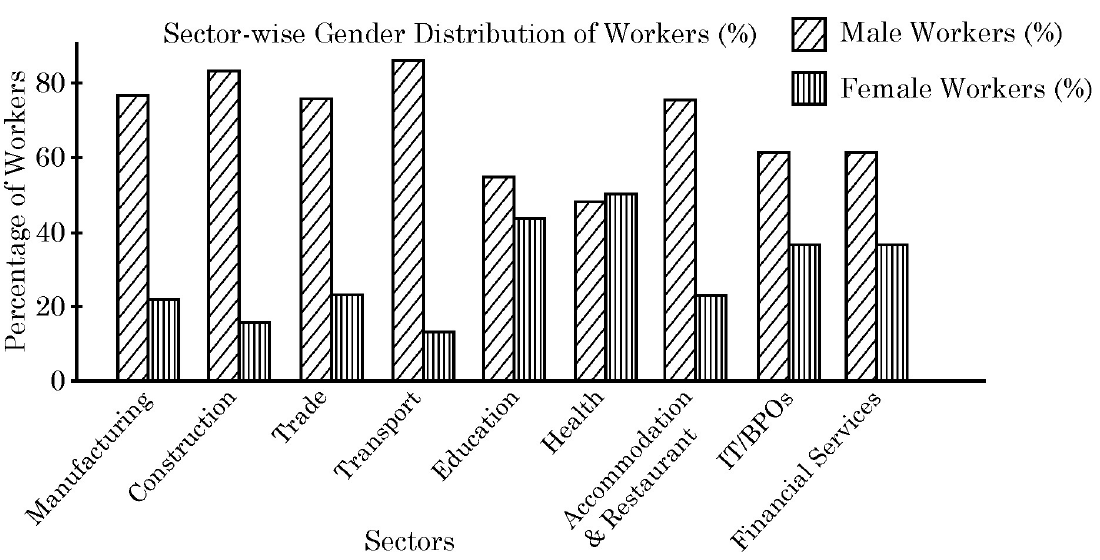
(A) State the meaning of 'Disguised Unemployment'. (B) In the light of the given chart, analyse the gender-wise sectoral distribution of workers.
(For Visually Impaired Candidates only, in lieu of Q. No. 32 (B): Elaborate any two reasons behind more women employed in economic activities in Rural areas as compared to Urbans areas.)
(a) (i) Mr. Ravi, an IT entrepreneur from Bengaluru, observed that several MNC's prefer India as their outsourcing Hub for services like software development, customer support, data management etc. His friend Priya believes this is due to certain inherent advantages of the Indian economy. In your opinion, state and explain any two factors that make India a preferred outsourcing destination. (ii) "In the post-independence era, India adopted a protective tariff policy." Do you agree with the given statement? Justify your answer with any two valid arguments.
(b) (i) 'Strategic sale of a public sector undertaking and minority sale of their shares are methods of disinvestment.' Defend or refute the given statement with valid argument. (ii) Discuss briefly, how bilateral trade agreements are different from multilateral trade agreements?
Read the following text carefully: To ensure inclusive and quality education for all, the Indian government has launched several important schemes. These schemes aimed at improving access, equity and learning outcomes, especially among disadvantaged group. The Right to Education (RTE) Act, passed by the India Parliament on August 4, 2009, guarantees free and compulsory education to every child between 6-14 years of age. It ensures that all children have access to education in neighbourhood schools, until they complete elementary education. Another key initiative is Sarva Siksha Abhiyan (SSA). It was introduced in 2001. It is one of India's flagship programmes for the Universalisation of Elementary Education. Digital India Campaign, launched on July 1, 2015, focuses on transforming India into a digitally empowered society by improving mobile and internet connectivity, particularly in rural and remote regions. This initiative supports digital learning & access to educational resources. Through these initiatives, the government strives to create an equitable, accessible & quality driven educational environment for all children, laying a strong foundation for national development. On the basis of the given text and common understanding, answer the following questions: (i) Identify, which law guarantees free and compulsory education upto the age of 14 years. Explain, how does it help in enhancing access to education. (ii) In your opinion, how has the increase in public spending on education contributed to India's social and economic transformation? Support your answer with valid arguments.
Solutions: CBSE 2026 · 58/1/1
Households supply factor services to firms, and firms pay them rent, wages, interest and profit. Answer: (A)
A deliberate cut in value under a fixed rate is devaluation; depreciation is market-driven under a flexible rate. Under a (free) floating system, authorities do not actively intervene. Answer: (D)
Barter transactions and unpaid family services are genuine production left out of GDP because they are non-monetary. Illegal activities are deliberately excluded, and depreciation is part of GDP anyway. Answer: (A)
Goods that lose their identity in production are intermediate goods, so Statement 1 is false. A final good may be transformed while being consumed (e.g. a consumer cooking vegetables), so Statement 2 is true. Answer: (B)
SLR is the percentage of deposits banks must keep in liquid assets (cash, gold, approved securities), reducing the funds available for lending. Answer: (B)
GDP after adjusting for inflation (real GDP) is the better indicator of welfare.
Real GDP is measured at constant (base-year) prices, so it changes only when the physical output of goods and services changes. Nominal GDP (at current prices) can rise merely because prices rise, even if output does not, and then overstates growth. Since welfare depends on the quantity of goods and services available to people, real GDP gives the truer picture.
The function is banker to the government. The RBI keeps the accounts of the central (and state) governments, receives their deposits and makes payments on their behalf. It handles remittances, exchange and other banking operations for them. It manages public debt and gives credit to the government when needed (e.g. during a financial crisis), so that the government can run smoothly and meet its obligations. It also acts as the government's financial adviser.
Factor income (earned by providing factor services): rental income from her flat (land/building), interest on fixed deposits (capital), and her retirement pension (a deferred payment for her past services as an employee).
Transfer income (received without any productive service in return): money sent by her children settled abroad.
The image shows the general price level rising and the value of money falling: inflation (excess demand).
1. Raise the repo rate: banks' cost of borrowing from the RBI rises, so they raise lending rates. Credit becomes dearer, borrowing and spending fall, and AD falls, checking inflation.
2. Open market operations (sale of securities): the RBI sells government securities, absorbing funds from banks. Their lending capacity falls, so credit and AD fall.
(Visually impaired candidates, deficient demand: the RBI lowers the repo rate and buys securities in the open market, making credit cheaper and more plentiful, which raises AD.)
(i) Autonomous consumption: the minimum consumption needed for survival, made even at zero income (financed by past savings or borrowing). It does not depend on income.
(ii) AD = C + I. Investment is taken as autonomous, but consumption rises as income rises (by MPC × ΔY). So AD rises with income: the AD curve slopes upward, though less steeply than the 45° line because MPC < 1.
The export surplus paid for invisible imports and for the expenses of the British office (home charges). Answer: (C)
Capital (stock) markets are part of the financial sector. Answer: (B)
Rural development includes health, education, infrastructure and non-farm jobs as well as farming (A true). R is also true, but it stresses agriculture, so it does not explain why rural development is wider than agriculture. Answer: (B)
Answer: (C)
Regulated markets were set up precisely to give farmers fair prices and protect them from exploitation by traders, so R explains A. Answer: (A)
Defended. Formal-sector workers get regular, fair wages and social security benefits (provident fund, pension, paid leave, medical benefits) and are protected by labour laws. Informal-sector workers get irregular incomes and no social security, and can be dismissed without compensation. E.g. a government employee gets a regular salary, pension and social security, while a daily-wage construction worker gets none.
Reason: China introduced the one-child policy (1979), which sharply reduced its birth rate; India relied on voluntary family planning.
Impacts: a declining share of young people and a rising share of the elderly (an ageing population), which reduces the future working-age population and raises the burden of supporting the old. The policy also worsened the sex ratio in China.
Yes. The British built infrastructure mainly to serve their own interests:
• Roads and railways were laid to move the army within India and to carry raw materials from the interior to ports for export to Britain, and British goods into Indian markets.
• Ports were developed for trade with Britain.
• The electric telegraph was introduced to maintain law and order.
Little was done for the welfare of Indians (e.g. rural roads, irrigation).
(A) Disguised unemployment: more people are engaged in a job than are needed, so the marginal productivity of the extra workers is zero; withdrawing them would not reduce output.
(B) • Male workers dominate most sectors (manufacturing, construction, trade, transport, accommodation and restaurants), each about 75–85% male.
• Female participation is lowest in transport and construction (about 13–16%), showing gender inequality in these jobs.
• Education and health are relatively balanced; in health, women are about equal to men.
• IT/BPOs and financial services have moderate female shares (about 35–37%).
(Visually impaired: rural women work more because poverty compels them to supplement family income, and farm work near home is available; in urban areas higher male earnings and social norms discourage women from seeking jobs.)
(i) Defended. Both reduce government ownership of PSUs. In a strategic sale, a large share of the government's equity is sold to a private buyer along with management control. In a minority sale, only a small portion of shares is sold to the public and the government keeps control. Both raise resources and aim to improve efficiency.
(ii) A bilateral trade agreement is between two countries only, on terms that apply to them alone. A multilateral trade agreement involves more than two countries (e.g. under the WTO), with common rules that apply equally to all members.
Get every solution for all 15 papers
- Every board question of every chapter, each fully solved the way the board gives marks
- 15 complete board papers, each followed by its solutions
- Weightage and most-asked topics for every chapter
- Instant PDF download, colour and black & white print copies
Revising the chapter first? Complete Economics Notes for Class 12 (NCERT 2026-27, CBSE Board 2027) →
What you get in the pack
- Questions from 129 CBSE Economics papers, 2016 to 2026: every set code available
- Complete: 1783 different questions and parts from all set codes, 14 chapters and 15 full papers
- Part A: all 14 chapters, questions sorted chapter-wise and by marks
- Year-wise weightage table and most-asked topics for every chapter
- Part B: each full board paper followed by its complete solutions
- National income, multiplier, budget and BOP numericals worked step by step
- Questions on topics out of the board syllabus flagged
All chapters in this pack
- PYQ Ch 1 Introduction to Macroeconomics
- PYQ Ch 2 National Income and Related Aggregates
- PYQ Ch 3 Money and Banking
- PYQ Ch 4 Determination of Income and Employment
- PYQ Ch 5 Government Budget and the Economy
- PYQ Ch 6 Open Economy: Balance of Payments and Exchange Rate
- PYQ Ch 7 Indian Economy on the Eve of Independence
- PYQ Ch 8 Indian Economy 1950–1990
- PYQ Ch 9 Liberalisation, Privatisation and Globalisation
- PYQ Ch 10 Human Capital Formation in India
- PYQ Ch 11 Rural Development
- PYQ Ch 12 Employment: Growth, Informalisation and Other Issues
- PYQ Ch 13 Environment and Sustainable Development
- PYQ Ch 14 Comparative Development Experiences of India and its Neighbours
- Board Paper 2026 Set 58-1-1 with Solutions
- Board Paper 2026 Set 58-1-2 with Solutions
- Board Paper 2026 Set 58-1-3 with Solutions
- Board Paper 2026 Set 58-2-1 with Solutions
- Board Paper 2025 Set 58-1-1 with Solutions
- Board Paper 2025 Set 58-2-1 with Solutions
- Board Paper 2024 Set 58-1-1 with Solutions
- Board Paper 2024 Set 58-2-1 with Solutions
- Board Paper 2023 Set 58-1-1 with Solutions
- Board Paper 2022 Term 2 Set 58-1-1 with Solutions
- Board Paper 2020 Set 58-1-1 with Solutions
- Board Paper 2019 Set 58-1-1 with Solutions
- Board Paper 2018 Set 58-1 with Solutions
- Board Paper 2017 Set 58-1 with Solutions
- Board Paper 2016 Set 58-1 with Solutions