
International Trade (World): Class 12 PYQs 2019–2026 with solutions
All 58 CBSE board questions asked from International Trade (World) in 18 board papers, with the year, set and marks of each. 30 are solved free below. The Class 12 Geography PYQ Book: Solved Board Papers 2016-2026 (CBSE) has every solution, all chapters and 15 full board papers.

International Trade (World): board weightage
Board weightage 2019–2026
| Year | 2019 | 2022 | 2023 | 2024 | 2025 | 2026 |
|---|---|---|---|---|---|---|
| Questions | 2 | – | 2 | 19 | 23 | 13 |
| Marks | 2 | – | 6 | 35 | 29 | 19 |
Most asked topics
59 questions from 18 papers. Repeated questions are shown once with every year they were asked.
1 mark: MCQ and Assertion–Reason
Choose the correct option related to oil tanker ports of the world.
Solution
(C) Maracaibo (Venezuela), Esskhira (Tunisia) and Tripoli (Lebanon) are oil ports. Singapore is an entrepot port; Manchester and Marmagao are other types.
Two statements are given below. They are Assertion (A) and Reason (R). Read both the statements carefully and choose the correct option:
Assertion (A): All the developed countries have opened their markets for products from developing countries.
Reason (R): World Trade Organisation deals with the global rules of trade between nations.
Solution
(D) A is false: developed countries have not fully opened their markets to developing countries' products (one criticism of the WTO); R is true.
B. A major sea port
Solution
Valparaiso (Chile).
World map, feature A: a major seaport. [VI: a major seaport in Canada]
Solution
Vancouver.
Which type of port is classified on the basis of function? (A) out port (B) oil port (C) inland port (D) comprehensive port
Solution
(B) Oil port. On the basis of location: inland and out ports; on the basis of cargo handled: industrial, commercial, comprehensive; on the basis of specialised functions: oil ports, ports of call, packet stations, entrepot ports, naval ports.
Which is not a basis of international trade? (A) differences in national resources (B) stage of economic development (C) level of transport development (D) social diversity in the country
Solution
(D) Social diversity. Bases of trade: differences in national resources, population factors, stage of economic development, extent of foreign investment, transport.
Match ports with examples: a. packet station b. naval port c. port of call d. entrepot port — i. Kochi ii. Copenhagen iii. Dover iv. Honolulu. (A) a-iii, b-i, c-iv, d-ii (B) a-iii, b-i, c-ii, d-iv (C) a-i, b-ii, c-iii, d-iv (D) a-i, b-ii, c-iv, d-iii
Solution
(A) a-iii, b-i, c-iv, d-ii: Dover (packet station, ferry across the English Channel), Kochi (naval port), Honolulu (port of call), Copenhagen (entrepot).
World map, feature B: a major sea port. [VI: a major seaport on the western coast of the USA]
Solution
San Francisco.
World map, feature F: a major sea port. [VI: in Western Australia]
Solution
Perth (Fremantle).
World map, feature B: a major sea port. [VI: in Yemen]
Solution
Aden.
The items exported by a port are first brought from different countries. Such a port is a/an: (A) comprehensive port (B) out port (C) entrepot port (D) packet station
Solution
(C) Entrepot port: collection centres where goods are brought from different countries for re-export (Singapore for Asia, Rotterdam for Europe, Copenhagen for the Baltic).
World map, feature A: a major sea port. [VI: the major seaport of South Africa]
Solution
Cape Town (also Durban).
About ports: (i) ports provide facilities for loading, unloading and storage (ii) the importance of a port is judged by the size of its hinterland (iii) cargo handled indicates the level of development of its hinterland (iv) ports are the chief gateways of world trade. (A) i, ii, iii (B) i, iii, iv (C) i, ii, iv (D) ii, iii, iv
Solution
(B) i, iii and iv, as per the board key: the importance of a port is judged by the size of cargo and the number of ships handled, which indicates the level of development of its hinterland.
Assertion (A): The WTO is widening the gulf between rich and poor by making rich countries richer. Reason (R): Influential nations in the WTO focus on their own commercial interests. (A) both correct, R explains A (B) both correct, R does not explain A (C) A correct, R incorrect (D) A incorrect, R correct
Solution
(A) Critics argue the WTO widens the gulf because the influential (rich) nations use it to advance their own commercial interests, while developed countries have not fully opened their markets to developing countries' products.
The act of opening up economies for trading is known as: (A) balanced trade (B) unilateral trade (C) free trade (D) bilateral trade
Solution
(C) Free trade (trade liberalisation).
World map, feature A: a major sea port in Germany.
Solution
Hamburg.
Choose the correctly matched pair of sea ports and their examples.
Solution
(C) Oil port – Tripoli (Lebanon). Duisburg is an inland port; Piraeus is an out port (Athens); Kolkata is an inland/riverine port; Kochi and Karwar are naval ports.
On the given political outline map of the world, seven geographical features have been marked as A, B, C, D, E, F and G. Identify any five with the help of the following information and write their correct names on the lines drawn near them.
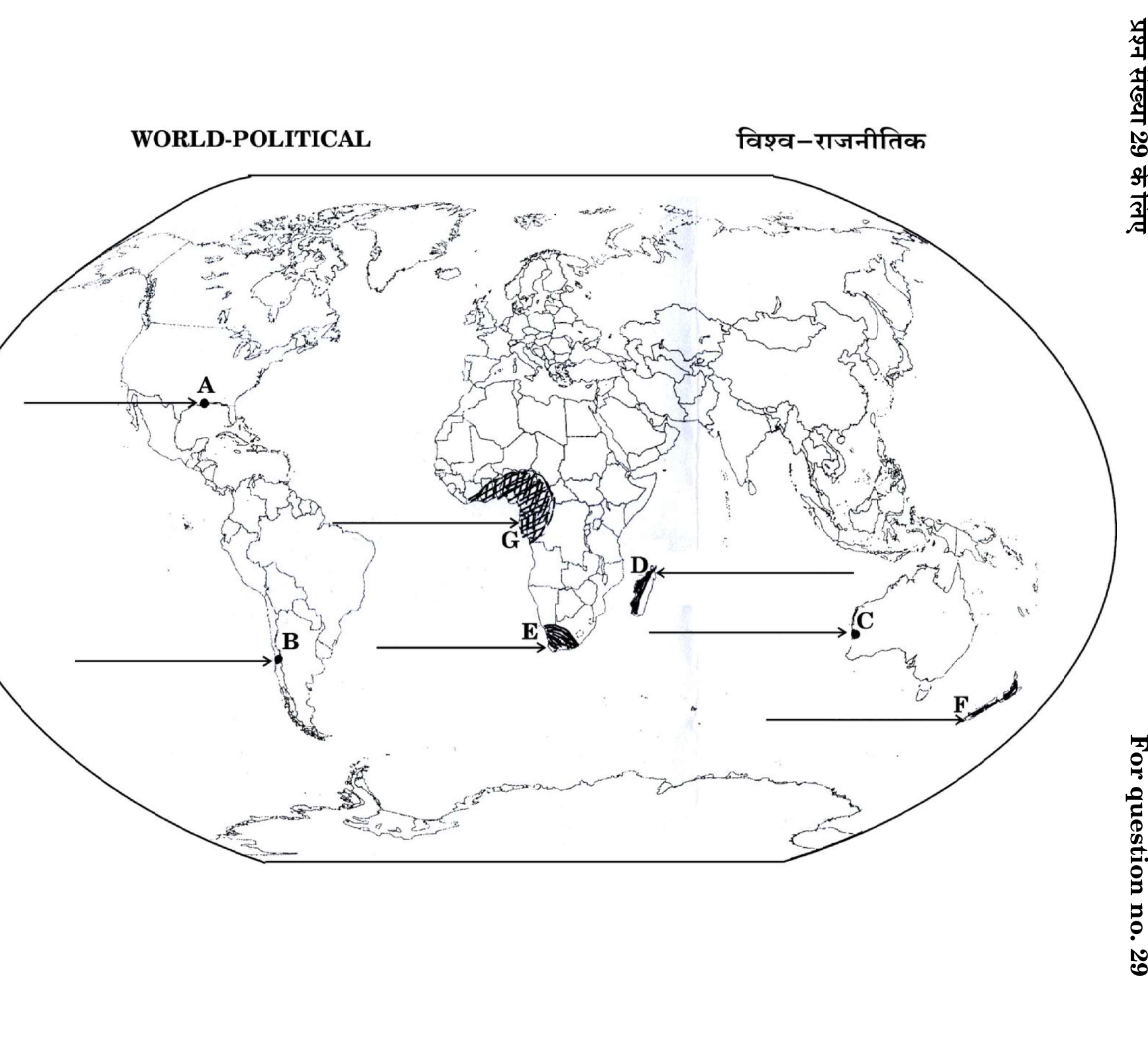
A. A major sea port
Solution
E.g. Vancouver (also San Francisco, New Orleans, New York).
Ports specialised in bulk cargo are called: (A) inland ports (B) industrial ports (C) out ports (D) comprehensive ports
Solution
(B) Industrial ports: they specialise in bulk cargo like grain, sugar, ore, oil, chemicals.
World map, feature B: a major sea port. [VI: in south-eastern Australia]
Solution
Sydney (also Melbourne).
Match the basis of international trade with its feature: a. geological structure b. mineral resources c. climate d. cultural factors — i. determines biotic life ii. determines the mineral resource base iii. provides the base for industrial development iv. determines the development of crafts and skills. (A) a-ii, b-iii, c-i, d-iv (B) a-ii, b-iii, c-iv, d-i (C) a-iii, b-ii, c-iv, d-i (D) a-iii, b-ii, c-i, d-iv
Solution
(A) a-ii, b-iii, c-i, d-iv. Geological structure determines the mineral base; minerals provide the base for industry; climate determines the type of flora and fauna; distinctive cultural features (art and craft) develop in certain cultures (e.g. Chinese porcelain, Iranian carpets).
Which practice in free trade can harm developing countries? (A) goods exchanging (B) goods dumping (C) goods purchasing (D) goods selling
Solution
(B) Goods dumping: selling a commodity in another country at a price below cost; it harms domestic producers.
Choose the correct option about the WTO: (A) GATT was its predecessor (B) 149 countries were its members in 2016 (C) India became a member in 1984 (D) its headquarters is in New York
Solution
(A) GATT (1948) was its predecessor; the WTO was set up in 1995 (164 members in 2016; headquarters in Geneva; India a founding member).
World map, feature C: a major sea port. [VI: in northern Europe]
Passage: the case for free trade (as above). Which is called free trade? (A) trade liberalisation (B) trade restriction (C) trade value (D) trade quantity
Same passage: the most adverse effect of free trade is observed in: (A) developed countries (B) developing countries (C) both underdeveloped and developed (D) both developed and developing
Same passage: the impact of developments in transport and communication on trade: (A) goods and services travel faster (B) they move farther (C) they travel faster and move farther (D) better connectivity only in the region concerned
World map, feature A: a major sea port. [VI: in England]
World map, feature G: a major sea port of South America. [VI: an international airport in Brazil]
Which of the following organisations sets the rules for the global trading among its member nations? Choose the most appropriate option.
C. A major sea port in Australia
E. A major sea port of South America
Assertion (A): Countries need to be cautious about dumped goods under free trade. Reason (R): Dumping of goods can harm domestic producers. (A) A true, R false (B) A false, R true (C) both true, R does not explain (D) both true, R explains A
World map, feature E: a major sea port of Asia.
Which of the following is an entrepot port? (A) Abadan (B) Maracaibo (C) Singapore (D) Tripoli
World map, feature D: a major sea port of South America. [VI: a sea port on the western coast of Canada]
Which is the headquarters of the World Trade Organisation? (A) New York (B) Delhi (C) Geneva (D) London
World map, feature D: a major sea port of Asia. [VI: the major sea port of Japan]
Assertion (A): Free international trade can prove detrimental to under-developed countries. Reason (R): Under-developed countries are not at par to compete with developed countries. (A) A correct, R incorrect (B) A incorrect, R correct (C) both correct, R explains A (D) both correct, R does not explain
Assertion (A): Ports and harbours are the gateways of international trade. Reason (R): Only heavy cargoes are transported through ports and harbours. (A) A correct, R incorrect (B) A incorrect, R correct (C) both correct, R explains A (D) both correct, R does not explain
Which is an example of an oil port? (A) Abadan (B) Manchester (C) Kochi (D) Dover
World map, feature A: a major sea port. [VI: the major sea port on the west coast of Canada]
C. A major seaport
Mention any two problems of barter system of trade.
(B) A major seaport
3 marks: short answer
"International trade is mutually beneficial to nations." Support with arguments.
Solution
(i) It results from specialisation in production: each country produces what it can make best and exchanges it for goods it lacks, benefiting all. (ii) It gives access to goods and resources not available at home; it leads to regional development, better use of resources, and transfer of technology. (iii) It promotes comparative advantage, complementarity of regions and transfer of specialised commodities, so world economy benefits if trade is carried out on fair terms. (Harmful if it leads to dependence, unequal terms or exploitation.)
"Global sea ports are the gateways of international trade." Support with arguments.
Solution
(i) International trade is mainly carried by sea, and ports are the points of entry and exit where ships load and unload cargo. (ii) The importance of a port is judged by the size of cargo and number of ships handled: ports serve vast hinterlands and link them to world markets. (iii) Ports provide facilities for docking, loading, unloading and storage, and handle different cargoes; types: industrial, commercial, comprehensive; oil ports, ports of call (Honolulu, Aden), packet stations, entrepot ports (Singapore, Rotterdam), naval ports. So they are gateways to the world.
Passage on the case for free trade (trade liberalisation by lowering tariffs; it can harm developing countries through unequal conditions; dumped goods harm domestic producers). (18.1) Define globalisation. (18.2) Explain the importance of transport in world trade. (18.3) Why can free trade adversely affect domestic producers?
Solution
(18.1) Globalisation is the process by which the world becomes increasingly interconnected through flows of goods, services, capital, technology, information and people. (18.2) With the development of transport and communication, goods and services can travel faster and farther than ever before, expanding markets and trade. (18.3) Free trade lets goods from everywhere compete with domestic products; cheaper imported or dumped goods (sold below cost) can drive domestic producers out of business, especially in developing countries with weaker industries.
Passage: the case for free trade (trade liberalisation brings down barriers like tariffs; globalisation and free trade can adversely affect developing economies through unfavourable conditions; dumped goods harm domestic producers). (18.1) Meaning of trade liberalisation. (18.2) How have globalisation and free trade affected developing economies? (18.3) Two steps developing countries should take against the negative impact of free trade.
Solution
(18.1) Opening up economies for trading by bringing down trade barriers like tariffs, so that goods and services from everywhere compete with domestic products. (18.2) They have been adversely affected, as developed countries do not give an equal playing field and impose unfavourable conditions. (18.3) (i) Keep their own markets protected from foreign products where needed; (ii) be cautious about dumped goods of cheaper prices that harm domestic producers (anti-dumping measures).
Read the given passage carefully and answer the questions that follow:
In agriculturally important countries, agro products are exchanged for manufactured goods, whereas industrialised nations export machinery and finished products and import food grains and other raw materials. Foreign investment can boost trade in developing countries which lack in capital required for the development of mining, oil drilling, heavy engineering, lumbering and plantation agriculture. By developing such capital intensive industries in developing countries, the industrial nations ensure import of food stuffs, minerals and create markets for their finished products. This entire cycle steps up the volume of trade between nations.
(18.1) What types of items are exported by the industrialised nations? (1)
(18.2) Mention the way by which trade could be boosted in developing countries. (1)
(18.3) Finished products of industrialised nations find the market in which types of countries? (1)
Solution
(18.1) Machinery and finished (manufactured) products. (18.2) Through foreign investment, which provides the capital for mining, oil drilling, heavy engineering, lumbering and plantation agriculture. (18.3) In developing countries (agriculturally important countries), which also import machinery.
Explain the importance of international trade in modern times.
Explain the criticisms faced by the World Trade Organization.
What is 'Balance of Trade'? Explain the characteristics of 'Balance of Trade'. (1 + 2 = 3)
How do differences in national resources become the basis of international trade? Explain with examples.
Explain the differences between inland ports and out-ports, with examples.
5 marks: long answer
Describe any five types of ports in the world on the basis of specialised functions.
Solution
(i) Oil ports: deal in processing and shipping oil, e.g. Maracaibo (tanker port), Abadan (refinery port). (ii) Ports of call: originally developed as calling points on main sea routes where ships anchor for refuelling, watering and food, e.g. Aden, Honolulu, Singapore. (iii) Packet stations (ferry ports): deal with transport of passengers and mail across short distances, occurring in pairs, e.g. Dover (England) and Calais (France). (iv) Entrepot ports: collection centres where goods are brought from different countries for re-export, e.g. Singapore, Rotterdam, Copenhagen. (v) Naval ports: serve warships and have repair workshops, e.g. Kochi and Karwar.
Describe any five bases of international trade in the world.
Solution
(i) Difference in national resources: differences in geological structure, mineral resources and climate. (ii) Population factors: size, distribution and diversity of people, cultural factors (distinctive art and crafts). (iii) Stage of economic development: agricultural countries export farm goods and import manufactured goods; industrial countries the reverse. (iv) Extent of foreign investment: boosts trade in developing countries lacking capital. (v) Transport: better rail, ocean and air transport and refrigeration expanded trade spatially.
Define the term 'international trade'. Describe two types of 'international trade' in the world. (1 + 2 + 2 = 5)
Get every solution for all chapters
- Every board question of every chapter, each fully solved the way the board gives marks
- 15 complete board papers, each followed by its solutions
- Weightage and most-asked topics for every chapter
- Instant PDF download, colour and black & white print copies
Revising the chapter first? Complete Geography Notes for Class 12 (CBSE 2026-27) →
What you get in the pack
- CBSE Class 12 Geography board papers 2016 to 2026 (all 129 sets, main and compartment; 15 in full)
- All 17 chapters and 15 full board papers complete
- Part A: all 17 chapters, questions sorted chapter-wise and by marks
- Year-wise weightage table and most-asked topics for every chapter
- Part B: each full board paper followed by its complete solutions
- Point-wise answers; every map item answered with the map shown
- Questions on chapters out of the board syllabus are flagged
All chapters in this pack
- PYQ Ch 1 Human Geography: Nature and Scope
- PYQ Ch 2 The World Population: Distribution, Density and Growth
- PYQ Ch 3 Human Development
- PYQ Ch 4 Primary Activities
- PYQ Ch 5 Secondary Activities
- PYQ Ch 6 Tertiary and Quaternary Activities
- PYQ Ch 7 Transport and Communication (World)
- PYQ Ch 8 International Trade (World)
- PYQ Ch 9 Population: Distribution, Density, Growth and Composition
- PYQ Ch 10 Human Settlements
- PYQ Ch 11 Land Resources and Agriculture
- PYQ Ch 12 Water Resources
- PYQ Ch 13 Mineral and Energy Resources
- PYQ Ch 14 Planning and Sustainable Development in Indian Context
- PYQ Ch 15 Transport and Communication (India)
- PYQ Ch 16 International Trade (India)
- PYQ Ch 17 Geographical Perspective on Selected Issues and Problems
- Board Paper 2026 Set 64-1-1 with Solutions
- Board Paper 2026 Set 64-1-2 with Solutions
- Board Paper 2026 Set 64-1-3 with Solutions
- Board Paper 2026 Set 64-2-1 with Solutions
- Board Paper 2025 Set 64-1-1 with Solutions
- Board Paper 2025 Set 64-2-1 with Solutions
- Board Paper 2025 Set 64-4-1 with Solutions
- Board Paper 2024 Set 64-1-1 with Solutions
- Board Paper 2024 Set 64-2-1 with Solutions
- Board Paper 2023 Set 64-1-1 with Solutions
- Board Paper 2022 Term 2 Set 64-1-1 with Solutions
- Board Paper 2019 Set 64-1-1 with Solutions
- Board Paper 2018 Set 64-1 with Solutions
- Board Paper 2017 Set 64-1 with Solutions
- Board Paper 2016 Set 64-1 with Solutions