
The World Population: Distribution, Density and Growth: Class 12 PYQs 2019–2026 with solutions
All 37 CBSE board questions asked from The World Population: Distribution, Density and Growth in 18 board papers, with the year, set and marks of each. 19 are solved free below. The Class 12 Geography PYQ Book: Solved Board Papers 2016-2026 (CBSE) has every solution, all chapters and 15 full board papers.

The World Population: Distribution, Density and Growth: board weightage
Board weightage 2019–2026
| Year | 2019 | 2022 | 2023 | 2024 | 2025 | 2026 |
|---|---|---|---|---|---|---|
| Questions | 1 | – | 5 | 11 | 12 | 10 |
| Marks | 5 | – | 5 | 19 | 34 | 26 |
Most asked topics
39 questions from 18 papers. Repeated questions are shown once with every year they were asked.
1 mark: MCQ and Assertion–Reason
Study the following table carefully and answer Question Nos. 15 to 17.
Most populous countries
| Sr. No. | Country | Population | % of world |
|---|---|---|---|
| 1 | India | 1,425,775,850 | 17.4 |
| 2 | China | 1,409,670,000 | 17.2 |
| 3 | United States of America | 337,975,234 | 4.13 |
| 4 | Indonesia | 278,696,200 | 3.41 |
| 5 | Pakistan | 229,488,994 | 2.80 |
| 6 | Nigeria | 216,746,934 | 2.65 |
| 7 | Brazil | 219,277,799 | 2.68 |
| 8 | Bangladesh | 168,220,000 | 2.06 |
| 9 | Mexico | 128,271,248 | 1.57 |
How many of the listed countries fall under Asian continent?
Solution
(C) 5: India, China, Indonesia, Pakistan and Bangladesh.
(Based on the table in Q15) Which of the following set of continents is not represented in the table? Choose the most appropriate option.
Solution
(D) Australia and Europe. Africa (Nigeria), South America (Brazil) and North America (USA, Mexico) are represented.
(Based on the table in Q15) China and Brazil together account for what percentage of the world population?
Solution
(C) 19.88 (17.2 + 2.68).
Who said "Asia has many places where people are few and few places where people are very many"? (A) Ellen C. Semple (B) George B. Cressey (C) Vidal de la Blache (D) Griffith Taylor
Solution
(B) George B. Cressey, describing the uneven distribution of population in Asia.
Assertion (A): River valleys are sparsely populated areas. Reason (R): Water is the most important factor for life. (A) both true, R explains A (B) both true, R does not explain A (C) A true, R false (D) A false, R true
Solution
(D) A is false: river valleys are among the most densely populated areas of the world (because water is available); R is true.
By 2050, the share of world population estimated to live in urban areas: (A) one-fourth (B) half (C) two-thirds (D) three-fourths
Solution
(C) Two-thirds, as per the board key (the UN projects about 68%).
Study the following graph carefully and answer the questions no. 15 to 17:
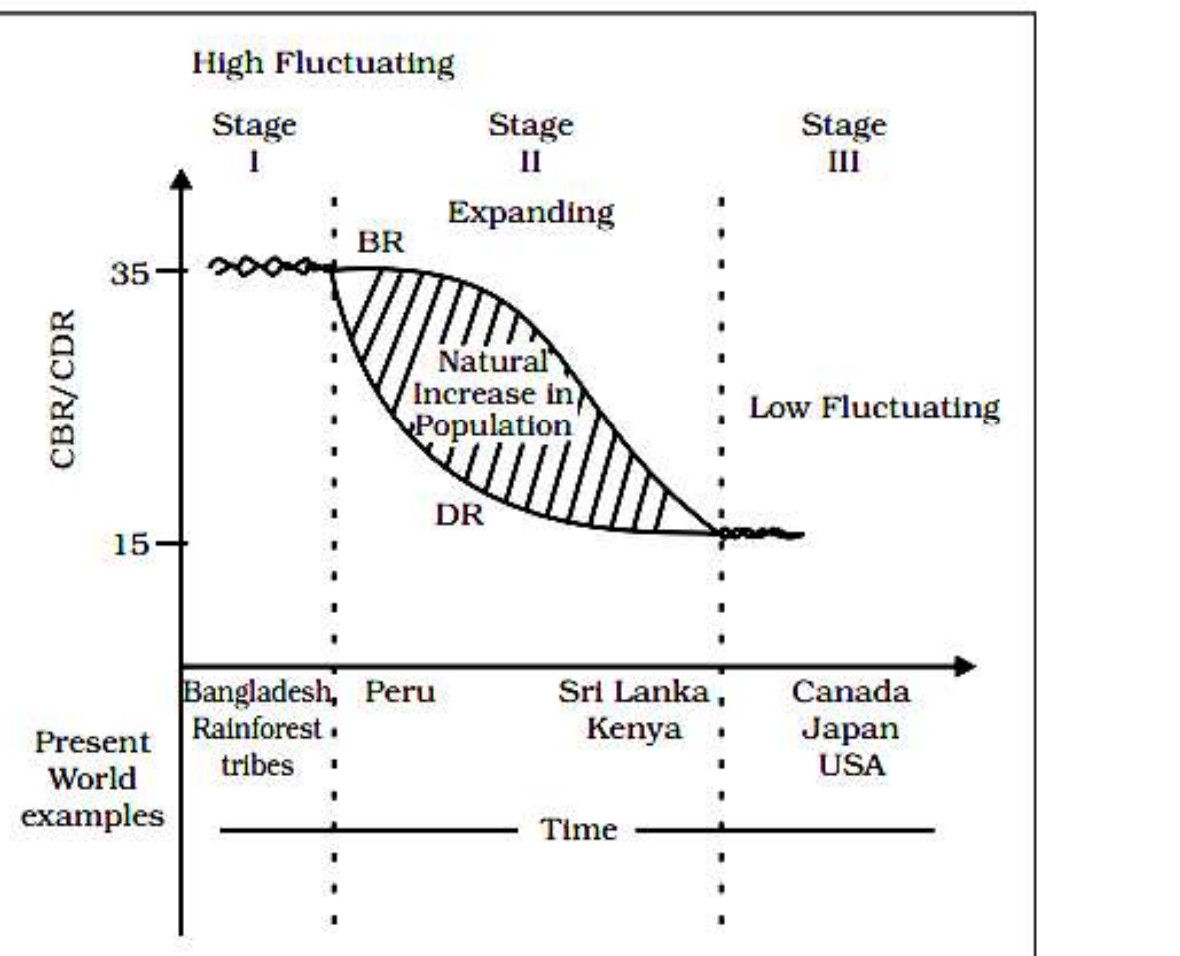
Which one of the following stages of demographic transition theory is an indicative of primitive stage?
Solution
(A) Stage I: high fertility and mortality, people mostly agrarian, illiterate, with low technology.
(Based on the graph in Q15) The highest difference between the crude birth rate and crude death rate is observed in which one of the following stages of demographic transition theory?
Solution
(B) End of the first part of stage II, when fertility remains high but mortality has fallen sharply, so the gap (natural increase) is widest.
(Based on the graph in Q15) Net increase in population during third stage of demographic transition theory is low due to which one of the following reasons?
Solution
(A) Low birth rate and low death rate.
The concept that population growth tends to outstrip the food supply was given by: (A) Griffith Taylor (B) Brundtland (C) Thomas Malthus (D) Walter Burley Griffin
Solution
(C) Thomas Malthus (1793): population would grow faster than food supply, leading to famine, disease and war (population control measures).
Read the case study given below and answer Q. No. 15 to 17.
Stages of Demographic Transition Theory
The first stage of demographic transition theory has high fertility and high mortality because people reproduce more to compensate for the deaths due to epidemics and variable food supply. The population growth is slow and most of the people are engaged in agriculture, where large families are an asset. Life expectancy is low, people are mostly illiterate and have low levels of technology. Two hundred years ago, all the countries of the world were in this stage.
Fertility remains high in the beginning of second stage but it declines with time. This is accompanied by reduced mortality rate. Improvements in sanitation and health conditions lead to decline in mortality. Because of this gap, the net addition to population is high.
In the last stage, both fertility and mortality decline considerably. The population is either stable or grows slowly. The population becomes urbanized, literate and has high technical know-how and deliberately controls the family size.
This shows that human beings are extremely flexible and are able to adjust their fertility.
In the present day, different countries are at different stages of demographic transition.
Which among the following stage/stages has/have high growth of population?
Solution
(B) Only the second stage: fertility remains high while mortality falls, so the net addition to population is high.
(Based on the case study in Q15) Choose the most appropriate option from the following regarding components of population change:
Solution
(A) Births, deaths and migration.
(Based on the case study in Q15) Which of the following stage/stages has/have a slow growth of population?
Factors of migration — choose those related to pull factors: I. peace and stability II. unfavourable climate III. protection of property IV. economic backwardness. (A) I, II (B) I, III (C) II, IV (D) II, III
Factors of migration — choose those related to push factors: I. peace and stability II. protection of property III. epidemics IV. unpleasant climate. (A) I, II (B) II, III (C) III, IV (D) I, IV
Passage on Demographic Transition Theory. In which stage(s) was the natural growth of population almost stagnant? (A) only I (B) only II (C) I and last (D) II and last
Same passage: in which stage(s) did the death rate decline the most? (A) only I (B) only II (C) I and II (D) I and last
Same passage: which country is an example of the second stage? (A) Kenya (B) Bangladesh (C) Japan (D) Canada
Which one of the following factors is an economic factor affecting the distribution of population in the world?
Read the following statements regarding objectives of family planning and choose the correct option:
I. Control the birth rate
II. Spacing the birth of children
III. Improving women's health
IV. Reducing the death rate of children
Which one of the following is related to push factor of migration?
On the given political outline map of the World, seven geographical features have been marked as A, B, C, D, E, F and G. Identify any five with the help of the following information and write their correct names on the lines drawn near them:
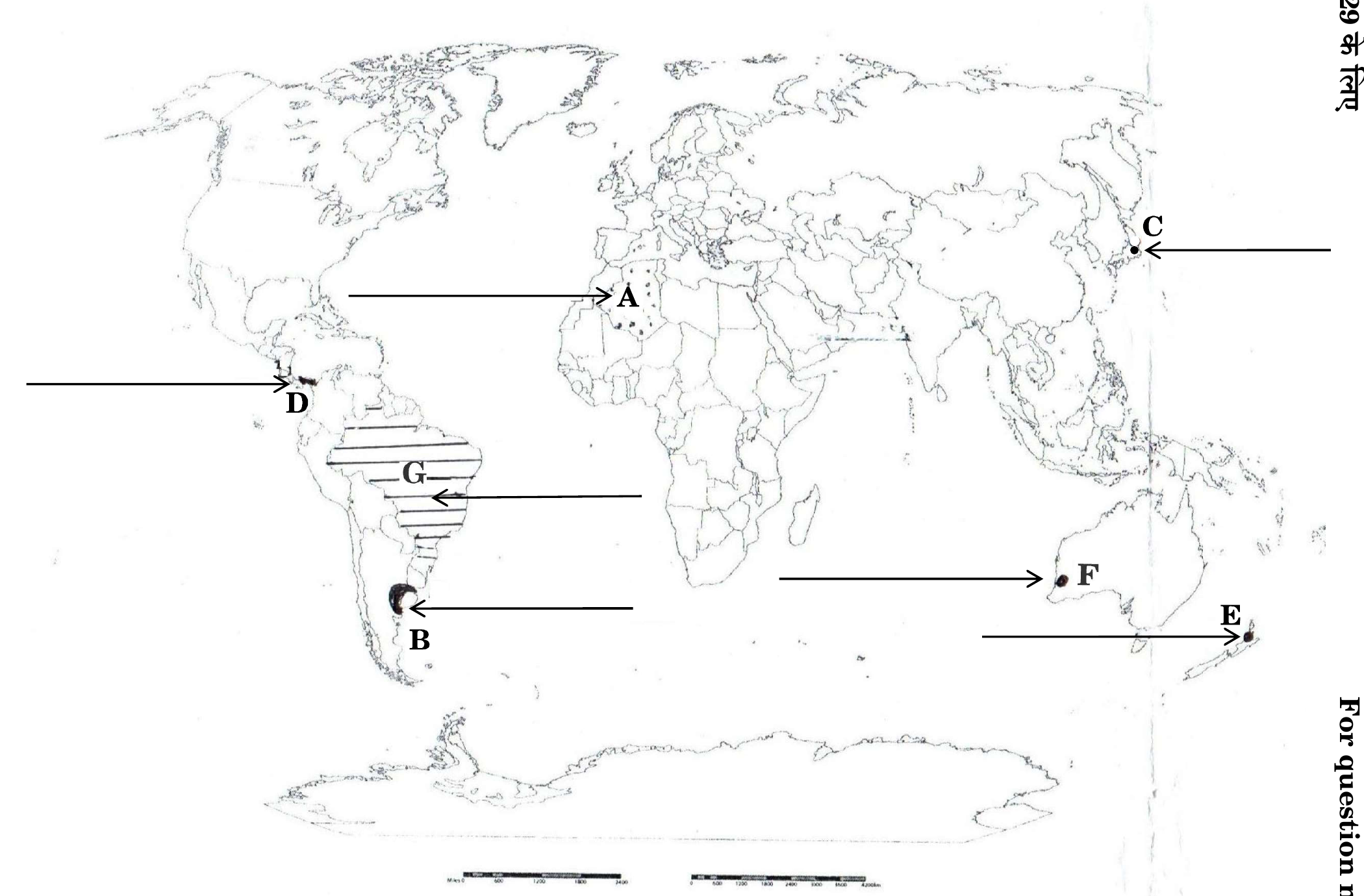
A. The largest country in Africa
G. The largest country in South America
(For Visually Impaired Candidates, in lieu of Q29, answer any five: 29.1 Which is the largest country in Africa? 29.2 Name an area of extensive commercial grain farming in Argentina. 29.3 Name any one major seaport in Japan. 29.4 Name the canal that connects the Atlantic Ocean to the Pacific Ocean in the West. 29.5 Name a major airport of New Zealand. 29.6 Name the canal that connects Red Sea to Mediterranean Sea. 29.7 Name the largest country in South America.)
3 marks: short answer
Diagram of the Demographic Transition Theory: explain the main characteristics of Stage I on birth rate, death rate and population growth. [VI: main characteristics of the demographic cycle]
Solution
Stage I: (i) high birth rate (high fertility), because people have more children to work in agriculture; (ii) high death rate (high mortality) due to epidemics, famines and poor health facilities; (iii) so population growth is slow (high births offset by high deaths); life expectancy is low; most people are illiterate, work in agriculture and live in large families; technology is low. (About 200 years ago all countries of the world were in this stage.) VI: (i) the theory can be used to describe and predict future population of an area; (ii) population changes from high births and high deaths to low births and low deaths as society moves from rural, agrarian and illiterate to urban, industrial and literate; (iii) stage I: high fertility and mortality, slow growth; stage II: fertility remains high, mortality falls, rapid growth; stage III: both decline, population stable.
Examine the role of climate, water availability and soil fertility in the distribution of world population.
Solution
(i) Climate: people avoid extreme climates (very hot or cold deserts); areas with comfortable climates with little seasonal variation attract people; e.g. Mediterranean regions were inhabited early. (ii) Water: people prefer areas where fresh water is easily available: river valleys are among the most densely populated (Nile, Ganga, Yangtze). (iii) Soil fertility: fertile soils support agriculture: fertile loamy plains like the Ganga, Huang He and Chang Jiang plains have high densities.
Examine the three stages of the demographic transition theory.
Solution
(i) Stage I: high fertility and mortality; slow growth; agricultural, illiterate society with low technology and large families. (ii) Stage II: fertility remains high at the start and declines later; mortality falls due to improved sanitation and health; large gap between births and deaths, so rapid population increase. (iii) Stage III: both fertility and mortality decline considerably; population is stable or grows slowly; urbanised, literate society with high technical know-how that deliberately controls family size.
Graph of the demographic transition theory. (22.1) Reason for high net population increase in stage II. (22.2) Difference between stages I and III. (22.3) Socio-economic conditions of countries in stage III. [VI: main characteristics of the theory]
Explain with examples any three economic factors affecting population distribution in the world.
How do science and technology help in the increase of population in the world? Explain.
5 marks: long answer
How do landforms and urbanisation influence the distribution of world population?
Solution
Landforms (geographical factor): (i) people prefer to live on flat plains and gentle slopes, which are favourable for crops, roads and industry: e.g. the Ganga plains are among the most densely populated areas; (ii) mountains and hilly areas hinder transport and agriculture, so they are sparsely populated: e.g. the Andes, Alps and Himalayas. Urbanisation (economic/social factor): (iii) cities offer better employment, education, health, transport and communication facilities, attracting large numbers of rural migrants: e.g. Mumbai, Tokyo, New York; (iv) good civic amenities and the attraction of city life draw people, so urban areas have very high densities.
How do water availability and industrialisation influence it?
Solution
Water: (i) water is the most important factor of life; people prefer to live where fresh water is easily available for drinking, bathing, cooking, irrigation and industry; (ii) river valleys are among the most densely populated areas (Nile, Ganga, Yangtze), while deserts are sparsely populated. Industrialisation: (iii) industrial belts provide jobs and attract large numbers of people, not only factory workers but also transport operators, shopkeepers, bank employees, doctors, teachers and other service providers: e.g. the Kobe-Osaka region of Japan, the Ruhr in Germany; (iv) so industrial areas become densely populated.
Analyse the factors affecting population change in the world.
Solution
Population change depends on three components: births, deaths and migration. (i) Crude Birth Rate (CBR): number of live births per thousand population; high fertility in developing countries increases population. (ii) Crude Death Rate (CDR): number of deaths per thousand; mortality falls with better health care, sanitation and medicines, raising growth. (iii) Natural growth = births − deaths. (iv) Migration: in-migration and out-migration change population of an area; push factors (unemployment, poor living conditions, political turmoil, epidemics, disasters) and pull factors (better jobs, living conditions, peace, security, healthy climate). (v) Economic development, technology, education and status of women, and government policies (family planning) also affect population change; e.g. the demographic transition from high births and deaths to low births and deaths.
Define immigration and emigration. Analyse the demographic transition theory.
Solution
Immigration: migrants who move into a new place; emigration: migrants who move out of a place. Demographic transition theory describes and predicts population change: a society moves from high births and high deaths to low births and low deaths as it changes from rural, agrarian and illiterate to urban, industrial and literate. (i) Stage I: high fertility and mortality; slow growth; low life expectancy; mostly agriculture; low technology (about 200 years ago all countries were here). (ii) Stage II: fertility remains high at the start and declines with time; mortality falls due to better sanitation and health; the gap leads to high population growth. (iii) Stage III: both fertility and mortality decline considerably; population is stable or grows slowly; it is urbanised, literate with high technical know-how and deliberately controls family size. Developed countries are in stage III; many developing countries are in stage II.
Analyse any five factors influencing the distribution of world population.
Explain the factors affecting population distribution in the world.
Define migration and differentiate between push and pull factors.
Define the term 'density of population'. Elaborate any four geographical factors that influence the distribution of population in the world. (1 + 4 = 5)
Get every solution for all chapters
- Every board question of every chapter, each fully solved the way the board gives marks
- 15 complete board papers, each followed by its solutions
- Weightage and most-asked topics for every chapter
- Instant PDF download, colour and black & white print copies
Revising the chapter first? Complete Geography Notes for Class 12 (CBSE 2026-27) →
What you get in the pack
- CBSE Class 12 Geography board papers 2016 to 2026 (all 129 sets, main and compartment; 15 in full)
- All 17 chapters and 15 full board papers complete
- Part A: all 17 chapters, questions sorted chapter-wise and by marks
- Year-wise weightage table and most-asked topics for every chapter
- Part B: each full board paper followed by its complete solutions
- Point-wise answers; every map item answered with the map shown
- Questions on chapters out of the board syllabus are flagged
All chapters in this pack
- PYQ Ch 1 Human Geography: Nature and Scope
- PYQ Ch 2 The World Population: Distribution, Density and Growth
- PYQ Ch 3 Human Development
- PYQ Ch 4 Primary Activities
- PYQ Ch 5 Secondary Activities
- PYQ Ch 6 Tertiary and Quaternary Activities
- PYQ Ch 7 Transport and Communication (World)
- PYQ Ch 8 International Trade (World)
- PYQ Ch 9 Population: Distribution, Density, Growth and Composition
- PYQ Ch 10 Human Settlements
- PYQ Ch 11 Land Resources and Agriculture
- PYQ Ch 12 Water Resources
- PYQ Ch 13 Mineral and Energy Resources
- PYQ Ch 14 Planning and Sustainable Development in Indian Context
- PYQ Ch 15 Transport and Communication (India)
- PYQ Ch 16 International Trade (India)
- PYQ Ch 17 Geographical Perspective on Selected Issues and Problems
- Board Paper 2026 Set 64-1-1 with Solutions
- Board Paper 2026 Set 64-1-2 with Solutions
- Board Paper 2026 Set 64-1-3 with Solutions
- Board Paper 2026 Set 64-2-1 with Solutions
- Board Paper 2025 Set 64-1-1 with Solutions
- Board Paper 2025 Set 64-2-1 with Solutions
- Board Paper 2025 Set 64-4-1 with Solutions
- Board Paper 2024 Set 64-1-1 with Solutions
- Board Paper 2024 Set 64-2-1 with Solutions
- Board Paper 2023 Set 64-1-1 with Solutions
- Board Paper 2022 Term 2 Set 64-1-1 with Solutions
- Board Paper 2019 Set 64-1-1 with Solutions
- Board Paper 2018 Set 64-1 with Solutions
- Board Paper 2017 Set 64-1 with Solutions
- Board Paper 2016 Set 64-1 with Solutions