
Secondary Activities: Class 12 PYQs 2019–2026 with solutions
All 36 CBSE board questions asked from Secondary Activities in 19 board papers, with the year, set and marks of each. 19 are solved free below. The Class 12 Geography PYQ Book: Solved Board Papers 2016-2026 (CBSE) has every solution, all chapters and 15 full board papers.

Secondary Activities: board weightage
Board weightage 2019–2026
| Year | 2019 | 2022 | 2023 | 2024 | 2025 | 2026 |
|---|---|---|---|---|---|---|
| Questions | 3 | 3 | 2 | 6 | 12 | 10 |
| Marks | 11 | 8 | 10 | 14 | 40 | 22 |
Most asked topics
36 questions from 19 papers. Repeated questions are shown once with every year they were asked.
Jump to: 1 mark2 marks3 marks5 marks
1 mark: MCQ and Assertion–Reason
An example of a non-metallic mineral-based industry: (A) aluminium (B) iron and steel (C) copper (D) cement
Solution
(D) Cement (limestone-based); the others use metallic minerals.
Characteristics of cottage manufacturing: I. artisans use local raw materials II. products supplied to distant markets III. mostly family members work IV. products like mats, bricks, pottery. (A) I, II, III (B) I, III, IV (C) I, II, IV (D) II, III, IV
Solution
(B) I, III and IV. Cottage manufacturing is the smallest unit; artisans with family members use local raw materials and simple tools; goods are for home use or local markets (not distant markets).
A product of forest-based industry: (A) leather (B) tea (C) cotton (D) paper
Solution
(D) Paper (forests supply timber, pulp, lac, gum, resins). Leather is animal-based; tea and cotton are agro-based.
Factors in large-scale manufacturing: I. variety of raw material II. advanced technology III. semi-skilled workers IV. large investment. (A) I, II, III (B) I, III, IV (C) I, II, IV (D) II, III, IV
Solution
(C) I, II and IV. Large-scale manufacturing needs a large market, various raw materials, enormous energy, specialised (skilled) workers, advanced technology, assembly-line mass production and large capital.
Characteristics of cottage industries: I. the smallest manufacturing units II. artisans use local raw materials III. all craftsmen use electrically powered tools IV. products mostly for own consumption or local markets. (A) I, II, III (B) I, II, IV (C) I, III, IV (D) II, III, IV
Solution
(B) I, II and IV. Artisans use simple, often hand tools, not necessarily electric tools.
An example of forest-based industry: (A) textiles (B) sugar (C) lac (D) edible oil
Solution
(C) Lac. Forests supply timber, pulp, lac, gum, resin, etc.; textiles, sugar and edible oil are agro-based.
Which factor most affects the location of footloose industries? (A) accessibility by road network (B) nearness to raw material (C) power availability (D) cheap labour
Solution
(A) Footloose industries (e.g. electronics, computer chips) can be located anywhere, as they use small components and do not depend on a particular raw material; they need accessibility by road network.
Assertion (A): All manufacturing industries are associated with raw materials. Reason (R): Resources are essential for human survival. (A) both true, R explains A (B) both true, R does not explain A (C) A correct, R incorrect (D) A incorrect, R correct
Solution
(B) as per the board key: both statements are true, but the importance of resources for survival does not explain why industries depend on raw materials. (Strictly, footloose industries are not tied to particular raw materials.)
Two statements are given below. They are Assertion (A) and Reason (R). Read both the statements carefully and choose the correct option.
Assertion (A): Foot loose industries can be located in a wide variety of places.
Reason (R): Location of foot loose industries is determined by transport network accessibility.
Assertion (A): Industries based on cheap, bulky and weight-losing materials are located close to raw material sources. Reason (R): This is done to reduce the cost of products. (A) both true, R explains A (B) both true, R does not explain A (C) A incorrect, R correct (D) A correct, R incorrect
The sector concerned with converting raw materials into finished products: (A) primary (B) secondary (C) tertiary (D) quaternary
Synthetic fibre and plastic manufacturing is an example of which one of the following?
Assertion (A): Footloose industries can be located in a wide variety of places. Reason (R): The important factor in their location is accessibility by road network. (A) both true, R explains A (B) both true, R does not explain (C) A true, R false (D) A false, R true
Match industry with example: 1. agro-based 2. forest-based 3. chemical-based 4. product-based — (i) soaps (ii) salts (iii) lac (iv) vegetable oil. (A) 1-iii, 2-iv, 3-ii, 4-i (B) 1-iii, 2-iv, 3-i, 4-ii (C) 1-iv, 2-iii, 3-ii, 4-i (D) 1-iv, 2-iii, 3-i, 4-ii
Assertion (A): Industries based on ores are located close to the sources of raw material. Reason (R): Industries maximise profits by reducing transportation costs. (A) A correct, R false (B) A false, R correct (C) both correct, R explains A (D) both correct, R does not explain
Identify the five geographical features shown on the given political outline map of the world as A, B, C, D and E. Write their correct names on the lines drawn near them with the help of the following information:
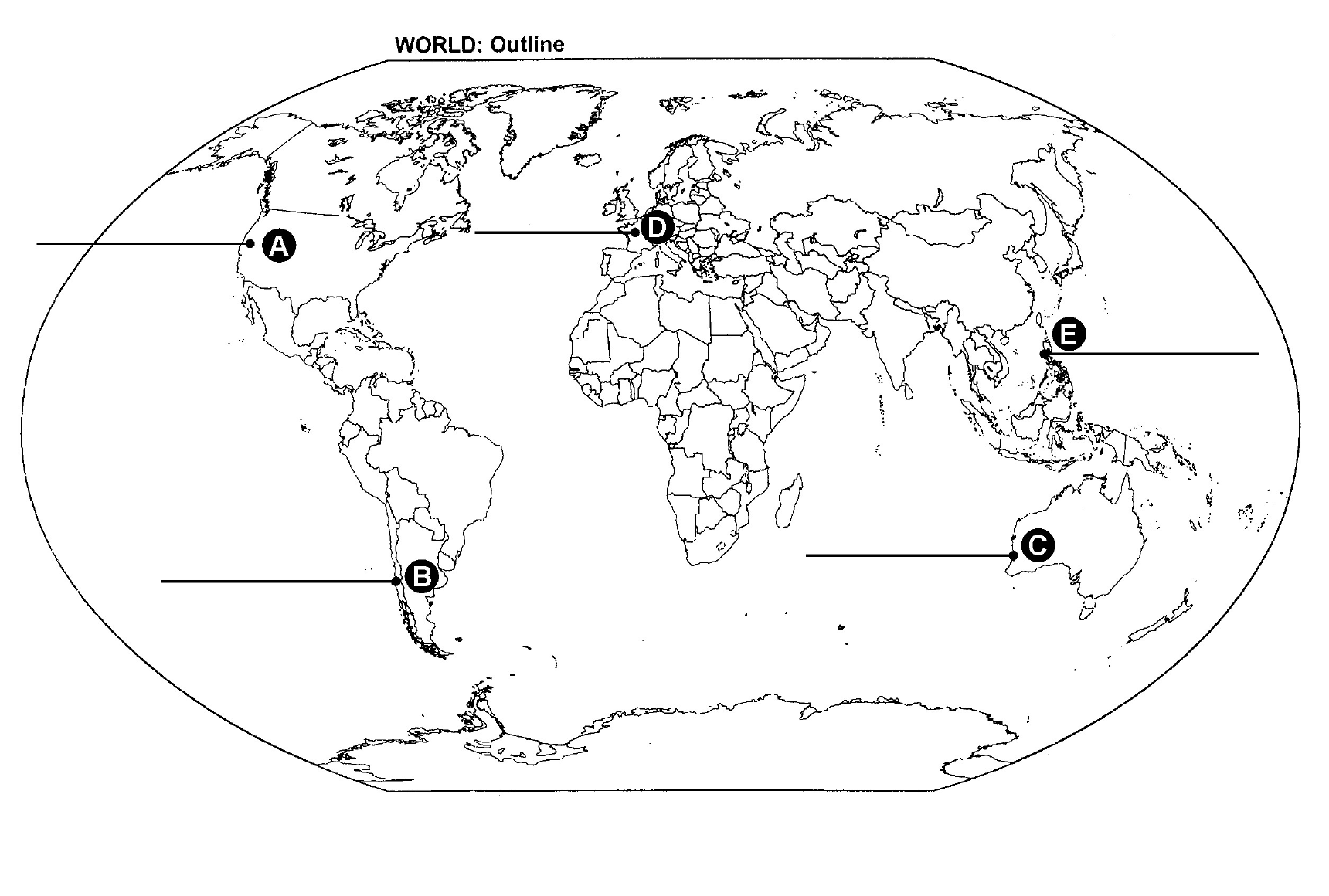
(A) An industrial region
2 marks: very short answer
Why is 'access to market' essential for setting up industries in the world? Explain.
Solution
(i) A market for manufactured goods is the most important factor in locating an industry; without buyers, production is pointless. (ii) 'Market' means people who demand the goods and have the purchasing power to buy them. Remote areas inhabited by few people offer small markets, while developed regions such as Europe, North America, Japan and Australia offer large global markets. (iii) Densely populated South and South-East Asia are also large markets. An efficient transport system connects the industry to its market.
3 marks: short answer
Explain the main reasons for the uneven distribution of modern manufacturing industries in the world.
Solution
Industries locate where production costs are lowest and profits highest, depending on: (i) access to markets with purchasing power (developed regions); (ii) access to raw materials (iron and steel near ore and coal); (iii) labour supply (cheap or skilled); (iv) energy sources; (v) transport and communication; (vi) government policies and agglomeration economies. These factors are concentrated in some regions (north-eastern USA, Western Europe, Japan, eastern China), so industries are unevenly distributed.
Classify industries based on product and explain their characteristics.
Solution
(i) Basic (key) industries: their products are used to make other goods, e.g. iron and steel used to make machinery. (ii) Consumer goods industries: produce goods consumed directly by consumers, e.g. bread, biscuits, tea, soaps, toiletries, paper, TVs, cosmetics. (Basic industries support further manufacturing; consumer industries serve final demand.)
"Iron and steel industry is called basic industry." Support the statement with examples.
"'High technology' is known as the latest generation of manufacturing activities in the world." Support the statement with examples.
5 marks: long answer
"Industries should be located at points where the production costs are minimum." Examine the statement with suitable arguments.
Solution
Industries maximise profits by reducing costs, so they locate where the following factors are favourable: (i) Access to market: the existence of a large market with purchasing power (e.g. developed regions). (ii) Access to raw material: industries using heavy, cheap or perishable, weight-losing materials (steel, sugar) locate close to raw material. (iii) Access to labour supply: a cheap, skilled labour force. (iv) Access to sources of energy: industries using much power (aluminium) locate near energy sources. (v) Access to transport and communication: speedy, efficient transport reduces costs (e.g. Western Europe, eastern USA). (vi) Government policy: incentives for balanced regional development. (vii) Agglomeration economies: benefits from nearness to other industries and services. Thus industries locate where the total of these costs is lowest.
Classify industries on the basis of size and explain the significance of manufacturing.
Solution
By size: (i) Cottage/household: smallest units, artisans with family use local raw materials and simple tools; products for home use or local markets (pottery, baskets). (ii) Small-scale: uses local raw material, simple power-driven machines and semi-skilled labour, run in workshops outside the home (India, China, Indonesia, Brazil). (iii) Large-scale: large market, various raw materials, enormous energy, specialised workers, advanced technology, assembly-line mass production and large capital (e.g. north-eastern USA, north-western Europe, Japan). Significance: manufacturing adds value to raw materials, creates jobs, earns foreign exchange, modernises the economy and supports agriculture and services.
Why are manufacturing industries necessary? Classify industries on the basis of ownership and explain them.
Solution
Necessity: manufacturing transforms raw materials into finished goods of higher value, provides employment, increases national income and exports, and is the basis of development. By ownership: (i) Public sector: owned and managed by governments (e.g. SAIL, BHEL); socialist countries have many state-owned industries. (ii) Private sector: owned by individual investors (e.g. Tata Steel); capitalist countries have mostly private industries. (iii) Joint sector: owned by joint stock companies, or the government and private sector together (e.g. Maruti Udyog originally).
"The cost of transport plays an important role in the location of industries." Justify with examples.
Solution
(i) Industries try to locate where the total cost of production, including transport of raw materials and finished goods, is lowest. (ii) Industries using heavy, bulky, weight-losing raw materials (iron and steel, sugar, cement) locate near raw material to save transport costs: e.g. steel plants near iron ore and coal in Jharkhand–Odisha. (iii) Industries producing perishable or bulky finished goods locate near markets (e.g. bakery, soft drinks). (iv) Speedy and efficient transport facilitates movement of raw materials and products: e.g. Western Europe and eastern North America have highly developed transport, so industries are concentrated there. (v) Ports and junctions (break-of-bulk points) attract industries (e.g. oil refineries at ports).
"Dairy farming is practised mainly near urban and industrial centres." Justify with examples.
Solution
(i) Dairy farming is the most advanced and efficient rearing of milch animals; it is capital- and labour-intensive. (ii) It is practised mainly near urban and industrial centres, which provide a neighbourhood market for fresh milk and dairy products; milk is perishable. (iii) Development of transport, refrigeration, pasteurisation and other preservation processes has increased the duration of storage of dairy products. (iv) Three main regions: north-western Europe, Canada and north-eastern USA, and south-eastern Australia, New Zealand and Tasmania; all have large urban-industrial populations nearby.
Explain the main features of large-scale manufacturing industries in the world.
Solution
(i) A large market; (ii) various raw materials; (iii) enormous energy; (iv) specialised workers and advanced technology; (v) assembly-line mass production and large capital investment. It developed in the last 200 years in the UK, north-eastern USA and Europe and now spreads to the developing world; major regions: Western and Central Europe, eastern North America, Japan, Russia, and newly industrialising countries (China, India, Korea).
Explain the main features of high-tech industries in the world.
Solution
(i) The latest generation of manufacturing: application of intensive research and development to produce products of an advanced scientific and engineering character. (ii) Professional (white-collar) workers make up a large share of the workforce. (iii) Robotics on assembly lines, CAD and manufacturing, electronic controls of smelting and refining processes, and constant development of new chemical and pharmaceutical products. (iv) Neatly spaced, low, modern office-plant-lab buildings rather than massive assembly structures. (v) Regionally concentrated, self-sustained, highly specialised technopolies: Silicon Valley (San Francisco), Silicon Forest (Seattle), Bengaluru.
"Industries maximise profits by reducing costs." Explain with examples.
Solution
Industries locate where costs are lowest: (i) access to market: people with demand and purchasing power (developed regions of Europe, North America, Japan); (ii) access to raw material: industries using cheap, bulky, weight-losing material locate near its source (steel, sugar, cement); (iii) labour supply: cheap and skilled labour (textiles in China, India); (iv) energy: power-intensive industries near energy sources (aluminium near hydroelectric power); (v) transport and communication: efficient transport reduces costs (Western Europe); (vi) government policy and agglomeration economies: industries benefit from being near each other (industrial clusters).
Explain the classification of industries based on raw materials with examples.
Explain the difference between cottage and large-scale industries in the world, with examples.
Differentiate between small-scale and large-scale manufacturing industries in the world.
Analyse five main factors affecting location of industries in the world.
Analyse the classification of industries on the basis of raw materials into five heads.
Explain any five characteristics of 'high tech industry' in the world.
Explain any five characteristics of 'large scale manufacturing' in the world.
Get every solution for all chapters
- Every board question of every chapter, each fully solved the way the board gives marks
- 15 complete board papers, each followed by its solutions
- Weightage and most-asked topics for every chapter
- Instant PDF download, colour and black & white print copies
Revising the chapter first? Complete Geography Notes for Class 12 (CBSE 2026-27) →
What you get in the pack
- CBSE Class 12 Geography board papers 2016 to 2026 (all 129 sets, main and compartment; 15 in full)
- All 17 chapters and 15 full board papers complete
- Part A: all 17 chapters, questions sorted chapter-wise and by marks
- Year-wise weightage table and most-asked topics for every chapter
- Part B: each full board paper followed by its complete solutions
- Point-wise answers; every map item answered with the map shown
- Questions on chapters out of the board syllabus are flagged
All chapters in this pack
- PYQ Ch 1 Human Geography: Nature and Scope
- PYQ Ch 2 The World Population: Distribution, Density and Growth
- PYQ Ch 3 Human Development
- PYQ Ch 4 Primary Activities
- PYQ Ch 5 Secondary Activities
- PYQ Ch 6 Tertiary and Quaternary Activities
- PYQ Ch 7 Transport and Communication (World)
- PYQ Ch 8 International Trade (World)
- PYQ Ch 9 Population: Distribution, Density, Growth and Composition
- PYQ Ch 10 Human Settlements
- PYQ Ch 11 Land Resources and Agriculture
- PYQ Ch 12 Water Resources
- PYQ Ch 13 Mineral and Energy Resources
- PYQ Ch 14 Planning and Sustainable Development in Indian Context
- PYQ Ch 15 Transport and Communication (India)
- PYQ Ch 16 International Trade (India)
- PYQ Ch 17 Geographical Perspective on Selected Issues and Problems
- Board Paper 2026 Set 64-1-1 with Solutions
- Board Paper 2026 Set 64-1-2 with Solutions
- Board Paper 2026 Set 64-1-3 with Solutions
- Board Paper 2026 Set 64-2-1 with Solutions
- Board Paper 2025 Set 64-1-1 with Solutions
- Board Paper 2025 Set 64-2-1 with Solutions
- Board Paper 2025 Set 64-4-1 with Solutions
- Board Paper 2024 Set 64-1-1 with Solutions
- Board Paper 2024 Set 64-2-1 with Solutions
- Board Paper 2023 Set 64-1-1 with Solutions
- Board Paper 2022 Term 2 Set 64-1-1 with Solutions
- Board Paper 2019 Set 64-1-1 with Solutions
- Board Paper 2018 Set 64-1 with Solutions
- Board Paper 2017 Set 64-1 with Solutions
- Board Paper 2016 Set 64-1 with Solutions