
Primary Activities: Class 12 PYQs 2019–2026 with solutions
All 69 CBSE board questions asked from Primary Activities in 18 board papers, with the year, set and marks of each. 35 are solved free below. The Class 12 Geography PYQ Book: Solved Board Papers 2016-2026 (CBSE) has every solution, all chapters and 15 full board papers.

Primary Activities: board weightage
Board weightage 2019–2026
| Year | 2019 | 2022 | 2023 | 2024 | 2025 | 2026 |
|---|---|---|---|---|---|---|
| Questions | 1 | – | 4 | 24 | 30 | 28 |
| Marks | 5 | – | 4 | 60 | 58 | 50 |
Most asked topics
87 questions from 18 papers. Repeated questions are shown once with every year they were asked.
1 mark: MCQ and Assertion–Reason
Which one of the following is the low latitudes zone of subsistence gathering practiced in the world?
Solution
(C) South-east Asia. Gathering is practised in high latitudes (northern Canada, northern Eurasia, southern Chile) and in low latitudes: the Amazon basin, tropical Africa, northern fringe of Australia and the interior parts of South-east Asia.
E. An area of 'subsistence gathering'
Solution
Tropical Africa (Congo basin).
F. An area of 'commercial livestock rearing'
Solution
Western parts of the USA (also the Prairies; other areas: Pampas, Australia, New Zealand, South Africa).
G. An area of 'dairy farming'
(For Visually Impaired Candidates, in lieu of Q29, attempt any five: 29.1 Name the westernmost terminal station of Trans-Siberian Railway. 29.2 Mention a major sea port on the western coast of South America. 29.3 Mention an international airport of Kenya. 29.4 Name the shipping canal joining Pacific and Atlantic Oceans. 29.5 Mention one major region of 'subsistence gathering' in Africa. 29.6 Name a major area of 'commercial livestock rearing' in United States of America. 29.7 Name the major area of 'dairy farming' in North America.)
Solution
South-eastern Australia (on the map); in North America: the north-eastern USA and south-eastern Canada.
Which type of farming is most labour-intensive? (A) horticulture (B) subsistence agriculture (C) cooperative farming (D) collective farming
Solution
(A) Horticulture (market gardening of vegetables, fruits and flowers): it requires much labour and capital, as per the board key.
World map, feature D: a major area of subsistence gathering. [VI: an area of subsistence gathering in South America]
Solution
Amazon Basin (also southern Chile).
World map, feature E: a major area of nomadic herding. [VI: an area of nomadic herding in Africa]
Solution
South-West Africa (Namibia, Kalahari region).
World map, feature F: a major area of commercial livestock rearing. [VI: a country of the Australian continent with commercial livestock rearing]
Solution
New Zealand (also Australia).
World map, feature G: a major area of extensive commercial grain farming. [VI: the area of extensive commercial grain farming in Australia]
Solution
The Downs (Australia).
World map, feature E: an area of subsistence gathering. [VI: a region of Africa]
Solution
Tropical Africa.
World map, feature F: an area of extensive commercial grain farming. [VI: in New Zealand]
Solution
The Canterbury Plains (New Zealand).
World map, feature G: an area of mixed farming. [VI: in South America]
Solution
The temperate latitudes of South America (southern Brazil/Argentina).
In which region is dairy farming well developed? (A) West Indies (B) Madagascar (C) Malaysia (D) New Zealand
Solution
(D) New Zealand; dairy farming is also important in north-western Europe, Canada and south-eastern Australia.
World map, feature B: a major area of extensive commercial grain farming. [VI: in Africa]
Solution
The Velds of South Africa.
World map, feature C: a major area of nomadic herding. [VI: in Asia]
Solution
The Arabian Peninsula (also Mongolia, Central China, Tundra region of Eurasia).
World map, feature D: a major area of commercial livestock rearing. [VI: in North America]
Solution
The USA (western USA).
Assertion (A): Developing countries are more involved in mining and processing of minerals. Reason (R): Their economies are primarily based on the service sector. (A) both correct, R explains A (B) both correct, R does not explain (C) A correct, R incorrect (D) A incorrect, R correct
Solution
(C) A is correct (they mine and export minerals, often with foreign companies); R is incorrect: their economies are mainly primary-sector based.
Correct statements about mining: i. in ancient times minerals were used to make tools and weapons ii. all developed countries are extracting more minerals for development iii. actual development of mining began with the industrial revolution iv. there are many stages in the discovery of minerals. (A) ii, iii, iv (B) i, ii, iv (C) i, iii, iv (D) i, ii, iii
Solution
(C) i, iii and iv. Many developed countries have actually retreated from mining due to high labour costs, while developing countries are increasing mining.
World map, feature D: a major area of nomadic herding. [VI: the Asian peninsula with nomadic herding]
Solution
The Arabian Peninsula.
World map, feature G: a major area of mixed farming. [VI: in Africa]
Solution
The temperate latitudes of South Africa.
World map, feature D: an area of subsistence gathering. [VI: in Canada]
Solution
Northern Canada.
Read the following statements related to 'intensive subsistence agriculture' other than paddy in the world carefully and choose the correct option.
I. Wheat is grown in western parts of the Indo-Gangetic plains in India.
II. Wheat is grown in monsoonal areas only.
III. Millets are grown in dry parts of western and southern India.
IV. Wheat, soyabean etc. are grown in northern China.
Solution
(C) I, III and IV. In intensive subsistence agriculture not dominated by paddy, wheat, soyabean, barley and sorghum are grown in northern China, Manchuria, North Korea and Japan; in India wheat is grown in the western Indo-Gangetic plains and millets in the dry parts of western and southern India. Wheat is not confined to monsoonal areas.
D. A major area of nomadic herding
E. A major area of extensive commercial grain farming
F. A major area of commercial livestock rearing
G. A major area of subsistence gathering
About gathering: I. generally practised in regions with harsh climates II. in modern times some gathering is market-oriented III. Denmark is a classic example of gathering IV. practised mostly by primitive societies. (A) I, II, IV (B) I, II, III (C) II, III, IV (D) I, III, IV
World map, feature A: an area of nomadic herding. [VI: in southern Africa]
World map, feature C: an area of extensive commercial grain farming. [VI: in South America]
The type of agriculture predominantly practised in the Australian Downs: (A) mixed farming (B) plantation (C) cooperative farming (D) extensive commercial grain cultivation
World map, feature E: an area of commercial livestock rearing (marked in Australia). [VI: an area of extensive commercial grain farming in Australia]
World map, feature F: an area of nomadic herding. [VI: in northern Europe and Asia]
On the given political outline map of the World, seven geographical features have been marked as A, B, C, D, E, F and G. Identify any five with the help of the following information and write their correct names on the lines drawn near them:
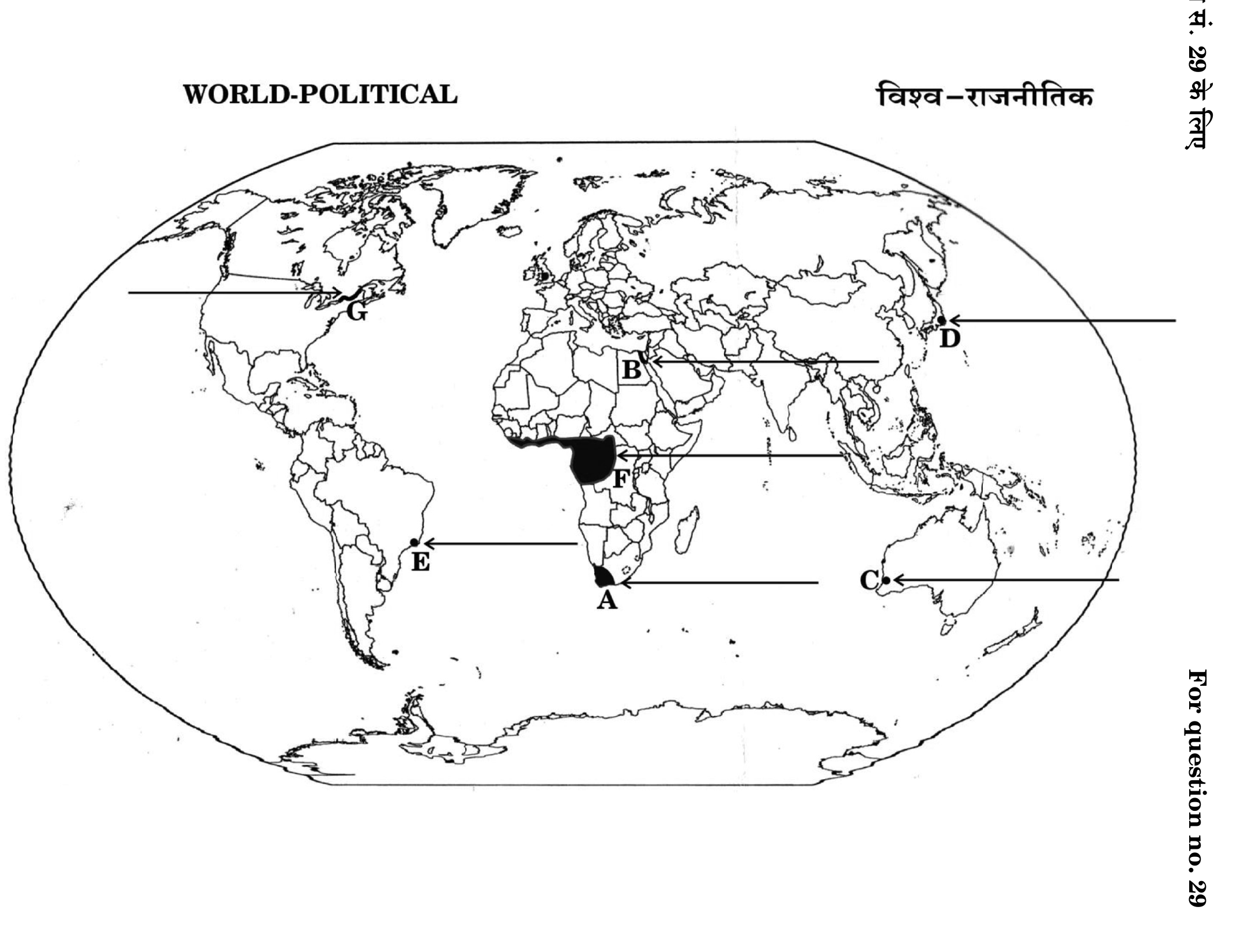
A. An area of extensive commercial grain farming
F. An area of subsistence gathering
Match the area with animal domestication (nomadic herding): 1. Tropical Africa 2. Asiatic deserts 3. mountainous areas of Tibet 4. Sub-Arctic areas — (i) camel (ii) cattle (iii) reindeer (iv) llamas. (A) 1-ii, 2-i, 3-iv, 4-iii (B) 1-i, 2-ii, 3-iv, 4-iii (C) 1-ii, 2-i, 3-iii, 4-iv (D) 1-i, 2-ii, 3-iii, 4-iv
World map, feature D: an area of commercial livestock rearing. [VI: the major country of South America]
Which type of agriculture is concerned with the production of a single crop? (A) intensive subsistence (B) plantation (C) mixed farming (D) Mediterranean
World map, feature B: a major area of nomadic herding. [VI: a major area of extensive commercial grain cultivation of Eurasia]
World map, feature A: an area of extensive commercial grain farming. [VI: of Argentina]
World map, feature B: an area of commercial livestock rearing. [VI: of South America]
Which among the following is related to 'truck farming'?
Which among the following is the largest region of 'commercial dairy farming'?
Fodder crops are an important component of which among the following types of agriculture?
B. An area of extensive commercial grain farming
3 marks: short answer
Study the map showing areas of 'extensive commercial grains farming' carefully and answer questions that follow:
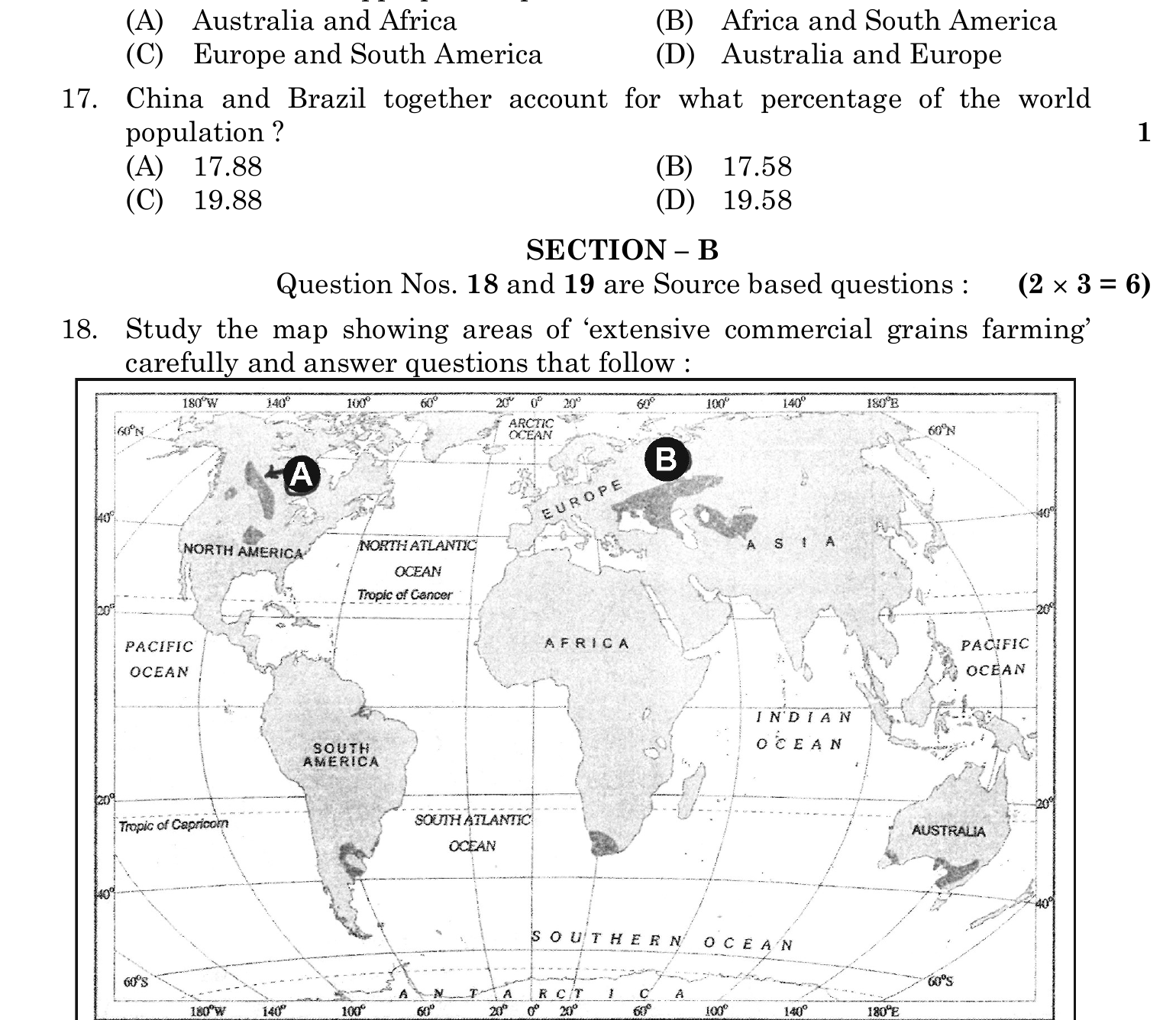
(18.1) Write the geographical name of the area marked as A. (1)
(18.2) Name any two major crops grown in the region A. (½ + ½ = 1)
(18.3) Explain the agricultural importance of the area marked as B. (1)
(For Visually Impaired Candidates, in lieu of Q18: Explain the main characteristics of 'extensive commercial grain farming' in the world.)
Solution
(18.1) The Canadian and American Prairies (North America). (18.2) Wheat and corn (also barley, oats, rye). (18.3) Area B (e.g. the Pampas / Velds / Downs) practises extensive commercial grain farming on very large, fully mechanised farms; yield per acre is low but yield per person is high, producing surplus grain for export. VI: (i) practised in the interior semi-arid lands of the mid-latitudes; (ii) very large farms (hundreds of hectares); (iii) all operations from ploughing to harvesting are mechanised; (iv) low yield per acre but high yield per person; (v) crops: wheat, corn, barley, oats, rye; regions: Canadian and American Prairies, Pampas of Argentina, Velds of South Africa, Australian Downs, Canterbury Plains of New Zealand.
Map: areas of nomadic herding. (18.1) Identify the area marked A. (18.2) Name an important animal reared in areas marked B. (18.3) Describe the main characteristic of nomadic herding. [VI: main characteristics of hunting and gathering]
Solution
(18.1) Madagascar. (18.2) Reindeer (in the Arctic and sub-Arctic tundra areas). (18.3) Nomadic herding is a primitive subsistence activity in which herders depend on animals for food, clothing, shelter, tools and transport, and move from place to place with their livestock depending on the amount and quality of pastures and water; each community occupies a well-identified territory. VI: (i) the oldest economic activity known; (ii) earliest humans depended on animals they hunted and edible plants gathered nearby; (iii) practised in harsh climatic regions by primitive societies; (iv) requires little capital and a low level of technology; yield per person is low and there is little surplus; (v) some gathering is now market-oriented (leaves, bark, rubber, gums, resins).
Map of areas of dairy farming. (19.1) The largest dairy farming region of the world. (19.2) An important dairy region of the southern hemisphere. (19.3) The main characteristic of dairy farming. [VI: main characteristics of dairy farming with examples]
Solution
(19.1) North-western Europe. (19.2) South-eastern Australia (also New Zealand, Tasmania). (19.3) Dairy farming is the most advanced and efficient type of rearing of milch animals; it is highly capital-intensive (animal sheds, storage for fodder, feeding and milking machines) and labour-intensive (rigorous care in feeding and milching). VI: (i) capital-intensive; (ii) labour-intensive; there is no off-season; (iii) emphasis on cattle breeding, health care and veterinary services; (iv) practised near urban and industrial centres, which provide markets for fresh milk and dairy products; refrigeration, pasteurisation and preservation processes have increased storage; (v) three main regions: north-western Europe (the largest), Canada, and south-eastern Australia, New Zealand and Tasmania.
Passage on hunting and food gathering (earliest humans depended on animals hunted and plants gathered; poaching has made many species extinct; primitive tools limited the kill; gathering in harsh climates with little capital and low technology). (18.1) Examine the impact of poaching on wild animals. (18.2) Why was hunting limited in early times? (18.3) Why did early man depend on his immediate environment?
Figure showing shaft and open-cast mining. (19.1) Name the methods of mining shown. (19.2) Differentiate between them. (19.3) Which method is more life-threatening? [VI: define mining; why developed countries avoid mining; two methods]
5 marks: long answer
"The earliest human beings depended on their immediate environment for sustenance." Examine with reference to hunting and gathering.
Solution
(i) The earliest humans depended on animals they hunted and the edible plants they gathered from nearby forests. (ii) Primitive societies used crude tools made of stone, twigs or arrows, so the number of animals killed was limited. (iii) Gathering is practised in regions with harsh climatic conditions, often by primitive societies: high latitudes (northern Canada, northern Eurasia, southern Chile) and low latitudes (Amazon basin, tropical Africa, northern Australia, interior South-east Asia). (iv) It requires a small amount of capital investment and operates at a very low level of technology; yield per person is very low and little or no surplus is produced. (v) In modern times some gathering is market-oriented and commercial (e.g. collecting leaves, bark, rubber, balata, gums, resins, quinine); but gathering has little chance of becoming important at the global level as synthetic products replace these.
"Commercial livestock rearing is well organised and capital-intensive." Examine in comparison with nomadic herding.
Solution
Commercial livestock rearing: (i) practised on permanent ranches covering large areas, divided into parcels fenced to regulate grazing; (ii) it is capital-intensive and associated with Western culture; (iii) specialised: only one type of animal (sheep, cattle, goats, horses); products like meat, wool, hides and skin are processed and packed scientifically and exported; (iv) scientific breeding, genetic improvement, disease control and health care of animals; (v) found in New Zealand, Australia, Argentina, Uruguay and the USA. Nomadic herding: herders move from place to place with their animals depending on availability of pasture and water; a primitive subsistence activity; animals provide food, clothing, shelter, tools and transport; transhumance in mountains; areas: the Sahara, Central Asia, South-west Africa, Tundra.
"Mixed farming is practised in the developed parts of the world." Support with examples.
Solution
(i) Mixed farming is found in the highly developed parts of the world: north-western Europe, eastern North America, parts of Eurasia and the temperate latitudes of the southern continents. (ii) Farms are moderate in size; crops include wheat, barley, oats, rye, maize, fodder and root crops. (iii) Fodder crops are an important component; crop rotation and intercropping maintain soil fertility. (iv) Equal emphasis on crop cultivation and animal husbandry: cattle, sheep, pigs and poultry provide income along with crops. (v) High capital expenditure on farm machinery and buildings, extensive use of chemical fertilisers and green manures, and skill and expertise of farmers.
"Market gardening is labour- and capital-intensive." Support with examples.
Solution
(i) Market gardening and horticulture specialise in high-value crops like vegetables, fruits and flowers, solely for urban markets. (ii) Farms are small and located where there are good transport links with urban centres with high-income consumers. (iii) It is both labour- and capital-intensive: it uses irrigation, HYV seeds, fertilisers, insecticides, greenhouses and artificial heating in colder regions. (iv) Found in densely populated industrial districts of north-west Europe, north-east USA and the Mediterranean; the Netherlands specialises in flowers (tulips) flown to all major European cities. (v) Truck farming: the distance a truck can cover overnight determines the area; factory farming of livestock (poultry, cattle) in Western Europe and North America.
"Market gardening and horticulture specialise in the cultivation of high value crops." Justify the statement.
Solution
(i) They specialise in the cultivation of high-value crops such as vegetables, fruits and flowers, solely for urban markets. (ii) Farms are small and located where there are good transport links with urban centres where high-income consumers live. (iii) It is both labour- and capital-intensive and uses irrigation, HYV seeds, fertilisers, insecticides, greenhouses and artificial heating in colder regions. (iv) Developed in densely populated industrial districts of north-west Europe, north-east USA and the Mediterranean; the Netherlands specialises in growing flowers and horticultural crops, especially tulips, flown to all major cities of Europe. (v) Truck farming and factory farming (livestock) are related specialised forms.
"High-tech industries are regionally concentrated, self-sustained and highly specialized." Justify the statement.
Solution
(i) High-tech industry is the latest generation of manufacturing, applying intensive research and development to produce products of an advanced scientific and engineering character. (ii) Professional (white collar) workers form a large share of the workforce. (iii) Robotics on assembly lines, computer-aided design (CAD) and manufacturing, electronic controls and constant development of new products are prominent. (iv) Regionally concentrated, self-sustained and highly specialised high-tech complexes called technopolies exist: e.g. Silicon Valley near San Francisco and Silicon Forest near Seattle; in India, Bengaluru. (v) They have neatly spaced, low, modern office-plant-lab buildings rather than massive assembly structures.
"Rearing of animals in ranches is organised on a scientific basis." Examine.
Solution
Commercial livestock rearing: (i) practised on permanent ranches covering large areas divided into parcels fenced to regulate grazing; (ii) when the grass of one parcel is grazed, animals are moved to another; the number of animals is kept according to the carrying capacity of pastures; (iii) it is a specialised activity in which only one type of animal is reared (sheep, cattle, goats, horses); (iv) products such as meat, wool, hides and skin are processed and packed scientifically and exported; (v) emphasis on breeding, genetic improvement, disease control and health care; (vi) it is capital-intensive; found in New Zealand, Australia, Argentina, Uruguay and the USA.
"Mixed economies have public, private and joint sector industries." Examine.
Solution
(i) Mixed economies have both the state and private enterprise owning industries. (ii) Public sector industries are owned and managed by the government (e.g. SAIL, BHEL, ONGC in India); in socialist countries most industries are state-owned. (iii) Private sector industries are owned by individual investors (e.g. Tata, Reliance); in capitalist countries they dominate. (iv) Joint sector industries are owned by the government and private firms together or by joint stock companies. India's mixed economy has all three, combining social welfare goals with efficiency.
Analyse the main features of plantation agriculture in the world.
Solution
(i) Introduced by Europeans in colonies situated in the tropics. (ii) Important crops: tea, coffee, cocoa, rubber, cotton, oil palm, sugarcane, bananas and pineapples. (iii) Large estates or plantations, large capital investment, managerial and technical support, scientific methods of cultivation, single-crop specialisation, cheap labour, and a good transport system linking estates to factories and markets for export. (iv) Examples: the French established cocoa and coffee plantations in West Africa; the British set up tea gardens in India and Sri Lanka, rubber in Malaysia, sugarcane and bananas in the West Indies; the Spanish and Americans coconut and sugarcane in the Philippines; the Dutch sugarcane in Indonesia. (v) Some plantations are now owned by governments or nationals of the countries.
Analyse the main features of nomadic herding in the world.
Solution
(i) A primitive subsistence activity in which herders rely on animals for food, clothing, shelter, tools and transport. (ii) They move from place to place with livestock depending on the amount and quality of pastures and water; each community occupies a well-identified territory. (iii) A wide variety of animals: in tropical Africa cattle; in the Sahara and Asian deserts sheep, goats and camels; in mountainous Tibet and the Andes yak and llamas; in the Arctic and sub-Arctic reindeer. (iv) Transhumance: in mountain regions, movement to higher altitudes in summer and lower in winter (e.g. Gujjars, Bakarwals, Gaddis, Bhotiyas in the Himalayas). (v) Regions: the Atlantic shores of North Africa through Arabia into Mongolia and Central China; the Tundra of Eurasia; South-west Africa and Madagascar. The number of nomads is decreasing due to political boundaries and settlement policies.
Analyze the main features of Plantation Agriculture in the world.
Analyse the main features of extensive commercial grain cultivation in the world.
Describe any five features of plantation agriculture in the world.
Describe any five features of extensive commercial grain farming in the world.
Explain any five features of mixed farming in the world, with examples.
Explain any five features of dairy farming in the world, with examples.
Describe any five features of commercial livestock rearing in the world.
Examine the main characteristics of co-operative farming in the world.
Examine the main characteristics of dairy farming in the world.
Describe any five characteristics of 'Pastoral Nomadism' in the world.
Get every solution for all chapters
- Every board question of every chapter, each fully solved the way the board gives marks
- 15 complete board papers, each followed by its solutions
- Weightage and most-asked topics for every chapter
- Instant PDF download, colour and black & white print copies
Revising the chapter first? Complete Geography Notes for Class 12 (CBSE 2026-27) →
What you get in the pack
- CBSE Class 12 Geography board papers 2016 to 2026 (all 129 sets, main and compartment; 15 in full)
- All 17 chapters and 15 full board papers complete
- Part A: all 17 chapters, questions sorted chapter-wise and by marks
- Year-wise weightage table and most-asked topics for every chapter
- Part B: each full board paper followed by its complete solutions
- Point-wise answers; every map item answered with the map shown
- Questions on chapters out of the board syllabus are flagged
All chapters in this pack
- PYQ Ch 1 Human Geography: Nature and Scope
- PYQ Ch 2 The World Population: Distribution, Density and Growth
- PYQ Ch 3 Human Development
- PYQ Ch 4 Primary Activities
- PYQ Ch 5 Secondary Activities
- PYQ Ch 6 Tertiary and Quaternary Activities
- PYQ Ch 7 Transport and Communication (World)
- PYQ Ch 8 International Trade (World)
- PYQ Ch 9 Population: Distribution, Density, Growth and Composition
- PYQ Ch 10 Human Settlements
- PYQ Ch 11 Land Resources and Agriculture
- PYQ Ch 12 Water Resources
- PYQ Ch 13 Mineral and Energy Resources
- PYQ Ch 14 Planning and Sustainable Development in Indian Context
- PYQ Ch 15 Transport and Communication (India)
- PYQ Ch 16 International Trade (India)
- PYQ Ch 17 Geographical Perspective on Selected Issues and Problems
- Board Paper 2026 Set 64-1-1 with Solutions
- Board Paper 2026 Set 64-1-2 with Solutions
- Board Paper 2026 Set 64-1-3 with Solutions
- Board Paper 2026 Set 64-2-1 with Solutions
- Board Paper 2025 Set 64-1-1 with Solutions
- Board Paper 2025 Set 64-2-1 with Solutions
- Board Paper 2025 Set 64-4-1 with Solutions
- Board Paper 2024 Set 64-1-1 with Solutions
- Board Paper 2024 Set 64-2-1 with Solutions
- Board Paper 2023 Set 64-1-1 with Solutions
- Board Paper 2022 Term 2 Set 64-1-1 with Solutions
- Board Paper 2019 Set 64-1-1 with Solutions
- Board Paper 2018 Set 64-1 with Solutions
- Board Paper 2017 Set 64-1 with Solutions
- Board Paper 2016 Set 64-1 with Solutions