
CBSE Class 12 Geography Question Paper 2026 (64/1/1) with Solutions
The complete CBSE Class 12 Geography board paper of 2026, Q.P. code 64/1/1: all 30 questions exactly as set, with marks. 24 solutions are free below. The Class 12 Geography PYQ Book: Solved Board Papers 2016-2026 (CBSE) solves all 15 papers in full and sorts every question chapter-wise.

Question paper
Jump to: Question paperSolutions
2026 · Q.P. Code 64/1/1
Maximum marks: 70
Section A: Multiple choice questions (1 mark each)
Which of the following statements related to the concept of 'development' are correct? Choose the appropriate option.
I. Development means positive change in life.
II. When positive growth is there, it is development.
III. When quantity is greater, it is development.
IV. Development is always relative to value.
Match column-I with column-II correctly and choose the appropriate option:
| Column-I (Approach) | Column-II (Characteristics) |
|---|---|
| a. Income Approach | i. Proposed by International Labour Organisation |
| b. Welfare Approach | ii. Health, education and access to resources – key factors |
| c. Basic Needs Approach | iii. It is one of the oldest approach |
| d. Capability Approach | iv. Human being – targeted beneficiaries |
Options (a, b, c, d):
Which one of the following is the low latitudes zone of subsistence gathering practiced in the world?
Choose the correct option related to oil tanker ports of the world.
Two statements are given below. They are Assertion (A) and Reason (R). Read both the statements carefully and choose the correct option:
Assertion (A): All the developed countries have opened their markets for products from developing countries.
Reason (R): World Trade Organisation deals with the global rules of trade between nations.
Read the following statements carefully regarding 'tertiary activities' and choose the correct option:
I. Tertiary activities include both production and exchange of services.
II. Tertiary activities involve the commercial output of services.
III. Tertiary activities are directly involved in the processing of raw material.
IV. The examples of tertiary activities are – plumber, doctor, publisher.
Choose the correctly matched pair from the following.
Which one of the following statements is true regarding 'medical tourism' in India?
Choose the right group of states where Dravadian language is spoken majorly.
During which one of the following phase of population growth in India, negative growth was recorded in a decade?
Which one of the following set of cities falling on the 'Golden Quadrilateral' are arranged in a clock-wise direction from Delhi?
Which one of the following cities serve as headquarter of two railway zones?
Which one of the following is a natural process of land degradation?
The loudness of the sound is measured in the unit known as:
Study the following table carefully and answer Question Nos. 15 to 17.
Most populous countries
| Sr. No. | Country | Population | % of world |
|---|---|---|---|
| 1 | India | 1,425,775,850 | 17.4 |
| 2 | China | 1,409,670,000 | 17.2 |
| 3 | United States of America | 337,975,234 | 4.13 |
| 4 | Indonesia | 278,696,200 | 3.41 |
| 5 | Pakistan | 229,488,994 | 2.80 |
| 6 | Nigeria | 216,746,934 | 2.65 |
| 7 | Brazil | 219,277,799 | 2.68 |
| 8 | Bangladesh | 168,220,000 | 2.06 |
| 9 | Mexico | 128,271,248 | 1.57 |
How many of the listed countries fall under Asian continent?
(Based on the table in Q15) Which of the following set of continents is not represented in the table? Choose the most appropriate option.
(Based on the table in Q15) China and Brazil together account for what percentage of the world population?
Section B: Source and graph based (3 marks each)
Study the map showing areas of 'extensive commercial grains farming' carefully and answer questions that follow:
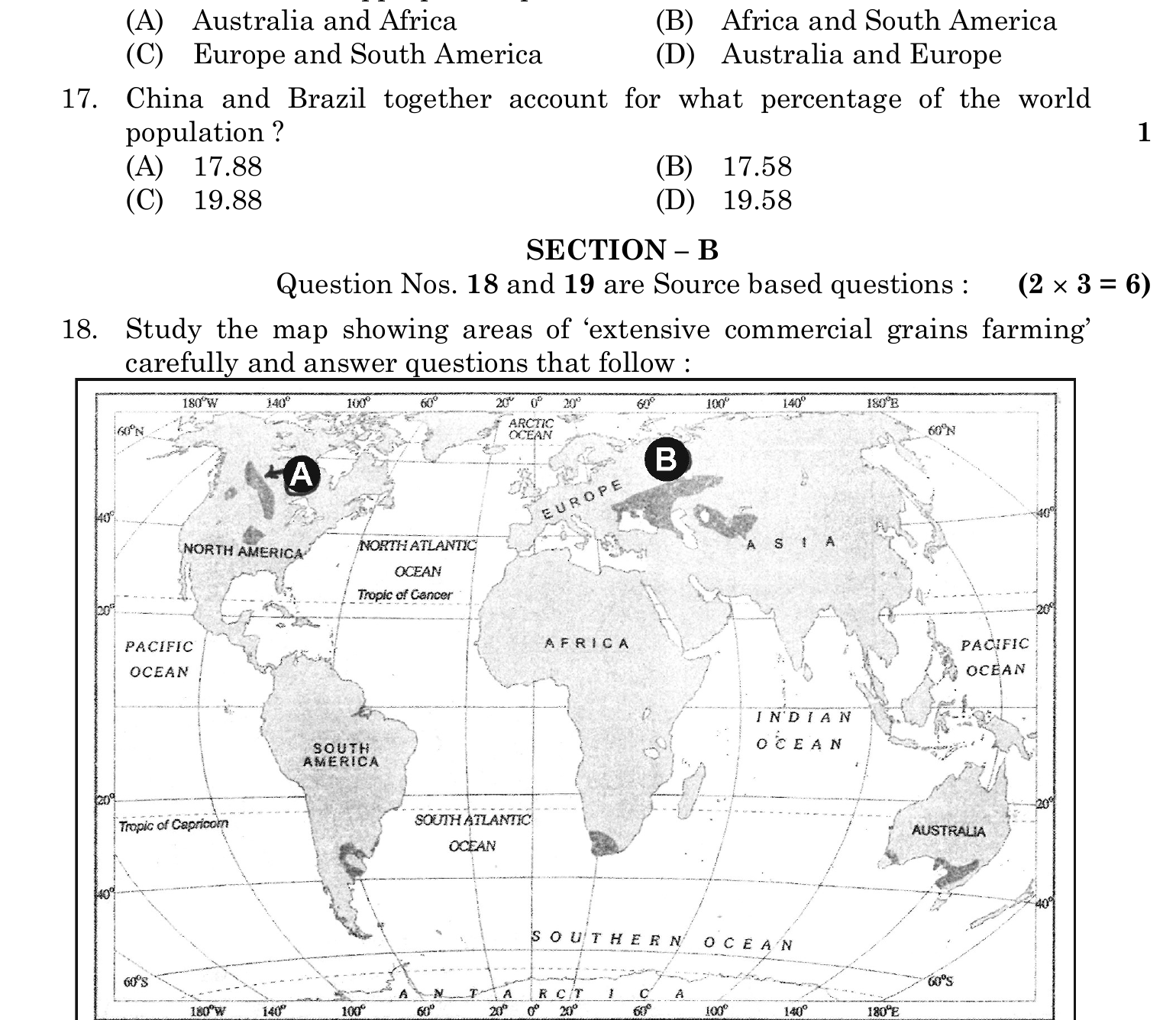
(18.1) Write the geographical name of the area marked as A. (1)
(18.2) Name any two major crops grown in the region A. (½ + ½ = 1)
(18.3) Explain the agricultural importance of the area marked as B. (1)
(For Visually Impaired Candidates, in lieu of Q18: Explain the main characteristics of 'extensive commercial grain farming' in the world.)
Read the given passage carefully and answer the questions that follow:
Water Pollution
Industries produce several undesirable products including industrial wastes, polluted waste water, poisonous gases, chemical residuals, numerous heavy metals, dust, smoke, etc. Most of the industrial wastes are disposed off in running water or lakes. Consequently, poisonous elements reach the reservoirs, rivers and other water bodies, which destroy the bio-system of these waters. Major water polluting industries are leather, pulp and paper, textiles and chemicals.
(19.1) Explain how industries are the major contributor of water pollution in India. (1)
(19.2) Suggest the way for minimising water pollution. (1)
(19.3) Mention two rivers of India which are highly polluted. (½ + ½ = 1)
Section C: Short answer (3 marks each)
Examine the relationships between the 'unresting man' and 'unstable earth'.
Examine the importance of 'sustainability' as a pillar of 'human development'.
(a) Explain the main characteristics of urban settlements in India.
(b) Explain the evolution of towns in India.
Study the following table carefully and answer the questions that follow:
Sectoral composition of workforce in India, 2011
| Categories | Persons | % to total workers | Male | Female |
|---|---|---|---|---|
| Primary | 26,30,22,473 | 54.6 | 16,54,47,075 | 9,75,75,398 |
| Secondary | 1,83,36,307 | 3.8 | 97,75,635 | 85,60,672 |
| Tertiary | 20,03,84,531 | 41.6 | 15,66,43,220 | 4,37,41,311 |
(23.1) Why is the large difference between primary and tertiary categories of female workers? (1)
(23.2) Explain the reason of low variation between male workers of 'primary' and 'tertiary' sectors. (1)
(23.3) Why 'secondary sector' has low contribution in India's workforce? (1)
Section D: Long answer (5 marks each)
"Industries should be located at points where the production costs are minimum." Examine the statement with suitable arguments.
(a) "Railway is the mode of land transport for bulky goods and passengers over long distances." In the context of this statement, explain the significance of railways in the world.
(b) "Road transport is the most economical for short distances compared to railway." In the context of this statement, explain the significance of road transport in the world.
(a) "Generally land-use in a region is influenced by the nature of economic activities." Support the statement with suitable examples.
(b) "The Indian agricultural problems have physical constraints and institutional hindrances." Support the statement with suitable examples.
(a) Explain the significance of petroleum as major source of energy and describe its distribution in India. (3 + 2 = 5)
(b) Explain the significance of iron-ore as industrial raw material and describe its distribution in India. (3 + 2 = 5)
(a) Analyse the importance of Indian seaports in the development of international trade.
(b) Analyse the changing pattern of India's international trade.
Section E: Map-based questions (5 marks each)
(A) In the given political outline map of the world, seven geographical features have been marked as A, B, C, D, E, F and G. Identify any five of them with the help of following information and write their correct names on the lines drawn near them:
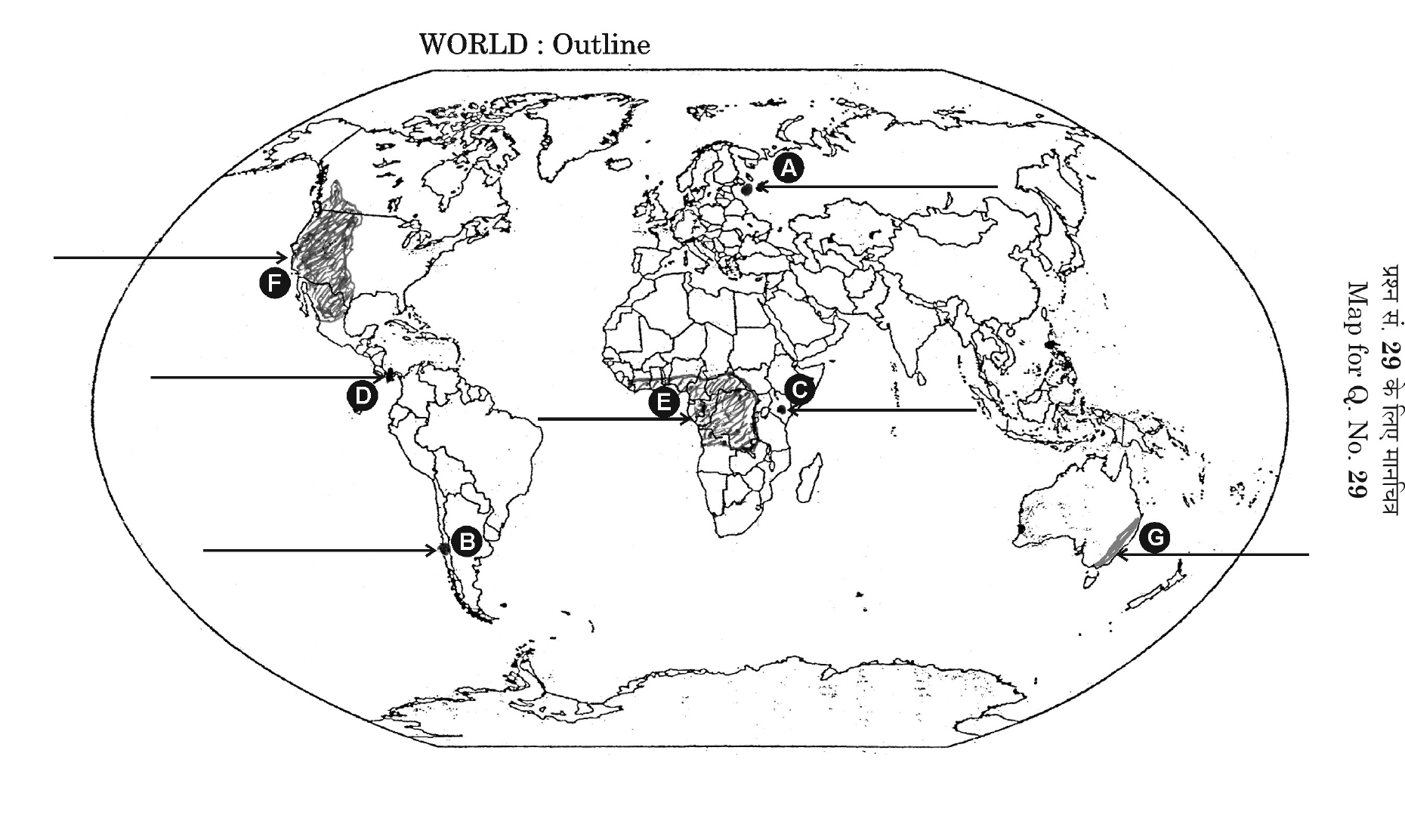
A. A terminal station of Trans-Siberian Railway
(B) A major sea port
(C) A major air port
(D) An international shipping canal
(E) An area of 'subsistence gathering'
(F) An area of 'commercial livestock rearing'
(G) An area of 'dairy farming'
(For Visually Impaired Candidates, in lieu of Q29, attempt any five: 29.1 Name the westernmost terminal station of Trans-Siberian Railway. 29.2 Mention a major sea port on the western coast of South America. 29.3 Mention an international airport of Kenya. 29.4 Name the shipping canal joining Pacific and Atlantic Oceans. 29.5 Mention one major region of 'subsistence gathering' in Africa. 29.6 Name a major area of 'commercial livestock rearing' in United States of America. 29.7 Name the major area of 'dairy farming' in North America.)
(1) On the given political outline map of India, locate and label any five of the following seven geographical features with appropriate symbols:
30.1 A state with the highest density of population (2011).
(2) 30.2 A state leading in the production of tea.
(3) 30.3 An iron-ore mining area in southern Chhattisgarh.
(4) 30.4 A major area of bauxite mining in Odisha.
(5) 30.5 An oil refinery in Uttar Pradesh.
(6) 30.6 A major seaport located at the head of Gulf of Kuchchh.
(7) 30.7 An international airport in Punjab.
Solutions: CBSE 2026 · 64/1/1
(B) I, II and IV. Development means a qualitative change which is always value-positive; growth is quantitative and value-neutral (it may be positive or negative). A bigger quantity alone is growth, not development.
(C) South-east Asia. Gathering is practised in high latitudes (northern Canada, northern Eurasia, southern Chile) and in low latitudes: the Amazon basin, tropical Africa, northern fringe of Australia and the interior parts of South-east Asia.
(D) A is false: developed countries have not fully opened their markets to developing countries' products (one criticism of the WTO); R is true.
(B) Gold collar workers are the highly paid top executives and decision-makers (quinary activities). Red collar refers to primary workers (farmers), white collar to office workers, pink collar to jobs traditionally held by women.
(C) Tamil Nadu, Kerala and Karnataka (Tamil, Malayalam, Kannada; also Telugu in Andhra Pradesh and Telangana). Marathi is Indo-Aryan.
(D) Delhi – Kolkata – Chennai – Mumbai (and back to Delhi).
(B) Gully erosion; mining, industrial waste and shifting cultivation are human-made causes.
(C) 5: India, China, Indonesia, Pakistan and Bangladesh.
(C) 19.88 (17.2 + 2.68).
(19.1) Industries dispose of industrial waste, polluted waste water, poisonous gases, chemical residues, heavy metals, dust and smoke into running water or lakes; these poisonous elements reach reservoirs and rivers and destroy the bio-system of the water. (19.2) Prevent untreated industrial waste from being discharged into rivers by treating effluents before disposal and reusing treated water (also controlling fertiliser and pesticide run-off, and public awareness). (19.3) Any two: the Ganga and the Yamuna (also Sabarmati, Gomti, Kali, Adyar, Cooum, Vaigai, Musi).
Sustainability means continuity in the availability of opportunities. (i) Each generation must have the same opportunities as the previous one. (ii) All environmental, financial and human resources must be used keeping the future in mind. (iii) Misuse of any of these resources will lead to fewer opportunities for future generations: e.g. if a community does not send girls to school, many opportunities are lost to these young women when they grow up. So sustainable human development ensures that choices and opportunities remain available to future generations.
Towns flourished in India since prehistoric times (Harappa, Mohenjodaro). On the basis of evolution: (i) Ancient towns, with over 2000 years of history, mostly religious and cultural centres: Varanasi, Prayagraj, Pataliputra (Patna), Madurai. (ii) Medieval towns, about 100 of them, mostly headquarters of principalities and kingdoms, often fort towns built on the ruins of ancient towns: Delhi, Hyderabad, Jaipur, Lucknow, Agra, Nagpur. (iii) Modern towns developed by the British and other Europeans: coastal trading ports (Surat, Daman, Goa, Puducherry), then the three nodes Mumbai, Chennai, Kolkata built in British style, and hill towns, cantonments, administrative and industrial towns; after independence, administrative towns (Chandigarh, Bhubaneswar, Gandhinagar, Dispur), industrial towns (Durgapur, Bhilai, Sindri, Barauni) and satellite towns (Ghaziabad, Rohtak, Gurugram around Delhi).
Industries maximise profits by reducing costs, so they locate where the following factors are favourable: (i) Access to market: the existence of a large market with purchasing power (e.g. developed regions). (ii) Access to raw material: industries using heavy, cheap or perishable, weight-losing materials (steel, sugar) locate close to raw material. (iii) Access to labour supply: a cheap, skilled labour force. (iv) Access to sources of energy: industries using much power (aluminium) locate near energy sources. (v) Access to transport and communication: speedy, efficient transport reduces costs (e.g. Western Europe, eastern USA). (vi) Government policy: incentives for balanced regional development. (vii) Agglomeration economies: benefits from nearness to other industries and services. Thus industries locate where the total of these costs is lowest.
(i) Roads are most economical for short distances and provide door-to-door service. (ii) They act as feeders to railways, ports and airports. (iii) They are vital for a nation's trade, commerce and tourism; quality of roads varies greatly between developed and developing countries. (iv) North America has the highest road density (about 33% of the world's motorable roads); Europe has a dense highway network; in Russia a dense network lies west of the Urals; China's highways connect all major cities; India has highways linking major cities. (v) Highways (e.g. Trans-Canadian, Alaskan, Pan-American, Trans-continental Stuart highway) connect distant places.
Physical constraints: (i) dependence on erratic monsoon: only about a third of cropped area is irrigated; droughts and floods are frequent; (ii) low productivity compared to world levels; (iii) land degradation: salinity, alkalinity and waterlogging in irrigated areas, soil erosion. Institutional hindrances: (iv) small and fragmented landholdings, mostly below one hectare; (v) constraints of financial resources and indebtedness: farmers depend on loans; (vi) lack of land reforms and unequal land distribution; (vii) under-employment in agriculture and poor marketing and storage facilities.
Significance: (i) Iron ore is the basic raw material for the iron and steel industry, the backbone of industrialisation; (ii) India has one of the largest reserves of iron ore in Asia (haematite and magnetite of high quality); it is in great demand abroad, and India exports it. Distribution: about 95% of reserves are in Odisha, Jharkhand, Chhattisgarh, Karnataka, Goa, Telangana, Andhra Pradesh and Tamil Nadu. (i) Odisha: Sundergarh, Mayurbhanj and Jhar (Gurumahisani, Sulaipet, Badampahar, Kiruburu, Bonai). (ii) Jharkhand: Noamundi and Gua in Poorbi and Pashchimi Singhbhum. (iii) Chhattisgarh: Dalli and Rajhara in Durg; Bailadila in Dantewara. (iv) Karnataka: Sandur-Hospet (Ballari), Baba Budan hills and Kudremukh (Chikkamagaluru), Shivamogga; (v) Goa, and Maharashtra (Chandrapur, Bhandara, Ratnagiri).
(i) The volume of India's international trade has increased many-fold since 1950–51 (exports and imports both rose). (ii) Exports: traditional items (cashews, tea, coffee, spices) have declined in share; floriculture, fresh fruits, marine products and sugar increased; manufactured goods, engineering goods, chemicals, software and services grew greatly. (iii) Imports: in the 1950s and 60s food grains, capital goods, machinery and equipment were imported; after the 1970s food-grain imports were replaced by fertilisers (Green Revolution) and crude petroleum; machines and equipment, special steel, edible oils and chemicals form a large share. (iv) Pearls, precious stones, gold and silver are both imported and exported (value is added through gems and jewellery). (v) The direction of trade has shifted: Asia and the USA are now major partners; India's trade deficit has been increasing due to rising imports of crude oil.
Valparaiso (Chile).
Panama Canal.
Western parts of the USA (also the Prairies; other areas: Pampas, Australia, New Zealand, South Africa).
Bihar (1,106 persons per sq km).
Bailadila (Dantewara district); also Durg/Dalli-Rajhara.
Mathura.
Amritsar (Sri Guru Ram Dass Jee International Airport, Raja Sansi).
Get every solution for all 15 papers
- Every board question of every chapter, each fully solved the way the board gives marks
- 15 complete board papers, each followed by its solutions
- Weightage and most-asked topics for every chapter
- Instant PDF download, colour and black & white print copies
Revising the chapter first? Complete Geography Notes for Class 12 (CBSE 2026-27) →
What you get in the pack
- CBSE Class 12 Geography board papers 2016 to 2026 (all 129 sets, main and compartment; 15 in full)
- All 17 chapters and 15 full board papers complete
- Part A: all 17 chapters, questions sorted chapter-wise and by marks
- Year-wise weightage table and most-asked topics for every chapter
- Part B: each full board paper followed by its complete solutions
- Point-wise answers; every map item answered with the map shown
- Questions on chapters out of the board syllabus are flagged
All chapters in this pack
- PYQ Ch 1 Human Geography: Nature and Scope
- PYQ Ch 2 The World Population: Distribution, Density and Growth
- PYQ Ch 3 Human Development
- PYQ Ch 4 Primary Activities
- PYQ Ch 5 Secondary Activities
- PYQ Ch 6 Tertiary and Quaternary Activities
- PYQ Ch 7 Transport and Communication (World)
- PYQ Ch 8 International Trade (World)
- PYQ Ch 9 Population: Distribution, Density, Growth and Composition
- PYQ Ch 10 Human Settlements
- PYQ Ch 11 Land Resources and Agriculture
- PYQ Ch 12 Water Resources
- PYQ Ch 13 Mineral and Energy Resources
- PYQ Ch 14 Planning and Sustainable Development in Indian Context
- PYQ Ch 15 Transport and Communication (India)
- PYQ Ch 16 International Trade (India)
- PYQ Ch 17 Geographical Perspective on Selected Issues and Problems
- Board Paper 2026 Set 64-1-1 with Solutions
- Board Paper 2026 Set 64-1-2 with Solutions
- Board Paper 2026 Set 64-1-3 with Solutions
- Board Paper 2026 Set 64-2-1 with Solutions
- Board Paper 2025 Set 64-1-1 with Solutions
- Board Paper 2025 Set 64-2-1 with Solutions
- Board Paper 2025 Set 64-4-1 with Solutions
- Board Paper 2024 Set 64-1-1 with Solutions
- Board Paper 2024 Set 64-2-1 with Solutions
- Board Paper 2023 Set 64-1-1 with Solutions
- Board Paper 2022 Term 2 Set 64-1-1 with Solutions
- Board Paper 2019 Set 64-1-1 with Solutions
- Board Paper 2018 Set 64-1 with Solutions
- Board Paper 2017 Set 64-1 with Solutions
- Board Paper 2016 Set 64-1 with Solutions